Zyphra Open-Sources ZONOS3-Mini: A 100M Active Parameter Speech Synthesis Model
Zyphra open-sources ZONOS3-Mini, a sparse 800M total / 100M active model for real-time browser TTS.
Zyphra releases ZONOS3-Mini under Apache 2.0. Its 800M total / 100M active sparse architecture (MoE-like) cuts per-inference cost while keeping capacity. It supports voice cloning, word-level prosody control, and real-time browser execution, enabling client-side TTS with lower latency and better privacy. The permissive license allows modification, distribution, and commercial use, lowering the barrier for readers, accessibility tools, and online education. Data on audio quality, multilingual performance, and device-level real-time behavior is not yet public, and cloning authorization/misuse risks need independent verification.
Small Model, Real-Time Speech: Where ZONOS3-Mini Fits
According to MarkTechPost, Zyphra has released the ZONOS3-Mini text-to-speech model under the Apache 2.0 license. Its parameter structure is interesting: 800M total parameters but only 100M active parameters. This combination suggests a sparse activation approach similar to Mixture of Experts (MoE)—the model's overall capacity is substantial, but each inference call only invokes a small fraction of it, thereby keeping real-time performance high and deployment costs low.
Sparse activation is not a new concept in TTS, but bringing it down to the 100M active parameter level and releasing it directly under an open-source license means high-quality speech synthesis on consumer-grade hardware—or even in the browser—is moving from demo to practical usability.
Mixture of Experts (MoE) and Sparse Activation: MoE is an architecture that splits a model into multiple "expert" subnetworks, paired with a routing network so that each forward pass activates only the few experts most relevant to the current input. As a result, the model's total parameters determine its overall knowledge capacity, while the active parameters determine the actual computation per inference. This differs from dense models, which must pass through all parameters on every inference—maintaining equivalent capacity in a dense model would cause inference costs to rise linearly with parameter count. A 100M active parameter level roughly corresponds to the computational overhead of a lightweight dense model, but the overall expressive capacity benefits from 800M in total—this is precisely the key mechanism behind "big-model results from small compute."
TTS (Text-to-Speech) and Real-Time Constraints: TTS needs to map text sequences to acoustic features and then synthesize waveforms, and latency directly determines the interaction experience. Speech scenarios are particularly sensitive to first-packet latency and streaming output, so inference cost often becomes a deployment bottleneck earlier than raw audio quality. Sparse activation compresses computation to a level that matches the pace of real-time playback, which is what makes real-time synthesis possible in compute-constrained environments like the browser.
Three Capabilities, Pointing to Three Use Cases
The official capability description revolves around three things, each corresponding to a clear category of need.
Voice Cloning
The model supports timbre cloning: users can use samples of a target speaker to make the synthesized speech resemble a specific timbre. This is essential for content creation, audiobooks, and localized dubbing. Under an open-source license, developers can deploy it themselves without handing audio data to a third-party API.
Word-by-Word Expressive Control
Going a step beyond cloning is "word by word" prosody control—the ability to adjust tone and expression at the word granularity. Traditional TTS typically only allows adjusting speed or emotion at the sentence level; word-level control enables finer arrangement of stress, pauses, and emphasis, suitable for scenarios with demanding broadcast quality requirements.
What Prosody and Word-Level Control Mean: Prosody refers to stress, pauses, intonation, and rhythm in speech, and is the core of what makes speech "sound natural." Most traditional TTS can only adjust speed and emotion tags at the sentence or paragraph level, making it difficult to precisely specify that a particular word be emphasized or lengthened. Word-level control means the model accepts fine-grained conditional inputs aligned with text tokens, allowing word-by-word adjustment of emphasis and pauses during synthesis. This kind of capability typically relies on alignment information or explicit temporal/prosodic annotations, places higher demands on the model's conditional modeling ability, and is also more likely to expose gaps in training data coverage.
Real-Time Browser Execution
The direct benefit of 100M active parameters is low inference overhead. The original article explicitly mentions that it can run in real time in the browser, which means speech synthesis can be performed entirely on the client side—eliminating network round-trip latency and avoiding privacy concerns associated with uploading audio.
Technical Prerequisites for Browser-Side Inference: Running neural network inference in the browser generally relies on runtimes such as WebAssembly or WebGPU, downloading model weights to the client and executing locally. Its advantages are zero network round-trips and audio never leaving the device, but it is constrained by device compute, memory, and initial load size. 100M active parameters significantly reduce the compute and memory pressure per inference, making real-time streaming synthesis feasible on ordinary devices; however, GPU support and compute vary widely across devices, so actual real-time performance still needs to be verified separately by device tier.
What Sparse Activation Means for TTS
Widening the gap between total and active parameters is essentially decoupling "model capability" from "inference cost." 800M total parameters ensure capacity for acoustic modeling and prosody prediction, while 100M active parameters ensure each forward pass touches only the necessary subnetworks. For a latency-sensitive task like speech, this trade-off direction is reasonable: the stutter users perceive comes from latency, not from total parameter count.
The more practical impact is on the deployment side. Real-time browser inference means the front end can integrate TTS directly, without building a GPU inference cluster. For teams building readers, accessibility tools, and online education products, this significantly lowers the barrier to using audio capabilities.
How Open Apache 2.0 Is
Apache 2.0 is a commercially friendly permissive license that allows modification, distribution, and commercial use. For Zyphra, releasing ZONOS3-Mini under this license is clearly intended to rapidly expand ecosystem coverage and make the model a foundational component for speech synthesis rather than a closed service. For developers, this means it can be embedded into commercial products and fine-tuned as well.
Boundaries to Keep in Mind
Open-source releases typically do not spell out every detail at once. The authorization and misuse risks involved in voice cloning, the actual performance of word-level control across languages, and differences in real-time performance across devices in the browser are all aspects that need to be verified independently before deployment. The original article does not provide evaluation data on these dimensions, so actual results should still be based on the official repository and hands-on testing.
From a trends perspective, ZONOS3-Mini represents a direction: using sparse architectures to fit large-model capabilities into low-compute scenarios, then releasing them to the community under permissive licenses. The competitive focus in speech synthesis is expanding from "whose audio quality is better" to "who can run in real time on more devices."
One-line Summary
Zyphra open-sources ZONOS3-Mini, achieving real-time browser-based speech synthesis with an 800M total / 100M active sparse architecture.
Paragraph Summary
Zyphra has released the ZONOS3-Mini text-to-speech model under the Apache 2.0 license. Its 800M total / 100M active parameter structure uses a sparse activation approach similar to Mixture of Experts, greatly reducing per-inference cost while preserving model capacity. It supports voice cloning, word-level prosody control, and real-time execution in the browser, enabling speech synthesis entirely on the client side and reducing network latency and privacy concerns around audio uploads. The permissive open-source license allows modification, distribution, and commercial use, lowering the barrier for readers, accessibility tools, and online education products to integrate TTS. However, hands-on data on audio quality, multilingual performance, and real-time behavior across devices has not yet been published, and the authorization and misuse risks of cloning need to be verified independently before deployment.
Related articles

Seven Years of Evolution: How Far Has the Foldable Come From the First Generation?
From the first foldable to today's latest models, what has seven years changed? Shallower creases, higher brightness, thinner bodies, and smoother software migration—has the foldable crossed the chasm from enthusiasts to ordinary users? This article discusses the question based on a video comparison.

When Did Humans Start Eating Salt? A 10,000-Year History of Salt
When did humans start eating salt? From salt use at the dawn of agriculture 11,000 years ago to ancient seawater evaporation and rock salt mining, and on to the salt trade, salt taxes, and Gandhi's Salt March, this article traces salt's key role in human civilization.
Microsoft Paza Research: How African Language Speech Recognition Breaks Through Architecture and Data Bottlenecks
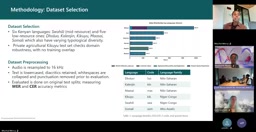
Microsoft's Paza research evaluates 53 speech models across 39 African languages, revealing architecture choice matters more than pre-training coverage, 200-300 hours is the practical data threshold, and language typology deeply influences recognition performance.