#distributed consensus
168 related articles

·3 min
The Open-Weights Model Debate: Balancing Safety and Openness
An in-depth analysis of the open-weights model debate: public release brings transparency and innovation, but raises safety and misuse risks. Exploring tiered release, red-teaming, and governance challenges.
Read more →

·2 min
Will AI End Human History? The Deep Anxiety Behind Technological Optimism
A viral Reddit post asks: will AI end human history? This article analyzes the blind spots of tech accelerationism, the governance mismatch, and how to rationally navigate AI transformation.
Read more →
·3 min
The Open-Weights Model Debate: Balancing Safety and Openness
An in-depth analysis of the open-weights model debate: publicly releasing model weights enables transparency and innovation but raises safety risks. Explores tiered release, red-teaming, and the industry dynamics behind open AI governance.
Read more →

·3 min
Claude Opus 5 Officially Released: Performance Approaching the Top Tier as the Open-Weight Debate Heats Up Again
Anthropic releases Claude Opus 5 with near-frontier performance at lower prices. Same day, Jensen Huang co-signs open-weight letter with 20+ companies while DeepSeek fundraising rumors surface.
Read more →
·2 min
Claude as Music Partner: The AGI Moment of AI Paired Creation
A developer added a DAW to their agentic dev environment with Claude, then paired with AI to finish music — experiencing a true AGI moment in creative collaboration.
Read more →

·4 min
The Dao of DeepSeek: Liang Wenfeng on Vision, Restraint, and the Philosophy of Open Source
Analysis of DeepSeek founder Liang Wenfeng's rare investor dialogue, exploring the company's vision-driven culture, strategic restraint toward AGI, and open-source philosophy in the US-China AI race.
Read more →

·3 min
The Jargon Trap: Why Engineers Can Never Seem to Speak Plain Language
Why do engineers struggle to communicate in plain language? Exploring the curse of knowledge, jargon as identity, and practical tips for clearer technical communication.
Read more →

·3 min
Apache Cassandra Explained: A Linearly Scalable and Highly Available Distributed Database
Deep dive into Apache Cassandra's core design: linear scalability, decentralized architecture, tunable consistency, and ideal use cases for engineering teams.
Read more →

·5 min
Why Are China's Open-Source AI Models Getting Stronger? A Deep Dive Into Three Comeback Strategies
Facing US chip bans and closed-source monopoly, how do China's open-source AI models keep fighting back? A deep dive into three core paths: open-source pricing games, optical interconnect positioning, and on-device scenarios.
Read more →
·7 min
Qwen3 235B A22B in Practice: A 2.4-Trillion-Parameter Open Model Surpasses Claude Opus
Hands-on with Alibaba Tongyi Qianwen's strongest Qwen3: a 2.4-trillion-parameter open weight model scoring 81.25% on KingBench, ranking second and beating Claude Opus 4.8 with perfect scores in game dev, math, and agent tasks.
Read more →
Human-Centered AI: Real-World Implemen…
·6 min
Human-Centered AI: Real-World Implementation in Healthcare and Design
An MSR workshop reveals the truth about AI deployment: from a $20 corneal diagnostic device to expert-in-the-loop chatbots, researchers share real-world experiences of AI in healthcare and design within resource-scarce environments.
Read more →

·2 min
Dependency Drift in Production AI Agents: Detection, Response, and Building Resilient Systems
AI Agents in production face systemic dependency drift risks — model updates silently change outputs and silent failures are hard to detect. Learn detection strategies, hidden costs, and engineering practices.
Read more →

·2 min
Karma: An AI Coding Agent Orchestration Tool for Building Multi-Agent Collaborative Systems
Karma is an orchestration layer for AI coding agent frameworks, solving multi-agent collaboration, task decomposition, state management, and observability challenges. Compatible with Aider, OpenHands, and more.
Read more →
·2 min
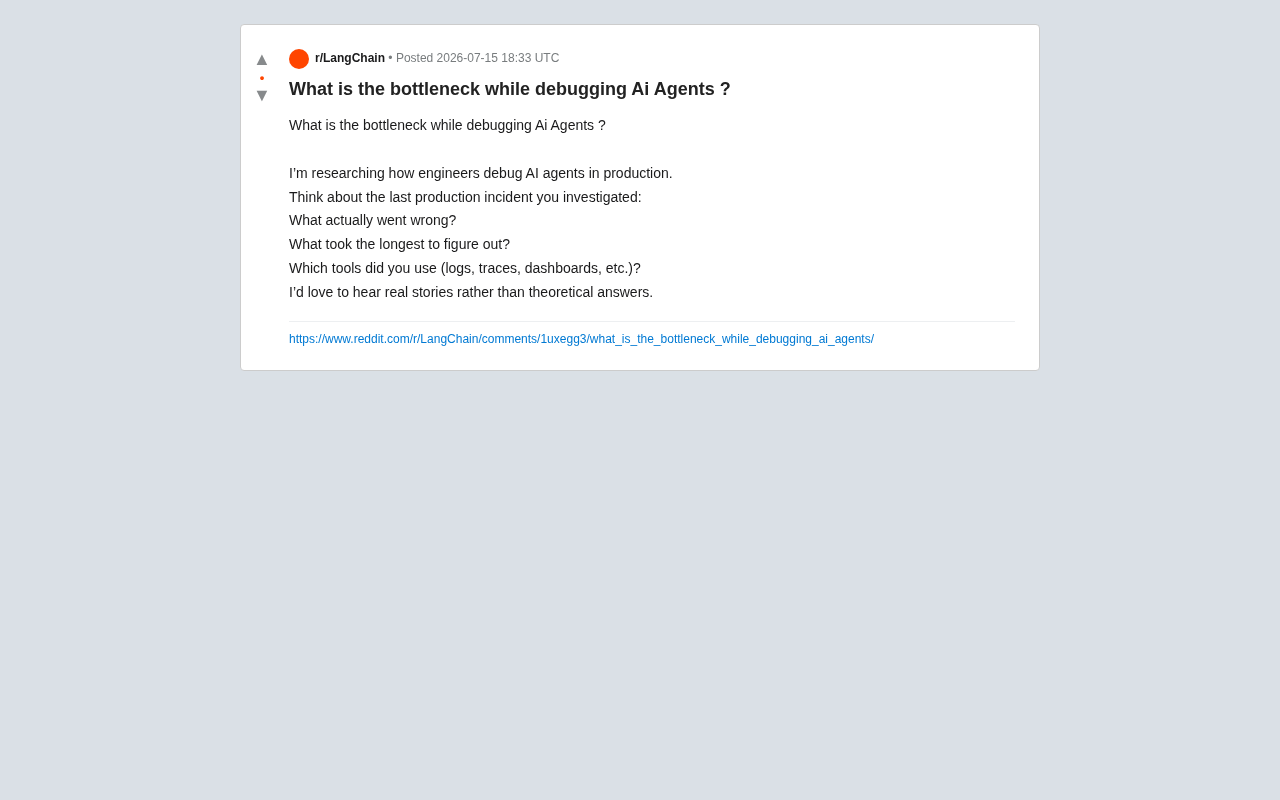
AI Agent Debugging Bottlenecks: A Practical Guide to Production Observability
Explore core AI Agent debugging challenges in production: non-determinism, multi-step error propagation, and observability gaps — with practical guidance on LangSmith and tracing tools.
Read more →

·3 min
Vibe Coding in Action: How AI Collaboration Built an Award-Winning Sleep Aid Product
A Bilibili creator used Vibe Coding to independently build 'Breath Garden,' an AI sleep companion app, winning third place at the Tencent Music Hackathon. Full breakdown inside.
Read more →
Sx 2.0: Sharing AI Skills via Dropbox …
·3 min
Sx 2.0: Sharing AI Skills via Dropbox to Bridge Team Collaboration Gaps
Sx 2.0 distributes team AI skills via shared Dropbox folders — no servers, zero deployment cost. A deep dive into its design philosophy, technical trade-offs, and the future of AI skill asset management.
Read more →
Distributed Secret Storage: A Deep Div…
·2 min
Distributed Secret Storage: A Deep Dive into Threshold Cryptography and Robust Security Architectures
A deep dive into robust secret storage in distributed networks, covering Shamir Secret Sharing, VSS, Proactive Secret Sharing, and real-world applications in blockchain KMS and MPC.
Read more →
SendLang: Rethinking Email Automation …
·3 min
SendLang: Rethinking Email Automation with a Domain-Specific Language
SendLang is a DSL for email automation that uses declarative syntax to separate trigger conditions, content templates, and send timing — tackling logic coupling in traditional email systems.
Read more →

·3 min
Continual Learning and AGI: Conceptual Confusion, Core Bottlenecks, and the Real Challenges
Dario Amodei and Demis Hassabis both call continual learning key to AGI, yet the term remains undefined. This article clarifies five interpretations and analyzes three core bottlenecks.
Read more →

·3 min
Waku Agent Deep Dive: The Four Core Pillars of a Local-First AI Assistant
A deep dive into Waku Agent's four pillars: Loop Engineering, three-tier Memory system, Eval assessment, and the Harness scaffold. Full walkthrough of a local-first AI assistant from task execution to memory consolidation.
Read more →