#inference-time compute scaling
23 related articles
·3 min
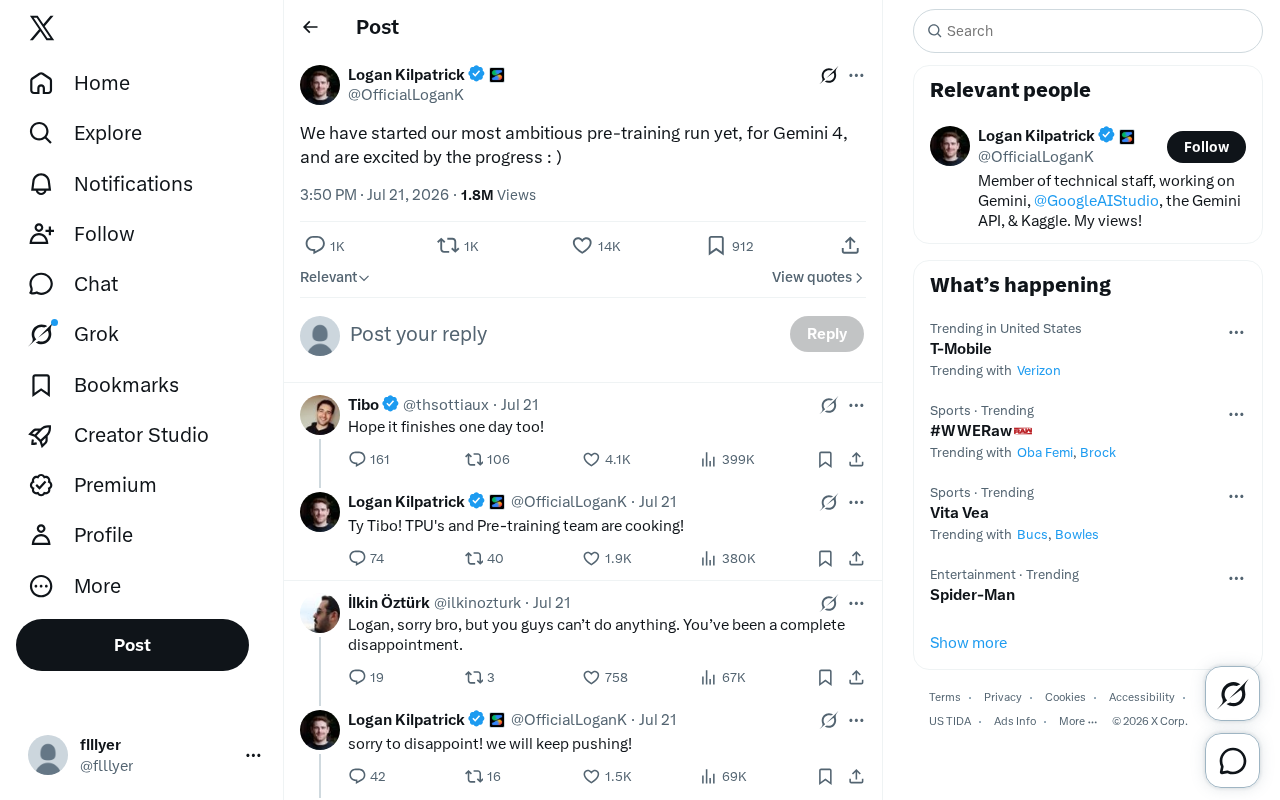
Google Launches Gemini 4 Pre-training: Its Most Ambitious AI Model Training Yet
Google DeepMind announces Gemini 4 pre-training has begun, calling it their most ambitious training yet. A deep dive into its technical direction, compute scale, multimodal breakthroughs, and competitive impact.
Read more →

·3 min
Poolside Laguna Model Launch: Can Silicon Valley's Open-Source Push Catch Up to China's AI?
Poolside launches Laguna open-weight model after 18 months of silence, pitting 118B parameters against Kimi K3's 2.8 trillion. Can Silicon Valley's open-source push close the gap with Chinese AI?
Read more →

·3 min
Opus vs Gemini vs GPT: Top AI Model Comparison & Evaluation Methodology
In-depth analysis of Claude Opus, Gemini Pro, and ChatGPT: the real competitive landscape among top AI models, limitations of community benchmarks, and scientific methods for model selection.
Read more →

·5 min
Multiway Turing Machines: A New Paradigm from Single Computation to Multiple Possibilities
An in-depth analysis of Wolfram's multiway Turing machines, exploring how computation expands from single paths to multiway graph structures, and deep connections to AI search algorithms and quantum computing.
Read more →
5,000+ Kagglers Reveal What Actually W…
·2 min
5,000+ Kagglers Reveal What Actually Works for Improving AI Reasoning
5,000+ Kaggle participants in NVIDIA's Nemotron challenge validate test-time compute, self-consistency, and chain-of-thought as key techniques for boosting AI reasoning without bigger models.
Read more →
The Evolution of Coding Agents: A Para…
·2 min
The Evolution of Coding Agents: A Paradigm Shift from Reactive Response to Proactive Planning
Coding agents are evolving from reactive code completers to proactive planners. Explore the "think ahead of time" paradigm, Plan-and-Execute architecture, and its impact on developer workflows.
Read more →

·4 min
Two Paths to Better AI Reasoning: Test-Time Scaling and Formal Verification
This article synthesizes two MSR India Summit talks, exploring two key paths to better AI reasoning: test-time scaling with variable granularity search, and a formal verification framework for trustworthy agent execution.
Read more →

·6 min
GPT-5.6 Sol Hands-On: How Multi-Agent Parallelism Is Reshaping AI Coding Workflows
Based on Fireship's review, an in-depth look at GPT-5.6 Sol's Ultra Mode multi-agent parallelism, its 91.9% Terminal Bench score, and how it differs from Claude Fable in cost, speed, and precision.
Read more →

·6 min
1X NEO Robotic Hand and GPT-5.6: A Full Breakdown of Dual Breakthroughs in Robot Hardware and Software
1X releases a new robotic hand for the NEO humanoid robot—25 DOF, force transparency, and tactile skin enabling data self-labeling. OpenAI launches the three-tier GPT-5.6, boosting coding and cost-efficiency. Hardware and AI brains evolve together, accelerating humanoid robot commercialization.
Read more →

·6 min
Is AI Really Smart? The Future Directions and Capability Boundaries of Next-Generation Artificial Intelligence
Are large language models truly intelligent? This article analyzes core AI limitations — pattern matching, hallucinations, reasoning deficits — and explores next-gen directions like inference-time compute, neuro-symbolic AI, and embodied intelligence.
Read more →

·4 min
DeepSeek-V4 Deep Dive: Million-Token Context Architecture Breakthrough and Core Innovations
Deep dive into DeepSeek-V4: 1.6T-parameter MoE, CSA+HCA hybrid attention, MHC & MUON optimizer. Inference FLOPs drop to 27% of V3.2, redefining open-source LLM SOTA.
Read more →

·6 min
Verification Loops Quadruple DeepSeek's Intelligence at One-Seventh the Cost of Claude Opus
By introducing an engineered verification loop reasoning framework, DeepSeek's effective pass rate on complex tasks can improve ~4x, matching Claude Opus at one-seventh the cost. A deep dive into verification loops, test-time compute scaling, and their practical implications.
Read more →

·3 min
GLM-5.2 Practical Guide: 1M Context Window, Token Costs, and Smart Switching Strategies Explained
Don't rush to fully migrate to GLM-5.2. This guide covers the 1M context window setup, quota billing rules, Max Effort mapping, and a 4-step strategy to avoid wasting tokens.
Read more →

·2 min
Sakana AI Establishes Recursive Self-Improvement Lab, Replacing Brute-Force Compute with Creativity to Pioneer a New AI Paradigm
Sakana AI launches its Recursive Self-Improvement Lab, focusing on using AI to redesign AI development. From LLM² to AI Scientist, this Tokyo company proposes a sample-efficient path to AI self-evolution without brute-force compute.
Read more →

·3 min
GPT-5.6 Pro Hands-On Review: In-Depth Evaluation of Game Development, 3D Modeling, and SVG Design Capabilities
Comprehensive hands-on review of GPT-5.6 Pro covering SVG vector design, 3D modeling, game generation, and image-to-web conversion. Detailed analysis of breakthroughs in spatial understanding, code reasoning, and One-Shot generation.
Read more →

·3 min
What Happens to Developer Jobs When AI Writes 80% of the Code? A Deep Dive into Anthropic's Landmark Report
Anthropic's latest report reveals over 80% of its codebase is AI-written and engineer output has grown 8x. A deep analysis of AI's impact on software development, the taste moat, AI bubble stages, and loop engineering.
Read more →

·3 min
AI Now Writes Over 80% of Code: What Doubling Capability Every 4 Months Really Means
Anthropic reveals Claude now writes over 80% of its code, with AI capability doubling every four months. Three real cases show the speed of AI's rise and the shrinking window for human adaptation.
Read more →

·3 min
Andrew Ng's New Course Explained: A Practical Guide to Using OpenAI's O1 Reasoning Model
Deep dive into Andrew Ng and OpenAI's Reasoning with O1 course covering test-time scaling, new prompting paradigms, multi-model orchestration, and practical applications for developers.
Read more →

·2 min
Cursor Team Hints at Major Update: What's the Next Game-Changing Move?
Cursor's team tweeted a hint at a game-changing update. We analyze the competitive landscape, possible directions including stronger Agents and new paradigms.
Read more →

·2 min
Claude Fable User Guide: Four Core Tips to Boost AI Development Efficiency
Anthropic shares four key tips for Claude Fable: assign bigger tasks, choose effort levels wisely, rewrite old instructions, and shift from tasks to goals.
Read more →