#real-world code benchmark
1053 related articles

·3 min
AI Coding Showdown: Four Major Models Show Shocking Performance Gaps on a Dynamic Web Scraping Task
Real-world test of ChatGPT 5.4, Gemini 3.1, DeepSeek V4 Pro, and Kimi 5.1 on a Baidu dynamic web scraping task reveals surprising gaps in AI coding ability.
Read more →

·4 min
Nex-N2 Pro In-Depth Review: Impressive Code Generation, But How Inflated Are the Benchmarks?
In-depth review of open-source agent model Nex-N2 Pro: testing code generation, SVG output, and game dev capabilities while analyzing benchmark inflation, GPT distillation traces, and speed issues.
Read more →

·3 min
Minimax M3 vs DeepSeek V4 Hands-On Test: Who Builds a Better Dino Run Game?
Hands-on comparison of Minimax M3 and DeepSeek V4 Pro building a Dino Run game from the same prompt, revealing how native multimodal AI changes game dev.
Read more →

·3 min
Open-Source Models Keep Throwing Errors in Your Code? The Problem Might Be the Framework
DeepSeek and Kimi keep failing at coding? The problem may not be the model but the framework. Learn how Commander Code fixes this with cache routing, tool call repair, and continuous learning.
Read more →

·2 min
GitHub May 2026 Availability Report: A Comprehensive Analysis of Nine Service Degradation Incidents
GitHub's May 2026 availability report reveals nine service degradation incidents. This article analyzes the frequency, historical trends, developer impact, and platform reliability implications.
Read more →
From Prompt Engineer to Loop Architect…
·2 min
From Prompt Engineer to Loop Architect: The Paradigm Shift in AI Programming
Explore the paradigm shift from prompt engineering to loop architecture in AI programming. Learn about Anthropic's Routines, the six elements of mature coding loops, and token cost strategies.
Read more →

·3 min
Deep Dive into LangChain's Social Media Agent Open-Source Project: Architecture, Features, and Practical Value
In-depth analysis of LangChain's open-source social-media-agent: content sourcing, AI curation, scheduled publishing, Human-in-the-Loop design, and LangGraph architecture.
Read more →

·3 min
Claude Code Loop Patterns in Practice: Community Insights and Best Practices
Explore Boris Cherny's Claude Code loop patterns with community insights on /loop commands, test-driven loops, multi-agent collaboration, and best practices to avoid loop divergence.
Read more →

·3 min
Claude Code Desktop Without an Account: Connect DeepSeek Models + Full Chinese Localization Guide
Step-by-step guide to using Claude Code Desktop without an account, connecting DeepSeek models via CC Switch, and applying Chinese localization patches.
Read more →

·2 min
An Anthropic Employee's Firsthand Account: How Claude Fable 5 Evolved from Tool to Collaborative Partner
A veteran Anthropic employee shares observations on Claude's evolution from Opus 3 to Fable 5, highlighting four milestone releases and how Fable 5 marks the shift from tool to collaborative partner.
Read more →

·2 min
Fable 5 Released: An AI Coding Tool Built for Complex Software Engineering
Fable 5 officially launches, targeting high-complexity software engineering with five core capabilities: code review, architectural reasoning, large-scale project planning, multi-step task orchestration, and high-stakes engineering support.
Read more →
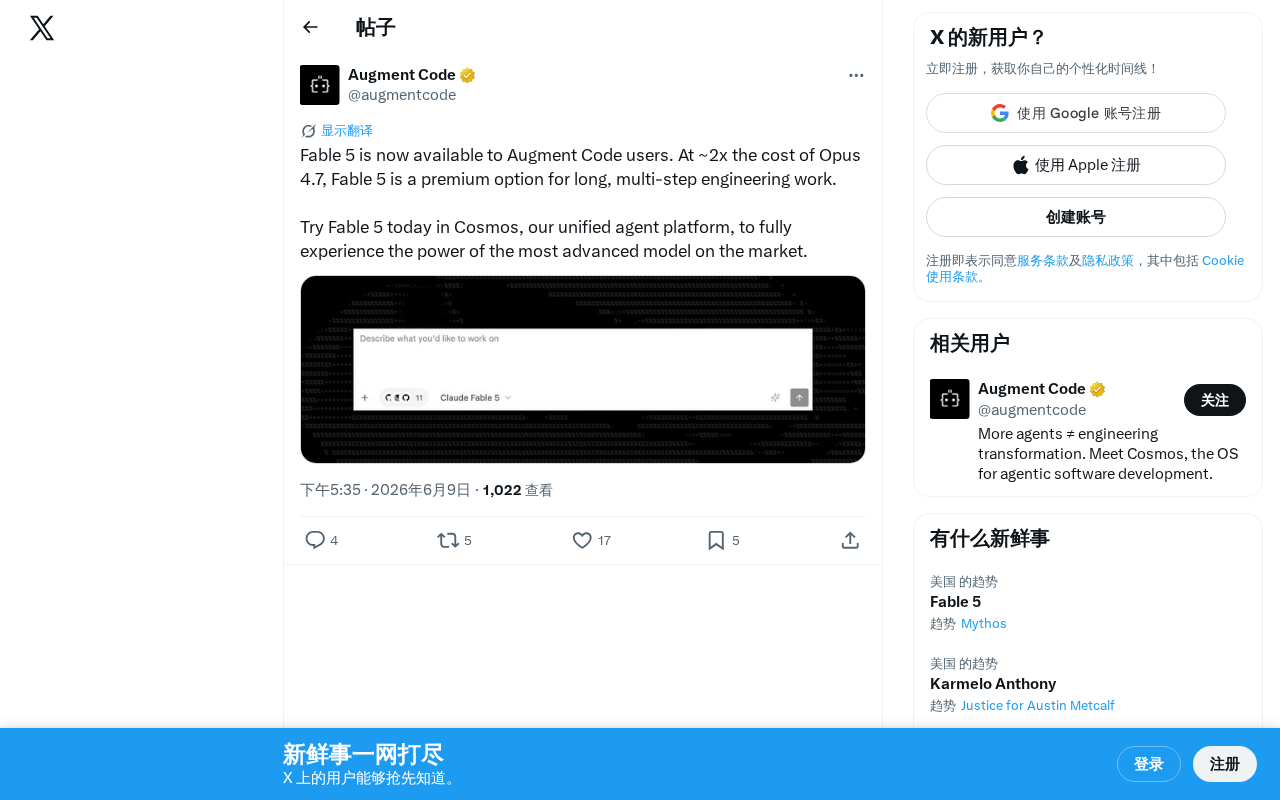
·2 min
Fable 5 Lands on Augment Code: A Premium Coding Model Priced at 2x Claude Opus 4.7
Fable 5 launches on Augment Code's Cosmos platform, priced at ~2x Claude Opus 4.7, targeting long-chain multi-step engineering tasks. Analysis of its positioning, pricing, and market impact.
Read more →

·1 min
Claude Opus vs. Sonnet vs. Haiku: A Practical Comparison and Selection Guide
A practical comparison of Claude's Opus, Sonnet, and Haiku models covering capabilities, use cases, and costs to help developers choose the right model for every task.
Read more →

·1 min
AI Model Benchmarks Driving VC Decisions: From Benchmarks to Investment Signals
How AI model benchmarks and evals can build a VC decision framework—using capability overhangs, weakness analysis, and trajectory tracking to identify investment opportunities.
Read more →
·2 min
June 2 AI Industry Roundup: NVIDIA's 550B Model, xAI's Coding Model, and More Major Releases
June 2, 2025 AI roundup: NVIDIA's 550B Nimitron 3 Ultra, xAI Composer 2.5, Anthropic & ZhiPu IPOs, OpenAI's agentic OS prototype, and key advances in agents, compute infrastructure, and open source.
Read more →

·2 min
Unreal Engine 5.8 MCP Server Setup Tutorial: AI Agent-Driven Game Development in Practice
A detailed guide to configuring Unreal Engine 5.8's built-in MCP server for AI agent-driven game development, covering DeepSeek API setup, plugin activation, and natural language scene building.
Read more →

·3 min
Google CEO Pichai Admits AI Coding Gap, Details Catch-Up Strategy and AGI Outlook
Google CEO Sundar Pichai admits Google lags in AI coding, details its catch-up strategy involving data flywheels, addresses Gemini controversies, and shares his evolving views on AGI.
Read more →

·1 min
OpenAI Codex Deep Dive: The AI Development Tool That Makes Programming Feel Like Flying
Deep dive into how OpenAI Codex redefines programming. From real developer feedback to the Time to Fly project, analyzing Codex's strengths in code generation, context understanding, and the AI coding tool competitive landscape.
Read more →

·3 min
Claude Code Enterprise E-commerce in Practice: A Methodology for Taking AI Programming from Demo to Industrial-Grade
A deep dive into engineering methodology for enterprise e-commerce development with Claude Code and Harness AI, covering architecture, code quality, and CI/CD practices.
Read more →

·3 min
GPT-5.2 Codex vs Opus 4.5 Hands-On: A Comprehensive Comparison of Coding Ability, Speed, and Developer Experience
Hands-on comparison of GPT-5.2 Codex vs Opus 4.5 across frontend generation, physics simulation, 3D scenes, and code refactoring, with practical selection advice.
Read more →