Building a Streaming LLM Backend in Go: Deep Dive into the SDK and React Frontend Library

A deep dive into building streaming LLM backends in Go with SDK and React frontend integration.
This article explores an open-source Go SDK designed for building streaming LLM backends with tool-calling support, along with a companion React frontend library. It examines Go's concurrency advantages for handling streaming connections, the standardized abstraction of tool-calling for Agent architectures, and the end-to-end integration approach that lowers the barrier for teams already using Go to introduce AI capabilities into production systems.
Why We Need an LLM SDK for Go
In the current wave of AI application development, Python undeniably dominates — from model training to inference deployment, the Python ecosystem covers nearly the entire chain. However, when we shift our focus to production backend services, Go's advantages become apparent: an excellent concurrency model, extremely low runtime overhead, single-binary deployment, and characteristics naturally suited for handling high-throughput network requests.
Go's concurrency advantage stems from its unique goroutine mechanism. A goroutine is a user-space coroutine managed by Go's runtime scheduler (rather than the OS kernel), with an initial stack of only about 2-8KB — far smaller than the 1-8MB stack of traditional threads. This allows a single server to easily run hundreds of thousands or even millions of goroutines. Go's M:N scheduling model maps M goroutines onto N OS threads, combined with the channel communication mechanism to implement the CSP (Communicating Sequential Processes) concurrency paradigm. This means handling large numbers of I/O-intensive tasks doesn't require callback hell or async/await syntactic sugar — you can efficiently handle concurrency with straightforward synchronous code style.
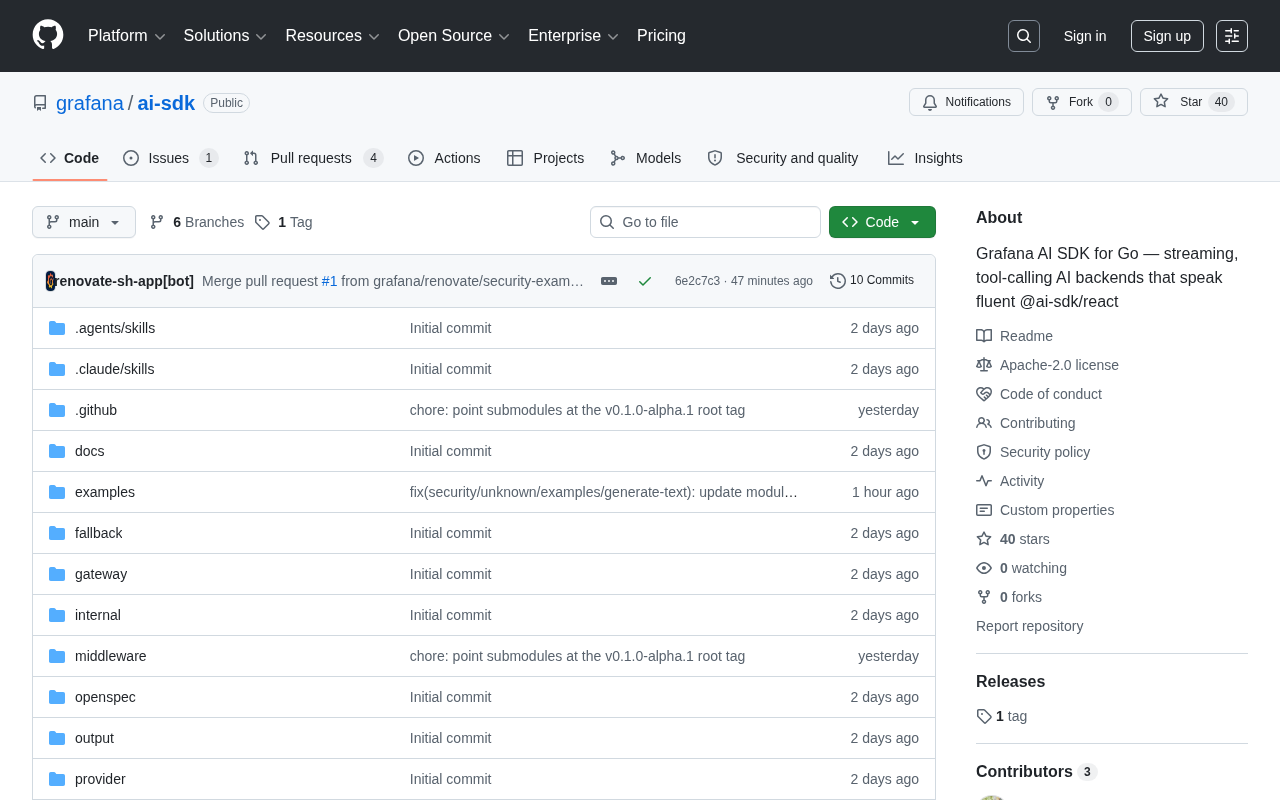
A recent open-source project that appeared on Hacker News addresses exactly this pain point: a Go LLM SDK focused on streaming responses and tool-calling, with a companion frontend React library. The technical direction it represents is worth developers' attention — namely, how to build high-performance, scalable AI backends using a systems-level language.
Streaming Responses: Go's Core Advantage for LLM Output
The Engineering Value of Streaming Output
For any user-facing AI application, streaming output is practically a must-have. Traditional request-wait-complete-response patterns create an unbearable waiting experience, especially when generating long text. Streaming responses use Server-Sent Events (SSE) or similar mechanisms to push tokens one by one to the frontend, achieving a typewriter-style real-time presentation.
SSE is a protocol defined in the HTML5 specification for one-way server-to-client data pushing, built on standard HTTP connections. Unlike WebSocket's full-duplex communication, SSE is unidirectional (server to client), uses the text/event-stream MIME type, formats data as plain text lines (identified by the data: prefix), and supports automatic reconnection and event ID tracking. In LLM applications, major APIs from OpenAI, Anthropic, and others all use SSE as the streaming output protocol, pushing each token or token group as an event. SSE's advantages include good compatibility (penetrating most proxies and firewalls), simple implementation, and native browser support via the EventSource API, though it doesn't support binary data transmission or client-initiated pushing.
Go has an inherent advantage in handling these long-lived connections with continuous data pushing. Thanks to lightweight goroutine concurrency, a Go backend can simultaneously maintain thousands of streaming connections without suffering the heavy thread or memory burden that some other runtimes face. The SDK encapsulates stream processing into a unified interface, so developers don't need to manually handle underlying chunked transfer and buffering logic.
Standardized Abstraction for Tool-Calling
Tool-calling is the key capability that transforms modern LLM applications from "chatbots" into "intelligent agents." It allows models to proactively invoke external functions during reasoning — querying databases, calling APIs, performing calculations — thereby breaking through the limitations of pure text generation.
From a technical implementation perspective, tool-calling originated from OpenAI's introduction of function calling in June 2023, subsequently adopted and evolved by Anthropic, Google, and others. The workflow is: developers attach tool definitions (describing parameter types and meanings in JSON Schema format) to the request; if the model determines during inference that a tool call is needed, it returns a special tool_call message (containing the function name and structured parameters); the application layer executes the function and backfills the result into the conversation context with a tool_result role; the model then continues generating based on the result. Different providers have significant differences in tool_call message formats, parallel call support, and forced call strategies.
The SDK abstracts tool-calling into a standardized registration and execution flow: developers define tool schemas (name, parameters, description), and the SDK handles parameter parsing, function dispatching, and result backfilling when the model requests a call. This design shields business code from differences in tool-calling protocols across model providers, keeping the code clean.
From a broader perspective, tool-calling capability is the infrastructure layer of Agent architectures. The core Agent loop typically includes: perception (receiving user input or environment state), thinking (model reasoning to decide the next action), action (calling tools or generating output), and observation (obtaining action results and providing feedback). Representative frameworks like LangChain's AgentExecutor and AutoGPT's loop architecture all revolve around this cycle. The reliability and standardization of tool-calling directly determines whether an Agent can stably interact with the external world.
Frontend-Backend Synergy: End-to-End Integration with the Companion React Library
Interestingly, the project doesn't just provide a backend SDK — it also includes a frontend React library. This reflects an end-to-end product mindset: the complexity of AI applications isn't limited to the backend; the frontend also needs to handle incremental rendering of streaming data, visualization of tool-calling states, and reconnection logic for interrupted connections.
Through the officially paired React components and Hooks, frontend developers can directly consume the backend's streaming interface without writing SSE parsers or state management logic from scratch. This "full-stack packaging" approach significantly lowers the barrier to building a complete AI interaction interface, making it particularly suitable for teams looking to quickly validate product prototypes.
Go vs Python: Weighing LLM Backend Technology Choices
Go's Advantages and Trade-offs
Choosing Go over Python for building an LLM backend is essentially a trade-off between operational costs and development ecosystem:
- Advantages: Higher concurrency performance, lower memory footprint, type safety from a compiled language, and an extremely deployment-friendly experience (single binary, no dependency hell). For production services that need to handle large numbers of concurrent streaming requests, these characteristics directly translate to lower server costs.
Go's deployment advantages are particularly prominent in cloud-native environments. Go compiles to a statically-linked single binary that can be directly copied to the target machine and run. Docker images can be built on scratch or distroless bases, typically only 10-30MB — a stark contrast to Python applications whose images often reach hundreds of MB. In Kubernetes environments, this means faster image pulls, faster Pod startup, and a smaller security attack surface. Additionally, Go's cross-compilation capability allows one-click compilation of Linux/ARM64 binaries on macOS, greatly simplifying CI/CD pipelines.
- Trade-offs: Go's AI ecosystem is far less mature than Python's, lacking rich model toolchains and community examples. This is precisely where such SDKs provide value — they fill the ecological gap in Go's "application-layer AI integration."
Positioning: Backend Integration Layer, Not Inference Engine
It's important to clarify that SDKs like this typically don't handle model inference itself, but rather serve as the integration layer between the backend and LLM APIs. In a typical AI application architecture, there are clearly defined layers: the inference layer (running model weights, executing forward passes), the API gateway layer (rate limiting, authentication, routing), the integration layer (protocol adaptation, retries, stream processing, tool orchestration), the business layer (application logic), and the presentation layer (frontend). A Go LLM SDK is positioned at the integration layer, similar to the role of a database ORM in traditional applications — it's not responsible for executing SQL (inference), but provides type-safe interface construction, connection management, and result mapping.
It targets teams that are already using Go to build their microservice architecture and want to introduce AI capabilities. In this architecture, model inference is still handled by cloud services like OpenAI and Anthropic, or local inference servers (such as vLLM, Ollama), while the SDK is responsible for elegantly integrating these capabilities into the existing Go tech stack. This positioning means teams can leverage Go's engineering advantages to build robust AI application services without touching model deployment.
Developer Evaluation Recommendations and Practical Insights
This project reflects an emerging trend: AI capabilities are moving from the experimental stage to engineering-grade production. When AI features are no longer isolated demos but need to be integrated into high-concurrency, high-availability production systems, developer demand for systems-level language SDKs will continue to grow.
For teams evaluating tools like this, consider the following points:
- Protocol compatibility: Does the SDK support the model providers you use, and is it easy to extend to new backends?
- Streaming robustness: How does it perform under abnormal scenarios like network jitter and connection interruptions?
- Community activity: As an early-stage open-source project, long-term maintenance capability is an important consideration.
- Frontend-backend fit: Does the companion React library genuinely reduce integration effort, or does it introduce additional coupling?
Conclusion
Building a streaming, tool-calling-capable AI backend in Go represents a pragmatic direction in AI engineering. It may not be suitable for every scenario — if your team is deeply tied to the Python ecosystem, migration costs may not be worthwhile. But for engineering teams that have already embraced Go, such SDKs provide a low-friction path to introducing AI capabilities. As the demand for large-scale AI application deployment grows increasingly urgent, the AI ecosystem for Go and other systems-level languages (like Rust) will become richer. We are witnessing AI infrastructure transitioning from "Python dominance" to "multi-language collaboration."
Related articles

From DevOps to MLOps: Market Demand, Transition Path, and Practical Advice
In-depth analysis of transitioning from DevOps to MLOps: core differences, market demand, required skills, and a practical three-step path for operations engineers making rational career decisions.

How Realistic Is ChatGPT's Live Voice Feature? Its Human-Like Quality Is Downright Unsettling
ChatGPT Live Voice hands-on: natural interruptions, human-like pauses, and realistic breathing. Two phones chatting sound like real people. A deep dive into the tech and uncanny valley effects.

Training ASR Models with Simulated Call Center Audio: Can the Gap Between Simulated and Real Data Be Bridged?
Deep dive into training ASR models with simulated call center audio: analyzing codec simulation, code-switching, and diarization bottlenecks that reveal the gap between simulated and real phone data.