#Server-Sent Events
231 related articles

·2 min
MicroCodex: A C++ Programming Agent Under 1MB — A Fresh Take on Minimalist AI Tools
MicroCodex re-implements OpenAI's Codex programming agent in C++ with a binary under 1MB. This article analyzes its engineering design, minimalist philosophy, and use cases in CI/CD and embedded systems.
Read more →

·2 min
RecordRanks: A Deep Dive into the Event Management and Ranking Platform for Niche Competitive Sports
Deep dive into RecordRanks, an all-in-one competition management platform for niche sports like powerlifting, speedcubing, and robotics with real-time scoring and automated leaderboards.
Read more →

·2 min
MLflow 3.15.0 Released: MCP Registry, Smarter Assistant & Multimodal Judges Explained
MLflow 3.15.0 introduces MCP Registry for unified Agent tool management, a smarter Assistant to reduce dev friction, and Multimodal Judges for multi-modal evaluation.
Read more →

·2 min
DeepSeek V4 Flash Free Access: Complete Breakdown of the 0731 Version on InferX
InferX offers free access to DeepSeek V4 Flash (0731 version) with zero data retention and OpenAI-compatible API. Full breakdown of features, pricing, and developer value.
Read more →

·3 min
Building a Streaming LLM Backend in Go: Deep Dive into the SDK and React Frontend Library
Deep dive into an open-source Go SDK for building streaming LLM backends, covering streaming responses, tool-calling architecture, and companion React library for end-to-end integration.
Read more →

·4 min
G.I.A.ac: An AI Architect That Generates Working Apps from a Single Sentence
G.I.A.ac (General Intelligence Architect) is an AI architect tool that generates runnable apps from a single sentence. Deep dive into its positioning, competitive landscape, target users, and core challenges.
Read more →

·3 min
Datastar Framework Explained: A New Hypermedia-Driven Paradigm for State Management
Deep dive into the Datastar hypermedia framework: its core philosophy, technical implementation, HTMX comparison, and how putting state in the right place simplifies frontend architecture.
Read more →

·3 min
Datastar Framework Deep Dive: A New Paradigm for Hypermedia-Driven State Management
Deep dive into Datastar hypermedia framework's core philosophy and implementation. Learn how putting state in the right place simplifies frontend architecture.
Read more →

·2 min
Severe Lag in Gemini Web App During Long Conversations Drives Users to AI Studio
Google Gemini web app suffers from severe lag in long conversations, history loading failures, and content loss. Users are switching to Google AI Studio for a more stable AI experience.
Read more →

·3 min
Ollama API Key Proxy: Multi-Key Rotation to Solve Rate Limiting Issues
Learn how Ollama API Key Proxy solves cloud LLM rate limiting through reverse proxy with round-robin key rotation, 429 auto-cooldown, and smart retry logic.
Read more →
·4 min
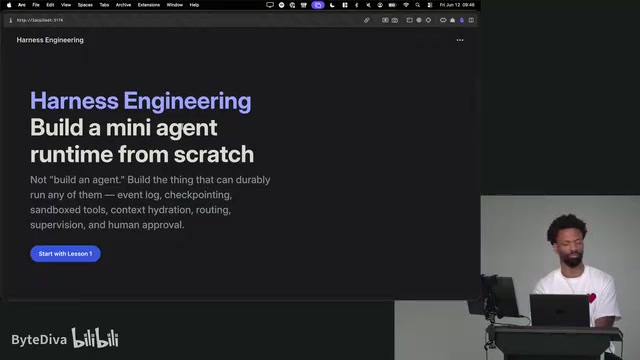
Harness Engineering: The Core Infrastructure for Taking AI Agents from Demo to Production
Deep dive into Harness Engineering: why AI Agents need memory management, durable execution, guardrails & approvals to go from demo to production.
Read more →

·4 min
Harness Engineering: The Core Infrastructure for Taking AI Agents from Demo to Production
Deep dive into Harness Engineering: why AI Agents need memory management, durable execution, guardrails & approvals to reach production. Based on Scott Moss's workshop.
Read more →

·3 min
Backend Developer Transition to AI/LLM: 4 Core Skills and a Practical Learning Roadmap
Complete guide for backend developers transitioning to AI/LLM engineering. Covers the 4 core skills—Python, RAG, Fine-tuning, and Agents—with a phased learning roadmap and practical project advice.
Read more →

·5 min
The Complete Guide to AI Agent Development: A Four-Stage Progressive Roadmap
A systematic guide to AI Agent development across four stages: LLM fundamentals, ReAct paradigm, memory & tools, and multi-agent collaboration for developers.
Read more →

·4 min
Spring AI 2.0: Five Key Updates Explained — Marching Toward the Age of AI Agents
Spring AI 2.0 brings five core updates: mandatory upgrade to Spring Boot 4, Tools parsing moving up, a built-in Agentic mechanism, MCP switching to Streamable HTTP, and an on-demand tool Advisor.
Read more →

·4 min
Spring AI 2.0 Explained: Five Key Updates Ushering in the Age of AI Agents
Spring AI 2.0 brings five core updates: mandatory Spring Boot 4 upgrade, Tools parsing moved up, built-in Agentic mechanism, MCP switch to Streamable HTTP, and on-demand tool-loading Advisor.
Read more →

·4 min
Spring AI 2.0: Five Key Updates Explained — Stepping into the Agent Era
Spring AI 2.0 brings five core updates: mandatory upgrade to Spring Boot 4, lifted Tools parsing, built-in Agentic mechanism, MCP switch to Streamable HTTP, and an on-demand tool-loading Advisor.
Read more →
·2 min
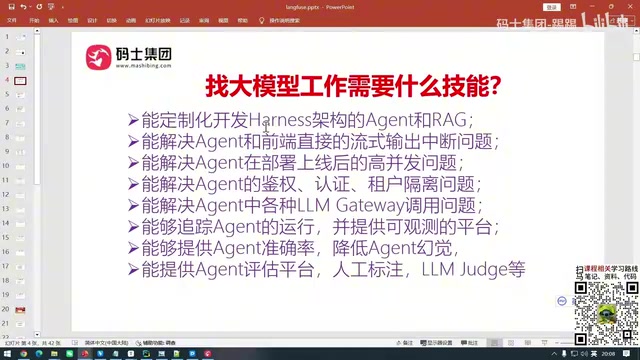
The New Bar for AI/LLM Roles: A Practical Guide to Agent Observability and Evaluation
Enterprise AI/LLM roles now demand engineering skills: streaming recovery, high concurrency, multi-tenancy, LLM gateways, Langfuse observability, and evaluation platforms. Master these 8 core competencies.
Read more →

·3 min
Multi-Agent AI Paper Writing System: A Full-Stack Breakdown of FastAPI + Vue3
A deep dive into an AI paper writing system built with FastAPI + Vue3, covering multi-agent collaboration, RAG, streaming output, and full academic workflow automation.
Read more →

·6 min
Hands-On with Panel AI On-Premises Deployment: One-Click Enterprise Adoption and Unified Compute Cluster Scheduling
In-depth review of Panel AI v1.1.1: second-level installation, no-public-IP networking, batch compute cluster management. Learn how enterprise AI on-premises deployment barriers are dramatically lowered.
Read more →