10 Open-Source AI Agents: In-Depth Technical Analysis from Programming to Video Creation
Technical deep-dive into 10 open-source AI Agents spanning programming, video creation, and automation.
A comprehensive technical examination of 10 open-source AI Agent projects, from Codex's context management and DeepSeek's cache optimization to multi-agent collaboration systems, video creation pipelines, and browser automation tools. Learn how these projects implement memory mechanisms, plugin architectures, and multi-model orchestration.
When using AI Agent products like Codex and DeepSeek, have you ever wondered about the technical implementation behind these tools? For instance, how does Codex retain your content even after context compression? How does the DeepSeek desktop client achieve high cache hit rates to reduce token costs? And how does Codex control your computer and browser?
This article, based on an in-depth presentation by a Bilibili content creator, examines 10 open-source AI Agent projects spanning programming, video creation, education, browser automation, and more. They're not just productivity tools ready for immediate use—they're invaluable resources for learning product design and engineering implementation in the AI era.
Why Study Open-Source AI Agents
The value of researching open-source Agent projects goes far beyond "usability." The creator summarized four core drivers that are worth noting.
First, satisfying curiosity. These projects encompass capabilities ranging from coding to video production. Understanding how they're implemented is itself a tremendous technical satisfaction.
Second, learning how to call large language models. Nearly all AI products interact with LLMs at their core, and different tools employ varying prompt engineering approaches. By reading source code, you can truly understand what "prompt engineering" looks like in practice.
Third, understanding product formats in the AI era. A clear trend is that more and more products are building desktop clients rather than traditional web or mobile apps. Studying these projects helps you grasp the technology choices of this new era.
Fourth, learning how others do web coding. Most open-source Agents are built with AI-assisted programming. Their AGENTS.md global constraint files, skill definitions, and other details are excellent teaching materials for learning how to constrain AI when writing code.
Additionally, the creator recommends using specialized "code repository explanation" tools that can automatically generate architecture diagrams, flowcharts, and dynamic module details for entire repositories, dramatically improving the efficiency of reading open-source projects.
Programming AI Agents: Open-Source Codex and Command-Line Tools
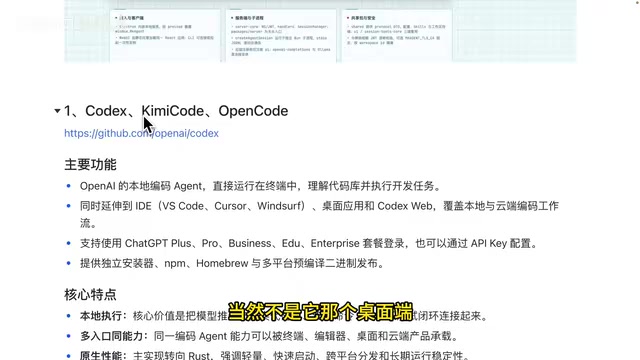
Many people don't know that Codex is actually open-source—though not the desktop version, but rather the terminal command-line version. This command-line tool has many users and is first-rate material for learning AI programming capabilities.
By studying Codex, you can figure out these key questions: When executing a long task, how does it stay running for hours without crashing? How does it read and understand your code? And how does it interact with large language models? Understanding these implementations will qualitatively enhance your ability to control AI programming—knowing when to manage context and how to effectively communicate with Agents.
Besides Codex, similar open-source AI programming tools include Gemini CLI, OpenCode, Mem Code, and others, all worth comparative study.
Personal Assistant Agents: Cherry Studio and Craft Agent
The second category is personal assistant-type Agents, represented by Cherry Studio and Craft Agent. Their form resembles localized conversational tools that can freely switch between different models, with concepts highly similar to mainstream AI dialogue products.
For developers, an additional bonus is that these two projects are built on Python. If you're looking for a Python practical project to study, they're very suitable. By learning these products, you can build your own personal assistant or set up an internal Agent dialogue tool for your enterprise.
Multi-Agent Collaboration: Heder and Group Chat Mode
The third project is Heder, whose biggest feature is the ability to invoke different Agents for collaborative dialogue. For example, you can open Claude Code to complete a conversation, then forward the content to Codex for processing, and after completion notify Claude Code for review—achieving inter-Agent communication and collaboration. Studying how it monitors different Agent states and how dialogue is passed between Agents is a good entry point for understanding multi-agent collaboration.
Another project takes this concept to the extreme: its format is very much like WeChat group chat, except most members in the group are AI Agents playing different roles, and you can also pull humans into the group to chat together.
This conceals an extremely challenging technical difficulty: in a group chat, how does each Agent handle its own context? When users keep speaking, which Agent ultimately determines "this question should be answered by me"? This is a direction that many current Agent products are tackling. The creator also made a Demo based on this open-source project, with the difference being that he used local Agents (like Claude Code, Codex) to handle the collaborative capabilities of group chat roles.
AI Video Creation and Education: Multi-Model Collaborative Productivity Tools
The fourth is a video creation Agent system. It breaks down the entire video production into a pipeline: storyboarding, voiceover, music, and other stages are all decomposed in one place according to workflow. The creator used a single sentence to have it generate a short video introducing AI programming. The system first provides a "hook" design for the first three seconds, then breaks down visual shots and editable narration, ultimately outputting a finished video. You may not have noticed that this Demo video didn't call any external speech or video large models—it was purely implemented with local code.
The fifth is an education product whose core function is converting a topic or set of materials (documents, audio, video) into an interactive course. Its highlight is coordinating multiple models including image models, video models, and voice models to ultimately produce a complete instructional video. The official website showcases an instructional video case explaining "buoyancy," with voiceover using ByteDance's speech model, achieving quite natural results. For the education industry and teachers, this is an excellent example for understanding "multi-model collaborative generation of interactive courses."
Agent Memory Mechanisms and Browser Automation
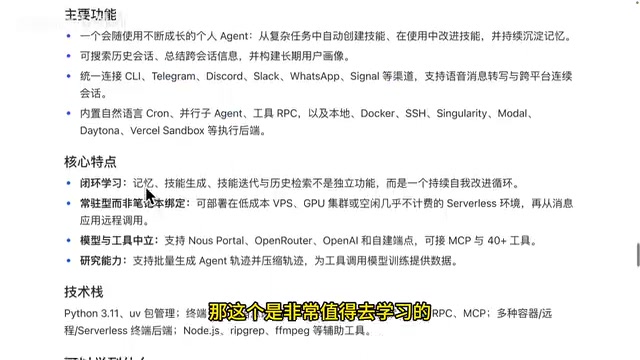
The sixth is Nemis Agent and OpenCrawl (the latter recently released version 2.0 with massive changes). The most worthwhile aspect of Nemis Agent to study is its memory mechanism—how it captures conversation fragments that can be distilled into "skills" during continuous dialogue, transforming memory into capability. This is a core topic for building long-term usable personal assistant Agents.
The eighth is Eagle, a browser designed specifically for AI Agents. Traditional automated testing mostly relies on Chrome, but Chrome is designed for humans, with complex internal calls and high token consumption. Eagle, on the other hand, is built from the ground up for AI.

In actual testing, the creator had Eagle open Bilibili and search for "ten recent popular AI videos." The browser automatically opens a new window, executes the search, locates keywords, and ultimately returns results. You can use it to complete various automation tasks while learning about browser automation implementation.
DeepSeek Open-Source Ecosystem: Cache Optimization and Plugin Architecture
The last two projects are both related to DeepSeekAd.
The ninth is the DeepSeek desktop client, which focuses on improving cache hit rate. The higher the cache hit rate, the lower the token cost. By studying its source code, you can reverse-engineer "how to write prompts and develop usage habits" to increase hit rates and reduce costs—very practical.
The tenth is DeepSeek Harness, whose biggest feature is "everything as a plugin." How it installs plugins at the underlying level, how plugins are loaded in the event thread, how plugins are invoked and unloaded—these are all extremely valuable architectural learning points. You can also study how it improves model output quality.
Conclusion
These 10 open-source AI Agents target different industries and audiences, and each is an outstanding and worthwhile work to learn from. Together, they sketch out the current technical landscape of AI Agents: from long-task execution and context management, to multi-agent collaboration and multi-model orchestration, to memory consolidation, cache optimization, and plugin architectures.
A special reminder: whether learning from or reusing code from these projects, you must strictly comply with their respective open-source licenses. Reading source code with curiosity, then migrating learned techniques to your own projects—that's the right approach to studying open-source Agents.
Related articles

Amphibious Transforming Drone: Beyond 100x Power Savings, What Are the Real Needs?
Is the amphibious transforming drone just a gimmick? Starting from the 100x power difference of the M4 Morphobot, explore real application scenarios and thesis topic ideas, analyzing boundary conditions where pure drones and pure ground robots both fail.

Warhound Raises $200 Million: Genetically Engineered "War Dogs" Paired with Anduril Gear
Warhound raises $200M, backed by Ben Lamm and Palmer Luckey, to genetically engineer dogs for military and law enforcement use and equip them with Anduril gear. This article analyzes its technology direction, funding logic, and ethical controversy.

Claude API Comes to Google Cloud: IAM Integration and SDK Access Guide
Anthropic hosts the full Claude API on Google Cloud with IAM-controlled permissions and unified billing. This guide covers the Vertex AI and Anthropic-hosted entry points, IAM role configuration, and SDK access.