100x Faster RNN Training: Parallel-in-Time Methods Tackle Chaotic System Reconstruction

Combining DEER parallel iteration with GTF stabilization achieves 100x faster RNN training on chaotic long sequences.
This NeurIPS 2026 Spotlight paper addresses the serial bottleneck of RNN training on ultra-long chaotic time series (T > 10^6) by combining DEER parallel fixed-point iteration with Generalized Teacher Forcing (GTF). DEER reformulates sequential forward passes as a parallelizable system of equations, reducing theoretical complexity from O[T] to O[(log T)²], but chaotic dynamics cause its iterations to diverge. GTF stabilizes DEER by mixing ground-truth observations with model predictions, while also reducing exposure bias. Together, they achieve over 100x training speedup on dynamical systems reconstruction tasks and demonstrate clear advantages over Mamba and other state space models, offering a new efficient training paradigm for chaotic system modeling in fields like meteorology and fluid dynamics.
A Long-Standing Bottleneck in RNN Training
Recurrent neural networks (RNNs) have a natural advantage when working with dynamical systems — they can capture nonlinear dependencies in time series data. But a persistent problem remains: RNN forward passes are inherently sequential, with each step depending on the output of the previous one. When faced with ultra-long time series from chaotic systems (T > 10^6 steps), this serial nature makes training extremely slow, with computational complexity scaling linearly with sequence length T, i.e., O[T].
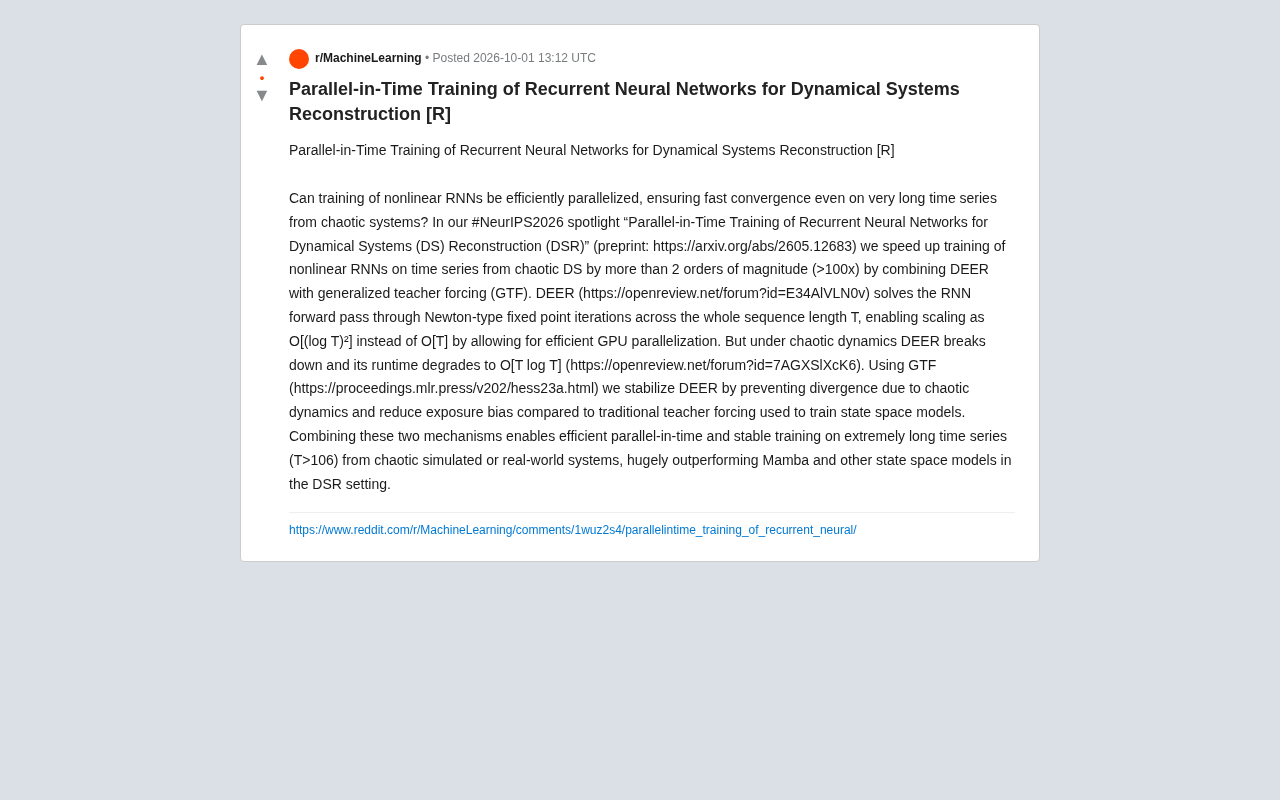
This is precisely the core problem addressed in a paper selected as a NeurIPS 2026 Spotlight. The paper, Parallel-in-Time Training of Recurrent Neural Networks for Dynamical Systems Reconstruction, proposes a combined approach that claims to speed up nonlinear RNN training on chaotic dynamical system time series by more than two orders of magnitude (>100x).
The Core Idea: Combining DEER and GTF
The key insight of this work is combining two existing techniques to overcome limitations that neither can solve alone.
DEER: Turning Sequential Forward Passes into Parallel Solving
Rather than executing the RNN forward pass step by step, DEER reformulates the entire sequence computation (of length T) as a large system of equations, solved all at once via Newton-type fixed point iterations. This fully leverages the GPU's parallel computing capabilities, theoretically reducing complexity from O[T] to O[(log T)²].
The longer the sequence, the more pronounced the relative gains — for dynamical system data spanning millions of steps, this improvement is nearly transformative.
DEER (Deep Equilibrium Recurrent) borrows from the ideas of implicit deep learning: treating the RNN's temporal unrolling as an implicit equation h = F(h, x), where h is the hidden state vector across the entire sequence and x is the input. Newton-type iterations approximate the inverse of the Jacobian matrix to progressively refine the solution, rather than recursing through time steps one by one. This allows all hidden states across the sequence to be updated simultaneously in a single iteration — perfectly suited for large-scale parallel computation on GPUs. The theoretical O[(log T)²] complexity arises because Newton iteration's quadratic convergence requires roughly O(log T) iterations, and each iteration involves a nested layer of parallel operations, giving rise to the squared logarithm term. This complexity advantage grows dramatically as sequence length scales from thousands to millions of steps.
Chaotic Dynamics Break DEER
The problem is that DEER breaks down in the presence of chaotic systems. The very nature of chaotic dynamics — extreme sensitivity to initial conditions — means that small errors get amplified exponentially, causing DEER's fixed-point iterations to fail to converge. Runtime degrades to O[T log T], and the parallel advantage largely disappears. This is why naive parallel methods cannot be directly applied to dynamical systems reconstruction (DSR) tasks.
GTF: The Key to Stabilizing Training
The research team introduced Generalized Teacher Forcing (GTF) to stabilize DEER. GTF itself is a training technique previously developed for dynamical systems reconstruction, and it serves two purposes:
First, it prevents the divergence caused by chaotic dynamics, making DEER's iterative process controllable and convergent again. Second, compared to traditional teacher forcing, GTF reduces exposure bias — the distribution mismatch that arises when a model relies on ground-truth data during training but must rely on its own predictions at inference time. This issue is especially pronounced in the training of state space models (SSMs).
Combining DEER's parallelism with GTF's stabilization is what truly enables "parallel-in-time" training that is both fast and stable, allowing the model to efficiently converge on extremely long chaotic time series.
Traditional teacher forcing directly feeds ground-truth observations as the input at each training step. While this accelerates convergence, it introduces exposure bias: the model never learns to recover from its own prediction errors during training, causing error accumulation to spiral during inference. GTF uses a tunable mixing coefficient to blend ground-truth observations and the model's own predictions as the input to each subsequent step — leaning toward real data early in training to stabilize gradients, then gradually increasing the weight of model-generated predictions as training progresses. In the context of chaotic systems, GTF additionally acts as an attractor regularizer: by periodically "pulling" the hidden state back toward the true trajectory, it suppresses the exponential error amplification inherent to chaotic sensitivity. This is the fundamental mechanism that restores convergence to DEER's fixed-point iterations.
Comparison Against Mamba and Other State Space Models
In recent years, state space models (SSMs) — with Mamba as the leading example — have attracted significant research attention for their efficient handling of long sequences. However, in the specific setting of dynamical systems reconstruction, the paper claims its method substantially outperforms Mamba and other SSMs.
This finding is worth noting. It suggests that when pursuing long-sequence modeling capability, not all architectures handle highly nonlinear, sensitivity-prone processes like chaotic systems equally well. Training strategies specifically designed for dynamical reconstruction may prove more valuable in domains such as physics modeling, climate simulation, and neuroscience — wherever faithfully reproducing real dynamical systems is the goal.
Mamba's core innovation lies in its Selective State Space mechanism (Selective SSM): by making state transition matrices and selection gates dynamically dependent on input content, it escapes the limitations of traditional linear time-invariant SSMs, while using a hardware-aware parallel scan algorithm to achieve efficient computation along the sequence dimension. This makes Mamba excel at long-sequence tasks in language and audio. However, SSM state transitions are fundamentally linear recurrent structures, creating an inherent expressiveness bottleneck for reconstructing highly nonlinear chaotic attractors — the trajectory bifurcations and strange attractors characteristic of chaotic systems require strongly nonlinear dynamics to be accurately captured. This explains why a parallel training scheme designed specifically for nonlinear RNNs can outperform general-purpose linear SSM architectures in the vertical domain of dynamical reconstruction.
Why This Research Matters
The goal of dynamical systems reconstruction is to recover the underlying dynamical laws from observed time series. This class of tasks has practical relevance in weather forecasting, fluid mechanics, biological neural activity analysis, and more — and the systems involved are often both chaotic and data-intensive, requiring processing of massive long sequences.
In the past, training efficiency has been the primary barrier to applying RNNs to these problems. A speedup of more than 100x means that training that once took days could be completed in hours, enabling researchers to iterate experiments on longer, more realistic datasets. Whether the data comes from simulated or real-world systems, this efficiency gain opens the door to dynamical modeling at much larger scales.
Of course, as a preprint result (arXiv:2605.12683), the reported performance still awaits broader reproduction and validation. But from a methodological standpoint, it offers a clear lesson: when tackling specific problems, combining targeted techniques is often more effective than simply stacking general-purpose architectures.
Related articles

Apple HomeView Hands-On Review: Is the $300 Smart Home Hub Worth It?
Apple HomeView hands-on: a $300 smart home hub with facial recognition for quick account switching, but no App Store or voice recognition. Is the wall-mounted version worth it? Should you buy the first generation?

Meta Muse Wonder Launch: What It Means for Meta's Return to the Frontier AI Race
Meta releases Muse Wonder and WonderFull, benchmarks reach the frontier, community feedback is polarized. An in-depth look at Meta's return to the frontier AI race, its personal agent strategy, and Zuckerberg's different path.

Apple Home Smart Home Lineup Leaked: LG and Schneider Team Up, UWB Door Lock on Board
Apple Home ecosystem gains new LG and Schneider devices: UWB smart lock with proximity unlock, 2.5K dual-camera doorbell, privacy indoor camera, and AirPods-like seamless pairing.