1,150-HP Electric Beast: Mercedes-AMG's First All-Electric SUV Debuts

Mercedes-AMG unveils its first ground-up electric SUV with three motors, over 1,150 horsepower, and ultra-fast charging.
Following the four-door GT coupe, Mercedes-AMG has launched its first ground-up electric SUV—the 2028 AMG GT SUV—sharing its powertrain with the four-door GT coupe. It features three axial flux motors with a combined output exceeding 1,150 horsepower and supports ultra-fast charging, balancing performance and everyday practicality. The article notes that building an electric SUV from scratch is AMG's strategic statement on electrification, not a perfunctory converted product. The three-motor layout provides the hardware foundation for torque distribution and AWD handling, while axial flux motors offer advantages in power density and compact size. However, key details like range, acceleration figures, and price have yet to be announced, and real-world challenges such as weight control and energy management remain to be seen, so competitiveness is hard to judge for now.
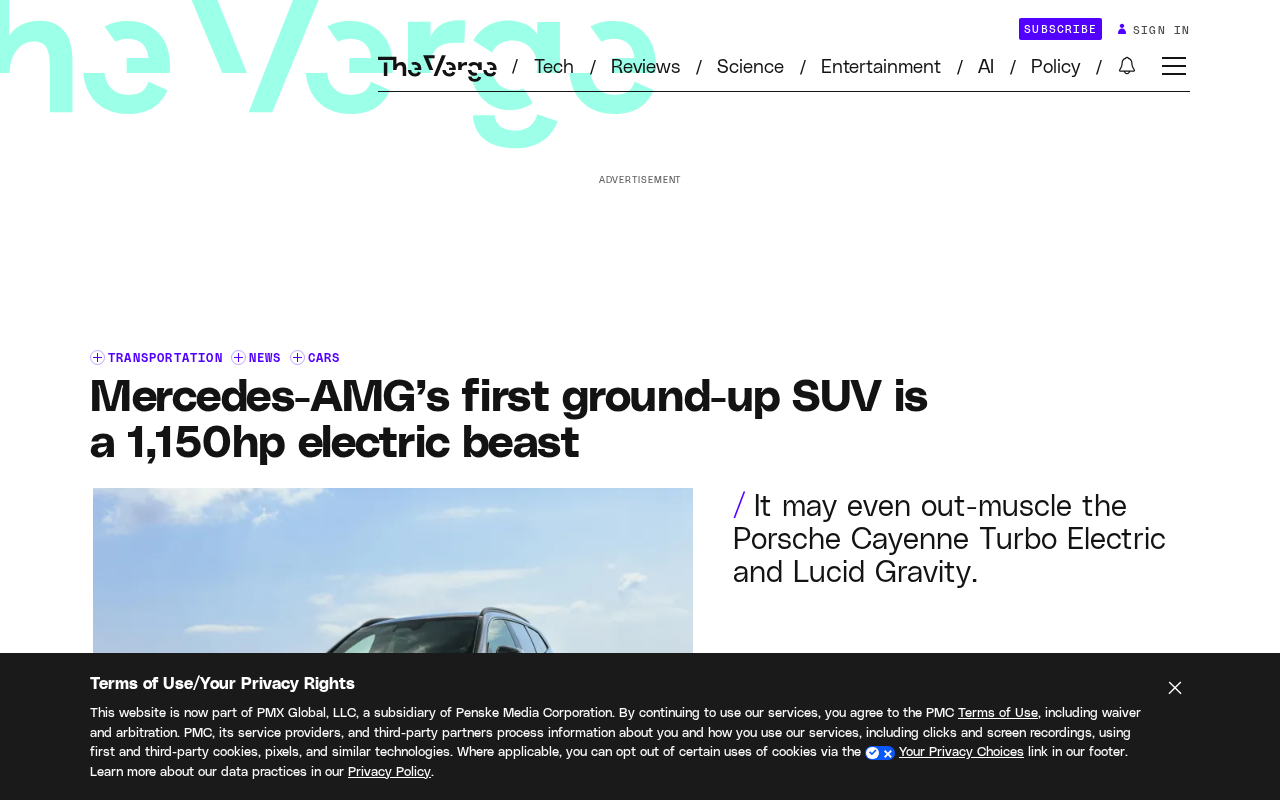
Mercedes-AMG is accelerating its electrification transformation. Following the four-door GT coupe, the performance brand has unveiled its first SUV built from the ground up—the 2028 Mercedes-AMG GT SUV, an electric performance vehicle that likewise delivers over 1,150 horsepower and supports ultra-fast charging.
A Performance Flagship Built from Scratch
Unlike many "converted" products that started as gas cars, the AMG GT SUV is the first SUV model designed entirely from scratch by the AMG brand. According to the original report, it's described as a "burlier cousin" of the four-door GT coupe, with the two sharing a high degree of powertrain commonality.
This means AMG didn't simply stuff motors into an existing SUV, but redesigned the vehicle around a high-performance electric architecture. For a brand known for engine roar and internal combustion performance, building an all-electric SUV from scratch is itself a strategic statement.
Three Motors and 1,150 Horsepower
Power is the most eye-catching label on this car. The AMG GT SUV is equipped with three axial flux motors, delivering a combined output of over 1,150 horsepower—on par with the four-door GT coupe.
Compared with the more common radial flux motors, axial flux motors offer advantages in power density and compact size, making them a popular technology path in the high-performance EV space in recent years. A three-motor layout typically means more refined torque distribution capability, providing the hardware foundation for all-wheel-drive performance and handling.
You may not have noticed that the original article does not disclose specific acceleration figures or range data—these key metrics await further official announcement.
Axial Flux Motor is a motor structure in which the magnetic flux passes through the air gap along the axial direction of the motor, as opposed to radial flux motors where flux is distributed along the radial direction. Because the stator and rotor of an axial flux motor are arranged in parallel disc shapes, its diameter is larger while its axial length is shorter, giving it inherent advantages in high torque density and compact size. YASA (now part of Mercedes-Benz) is one of the representative manufacturers of this technology path, and its axial flux motors have been used in several high-performance electric AMG models. Compared with radial flux motors, axial flux motors can also maintain higher efficiency across a wider speed range, but their manufacturing process is more complex and more costly, so they are currently mainly used in high-performance or space-constrained applications.
A three-motor layout in an EV typically refers to a configuration with one motor on the front axle and two on the rear axle (or one each front and rear plus a rear-axle dual motor). Its core value lies in torque vectoring: by independently controlling the output of each motor, the system can actively adjust the drive force of the left and right wheels during cornering, thereby improving steering response and cornering limits. For a high-performance SUV with over 1,150 horsepower, three motors are not just about stacking power but also serve as the hardware guarantee for handling precision.
Balancing Ultra-Fast Charging and Practicality
Beyond the horsepower figures, the original article also defines this car as an "electric people carrier that supports ultra-fast charging." This shows that while AMG pursues performance, it hasn't overlooked everyday use scenarios.
The SUV body style itself implies more space and practicality, while ultra-fast charging capability directly relates to the convenience of long-distance use. For a high-performance electric SUV, how to strike a balance among performance, range, and charging efficiency is often the key to a product's success.
Thoughts on Market Positioning
From a product line perspective, the AMG GT SUV and the four-door GT coupe complement each other: one leans toward a sports sedan posture, the other offers SUV space and passability, but they share core powertrain technology. This "same platform, dual form" strategy is not uncommon in the high-end performance EV market, helping to amortize R&D costs and quickly cover users with different needs.
However, an electric SUV with over 1,150 horsepower also faces real challenges: weight control, energy consumption management, and the degree of matching with charging infrastructure will all affect the actual experience. The answers to these questions can only be judged after more technical details are released.
Ultra-fast charging typically refers to the capability to support high-power DC fast charging, generally corresponding to an 800V or higher high-voltage electrical architecture in industry parlance. Under an 800V platform, the operating voltage of the battery pack and electric drive system doubles, halving the current at the same power, thereby reducing wiring heat and weight while allowing higher charging power. Current mainstream ultra-fast charging piles have peak power between 250kW and 350kW, and some models can replenish from 10% to 80% in 15 to 20 minutes under ideal conditions. However, actual charging speed is constrained by multiple factors such as battery temperature, state of charge range, and charging pile power, so the ultra-fast charging experience is highly dependent on the degree of infrastructure matching.
Editor's View
The first all-electric SUV built from scratch by AMG carries more signal value than the parameters themselves. It shows that traditional performance brands are taking electrification seriously rather than perfunctorily launching compliance products. The combination of three motors, axial flux, and ultra-fast charging outlines a rather aggressive technical solution.
But it's worth keeping a cool head: currently disclosed information still focuses mainly on power parameters, while range, handling, price, and other dimensions consumers truly care about remain unclear. For AMG fans and potential buyers of high-end EVs, this car is worth watching, but it's not yet time to draw conclusions.
Related articles

Build an AI Super Employee System at Zero Cost: A Full Breakdown of Automated Agent Workflows
A deep breakdown of the AI super employee system demoed on Bilibili: agent orchestration, digital human voiceovers, map and enterprise lead generation, 24/7 customer service, and legal modules. We analyze the business logic and compliance risks behind zero-cost signup to help entrepreneurs judge the real ROI of this AI digital employee system.

The Essential Difference Between Chatbots and AI Agents: Crossing from Conversation to Execution
What's the difference between a chatbot and an AI agent? Based on the MCP series on the Learn Tech channel, this article uses examples like booking flights and summarizing notes to explain: a chatbot only gives answers, while an agent actually completes tasks through a think-act-observe loop. It breaks down the four core components—model, tools, memory, and goal—as well as MCP's role as a bridge, and discusses agents' applicable boundaries and permission risks.

Free GitHub Repo: 342 Hours of AI Courses, from Math to MCP Servers
A free GitHub repo offers 342 hours of AI courses: 523 lessons across 20 phases, from math fundamentals to agent building and MCP servers. Nearly 100,000 learners have started.