17-Year-Old AI Researcher: How Modular AI Challenges the Large Model Black Box

A 17-year-old Turkish high school student proposes a modular AI architecture and practices technology for good through projects such as E-LabS.
The article introduces the work of Hamza Bilden, a 17-year-old independent researcher from Ankara, Turkey. He advocates replacing a single black-box large model with a modular AI architecture that routes queries to expert modules on demand to improve transparency and efficiency, inspired by biological intelligence, with an academic plan of computer engineering undergraduate study plus a neuroscience master's. His representative project E-LabS is a web-based virtual laboratory for secondary schools that integrates a Google Gemma 4 AI assistant, Three.js 3D simulation, automatic report generation, and a KVKK-compliant user system; it won first place in the TÜBİTAK 2204-A Biology category and became a TEKNOFEST finalist. Another project is a participatory urban management platform that won second place nationally at SosyalFest. He also serves as the overall organizational president of TechTeam, combining research and organizational capabilities.
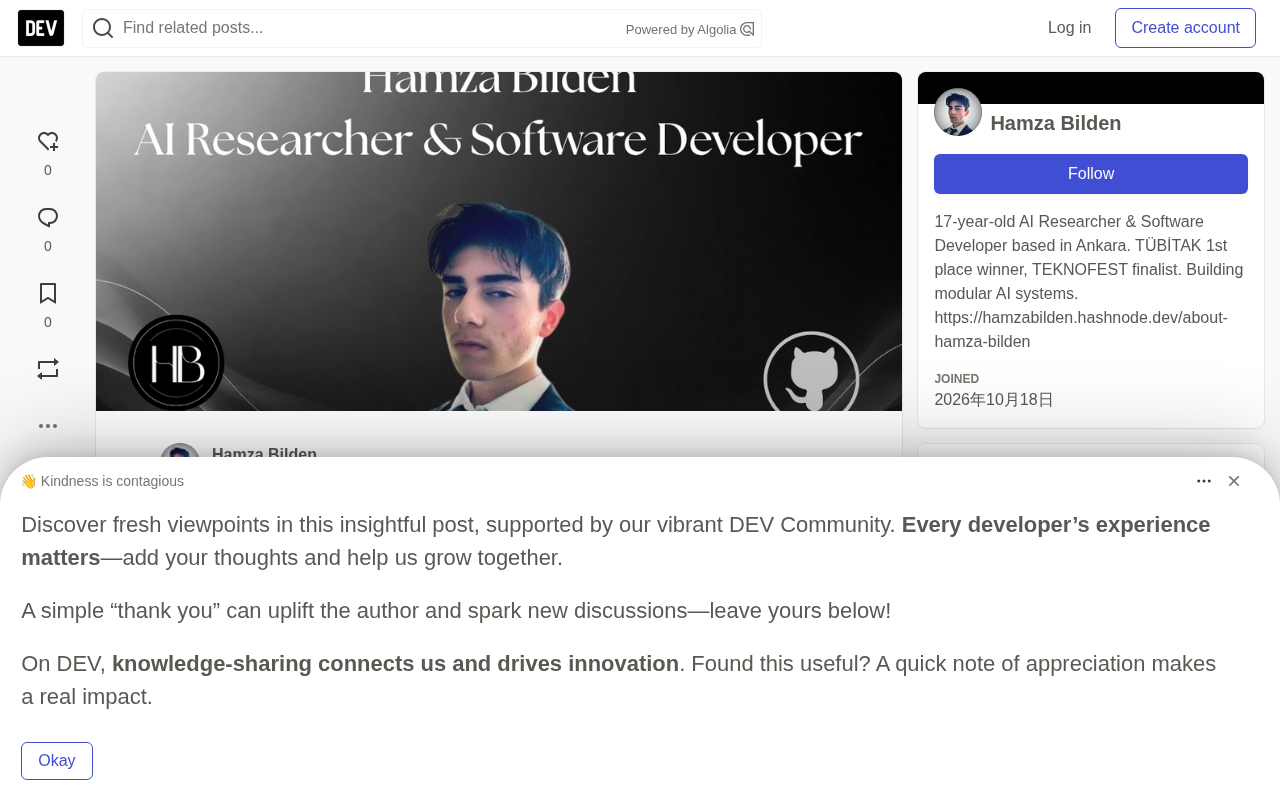
A 17-year-old high school student and independent researcher has just won first place in the TÜBİTAK 2204-A Biology category and become a finalist in the TEKNOFEST competition. Hamza Bilden, from Ankara, Turkey, has proposed a modular AI architecture approach that may offer a noteworthy alternative to the current AI development path dominated by large models.
Modular AI: Not Dependent on a Single Black Box
Bilden's core argument is clear: rather than relying on a massive single black-box model, we should build modular AI architectures that route each query to the relevant expert module. This design delivers both transparency and efficiency.
The inspiration comes from biological intelligence. Bilden hopes to explore how biological intelligence can inspire more efficient and adaptive AI systems. His academic plan revolves around this direction as well—computer engineering for his undergraduate degree, then neuroscience for his master's, with the goal of researching the intersection of biological systems and machine learning.
Current mainstream large models follow a "scale is everything" path: the more parameters, the more capable—but at the cost of high inference costs and decision processes that are hard to explain. A modular architecture breaks complex problems into manageable sub-problems, with each module focusing on a specific domain and being routed on demand. This idea is not new in academia (Mixture of Experts, or MoE, is a typical example), but Bilden's entry point is to combine it with cognitive science, emphasizing the inspiration of biological intelligence and grounding it in real-world secondary school science education scenarios.
Mixture of Experts (MoE) is the most mature engineering implementation of the modular idea in deep learning. At its core, multiple "expert" sub-networks and a gating network are set up within the network; for each input token, the gating network computes the weights of each expert and activates only a small number of top-ranked experts to participate in computation. This way, the total number of model parameters can be large, but the actual computation per inference depends only on the number of activated experts, thereby reducing inference costs while maintaining capacity. MoE has been used in multiple large-scale language models, such as sparse Transformer architectures. However, routing in traditional MoE still occurs at the tensor level, and expert division of labor is often unexplainable—which differs from Bilden's vision of routing semantic queries to interpretable expert modules, and is precisely where he hopes to improve by combining cognitive science.
E-LabS: Putting the Modular Philosophy into Practice
Beyond theory, Bilden emphasizes hands-on building. His most representative project is E-LabS (formerly BioLab), a web-based virtual laboratory for biology, chemistry, and physics, aimed at solving the real problem that many high schools lack physical science labs.
E-LabS's tech stack is worth noting: it integrates an AI lab assistant based on Google Gemma 4, real-time charts, automatic Markdown report generation, a Three.js 3D simulation engine, and a user system built on Firebase that complies with KVKK (Turkey's Personal Data Protection Law).
The project's track record is impressive: first place in the TÜBİTAK 2204-A Biology category, and a finalist spot in the TEKNOFEST "Technology for Humanity" category.
From an engineering perspective, embedding an AI assistant into educational tools is not uncommon, but integrating 3D simulation, automatic report generation, and data compliance into a single web platform is a relatively high level of completion for a project led by a high school student. AI here plays the role of "assistant" rather than replacing the experiment itself—which exactly echoes Bilden's understanding of AI as a tool.
Google Gemma is a series of lightweight open-weight language models released by Google, built on technology shared with Gemini. It offers versions at different parameter scales, can be deployed on consumer hardware or in the cloud, and allows developers to fine-tune for specific tasks. Compared with closed-source large model APIs, Gemma's open-weight nature allows educational applications to integrate AI capabilities at controllable cost and makes it easier to audit data flows for compliance. For a secondary-school-oriented web platform like E-LabS, choosing Gemma means the AI assistant can be deployed in a controlled environment, and student data need not all be sent to third-party closed-source services—which aligns with the project's emphasis on KVKK data protection requirements.
KVKK is the abbreviation for Turkey's Personal Data Protection Law (Kişisel Verilerin Korunması Kanunu), which took effect in 2016 and is modeled on the EU's General Data Protection Regulation (GDPR). It sets out principles for processing personal data, the rights of data subjects, the obligations of data controllers, and restrictions on cross-border transfers, and requires stricter protection for sensitive data. For edtech products, students are minors, and their learning records and behavioral data are personal data; platforms need to provide clear notice, obtain consent, and ensure data security. E-LabS declares KVKK compliance in its user system, indicating that the project considered compliance at the design stage, not just feature implementation.
Urban Governance Platform and Social Innovation
Bilden's second project, "Sadece Yaşama, Şehrini Yönet" (meaning "Don't Just Survive, Manage Your City"), is a participatory urban management digital platform that helps citizens solve community problems. The system supports 6 user roles, a voting mechanism, and real-time tracking, with the goal of enabling local problems to be resolved through collaboration. The project won second place nationally at SosyalFest (Turkey's Century of Success Model category).
Both projects point in the same direction: using technology to solve concrete social problems rather than pursuing technical showmanship for its own sake. This problem-oriented mindset is consistent with Bilden's advocacy of modular AI—find the real problem, break it down, and use the right combination of tools to solve it.
Participatory urban management platforms fall under the category of "civic tech," typically including modules for issue reporting, community voting, and progress tracking, with the aim of shortening the information chain between citizens and local government. Similar international practices include platforms such as FixMyStreet, and domestically there are also "snap-and-report" features in city government service apps. The main challenge for such systems is not technology but operations: how to ensure issues are actually addressed, how to prevent vote manipulation and abuse, and how to create a closed loop among different roles (citizens, community organizations, municipal departments). Bilden's project sets up 6 user roles and a real-time tracking mechanism, precisely attempting to respond to these governance-level issues.
Community Leadership and Continuous Learning
Beyond coding, Bilden serves as the overall organizational president of TechTeam, responsible for managing project processes, coordinating team participation in TÜBİTAK and TEKNOFEST, and designing systems to boost team motivation and efficiency. He is also a participant in the 42 Kocaeli Bootcamp, continuously honing his software development skills.
This dual identity of "researcher + organizer" is not common among young tech talents. Managing team competitions and handling project workflows exercises a different kind of ability—translating technical judgment into collaborative processes, which is often harder than writing code.
Bilden's blog ends with "Stay tuned for more technical deep dives into modular AI and EdTech," indicating he plans to continue going deeper into modular AI and educational technology.
For readers interested in diversity in AI architectures, edtech implementation, or the growth of young developers, Bilden's practice offers a sample worth following. Whether his modular AI proposition can be validated at larger scale, and whether E-LabS can truly reach more schools—the answers to these questions will take time. But a 17-year-old researcher is already letting his projects speak for him, and that itself is worth attention.
For more information, visit his portfolio at hamzabilden.vercel.app, the E-LabS project page at elabs.com.tr, or connect with him via LinkedIn and GitHub.
One-line Summary
A 17-year-old Turkish high school student proposes a modular AI architecture and practices technology for good through projects such as E-LabS.
Paragraph Summary
The article introduces the work of Hamza Bilden, a 17-year-old independent researcher from Ankara, Turkey. He advocates replacing a single black-box large model with a modular AI architecture that routes queries to expert modules on demand to improve transparency and efficiency, inspired by biological intelligence, with an academic plan of computer engineering undergraduate study plus a neuroscience master's. His representative project E-LabS is a web-based virtual laboratory for secondary schools that integrates a Google Gemma 4 AI assistant, Three.js 3D simulation, automatic report generation, and a KVKK-compliant user system; it won first place in the TÜBİTAK 2204-A Biology category and became a TEKNOFEST finalist. Another project is a participatory urban management platform that won second place nationally at SosyalFest. He also serves as the overall organizational president of TechTeam, combining research and organizational capabilities.
Related articles

Build an AI Super Employee System at Zero Cost: A Full Breakdown of Automated Agent Workflows
A deep breakdown of the AI super employee system demoed on Bilibili: agent orchestration, digital human voiceovers, map and enterprise lead generation, 24/7 customer service, and legal modules. We analyze the business logic and compliance risks behind zero-cost signup to help entrepreneurs judge the real ROI of this AI digital employee system.

The Essential Difference Between Chatbots and AI Agents: Crossing from Conversation to Execution
What's the difference between a chatbot and an AI agent? Based on the MCP series on the Learn Tech channel, this article uses examples like booking flights and summarizing notes to explain: a chatbot only gives answers, while an agent actually completes tasks through a think-act-observe loop. It breaks down the four core components—model, tools, memory, and goal—as well as MCP's role as a bridge, and discusses agents' applicable boundaries and permission risks.

Free GitHub Repo: 342 Hours of AI Courses, from Math to MCP Servers
A free GitHub repo offers 342 hours of AI courses: 523 lessons across 20 phases, from math fundamentals to agent building and MCP servers. Nearly 100,000 learners have started.