9 AI Subscription Plans Compared: The Real Cost Per 100M Tokens Revealed

Converting major AI subscription plans to price per 100M tokens reveals who's truly cheap and who has traps.
Based on hands-on testing by Bilibili creator "魔针针", the article converts mainstream AI subscription plans from Volcano, Alibaba, Tencent, Baidu, Zhipu, Xiaomi, and MiniMax into "cost per 100M tokens" and compares them against official API prices to derive discounts. The core finding is that plans fall into fixed-quota and three-tier coefficient types; the latter saves more with more cache hits, while the former gives no cache discount. Time-of-day discounts and five-hour/weekly limits further alter actual usable quota. The same plan with a different model can differ by over ten times in token count, so choosing the right model matters more than choosing the right plan. For GLM5.3, Volcano Coding is cheapest; for DeepSeek V4.1 Flash, Baidu's points plan is lowest while Baidu's token plan is most expensive.
Domestic AI subscription plans are getting more and more varied, with quota units ranging from "times" to "AFP" to "points" to "Credits" — you simply can't tell which is cheaper just by looking at the promotional pages. Bilibili creator "魔针针" (Mozhenzhen) broke down mainstream plans from Volcano, Alibaba, Tencent, Baidu, Zhipu, Xiaomi, MiniMax, and others one by one, converting them all to "how much per 100M tokens," and the conclusions deserve careful attention from anyone who writes code.
Two Billing Logics That Determine Whether Caching Saves Money
Plans on the market basically fall into two categories. The first is the fixed-quota system: Volcano Coding Plan, Volcano Agent Plan, and Baidu's token-based plan all belong here. The plan gives a fixed number by count, by AFP, or directly by token; regardless of whether the cache hits, each token is deducted the same amount — caching doesn't save money, and how many tokens you can run per month is essentially a fixed number.
The second is the three-tier coefficient system: Alibaba, Tencent, Baidu's points-based plan, Zhipu, Xiaomi, and MiniMax belong to this category. The plan gives a points or Credits quota, and each request is deducted at different coefficients for "uncached input, cache hit, output" — the cache-hit portion is deducted very little, so the more cache hits, the more you save. The key variable becomes: how much is one point actually worth. Tencent, Zhipu, and Xiaomi have published their conversion rates; Alibaba and MiniMax require hands-on testing to reverse-engineer.
Cache Hit refers to a prompt segment (such as a code file or system instruction) that has already been processed by the model before, with the intermediate computation results (KV Cache) stored server-side, so that subsequent requests can reuse them directly without recomputation, making the cost far lower than uncached input. The industry typically prices input tokens in two tiers — "cache hit" and "cache miss" — with the hit price as low as 1/10 or even less of the miss price. For scenarios like coding that involve long contexts and repeated references to the same repository, cache hit rates often reach 90% or more — this is precisely the fundamental reason why three-tier coefficient plans can save so much money, and the key reason why the fixed-quota system's "no cache discount" is seen as a disadvantage.
Two Overlapping Rules: Time-of-Day Discounts and Window Limits
The actual quota of the same plan is also altered by two rules. First, time of day: Baidu and Alibaba offer discounts at night, Zhipu deducts more during peak hours, and Xiaomi deducts slightly less in the early morning. Second, limits: Volcano, Zhipu, and MiniMax have five-hour and weekly caps in addition to monthly quotas, so intensive use will hit the ceiling early.
The UP creator's calculation methodology: mainly comparing GLM5.3 and DeepSeekAd V4.1 Flash, because the same plan with a different model can differ by more than ten times in token count; structurally, when writing code, the vast majority of input is cache hits, so the calculation uniformly assumes 95% cache hits, 4% uncached input, and 1% output.
Hands-On Testing of Each Plan: How Much of a Discount Off Official Prices
Volcano: Per-Call Billing, No Cache Discount
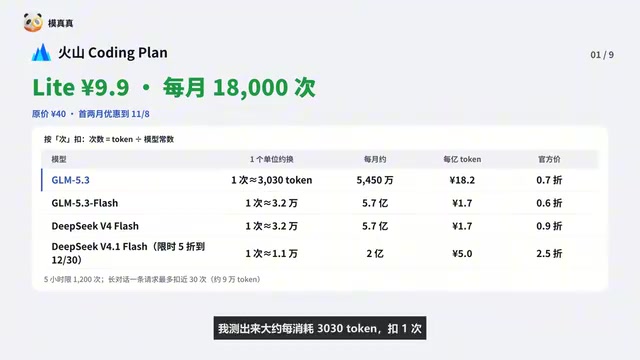
Volcano Coding Plan is billed per call; Lite is 9.9 yuan for the first two months (original price 40), with 18,000 calls per month. The "call" here is not the number of messages but tokens divided by a model constant — GLM5.3 deducts one call roughly every 3,030 tokens consumed, so a 10,000-token request deducts about three calls. Converted, that's about 54.5 million tokens per month, roughly 0.7 of the official price per 100M tokens (i.e., a 93% discount).
Volcano Agent Plan's unit is called AFP; the official disclosure is public: input plus output tokens multiplied by the model coefficient, then divided by 10,000. The key point is that cache-hit input is also deducted at the same coefficient, with no discount, so no matter how high the cache hit rate, you don't save money. GLM5.3 has a coefficient of 4.5, giving about 44 million tokens per month, roughly 0.9 of the official price (a 91% discount).
AFP (Agent Fuel Point) is the quota unit used by Volcano Engine's Agent Plan, essentially a "fuel point" converted by model coefficient: each request takes "public input tokens + output tokens" multiplied by that model's coefficient, then divided by 10,000 to get the deduction. Coefficients vary by model (GLM5.3 is 4.5 in this article); the higher the coefficient, the more is deducted for the same token consumption. Because cache-hit input is also multiplied by the same coefficient with no discount in the calculation, under the AFP system improving cache hit rates cannot reduce deductions — a sharp contrast with the points/Credits system.
Baidu: Two Lines — Token System and Points System
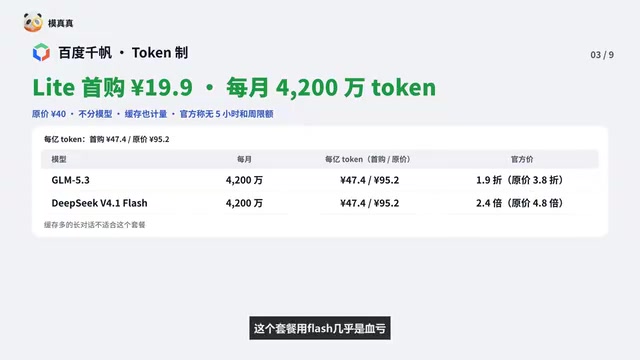
Baidu Qianfan's token-based Lite plan is 19.9 yuan for first purchase (original price 40), with a fixed 42 million tokens per month, regardless of model, and cache counts toward the quota. The result is that using Flash is almost a total loss, and only the most expensive models are worthwhile — running GLM5.3 is 1.9 of the official price (an 81% discount), while running DeepSeek V4.1 Flash actually costs more than the official API.
Baidu's points-based Lite plan is 19.9 yuan for first purchase (original price 40) for 6,600 points, with the rule that one point equals one cent at the official API peak price. Running DeepSeek V4.1 Flash is about 3 of the official price (a 70% discount), the lowest among plans for this model; from 10 PM to 8 AM, some models get an additional 80% off, bringing it to under 1 yuan per 100M tokens.
Tencent: Transparent Points Rules, but No Hidden Discounts
Tencent Cloud's Token PlanAd Lite tier costs 39 yuan for over 780 points, with clearly published rules: 1 point = 5 cents, each model is deducted at the official API list price with no discounts whatsoever, and the per-point price is the same across tiers, so buying a larger tier isn't cheaper. At GLM5.3's list price, one point only buys about 20,000 tokens; at the limited-time 55% discount, about 36,000. Tencent has no nighttime discount; once the limited-time promotion expires, it's back to list price.
Alibaba: Points Conversion Reverse-Engineered Through Testing
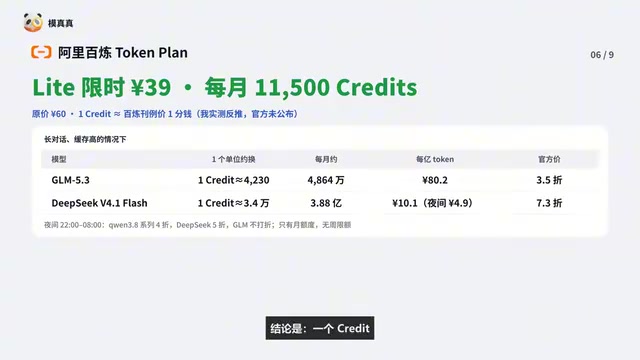
Alibaba Bailian Token Lite is a limited-time 39 yuan (original price 60), with 11,500 Credits per month; the official conversion method is not published. The UP creator reverse-engineered it through more than ten rounds of testing: one Credit is roughly equal to one cent calculated at Alibaba's official website API price. One Credit buys about 4,230 tokens for GLM5.3, about 3.5 of the official price (a 65% discount); about 7.3 for DeepSeek V4.1 Flash (a 27% discount); and with nighttime discounts on some models, even lower.
Zhipu and Xiaomi: Clearest Rules, Explicit Discount Conditions
Zhipu publishes the clearest rules: Lite is 118 yuan per month, with 10,000 points per week and an additional 2,000-point cap per five hours; weekday afternoons from 2 to 6 PM are peak hours, and other times are deducted at half. GLM5.3 at off-peak gives about 400 million tokens per month, about 200 million at peak. Quarterly billing is 94.4 yuan per month and annual billing 82.6 yuan per month, with the quota unchanged.
Xiaomi MiMo Lite is 39 yuan, 34.3 yuan for first purchase, with 4.1 billion Credits per month; from midnight to 8 AM only 0.8x is deducted, and 100 million Credits equals 1 yuan at the official API price. Converted, it's basically the official price with no extra discount.
MiniMax: No Absolute Quota Published, Only a Lower Bound
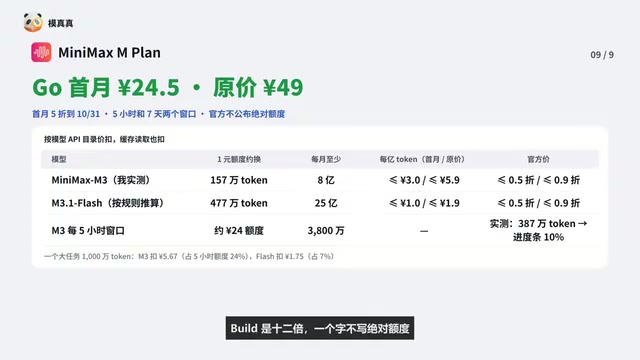
MiniMax M-Plan has a 50%-off first-month promotion running through October 31, with both a five-hour and a seven-day window limit. Officially it only states multipliers, not absolute quotas, saying only that deductions are at the model's API list price and that cache reads are also deducted, with the console showing only percentages. In testing, running M3 costs no more than 3 yuan per 100M tokens at the first-month price, less than 0.5 of the official price (over a 95% discount).
The "official price" that repeatedly appears in the article refers to the per-token unit price published by each model vendor in its API catalog (such as Volcano Ark, Alibaba Bailian, Zhipu Open Platform), which serves as the baseline for horizontal comparison. "How much of a discount" means the plan's converted per-token cost as a proportion of the official API unit price; 0.7 of the price means only 7% of the official price. The reason for unifying everything to "how much per 100M tokens" is that the quota units of different plans (calls, AFP, points, Credits) have different dimensions, and the same quota can buy vastly different token counts under different models — only by converting to the same monetary measure do they become comparable.
Side by Side: Who's Cheapest for the Same Model
Running GLM5.3, from low to high per 100M tokens, it's roughly: Volcano Coding, Volcano Agent, Zhipu off-peak, Zhipu peak, Baidu points, Alibaba, Tencent (with a clear gap between limited-time and list prices). Running DeepSeek V4.1 Flash, the ranking completely changes: Baidu points is lowest, Volcano Coding and Agent follow closely, Alibaba differs between day and night, Tencent is close to the official price, and Baidu's token-based system is actually the most expensive of the bunch.
The horizontal comparison of "how much per 100M tokens" is only meaningful when locked to the same model. The reason is that different models have different per-token unit prices, different token consumption per request, and different plan coefficient conversion methods; the same points can buy more than ten times as many tokens on a cheap model as on an expensive one. Therefore the article ranks twice, once with GLM5.3 and once with DeepSeek V4.1 Flash as the baseline, and the resulting rankings are completely reversed — which precisely shows that "choosing the right model" can have a greater impact on actual cost than "choosing the right plan."
Three Conclusions and Purchase Reminders
First, don't just look at the point count — convert it to how much per 100M tokens, then see what fraction of the official price it is. Second, choosing the right model matters more than choosing the right plan — the same plan with a different model can differ by more than ten times. Third, discounts depend on conditions: Baidu's and Alibaba's nighttime discounts do take effect in testing but only for some models; Tencent only has limited-time promotions; Volcano's cache gets no discount; MiniMax doesn't publish its quota officially, so only a lower bound can be given.
These prices and promotions are all changing, so before buying, always refer to the official page on the day of purchase.
(Multi-source cross-validation note: the core data in this article comes from the hands-on testing video by Bilibili creator "魔针针" (Mozhenzhen), and each platform's billing rules have been checked against official disclosures; the points conversions for Alibaba and MiniMax are reverse-engineered from a single source and should be used with attention to potential error.)
Related articles

Vibe Coding for Beginners: Expressing Intent Instead of Handwriting Code
What is Vibe Coding? A 137-episode Bilibili course defines it: the core is expressing intent, not writing code. This article analyzes Vibe Coding's productivity logic, target audience, and entry expectations to help beginners decide if it's worth learning.

LangChain Beginner's Guide: An Agent Development Roadmap from LangGraph to Deep Agents
Clarify the encapsulation relationship among LangChain, LangGraph, and Deep Agents, and master the learning path and selection logic for agent development frameworks—suitable for beginners in large model development.
Cursor Full-Stack in Practice: From Rules Configuration to ERP Development, Doubling AI Coding Efficiency
An analysis of a Bilibili Cursor full-stack course: comparing AI coding tools like GitHub Copilot and Windsurf, detailing Cursor Rules configuration, Chat/Compose features, and ERP and visualization report scenarios to boost your productivity.