LangChain Beginner's Guide: An Agent Development Roadmap from LangGraph to Deep Agents

LangChain, LangGraph, and Deep Agents are encapsulated layer by layer; learn the middle layer first, then the bottom, then the top.
This article clarifies that LangChain, LangGraph, and Deep Agents are not independent tools but are related through layer-by-layer encapsulation: Deep Agents encapsulates LangChain, and LangChain encapsulates LangGraph. LangChain is positioned as the middle layer for rapidly developing agent applications and excels at workflow orchestration; LangGraph is the lowest-level framework supporting full customization; Deep Agents is the highest-level encapsulation suitable for ultra-fast setup. The article recommends learning LangChain first, then diving into LangGraph, and finally understanding Deep Agents, emphasizing reliance on official documentation and hands-on practice. For selection, use LangChain for routine development and rapid prototyping, LangGraph for deep customization, and Deep Agents for ultra-fast setup.
LangChain, as a mainstream framework for large model agent development, has attracted many developers. But many people fall into a common misconception when learning: treating LangChain, LangGraph, and Deep Agents as three independent tools, which only makes things more confusing the more they study. In reality, these three frameworks are related through layer-by-layer encapsulation. Based on a widely followed teaching resource, this article outlines a clear learning path and selection logic.
LangChain's Positioning and Core Capabilities
LangChain is a complete solution for rapidly developing large model-driven agent applications. In plain terms, with LangChain you can quickly build the agent applications you want, and all of today's agent capabilities can be integrated through it.
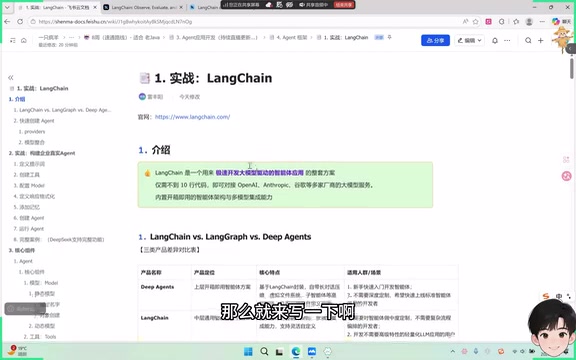
Its advantage lies in orchestrating agent workflows. Although tools like LlamaIndex can also converse with large models through OpenAI-compatible APIs (providing an API Key, URL address, and model name), LangChain is more professional and simpler when it comes to arranging agent workflows. Developers don't need to write large amounts of low-level code from scratch to connect with various model vendors.
Another component worth noting is LangSmith, LangChain's monitoring system, used to monitor metrics and execution traces across the entire agent. In the early stages of learning, you can temporarily skip it and focus on the core framework first.
Agent workflow orchestration refers to the process of organizing steps such as large models, tool calls, memory, and conditional judgments into an executable flow. In LangChain, this is typically achieved through abstractions such as Chain, Agent, and Tool, allowing developers to define task order and branching logic declaratively without manually managing the input and output of each step. This orchestration capability is what distinguishes LangChain from simple model-calling libraries; it makes building multi-step, multi-tool collaborative agent applications modular and reusable.
The Relationship Between the Three Frameworks: Who Encapsulates Whom
LangChain's official documentation lists three key projects: Deep Agents, LangChain, and LangGraph. Understanding their relationship is key to making the right choice.
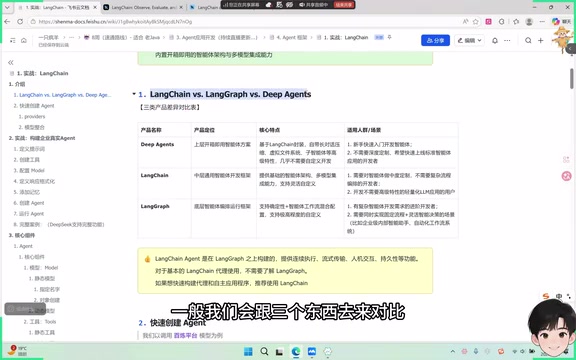
Simply put, Deep Agents encapsulates LangChain, and LangChain encapsulates LangGraph. So this is a relationship that goes downward layer by layer, becoming increasingly low-level:
- Deep Agents: The highest-level encapsulation. Suitable for quickly building agents, with almost no coding required and no need for deep customization—a few sentences are enough to get an agent application running.
- LangChain: The middle layer, and currently the most widely used. It encapsulates LangGraph at the bottom and is suitable for scenarios that require some orchestration and customization of agent workflows and adjustments at the architectural level.
- LangGraph: The lowest-level framework. Suitable for fully customizing every stage of the agent's execution flow, such as building standard customized products at the level of Coze.
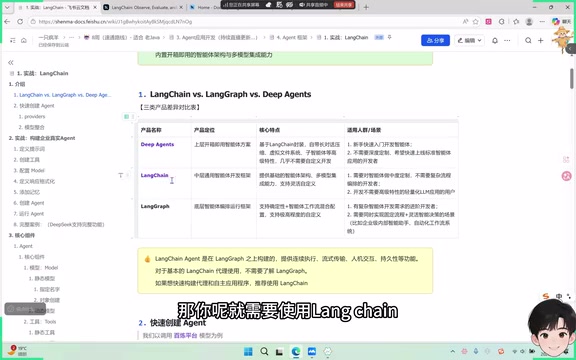
This layered design allows developers to choose flexibly according to their needs. If you just want to quickly validate a prototype, LangChain is enough; if you want product-grade standard customization, you'll need LangGraph at the bottom.
Encapsulation in software development refers to hiding complex underlying implementations and exposing simpler, higher-level interfaces externally. In the LangChain ecosystem, Deep Agents encapsulating LangChain means Deep Agents provides higher-level abstractions and preset configurations, so developers can obtain complete agent functionality with just a small amount of code or configuration; while LangChain encapsulating LangGraph means wrapping LangGraph's underlying graph computation and state management capabilities into more easy-to-use components. This layered design allows developers with different technical backgrounds to find a suitable entry point, while also ensuring the extensibility of underlying capabilities.
Learning Path: Middle First, Then Bottom, Finally Top
Since the three frameworks have an encapsulation relationship, the learning order should follow the same logic rather than starting from the very bottom and grinding through it.
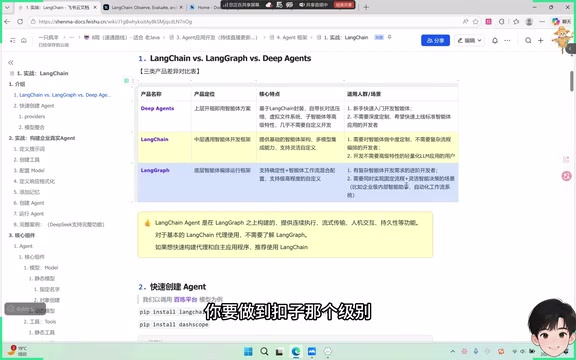
The recommended path is: learn LangChain first, then LangGraph, and finally look at Deep Agents.
By mastering LangChain first, you'll understand the core concepts and common orchestration methods of agent development; then dive into LangGraph to clarify the underlying mechanisms, and when you look back at LangChain's upper-layer encapsulation it will be very clear; once you've mastered both the bottom and middle layers, Deep Agents will be understandable in a single sentence—because it is just a further encapsulation of LangChain.
Here's an important reminder: all learning should be based on the official documentation. LangChain's official documentation is clearly structured; just follow it and practice. Although there is a lot of content, each knowledge point is basically a one-sentence matter when written out—the difficulty isn't in understanding, but in hands-on practice.
Official documentation is the most authoritative resource for learning LangChain and is synchronized with versions. LangChain's documentation usually includes sections such as quickstart, conceptual guides, how-to guides, and API reference, with a clear structure and runnable example code. Because LangChain iterates quickly, third-party tutorials may become outdated, so relying on the official documentation helps avoid learning deprecated usage. It is recommended to follow the quickstart in the documentation for hands-on practice, then gradually go deeper into each module, and consult the API reference and community discussions when you encounter problems.
Selection Advice: Match by Requirement Level
For most developers and teams, the middle layer—LangChain—is still the most commonly used in actual work. The reason is intuitive: it doesn't require handling all the low-level details like LangGraph, nor does it have limited customization space like Deep Agents. Using LangChain to quickly validate prototypes and develop products is the most efficient choice.
When a company needs deeper product customization, then move down to LangGraph. And if you just need an agent that can run, Deep Agents can get it done in a few sentences.
To summarize the selection logic: use LangChain for rapid prototyping and routine development, LangGraph for full customization, and Deep Agents for ultra-fast setup. When learning, take the official documentation as your guide, start with the middle layer then the bottom layer, and the top layer will naturally fall into place.
Related articles

9 AI Subscription Plans Compared: The Real Cost Per 100M Tokens Revealed
Bilibili creator tests 9 AI subscription plans from Volcano, Alibaba, Tencent, Baidu, Zhipu, Xiaomi, MiniMax and more, converting them all to real cost per 100M tokens, breaking down fixed-quota vs. three-tier coefficient billing and how caching, time-of-day discounts, and window limits affect actual quota.
Vibe Coding for Beginners: Expressing Intent Instead of Handwriting Code
What is Vibe Coding? A 137-episode Bilibili course defines it: the core is expressing intent, not writing code. This article analyzes Vibe Coding's productivity logic, target audience, and entry expectations to help beginners decide if it's worth learning.

Cursor Full-Stack in Practice: From Rules Configuration to ERP Development, Doubling AI Coding Efficiency
An analysis of a Bilibili Cursor full-stack course: comparing AI coding tools like GitHub Copilot and Windsurf, detailing Cursor Rules configuration, Chat/Compose features, and ERP and visualization report scenarios to boost your productivity.