2025 Comparison of Six Major Agent Development Frameworks: AutoGen/LangChain/LangGraph Selection Guide

A systematic comparison and selection guide for six mainstream AI Agent development frameworks in 2025.
This article systematically compares six mainstream AI Agent development frameworks: AutoGen, LangChain, LangGraph, Google ADK, OpenAI Agents, and AgentScope. AutoGen excels at multi-agent collaboration research; LangChain offers the most mature ecosystem for enterprise RAG systems; LangGraph supports complex graph-based workflow orchestration; Google ADK deeply integrates with Google's ecosystem; OpenAI Agents delivers the best performance but locks you into OpenAI; and AgentScope uses message-driven architecture for distributed high-concurrency scenarios. The article recommends evaluating selections based on team tech stack, project requirements, model availability, and maintenance costs.
With the rapid advancement of large language model technology, AI Agent development frameworks have been emerging at an unprecedented pace. Faced with choices like AutoGen, LangChain, LangGraph, Google ADK, OpenAI Agents, and AgentScope, developers often struggle to determine which framework best suits their specific use case.
An AI Agent refers to an intelligent system capable of perceiving its environment, making autonomous decisions, and taking actions to achieve specific goals. Unlike traditional single-turn Q&A-style LLM calls, Agents possess four core capabilities: Tool Use, Memory management, Planning/Reasoning, and Action. A typical Agent work loop goes: receive task → analyze task → formulate plan → invoke tools for execution → observe results → decide next action. This loop continues until the task is complete. This paradigm shift transforms LLMs from passive "answerers" into proactive "executors," which is precisely why Agent development frameworks have become the core infrastructure for AI engineering in production.
This article systematically reviews and compares these six mainstream Agent development frameworks across dimensions including architecture design, ecosystem maturity, learning curve, and applicable scenarios, helping you make the most appropriate technology selection decision.
AutoGen: A Research Powerhouse for Multi-Agent Collaboration
AutoGen is a multi-agent development framework from Microsoft, with its core strength being native support for multi-agent collaboration. Multiple Agents can naturally engage in conversations, negotiate, and distribute tasks, making it ideal for building complex agent collaboration systems.
Let's explain the concept of Multi-Agent Collaboration here. It refers to a mechanism where multiple Agents with different roles or capabilities work together to accomplish complex tasks through communication and coordination. Common collaboration patterns include: hierarchical (a primary Agent assigns tasks to sub-Agents), peer-to-peer (Agents negotiate as equals), and debate-style (multiple Agents propose different perspectives on the same problem and reach consensus). The advantage of this architecture is its ability to simulate human team division of labor—for example, one Agent handles code writing, another handles code review, and a third handles testing, thereby improving overall output quality. AutoGen provides deep framework-level support in this direction, enabling developers to build multi-role collaborative agent systems with minimal code.
However, AutoGen leans more toward being a research and experimental framework. Support for production environment requirements such as governance, monitoring, and stability is still insufficient. If your goal is academic research, proof of concept, or experimental projects, AutoGen is an excellent choice; but deploying it directly in production requires careful evaluation.
Best for: Academic research, multi-agent collaboration experiments, proof-of-concept projects.
LangChain: A Mature Ecosystem as an Enterprise Foundation
LangChain is one of the most established and ecosystem-mature Agent development frameworks available. Through extensive development over time, it has accumulated rich tool integrations and community resources, making it particularly suitable for building Agent + RAG (Retrieval-Augmented Generation) systems.
RAG (Retrieval-Augmented Generation) is one of the most mainstream architectural patterns in enterprise AI applications today, and warrants a detailed explanation here. Its core process works as follows: when a user asks a question, the system first retrieves the most relevant document fragments from a vector database or knowledge base, then injects these fragments as context into the LLM's prompt, and finally the model generates an answer based on the retrieved information. RAG effectively addresses the LLM's "knowledge cutoff" and "hallucination" problems, enabling the model to provide accurate answers based on the latest, domain-specific private data. LangChain has accumulated a wealth of out-of-the-box components in the RAG domain, including document loaders, text splitters, vector store adapters, retrievers, and more, forming a complete RAG toolchain.
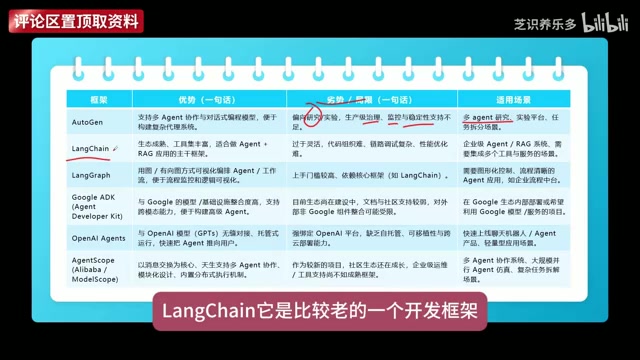
However, LangChain's flexibility is a double-edged sword. Its overly flexible design makes it easy for developers to build complex chains that become quite tricky to debug. If you need to build enterprise-grade agents or RAG systems, LangChain is still worth prioritizing, but be prepared to manage the complexity.
Best for: Enterprise Agent systems, RAG retrieval-augmented generation, projects requiring rich third-party tool integrations.
LangGraph: A Graph Orchestration Engine for Complex Workflows
LangGraph is an advanced tool from the LangChain team that uses a graph-based approach to build agent workflows. Compared to LangChain's chain structure, graph structures can express more complex logical relationships, including conditional branches, loops, and parallel execution.
Graph Orchestration is a technical paradigm that uses directed graphs to define and manage workflows—understanding this concept is crucial for mastering LangGraph. In a graph structure, nodes represent specific processing steps or Agents, and edges represent the flow relationships between steps. Compared to traditional linear chain structures (A→B→C), graph structures can naturally express conditional branching (if condition X is met, take path A; otherwise take path B), loops (repeatedly execute a step until a condition is met), parallel execution (multiple steps running simultaneously), and other complex logic. This approach essentially draws from finite state machine (FSM) and workflow engine design principles, making complex Agent orchestration logic visualizable and debuggable. LangGraph applies this philosophy to the Agent development domain, allowing developers to define interaction topologies between agents in a declarative manner.
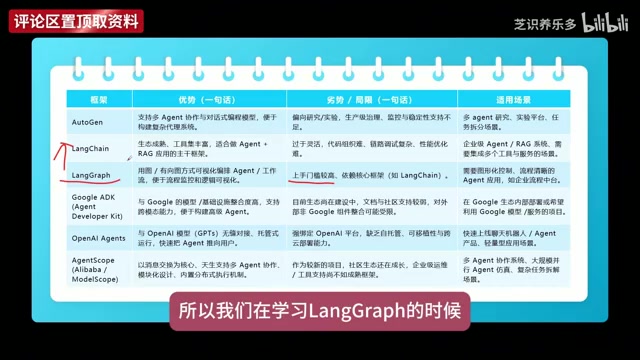
LangGraph has two main drawbacks: first, a high barrier to entry with a steep learning curve; second, it's fundamentally built on top of LangChain, meaning you need to master LangChain basics while learning LangGraph. If your project genuinely requires complex multi-step workflows and your team has sufficient technical depth, LangGraph is a powerful choice.
Best for: Complex multi-agent systems, workflow orchestration requiring conditional branches and loop logic.
Google ADK: The Perfect Companion for Google's Ecosystem
Google ADK (Agent Development Kit) is Google's agent development framework, with its core strength being deep integration with the Google ecosystem—if your system already heavily uses Google's cloud services, APIs, and infrastructure, developing agents with Google ADK will be remarkably smooth.

Notably, Google ADK doesn't only support Google's own Gemini model—it can also work with other models. This stands in stark contrast to OpenAI Agents. However, the disadvantage is equally clear: integration with components outside the Google ecosystem receives significantly less support.
Best for: Projects deeply invested in Google Cloud services, agent development based on Gemini models.
OpenAI Agents: Best Performance but Deepest Lock-in
OpenAI Agents is the official agent development framework released by OpenAI. Built on the GPT model series, it enables rapid construction of high-quality Agents with excellent performance and stability. From a pure agent output quality perspective, OpenAI Agents is likely the best performer among these frameworks.
But the drawbacks are equally prominent—tight binding to the OpenAI platform. Unlike Google ADK, OpenAI Agents only works with its own models and doesn't support integration with other model providers. This touches on a critically important risk dimension in technology selection: Vendor Lock-in. Vendor lock-in refers to a state where, after a system becomes deeply dependent on a specific vendor's technology, services, or platform, the cost of migrating to another vendor becomes prohibitively high. Once OpenAI adjusts its pricing strategy, terms of service, or API interfaces, projects using this framework will face a passive situation. By comparison, frameworks supporting multiple models (such as LangChain and AutoGen) allow developers to flexibly switch between different model providers, reducing the risk of single-vendor dependency. In enterprise technology selection, model interchangeability has become an increasingly important evaluation dimension.
In practical terms, many enterprises in China cannot directly use OpenAI services due to policy, network, and cost factors, which significantly limits the framework's applicability.
Best for: Projects with stable access to OpenAI services that demand the ultimate in agent performance.
AgentScope: Alibaba's Distributed Newcomer
AgentScope, released by Alibaba, is a noteworthy new framework. It is centered on message exchange, natively supports multi-agent collaboration, adopts a modular design, and has built-in distributed execution mechanisms.
Message Passing architecture is a classic communication paradigm in distributed systems, and AgentScope brings this mature system design philosophy into the Agent development domain. Its core idea is that components don't directly call each other's methods but instead communicate and coordinate through sending and receiving structured messages. In multi-agent scenarios, this means each Agent is an independent computational unit that communicates asynchronously through message queues or message buses. The advantage of this architecture is its natural support for distributed deployment—different Agents can run on different machines or even different data centers, as long as the message channel remains open. Additionally, message-driven architecture makes horizontal scaling and fault isolation easier to implement—when one Agent encounters issues, it won't affect the entire system's operation.

From an architectural design philosophy perspective, AgentScope incorporates message exchange, distributed execution, modular structure, and scalability into the framework from the ground up, giving it inherent advantages in multi-agent collaboration and high-concurrency scenarios.
As a recently released framework, AgentScope's ecosystem is still growing, and community resources and third-party tool integrations are not yet abundant. However, its design philosophy and technical direction show great potential and are worth continued attention.
Best for: Multi-agent collaboration, high-concurrency distributed scenarios, projects using domestic (Chinese) technology stacks.
How to Choose Among the Six Agent Frameworks: Practical Selection Guide
Based on different business scenarios, here are specific selection recommendations:
Enterprise Agent Systems
Recommended: LangChain + LangGraph combination. The most mature ecosystem, richest tooling, and most comprehensive community support, meeting enterprise project requirements for stability and maintainability.
Multi-Agent Collaboration and High-Concurrency Scenarios
Recommended: AgentScope. Its underlying architecture is optimized for multi-agent collaboration and distributed execution. If your project requires multiple agents to communicate with each other and execute in parallel, AgentScope is a highly promising choice.
Best Performance with Access to OpenAI Services
If your team can reliably use GPT models, OpenAI Agents delivers the best results. Rapid construction with high-quality output, ideal for scenarios demanding the ultimate in agent performance.
Projects Built on Google's Ecosystem
If your existing system is already deeply integrated with Google's various services, using Google ADK directly will be the most convenient, fully leveraging your existing infrastructure.
Academic Research and Proof of Concept
AutoGen has unique advantages in multi-agent dialogue and collaboration experiments, ideal for quickly building prototypes and validating ideas.
Summary Comparison of Six Frameworks
| Framework | Core Strength | Main Weakness | Model Support | Best Scenario |
|---|---|---|---|---|
| AutoGen | Multi-agent collaboration | Insufficient production support | Multi-model | Research & experiments |
| LangChain | Mature ecosystem, rich tooling | Complex chain debugging | Multi-model | Enterprise Agent+RAG |
| LangGraph | Complex workflow orchestration | High learning barrier | Multi-model | Complex multi-agent systems |
| Google ADK | Google ecosystem integration | Weak non-Google support | Multi-model | Google tech stack projects |
| OpenAI Agents | Best performance | Tight OpenAI binding | OpenAI only | Projects with GPT access |
| AgentScope | Distributed + message-driven | Immature ecosystem | Multi-model | Multi-agent/high-concurrency |
There is no perfect framework—only the most suitable choice. When making technology selections, consider four dimensions comprehensively: team tech stack, project requirements, model availability, and long-term maintenance costs, then choose the Agent development framework that best fits your scenario.
Related articles
 Product Reviews
The Programmer's Desk Setup Guide: Building a Workspace That Feels Like Home
Discover how programmers build productive, comfortable workspaces. From multi-monitor setups to ergonomic design, explore the desk philosophy that drives focus and flow.
 Product Reviews
Qoder vs Cursor Real-World Comparison: Which $20/Month AI IDE Is Better?
Hands-on comparison of Qoder vs Cursor AI IDEs: Agent autonomy, human interaction count, and architecture decisions. Qoder needed only 2 interactions vs Cursor's 8.
 Product Reviews
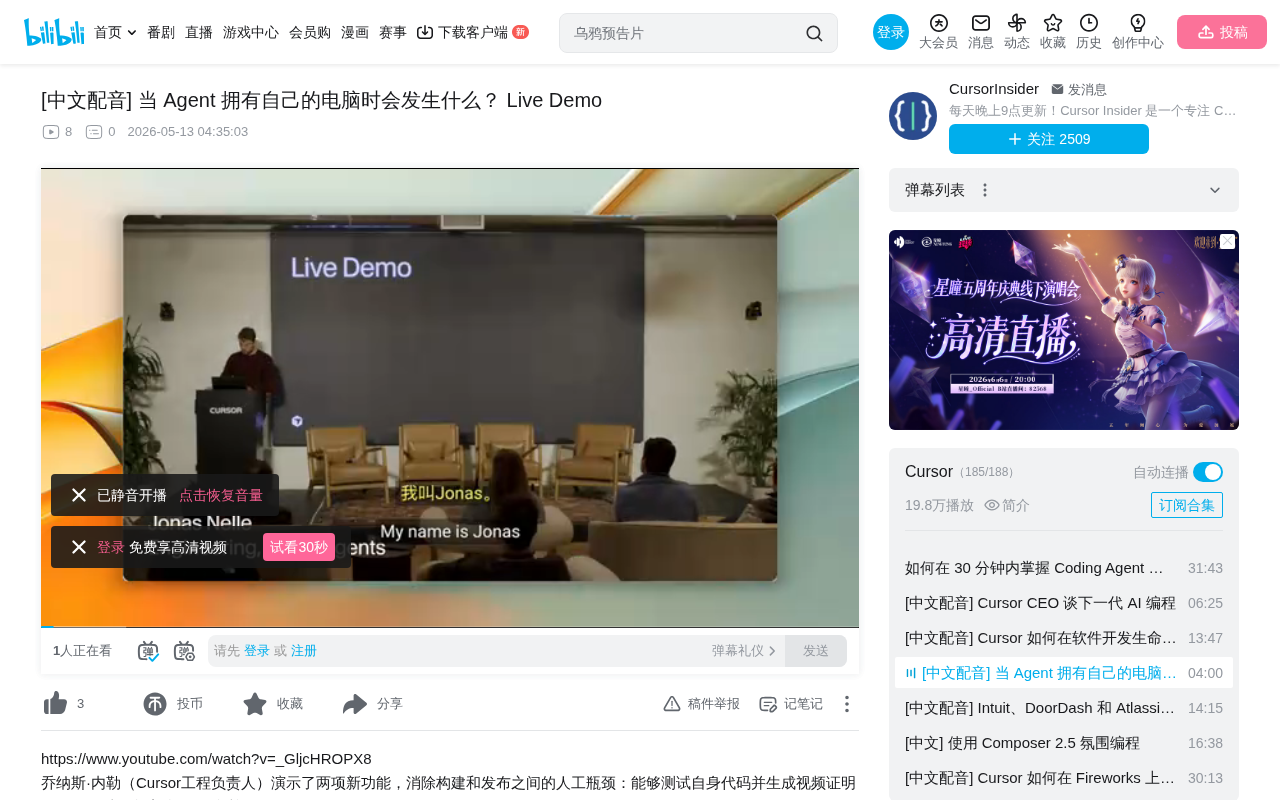
Cursor Cloud Agent Demo: Eliminating Bottlenecks Across the Entire Software Development Lifecycle
Deep analysis of Cursor's Cloud Agent demo showing how cloud VMs, automated test artifacts, and a full-chain control plane systematically eliminate human bottlenecks across the software development lifecycle.