2026 Nobel Prize in Chemistry: Cracking the Mystery of Molecular Chirality

2026 Nobel Chemistry Prize honors Kagan and Soai for groundbreaking chiral amplification and autocatalytic symmetry-breaking discoveries.
The 2026 Nobel Prize in Chemistry was awarded jointly to French chemist Henri Kagan and Japanese chemist Kenzo Soai for two landmark discoveries in asymmetric organic synthesis. Kagan overturned the linear assumption linking catalyst and product chiral purity, revealing positive nonlinear effects that let lower-purity catalysts yield higher-purity chiral products. Soai went further, building an asymmetric autocatalytic system where the product catalyzes its own formation, amplifying a chiral imbalance of just 0.00005% to over 99.5% ee — a 630,000-fold amplification — offering a plausible laboratory model for the spontaneous emergence of biological homochirality.
The Royal Swedish Academy of Sciences announced in Stockholm that the 2026 Nobel Prize in Chemistry has been awarded to French chemist Henri Kagan and Japanese chemist Kenzo Soai, recognizing their discovery of nonlinear effects and autocatalytic reactions in asymmetric organic synthesis. This fundamental research has not only deepened our understanding of molecular chirality, but also touches on a question that has puzzled scientists for a century: why did life choose only one mirror image?
What Is Chirality, and Why Does It Matter
Chirality is a foundational concept in organic chemistry. Many organic molecules resemble our hands — left and right hands are mirror images of each other, yet cannot be superimposed. These two mirror-image forms are called enantiomers.
Peter Somfai, a professor of organic chemistry and member of the Nobel Chemistry Committee, explained at the announcement that nearly all amino acids that make up living organisms are left-handed (L-form), while sugars are right-handed (D-form). Right-handed amino acids are almost entirely absent from nature. In other words, life as we know it is homochiral.
This single-handedness carries profound implications. Speaking via telephone connection, laureate Kenzo Soai emphasized: if amino acids were a random mixture of L- and D-forms, the correct enzymes and proteins could not form, and life would cease to function. Likewise, DNA requires D-type sugars to adopt its correct helical structure. The uniformity of chirality is a prerequisite for life to operate.
Chirality is especially critical in pharmaceuticals. Many active drug molecules are chiral — one mirror image may have the desired therapeutic effect, while the other may be completely inert or, in the worst case, harmful. Producing a specific enantiomer efficiently and selectively is therefore a practical challenge chemists must address.
The concept of chirality was first proposed by Louis Pasteur in 1848, when he manually sorted crystals of sodium ammonium tartrate and discovered two mirror-image forms. The standard metric for quantifying enantiomeric ratios is enantiomeric excess (ee%), calculated as the difference in mole fractions of the two enantiomers multiplied by 100%. An ee% of 0% indicates a racemic mixture with equal amounts of each enantiomer; ee% of 100% indicates absolute single chirality. Pharmaceutical manufacturing demands extremely stringent ee% values — new drug applications typically require chiral purity above 99%, which has directly driven advances in asymmetric synthesis. Thalidomide is a notorious example of a chiral drug tragedy: its R-enantiomer has antiemetic effects, while the S-enantiomer is strongly teratogenic, and the two interconvert in the body. This event profoundly changed global regulatory requirements for chiral purity in drug approvals.
Kagan's Breakthrough: Nonlinear Effects
For a long time, a prevailing "dogma" in organic chemistry held that in asymmetric catalysis, mixing catalyst ligands of different chirality should produce a linear relationship between the chirality ratio of the catalyst and the enantiomeric ratio of the product.
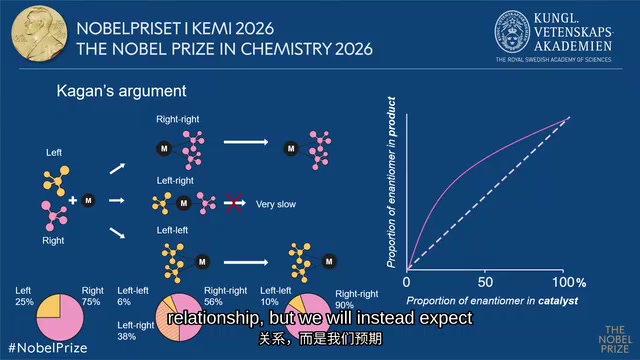
Henri Kagan challenged this assumption. He proposed that two or more chiral ligands could bind to a metal simultaneously to form a catalyst complex. Professor Somfai illustrated this with a concrete example: suppose a catalyst contains 75% left-handed and 25% right-handed ligands. Statistical combination would yield approximately 56% left-left complexes, 38% left-right complexes (effectively meso, catalytically neutral), and 6% right-right complexes.
If the left-right complex is far less reactive than the other two, the effective chiral purity of the catalyst participating in the reaction is amplified — the enantiomeric ratio of the product will be higher than that of the catalyst itself. This is what is known as the "positive nonlinear effect."

Kagan confirmed this model experimentally in a sulfide oxidation reaction. This not only enabled chemists to obtain higher-purity products from lower-purity catalysts, but more importantly, it provided a powerful analytical tool for studying asymmetric catalysis. Somfai noted that Kagan's findings, published in 1986, have since become part of every chemist's foundational knowledge.
Understanding Kagan's contribution requires some background on asymmetric catalysis. In asymmetric catalysis, chiral catalysts typically consist of a metal center coordinated with chiral ligands. The chiral environment created by the ligand induces the substrate to approach the metal from a specific direction, preferentially generating one enantiomeric product. Ideally, the chiral purity (ee%) of the catalyst and the product should have a 1:1 linear relationship — this is precisely the "linearity assumption" Kagan challenged. In his 1986 publication, Kagan systematically categorized experimental results into three types: positive nonlinear effects (product ee% exceeds catalyst ee%), linear effects, and negative nonlinear effects. Positive nonlinear effects have the most direct industrial value, as they mean catalysts need not be prepared at extremely high purity to yield high-purity products, substantially reducing production costs. This discovery also became a probe for investigating the structure of catalytic intermediates, helping chemists infer the coordination mode between metals and ligands.
Soai's Marvel: Creating Chirality from Nothing
If Kagan demonstrated that chirality could be "amplified," Kenzo Soai answered a more fundamental question: can single chirality be generated from scratch, starting from a point with no chirality at all?
Soai developed an asymmetric autocatalytic reaction — in which the product of the reaction itself serves as its own catalyst. He started from an achiral starting material, without adding any external chiral substance. The catalyst generated during the reaction initially consisted of an equal mixture of left- and right-handed forms, but with an exceedingly tiny imbalance. Yet the reaction's amplification power was so extraordinary that it could selectively amplify this minuscule deviation into a definitive preference for either the left-handed or right-handed product.
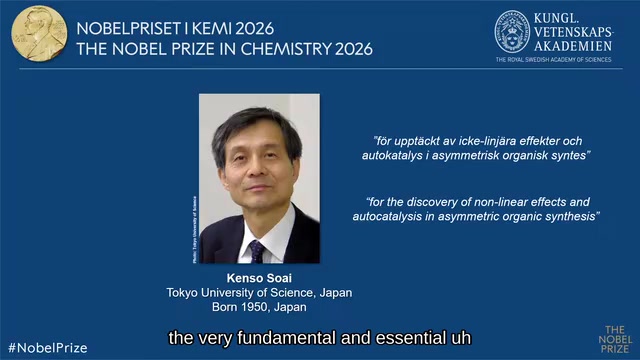
Soai conducted a large number of experiments: in about 37 trials, some yielded left-handed products and others right-handed products, but never an equal mixture. This is precisely spontaneous symmetry breaking of chirality. In subsequent experiments, he started with a catalyst having an enantiomeric excess of only 0.00005% — meaning 5,000,000 left-handed molecules versus 5,000,000 right-handed molecules, differing by only a few molecules — and after three successive reactions, the enantiomeric excess of the product rose to above 99.5%.
Professor Somfai could barely contain his excitement: "This is the coolest experiment in organic chemistry." The reaction, known as the Soai reaction (the reaction of pyridine-5-carbaldehyde with diisopropylzinc), achieves an amplification factor of up to 630,000-fold.
The chemical essence of the Soai reaction is an addition reaction between pyridinecarbaldehyde and diethylzinc (or diisopropylzinc), yielding a chiral secondary alcohol that can in turn catalyze the next round of the same reaction, forming an autocatalytic cycle. This mechanism — "product catalyzes its own formation" — is known as self-replicating catalysis and is exceedingly rare in chemistry. The key to its amplification lies in the dramatically different catalytic activities of homochiral dimers (e.g., L-L or D-D zinc complexes) versus heterochiral dimers (L-D type) — the former are far more active than the latter. This causes an initially tiny chiral imbalance to be exponentially amplified over multiple cycles. This mechanism is not only mathematically closely related to Kagan's nonlinear effects, but also provides chemists with a laboratory-operable model for studying the spontaneous emergence of homochirality under prebiotic chemistry conditions.
Does It Answer the Mystery of Life's Origin?
Soai candidly acknowledged in his phone connection that this work began in 1995. He believes it may offer some explanation for "why life is composed of essentially pure chiral organic compounds" — that is, the origin of homochirality.
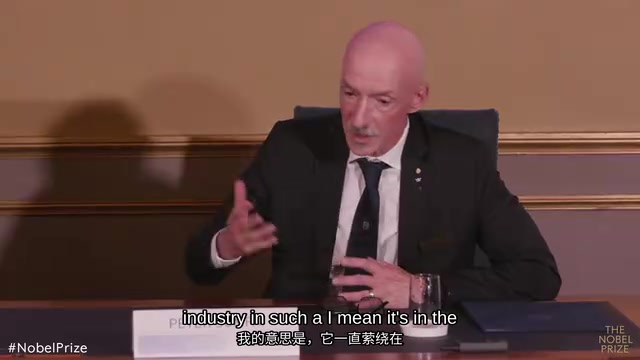
However, committee members carefully clarified this point in response to journalists' questions. How homochirality emerged four billion years ago is an extremely difficult and open question — "no one can know for certain." What the laureates have done is demonstrate, in a reaction vessel, how such a phenomenon could occur — they made it happen once and witnessed it firsthand.
"The Soai reaction is not itself the origin of chirality four billion years ago," Somfai stressed, "but we have, for the first time, reproduced it in the laboratory." This work has reinvigorated the field of life's origin research, making it a powerful research direction, with scientists using it to search for plausible models of how homochirality arose.
From Fundamental Research to Real-World Applications
On the practical value of these discoveries, Professor Somfai offered a two-part answer. The most important part is the contribution to our understanding of molecular chirality — this is fundamental research. Yet that foundational understanding is embedded in every development of asymmetric catalysis in industry.
"It runs in the background of our minds," he said. It is therefore difficult to point to any specific drug as being "made by this method." More accurately: the development of virtually every chiral drug uses these discoveries as tools for understanding and analyzing reactions. From designing chiral pharmaceuticals and using asymmetric sensors to asymmetric catalysis, the insights of both laureates serve as foundational tools.
Of the two laureates, Kagan was born in 1930 and is Professor Emeritus at Université Paris-Saclay (formerly Université Paris-Sud). Soai was born in 1950 in Hiroshima and is Professor Emeritus at Tokyo University of Science. When he received the call notifying him of the prize, Soai was shopping near his home. On the phone connection, he repeatedly expressed his joy: "I am very happy to share this prize with such a distinguished organic chemist as Professor Henri Kagan."
Related articles

M&M's Spent Millions Replacing Artificial Blue Dye — Why Is It So Hard?
Mars spent millions trying to replace artificial blue dye in M&M's with spirulina, but thick material clogs pipes and residue risks mold, forcing a full production-line rebuild. Here's the engineering behind the reformulation.
Teammate Wanted for Meta Global AI Developer Hackathon: Computer Vision & Medical AI
A Reddit developer seeks teammates for the Meta Global AI Developer Hackathon, focusing on computer vision and medical AI. This article analyzes the track logic, skills-complementarity needs, and topic selection strategy behind this teaming signal.
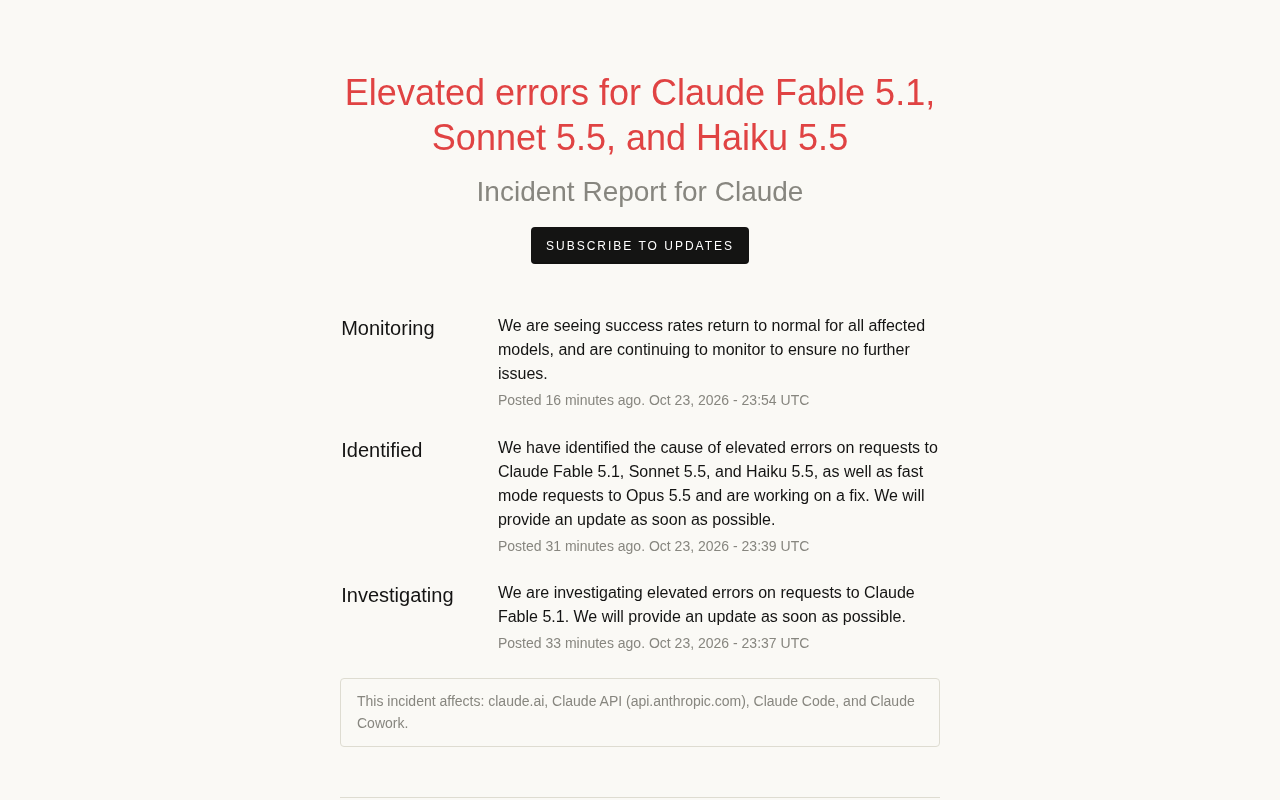
Multiple Claude Models Hit by Errors: A Postmortem of Fable 5.1, Sonnet 5.5, and Haiku 5.5
Claude Fable 5.1, Sonnet 5.5, Haiku 5.5, and Opus 5.5 fast mode saw elevated errors; Anthropic identified and resolved the issue in 17 minutes. This postmortem covers the timeline, the technical reasons for the multi-model cascading failure, and practical lessons for retry and degradation strategies.