M&M's Spent Millions Replacing Artificial Blue Dye — Why Is It So Hard?

Mars is swapping artificial blue dye for spirulina — the hard part isn't the color, it's rebuilding the production line.
Mars invested millions to make blue M&M's without artificial colors, choosing spirulina extract as its colorant, but the new formula still isn't in stores. The core obstacle is engineering: spirulina colorant is far thicker than artificial dyes, clogging pipes and leaving residue that creates mold risk, forcing Mars to replace equipment and redesign cleaning — essentially rebuilding the factory. Consumer demand and RFK Jr.'s criticism of artificial dyes drive the shift, though some claims are hard to substantiate. The report also notes that removing artificial colors doesn't make candy healthy, and that the real bottleneck in reformulation is the factory floor, not the lab.
The Engineering Challenge Behind a Single Blue M&M
Mars is trying to make equally vivid blue M&M's without using artificial colors. According to Wall Street Journal reporter Jesse Newman, who visited the factory in person, the effort has been underway for years and has cost millions of dollars. Yet the new natural blue formula has still not made it into M&M's bags sold in stores.
The problem isn't finding a blue — it's finding a blue that runs reliably on an industrial production line. Mars ultimately chose spirulina, a substance extracted from algae that has long been marketed as a high-protein "superfood." But once it's formulated into a color solution, the entire production process becomes troublesome.
The Production-Line Trouble with Spirulina Colorant
The chemical differences between natural and artificial colorants translate directly into challenges for production equipment. According to Newman's report, the spirulina mixture is far thicker than traditional artificial dyes, which means the factory must pump a much more viscous material through the entire piping system and out through extremely fine nozzles.

This thick material clogs pipes and leaves residue on equipment surfaces. The residue brings a mold risk — a hygiene issue that food factories must take seriously. As a result, Mars not only has to replace equipment but also redesign its cleaning procedures. In Newman's words, this amounts to renovating the entire factory: buying new equipment or retrofitting existing equipment.

The millions of dollars being spent aren't buying the color of a single candy — they're buying a complete rebuild of the production line around natural colorants.
The coloring substance in spirulina is phycocyanin, a water-soluble pigment protein that appears vivid blue under weakly acidic to neutral conditions but has poor stability — it fades or denatures easily when exposed to heat, strong acids, or light. Compared with synthetic blue dyes (such as Brilliant Blue FCF, or E133), phycocyanin has a lower color value and requires larger dosages, so when formulated into a color solution it has high solids content and high viscosity. Synthetic dyes are mostly high-purity small-molecule compounds; a small amount achieves the target color depth, and the solution behaves as a near-Newtonian fluid. Spirulina colorant suspensions, by contrast, often exhibit non-Newtonian behavior — viscosity changes with shear rate — which directly affects pump selection, nozzle atomization, and pipe pressure-drop calculations. In addition, natural colorants vary considerably in color from batch to batch, requiring stricter incoming inspection and finer formula adjustments — a hidden cost commonly incurred by food companies switching to natural colors.
Dual Pressure from Consumers and Regulators
Why would Mars bear these costs? The direct drivers come from both consumers and policymakers. The report notes that some consumers and U.S. Health and Human Services Secretary Robert F. Kennedy Jr. (RFK Jr.) strongly want artificial dyes removed from food. RFK Jr. has been harshly critical of ultra-processed foods, once saying that "the food our children are eating today isn't actually food — it's food-like substances."

Such statements are powerful in their reach, but the report also points out that their scientific basis is not easy to substantiate. Equating ultra-processed foods as a whole with "non-food" is a claim that is difficult to support with any single piece of evidence.
U.S. regulation of food colorants operates under two systems: "certified colors" and "colors exempt from certification." Synthetic colors such as Brilliant Blue, Tartrazine, and Sunset Yellow fall into the former and require FDA batch certification; spirulina extract from natural sources falls into the latter and is managed differently. In recent years, state-level school food dye bans — such as those in California — and the FDA's revocation of authorization for Red No. 3 (erythrosine) have formed the policy backdrop for companies reformulating their products. It's important to distinguish between "removing artificial colors" and "ultra-processed foods" as two different policy issues: the former has a clear additive list and regulatory pathway, while the latter (e.g., the NOVA classification) remains academically contested in terms of both definition and causal inference. RFK Jr.'s related remarks mostly fall into the latter category, and their evidentiary strength is weaker than that of regulatory actions targeting specific colorants — understanding this distinction helps gauge the real drivers behind corporate actions.
Removing Dye Doesn't Make It Healthy
One clear-eyed judgment in the report deserves to be singled out: using fewer natural colorants does not make candy healthy. Candy is still candy, and sugar is still sugar. M&M's with the blue dye swapped out show virtually no substantive change at the nutritional level.
This is a reminder for consumer perception. Natural colorants solve the problem of "a cleaner-looking ingredient list," not a nutritional problem. Public discussion around artificial colors easily slides into the simplified logic of "natural equals healthy," but the high-sugar nature of the candy category itself doesn't disappear just because the dye source changes.
The Cost of Reformulation in the Food Industry
The case of this single blue M&M shows that one adjustment to a food formula sets off a chain reaction across equipment, processes, cleaning protocols, and capital expenditure. Spirulina is nothing new as a colorant raw material; the hard part is making it work on a high-speed production line designed for artificial dyes.
This also explains why many brands, after announcing that they will "remove artificial colors," often see implementation progress lag behind public expectations. The bottleneck in reformulation is usually not in the lab but on the factory floor. When Mars's blue M&M's will actually make it into bags depends on when these engineering problems are solved one by one.
Food reformulation typically follows a path from lab to pilot to mass production: the lab stage verifies color, flavor, and stability; the pilot stage examines mixing, pumping, spraying, and drying behavior on small-scale equipment; only the mass-production stage exposes issues such as cleaning cycles, equipment wear, and batch consistency. Natural colorants tend to reveal their troubles in the later stages of this chain, because they are sensitive to temperature, pH, metal ions, and shear, and their processing window is far narrower than that of synthetic dyes. Moreover, switching colorants may also trigger label compliance reviews, accelerated shelf-life testing, and consumer sensory testing — soft costs that outsiders often underestimate. This is also the structural reason why the food industry's "clean label" movement advances slowly: one less word on the ingredient list means recalibrating the parameters of the entire production line.
One-line Summary
Mars is replacing artificial blue dye with spirulina — the hard part isn't the color, it's rebuilding the production line.
Paragraph Summary
To make blue M&M's without artificial colors, Mars invested millions of dollars and ultimately chose spirulina extract as its colorant source, but the new formula has yet to reach store shelves. The core obstacle is engineering: spirulina colorant solution is far thicker than artificial dyes, clogging pipes, leaving residue on equipment surfaces, and creating mold risk — forcing Mars to replace equipment and redesign cleaning procedures, essentially renovating the entire factory. Driving this shift are some consumers' demands and U.S. HHS Secretary RFK Jr.'s criticism of artificial dyes and ultra-processed foods, though some of his claims are hard to substantiate scientifically. The report also reminds us that removing artificial colors doesn't make candy healthy — its high-sugar nature is unchanged. The real bottleneck in food reformulation is the factory floor, not the lab, and the cost of equipment and process migration determines how fast it happens.
Related articles
Kyutai Releases CADRE: An Interactive World Model Video Autoencoder with Latency Cut to 230ms
Kyutai releases CADRE, an open family of 7 causal diffusion video autoencoders. CADRE-based world models run at 20 fps on a single H100 with under 230 ms reaction latency, offering a low-latency, reproducible open frontend for interactive world models.
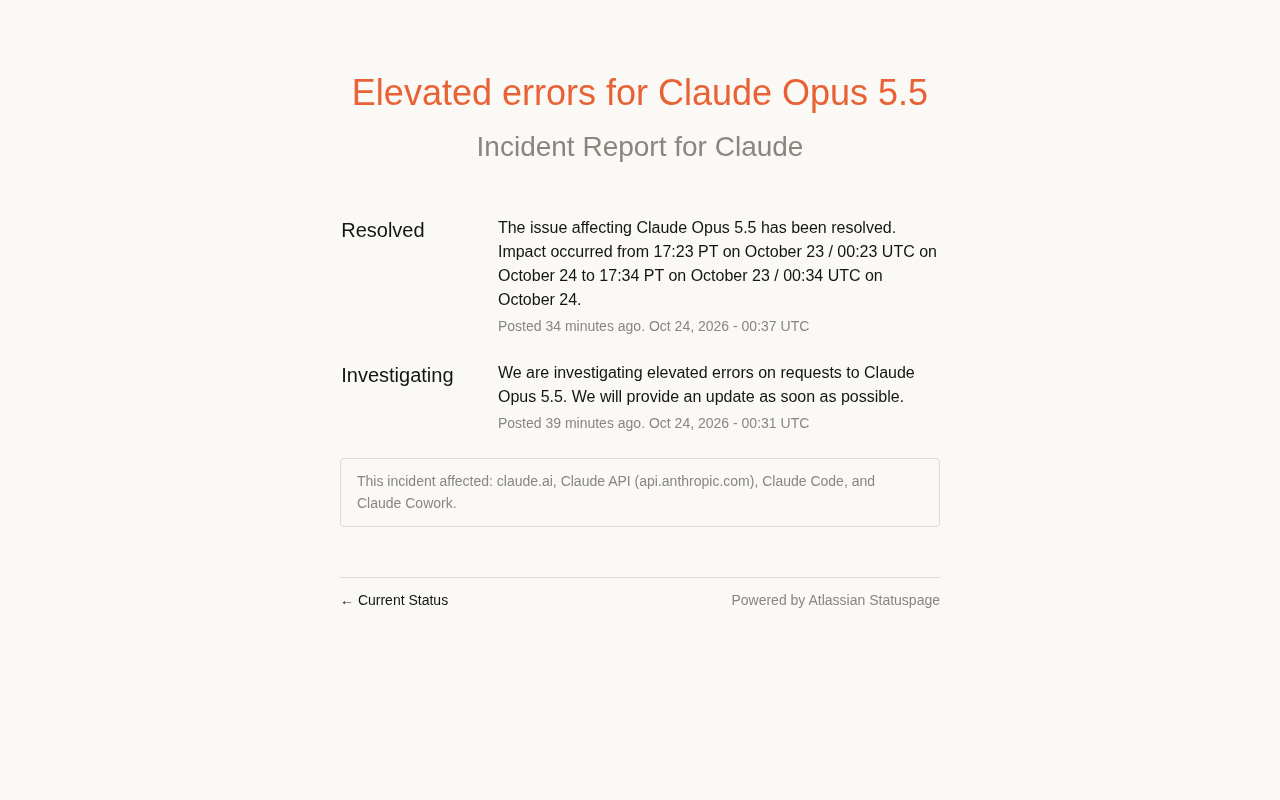
Claude Opus 5.5 Error Spike: Officially Resolved, an 11-Minute Incident Retrospective
Claude Opus 5.5 experienced elevated request error rates; the official status page shows the incident lasted about 11 minutes before being resolved. This article covers the event timeline, scope of impact, and offers developers retry, fallback, and multi-model redundancy recommendations for handling short model outages.
Teammate Wanted for Meta Global AI Developer Hackathon: Computer Vision & Medical AI
A Reddit developer seeks teammates for the Meta Global AI Developer Hackathon, focusing on computer vision and medical AI. This article analyzes the track logic, skills-complementarity needs, and topic selection strategy behind this teaming signal.