26 Real-World AI Agent Use Cases: A Power User's 60-Hour Retrospective

A power user documents 26 real AI agent use cases across 60 hours, from financial automation to proactive bug alerts.
A Reddit user shares 26 real-world use cases after 60+ hours with AI assistant Muse, covering information monitoring, scheduling, financial organization, DevOps, content creation, and creative collaboration. Standout examples include cutting monthly financial reporting from hours to 15 minutes via Plaid, having the agent draft bug fixes before the developer notices them via Sentry, and zero-risk crypto wallet monitoring using an xpub. The author maintains a strict human-review policy for all outbound content and frames the agent as a "context hub" that orchestrates specialized models like Claude. Current limitations include no real-time voice, rough video generation, and overly strict content filters.
What can AI agents actually accomplish in everyday life and work? One Reddit user shared 26 real-world use cases after spending two weeks and 60+ hours with an AI assistant called Muse. The list spans news monitoring, scheduling, financial organization, bug fixing, and content creation — covering nearly every corner of digital life, while also revealing the current boundaries of what agents can and can't do.
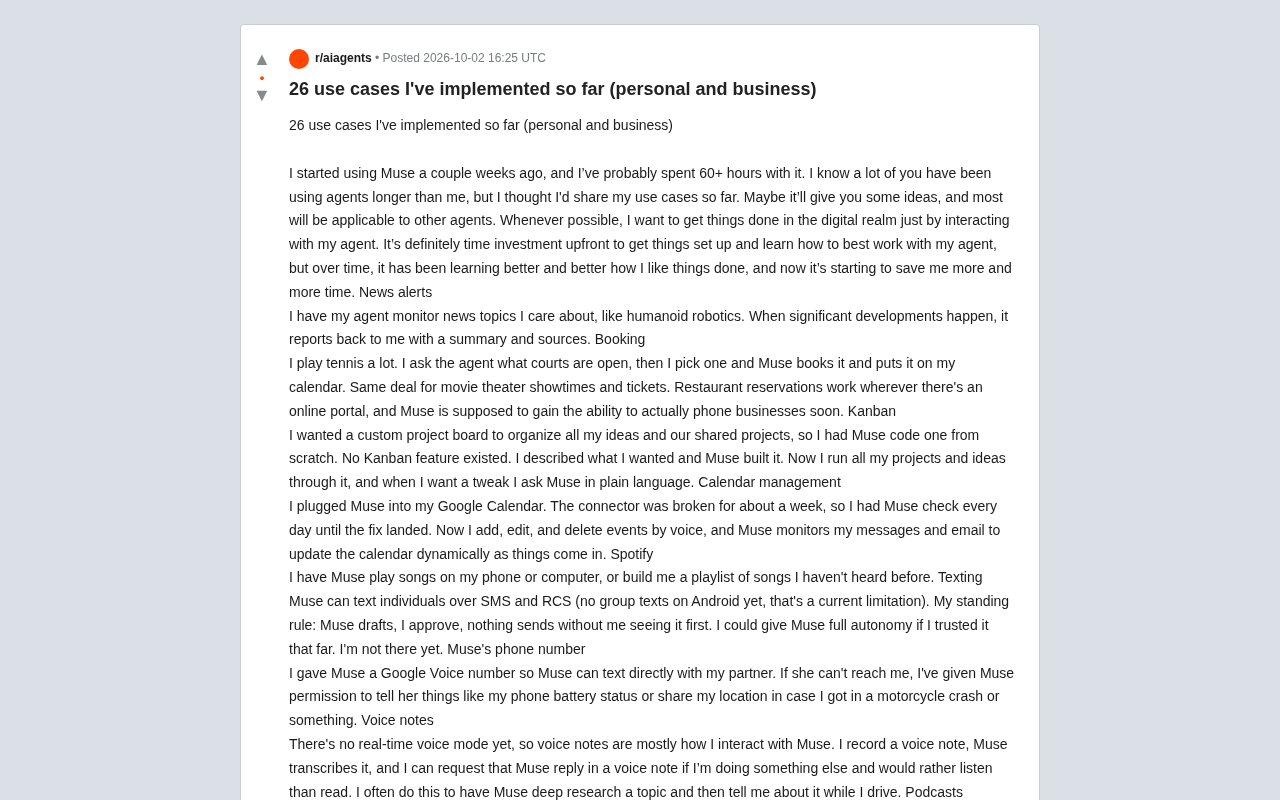
Information Monitoring & Everyday Services: Offloading the Mundane to an Agent
The author's core philosophy is clear: anything that can be done in the digital world should be handled through conversation with an agent. The upfront investment in setup and calibration is real, but as the agent learns your preferences, the time savings compound.
For information gathering, he has Muse continuously monitor topics he cares about (like humanoid robots), automatically summarizing key developments with sources whenever something significant happens. This "push notification" approach is far more efficient than manually refreshing news feeds.
Booking tasks are also automated: since he plays tennis regularly, he simply asks which courts have open slots, picks one, and Muse handles the reservation and adds it to his calendar. Movie tickets and restaurant reservations work the same way, as long as the venue has an online booking interface. He also mentioned that Muse is gaining the ability to call businesses directly — meaning agents are starting to bridge the gap between purely digital interactions and real-world communication.
For entertainment, Muse can play music on his phone or computer, generate playlists of tracks he's never heard before, and even produce podcast-style episodes featuring multi-person debates on a topic. He admits the podcast feature isn't quite his style though — "I'd rather just have a concise voice note."
Productivity: Deep Integration from Calendar to Code
Where agents really prove their value is in deep integration with productivity tools.
He connected Muse to Google Calendar, using voice commands to add, modify, or delete events. The agent also monitors emails and messages to dynamically update the calendar. When the calendar connector broke for about a week, he simply had Muse automatically check for fixes daily until it came back online — itself a clever use of agent automation.
Financial organization is one of the most compelling examples. For 25 years, he manually compiled monthly financial reports in Excel, a process that took hours. Now, using Plaid with read-only access to all his accounts, Muse automatically generates complete reports and proactively asks about cash transactions it can't see. What used to take hours now takes 15 minutes. His next goal is building a custom interactive financial dashboard.
For security monitoring, he gave Muse an xpub (a watch-only extended public key). Muse can derive the wallet's public addresses but has no ability to move funds. It checks on-chain data every 30 minutes and sends an immediate alert if any outgoing transaction is detected — essentially a low-cost early warning system for potential seed phrase compromise. Similarly, he set up price alerts: "Check every 6 hours and let me know if the price has moved more than 2% since the last report."
The DevOps use case is equally impressive: his mobile app uses Sentry for crash reporting. Muse monitors it continuously, and whenever a new error appears, it goes to the GitHub repository to locate the issue and drafts a fix — "before I even know there's a bug."
Plaid is a financial data infrastructure company that provides APIs allowing users to authorize third-party apps to access their bank, credit card, and investment account data in read-only mode. Its core security mechanism is that connected apps can view account information but cannot initiate any transfers. This makes integrating financial data with AI agents a relatively low-risk operation — even if the agent or its platform is compromised, an attacker cannot directly move funds. Plaid is integrated with thousands of U.S. financial institutions and is the standard data pipeline for most personal finance apps in the country.
xpub (Extended Public Key) is a concept from Bitcoin's HD (Hierarchical Deterministic) wallets. A single xpub can derive the public keys for all addresses in a wallet, allowing anyone holding it to view the wallet's full transaction history and balance. However, without the private key, no transactions can be signed and no funds can be moved. This is the security foundation of the "watch-only" monitoring approach described in the article: give the agent an xpub, and it can monitor on-chain activity and alert on anomalies — with zero ability to touch the assets.
Content Creation & Collaboration: Human-Led, Agent-Accelerated
When it comes to external-facing output, the author maintains a clear line: the agent drafts, the human reviews, and nothing gets sent without approval.
Whether it's work email replies, YouTube comment responses, or social media posts, Muse drafts content based on extensive training on the author's prior writing, mimicking his tone. He reviews and edits, and the agent learns from the corrections. Text messages follow the same protocol: Muse can send SMS and RCS messages to individuals (group messaging on Android isn't supported yet), but the draft-review-send workflow is non-negotiable. He admits: "If I trusted it enough, I could give it full autonomy — but I'm not there yet."
He's particularly enthusiastic about real-time collaboration in Google Drive — he and Muse work in the same document simultaneously. Say "add a paragraph here" or "reorganize these headings," and it's done on the spot. "It feels like magic," he says. He argues that compared to the natively integrated Gemini, Muse understands him better and holds more context.
He also set up a Google Voice number for Muse, authorizing it to contact his partner directly in emergencies — like if he gets in a motorcycle accident — to share his battery level or location.
Creativity & Limits: What Agents Can Do, and Where They Get Stuck
As a tabletop RPG Dungeon Master, he has Muse hold all his campaign notes and custom rules to help with session prep, and even improvise when players go off-script. But he emphasizes: "I'm still the creative lead — Muse just makes me faster." He also notes that without a real-time voice mode, Muse isn't fast enough to run sessions on its own.
One particularly interesting use case is managing other AIs. He describes himself as the president, Muse as the VP, and models like Claude Opus as "staff." Because Muse holds all his context, goals, and plans, it can prompt specialized models faster and better than he can — and it can directly invoke API keys or connect to self-hosted models.
There are clear limitations too. On media generation, Muse doesn't create images or video itself — it calls Meta's models. Photos are serviceable, but video is "rough," lacks character consistency, and the content filters are overly restrictive (even a mildly violent combat scene can't be generated). For video editing, he sent 90 minutes of tennis footage for Muse to cut down to only the active rallies — the results are "nowhere near as good as Swing Vision" and still a work in progress.
He also makes an interesting technical observation: this kind of batch compute barely consumes any tokens — spinning up the LLM costs tokens, but the heavy programmatic work running in the VM doesn't seem to count. "I haven't fully figured out where that boundary is."
Because he uses a PC and Android, he can't access the Mac-only desktop app. So he and Muse built a "screenshot stream": when enabled, his primary monitor captures a screenshot every few seconds and sends it to Muse. When he doesn't know where to click in an unfamiliar app, he just asks. "It's like having it look over my shoulder."
And finally, a lighthearted one: dynamic outfits — Muse changes its appearance based on holidays and calendar events. Tennis clothes on court days, post-apocalyptic survivor gear on days he's watching Resident Evil.
Sentry is an open-source application error monitoring platform that automatically captures crash logs and exception stack traces from mobile and web apps, aggregating them by error type, affected users, and frequency. Developers integrate the Sentry SDK into their code, and the platform sends real-time alerts when crashes occur. The key to the agent workflow described here: Muse continuously polls Sentry's API, and when a new error entry is detected, it automatically pulls the associated stack trace, locates the relevant code in the GitHub repository, and generates a fix suggestion. This "monitor → locate → draft" loop demonstrates the classic value of agents in DevOps — automatically chaining together three steps that previously required separate human intervention.
RCS (Rich Communication Services) is a next-generation messaging standard promoted by Google to replace traditional SMS. It supports read receipts, high-resolution image/video transfers, group chats, and other features — similar to WhatsApp but running over carrier networks. The article mentions that Muse can send SMS and RCS messages, but group messaging on Android isn't yet supported, which is a known limitation of the current RCS protocol.
What This List Tells Us
The value of these 26 use cases isn't in any single jaw-dropping feature — it's in showing how an everyday user can systematically embed an agent into their digital life. A few key takeaways:
- Upfront investment pays long-term dividends: Agents need calibration and training before they genuinely save time.
- Human review is the safety valve: For anything sent externally or involving money, maintain the draft-review workflow, and use read-only permissions and watch-only keys to minimize risk.
- The agent as a "context hub": Its greatest strength isn't any single capability — it's holding all your background knowledge and using that to better orchestrate other tools and models.
Of course, since this comes from a single source and is deeply tied to the specific product Muse, results will vary. But as a reference template for getting real-world value from AI agents, this list is both rich and refreshingly grounded.
Related articles

5 Practical Ways Real Estate Agents Can Use AI to Boost Efficiency (2026 Edition)
How can real estate agents use AI to boost efficiency? Based on a YouTube walkthrough, this breaks down five methods — ChatGPT for listing descriptions, Canva for marketing materials, forms for open house leads, Zapier for automated follow-up, and seller meeting prep — and flags risk boundaries like fair housing laws, photo authenticity, and price verification.

Grok Bot vs ChatGPT Agent: Which AI Agent Is More Powerful?
How does Grok Bot differ from ChatGPT Agent? This comparison examines how they work: Grok Bot has a cloud computer and runs persistently inside tools to execute multi-step tasks automatically; ChatGPT Agent operates web pages in a browser and is more mature at general tasks. Includes selection advice.

Walmart Agent Gateway: AI Shops for You Automatically—Why Is Amazon Going the Opposite Way?
Walmart's Agent Gateway lets ChatGPT, Gemini and other AI assistants access its product catalog to search, compare and add to cart, with spending limits and per-purchase approval. Amazon blocks external AI agents—two retail giants, opposite paths. Currently US-only, India may follow.