3-Stage Fast Track to Agent Development: From Prompting Models to Building Real Projects
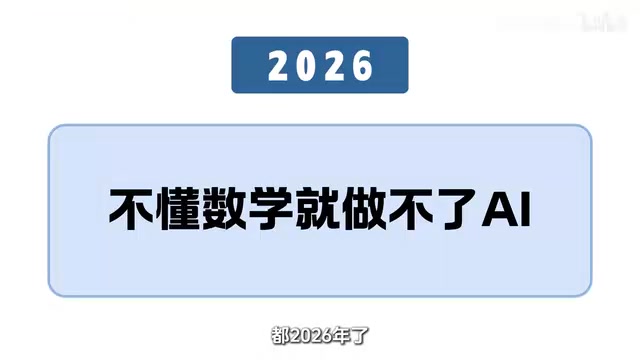
A 3-stage engineering-first roadmap to Agent development for developers who want to skip the math and ship fast.
This article outlines a pragmatic Agent development learning path aimed at application developers, arguing that building Agents is an engineering orchestration challenge — not a math research problem. The three stages progress from mastering ReAct loops, Tool Calling, and MCP protocol, to building engineering infrastructure with LangChain, LangGraph, memory mechanisms, and RAG, and finally completing real-world projects like medical consultation or customer service Agents with fine-tuning and private deployment. The article also cautions that demo-to-production is a massive gap, and "seven weeks to expert" is best treated as a structured entry map rather than a promise.
Many people who want to get into Agent development fall into the same trap at step one: courses that start with machine learning fundamentals — piling on math formulas and probability theory as if you need a graduate degree before you're allowed to touch AI. This curated learning path from Bilibili offers a completely different answer: Agent development is fundamentally an engineering problem, not a math problem. It breaks the entire learning journey into three progressive stages, emphasizing getting things working quickly with an engineering mindset rather than grinding through low-level theory.
Below is a breakdown of this three-stage path, drawing from the original tutorial content, with some practical commentary added along the way.
Stop Starting with Math Formulas
The tutorial opens with a somewhat counterintuitive position: delete all those patchwork online courses that start from machine learning fundamentals. The reason is straightforward — your goal is to build Agents, not conduct academic research. The idea that "you can't do AI without understanding the math" simply doesn't hold up at the application development level.
This stance has merit. Modern Agent development is closer to "orchestration" and "scheduling": you call existing LLM APIs, design tool chains, and manage state and memory. The core skill set here is engineering organization, not deriving backpropagation from scratch. For developers with a backend background, the transition cost is far lower than expected. That said, this doesn't mean math has no value — if you later get into fine-tuning or deep optimization, foundational theory is a genuine asset. It just shouldn't be the barrier to entry.
Stage 1: Understand the Core Mechanics of Agents
You don't need to start by studying how LLMs work under the hood, but you do need to get clear on one key distinction: what actually separates an Agent from a plain LLM call?
The tutorial identifies three "mission-critical" concepts: ReAct loops, Tool Calling, and Function Calls. These three form the core mechanism that distinguishes Agents from simple conversational interactions.
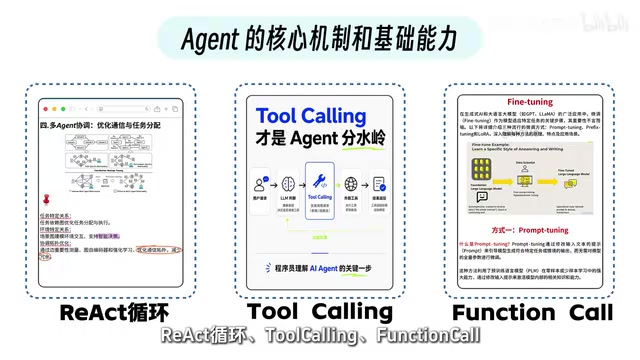
Here's an analogy: in traditional backend development, you define API routes and hard-code which endpoint handles which request. In Agent development, you hand that decision-making to the model — letting it determine which tool to call and what parameters to pass. This is the mental shift from "developer writes fixed logic" to "model makes autonomous decisions."
Building on that, the tutorial adds MCP protocol and prompt engineering. The former standardizes how tools and models interact; the latter determines whether the model accurately understands intent. The goal of this stage can be summed up in one sentence: upgrade from "calling a model" to "having the model call its own tools." Once you've got this layer down, you've genuinely crossed the threshold into Agent development.
ReAct loops (Reasoning + Acting) are the basic rhythm of how Agents operate: the model outputs a "Thought," decides on an "Action" based on that reasoning, receives an "Observation" back from the environment, then loops into the next round of thinking — repeating until the task is complete. This paradigm was introduced in a 2022 Google paper of the same name. It enables models to go beyond simple Q&A and dynamically revise their plans across multi-step reasoning. Tool Calling / Function Calls are the execution handles for the ReAct loop: the model "declares" which tool to call and what parameters to pass in structured JSON format, while the host program handles actual execution and feeds the result back into the context. Understanding this "declare → execute → return" three-step flow is the prerequisite for reading any Agent framework code. MCP (Model Context Protocol) is an open protocol released by Anthropic in late 2024, designed to standardize the interface between tools and models — think of it like USB for hardware peripherals. It lets the same tool plugin work across different models and frameworks without custom integration for each system.
Stage 2: Frameworks and Engineering Infrastructure
With the fundamentals in place, Stage 2 moves into the main arena — Agent frameworks and engineering infrastructure.
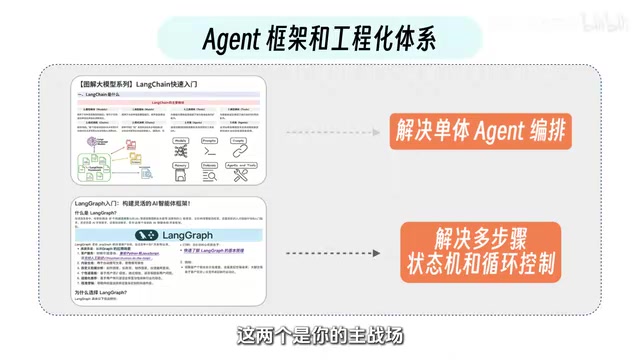
The tutorial calls out two core tools: LangChain for orchestrating single Agents, and LangGraph for managing multi-step state machines and loop control. Their responsibilities are well-defined: LangChain answers "how does one Agent organize its workflow," while LangGraph answers "how do multiple steps manage state and handle loops." For developers with microservices or state machine experience, this engineering mindset transfers almost seamlessly.
Beyond frameworks, memory mechanisms are what evolve an Agent from a "one-off conversation" into something with continuity. The tutorial breaks this into two layers: short-term context management, and long-term memory persistence via vector databases for experience recall. Add RAG (Retrieval-Augmented Generation) for knowledge injection, and the Agent genuinely has both "memory" and "knowledge."
The target output for this stage: a working multi-step reasoning Agent demo. But the tutorial is refreshingly blunt — getting from a demo to a production environment is "a world away." This directly addresses a common misconception: a working demo and a shippable system are completely different things.
RAG (Retrieval-Augmented Generation) works by not stuffing all knowledge into the prompt upfront, but instead retrieving on demand at runtime. The process: documents are chunked and encoded into vectors stored in a vector database (e.g., Chroma, Pinecone, Weaviate); at conversation time, the user's query is also vectorized, the most semantically similar chunks are retrieved, and they're injected into the prompt before sending to the model. This sidesteps context window length limits while giving Agents on-demand access to up-to-date private knowledge bases — no model retraining required. Vector database selection and chunking strategy (chunk size, overlap) significantly impact retrieval quality and are the two parameters most worth tuning in RAG engineering. LangChain includes a complete RAG pipeline abstraction for rapid prototyping, but production environments typically require custom adaptation to specific data structures.
Stage 3: Real Projects and Private Deployment
Stage 3 goes straight into hands-on project work, layering in fine-tuning and private deployment as advanced directions. This is the dividing line between "knowing how to use it" and "being able to ship it."
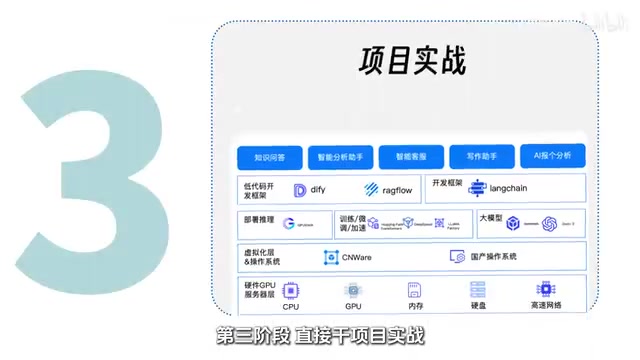
The tutorial recommends several real-world scenarios as practice targets: a medical consultation Agent, an intelligent customer service platform, a stock analysis assistant, and a digital human interaction system. What these have in common is that they all involve complete end-to-end pipelines and map closely to real business needs — the kind of projects you can actually talk through in an interview and put on a résumé.
One line from the tutorial is worth keeping: others see magic, you see engineering. This perfectly echoes the core philosophy of the entire path — Agent development isn't sorcery, it's a set of engineering practices that can be broken down and reproduced. Choosing projects with complete business pipelines builds far more genuine capability than stacking isolated features, and carries much more weight in hiring conversations.
Is This Path Worth Following?
Overall, the value of this "three-stage" path lies in its pragmatism: it skips the academic prerequisites, zeroes in on the core engineering skills for Agent development, and offers a clear, goal-oriented structure. For people with a programming background who want to transition quickly, it genuinely cuts out unnecessary detours.
That said, take the "seven weeks from zero to expert" marketing with a grain of salt. Completing the full path in seven weeks is achievable, but actually reaching "expert" level — especially for production-grade deployment and complex scenario optimization — requires extensive project experience beyond what any structured curriculum can provide. Think of it as a high-efficiency entry map: it tells you what to learn and in what order, but real mastery still has to be earned through hands-on struggle.
If you're getting ready to enter Agent development, here's the three-step sequence: first, deeply understand ReAct loops and tool-calling mechanics; next, build out the engineering layer with LangChain and LangGraph; finally, wrap up with a complete end-to-end project. Get the direction right, and the efficiency follows naturally.
Related articles
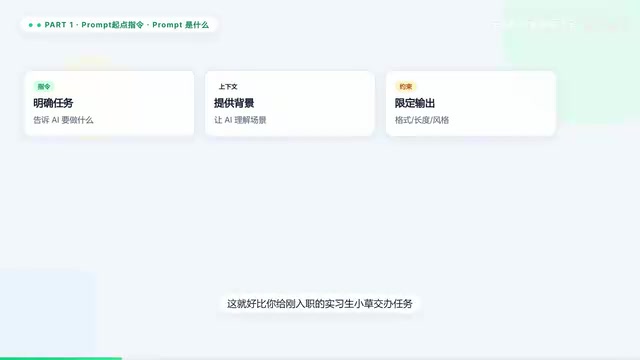
Prompt → MCP → Agent → Skill: The AI Terminology Evolution Chain Explained in 5 Minutes
A clear guide to five core AI concepts — Prompt, MCP, Agent, Skill, and Cowork — and how they connect in a layered evolution chain from simple instructions to multi-agent teamwork.
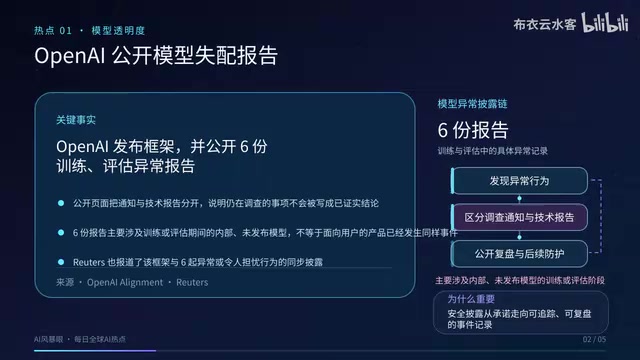
OpenAI Discloses Model Anomalies, DeepMind Launches AGI Forum, NVIDIA Partners on Grid Power Management
Sept 17 AI roundup: OpenAI publishes model anomaly disclosure framework with 6 reports, Google DeepMind launches AGI public forum, NVIDIA leads AI energy management alliance with 18 partners.
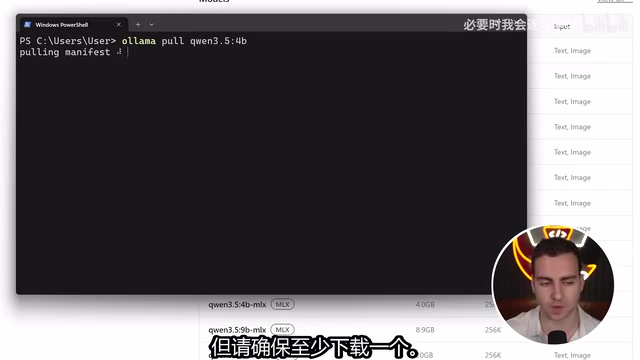
Build a Local AI Agent with Python in 10 Minutes: Ollama + PydanticAI in Action
A hands-on guide to building a fully local AI agent with Python, Ollama, and PydanticAI in 10 minutes — covering model selection, tool functions, and conversation loops.