3D Movies Are Making a Comeback: Mature Technology Finally Makes Home Viewing Worth It
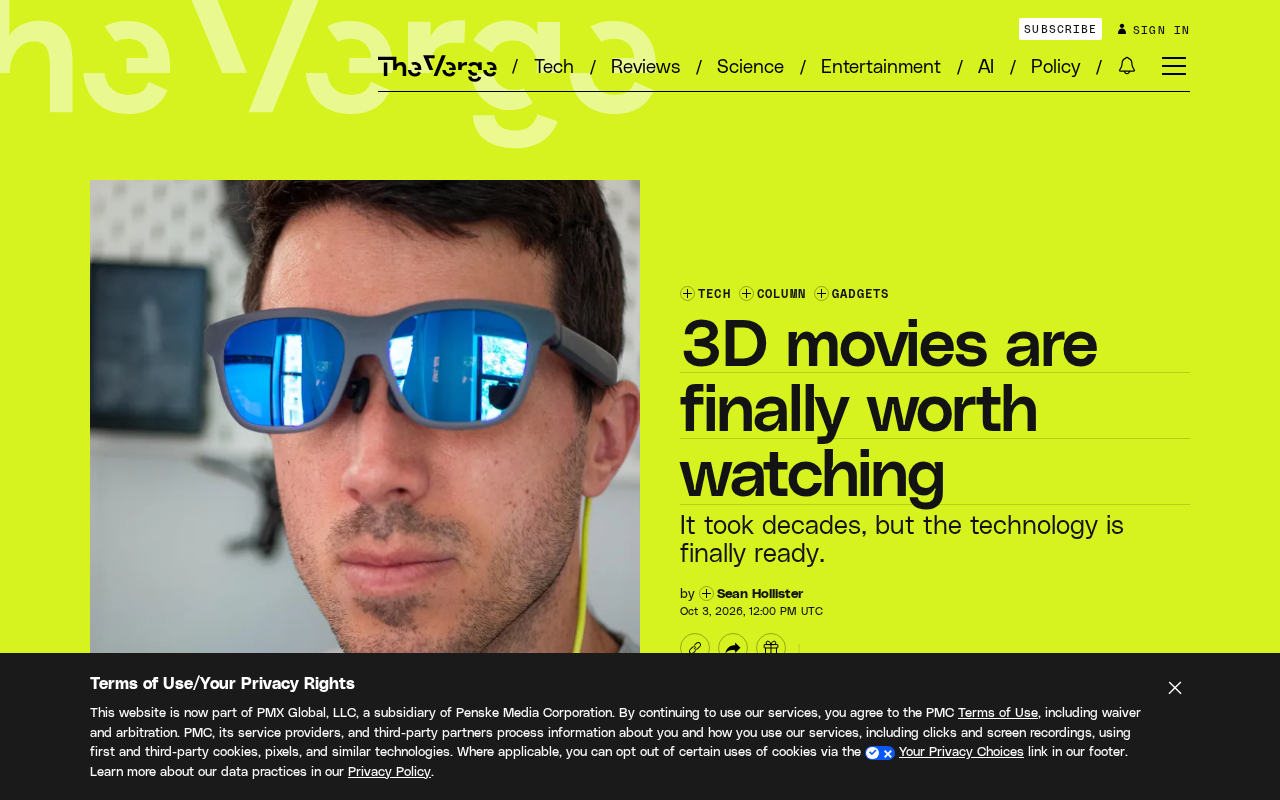
Mature display technology is finally delivering on 3D's original promise, reviving interest in 3D Blu-ray collecting.
3D home video once flopped due to dim images, bulky glasses, and scarce content. But over a decade of advances in high-brightness panels, precise frame sync, and content mastering have finally closed the hardware gap. Meanwhile, the market's collective retreat created a collector's window — 3D Blu-ray discs now circulate at accessible prices, offering enthusiasts the highest-quality format for preserving and revisiting classic films. The rise and fall of 3D is ultimately a story of a sound idea pushed to market before the ecosystem was ready.
From Tech Gimmick to Quiet Revival
For years, 3D was considered one of the biggest tech flops in history. It has been over fifteen years since James Cameron's Avatar wowed audiences on the big screen and went on to claim the top spot at the global box office. During that era, 3D televisions, 3D cinemas, and active shutter glasses flooded the market — yet the hype faded even faster than it had arrived. Dim images, bulky glasses, scarce content, and persistent eye strain quickly wore out consumer patience, and 3D became synonymous with empty marketing hype.
Today, however, something is quietly shifting. Some home theater enthusiasts have begun snapping up every 3D Blu-ray disc they can find — not out of nostalgia, but because of genuine technological maturation. After more than a decade of development, the display and playback technologies that underpin the 3D experience have finally caught up with the ambitions that the concept always carried.
Why the Technology Is "Finally" Ready
The core pain points of early 3D experiences came down to a few key issues: insufficient brightness that made images look murky, crosstalk between left and right eye channels that caused ghosting, and eye fatigue from extended viewing. Most of these problems stemmed from the hardware limitations of displays at the time — not from any fundamental flaw in the concept of 3D itself.
As display technology has evolved, high-brightness panels, more precise refresh and sync mechanisms, and more sophisticated content mastering have made it possible to present 3D imagery in a way that closely reflects the creator's original intent. In other words, the sense of immersion that Avatar delivered in theaters is now something that can be faithfully reproduced at home — and that is precisely what makes collecting 3D Blu-rays meaningful again.
Active Shutter Glasses were the dominant solution for early consumer 3D: the glasses contain liquid crystal lenses that alternate between blocking the left and right eye in sync with the TV signal at 120Hz or higher, creating stereoscopic depth. This mechanism demands extremely high peak brightness from the display — the lenses themselves block roughly 60% of incoming light, and if the panel isn't bright enough, the image looks dim and flat. The peak brightness of mainstream LCD televisions in the 2010s generally fell in the 300–500 nit range, far too low to compensate for that loss. Modern high-end displays — particularly those using Mini-LED backlighting or OLED panels — can reach peak brightness of 1,000 nits or more, which fundamentally solves the brightness problem. At the same time, the widespread adoption of HDMI 2.0/2.1 has dramatically improved frame sync precision between playback devices and displays, significantly reducing crosstalk (the leakage of left-eye and right-eye images into each other that produces ghosting).
The Rediscovered Value of the 3D Blu-ray Collection
There is a noteworthy phenomenon at play: precisely because 3D once "failed," the supply and pricing of 3D Blu-ray discs has entered a collector-friendly zone. When the mainstream market walked away, these physical media became a treasure trove for a dedicated community of film enthusiasts.
For those with the right playback setup, acquiring 3D Blu-rays now is both a way to preserve immersive versions of classic films and the best way to experience them again once the technology has matured. This "contrarian collecting" behavior essentially reflects a pattern common in consumer electronics — technologies pushed to market too early often only reveal their true value once the surrounding ecosystem catches up.
Full HD 3D Blu-ray uses a "Frame Packing" format that stores complete 1080p images for both the left and right eyes stacked vertically on a single disc. Compared to the polarized beam-splitting methods commonly used in theatrical projection, the physical medium retains 100% of vertical resolution, making it theoretically the most complete 3D content carrier available for home use. 3D content on streaming platforms is extremely rare, and what does exist is typically encoded in the more aggressively compressed "Side-by-Side" or "Top-and-Bottom" formats due to bandwidth constraints, cutting horizontal or vertical resolution in half. This means physical 3D Blu-ray discs will remain an irreplaceable source of high-quality 3D content for the foreseeable future — and that is the fundamental reason collectors are willing to stockpile them during a market lull.
A Long-Overdue Technical Payoff
The story of 3D offers a textbook case study in technology timing. A concept ahead of its time, held back by hardware that hadn't caught up — this is the root cause of many tech product failures. 3D wasn't a bad idea; it was simply over-promoted at the wrong moment, burdened with expectations that exceeded what the technology of the day could deliver.
Fifteen years later, now that display technology, content processing, and playback hardware have collectively reached the standard they always needed to reach, 3D movies have finally arrived at a moment that is genuinely worth watching. For enthusiasts who have followed this space for years, this represents not just a personal upgrade in the home viewing experience, but a belated vindication for a technology that was too hastily written off.
It should be noted that this article was written based on limited source material; details regarding specific technical specifications, device models, and the content ecosystem would benefit from more comprehensive reference sources.
Also worth mentioning is another force currently driving renewed interest in 3D: home projectors. Consumer laser projectors now achieve peak brightness of over 3,000 lumens, and DLP chips with high-speed color wheels can maintain stable active shutter 3D synchronization. Some enthusiasts are pairing ultra-short-throw laser projectors with 120-inch-or-larger high-gain screens to recreate a cinematic 3D experience that comes remarkably close to a commercial theater — a far cry from the low-brightness LCD projector home theater setups of a decade ago. Multiple simultaneous breakthroughs — brighter light sources, faster sync, more accurate color processing — have combined to drive this revival, rather than any single advancement working alone.
Related articles

M&M's Spent Millions Replacing Artificial Blue Dye — Why Is It So Hard?
Mars spent millions trying to replace artificial blue dye in M&M's with spirulina, but thick material clogs pipes and residue risks mold, forcing a full production-line rebuild. Here's the engineering behind the reformulation.

Teammate Wanted for Meta Global AI Developer Hackathon: Computer Vision & Medical AI
A Reddit developer seeks teammates for the Meta Global AI Developer Hackathon, focusing on computer vision and medical AI. This article analyzes the track logic, skills-complementarity needs, and topic selection strategy behind this teaming signal.

Multiple Claude Models Hit by Errors: A Postmortem of Fable 5.1, Sonnet 5.5, and Haiku 5.5
Claude Fable 5.1, Sonnet 5.5, Haiku 5.5, and Opus 5.5 fast mode saw elevated errors; Anthropic identified and resolved the issue in 17 minutes. This postmortem covers the timeline, the technical reasons for the multi-model cascading failure, and practical lessons for retry and degradation strategies.