4 Low-Cost Ways to Use ChatGPT in China: A Hands-On Comparison

Four practical low-cost methods for accessing ChatGPT from China, tested and compared.
This article compares four affordable ways to use ChatGPT in China: subscribing via WeChat through proxy platforms, leveraging GitHub Copilot's free credits, using API relay services for pay-as-you-go access, and substituting domestic models like Kimi K3 and DeepSeek V4 Flash for coding tasks. Each method is evaluated for cost, experience quality, and suitable use cases.
For users in China, ChatGPT's powerful capabilities need no introduction. But what actually stops most people isn't "knowing how to use it" — it's the practical hurdles of "how to subscribe" and "how to pay." Based on a video by Bilibili creator "AI航海员" (AI Navigator), this article systematically breaks down four low-cost or even free paths to using ChatGPT from within China, covering scenarios ranging from heavy programming use to lightweight writing tasks.
ChatGPT Plans: How to Choose Between Plus and Pro
Before discussing how to subscribe, it's worth clarifying ChatGPT's two main subscription tiers and their pricing logic.
ChatGPT Plus costs $20/month, roughly 130 RMB. For users writing papers, coding, or running small tasks with Codex, this plan already covers the vast majority of use cases and offers the best value for money.
ChatGPT Pro costs $200/month, approximately 1,300 RMB. While the price is steep, it's remarkably generous for programmers — according to one overseas blogger's testing, a Pro account can burn through roughly 33,000 RMB worth of Token allowance per month. Here's a quick explanation of Tokens: a Token is the basic unit large language models use to measure text volume, with one Token corresponding to approximately 4 English characters or 1-2 Chinese characters. Every interaction with ChatGPT — both your input prompts and the model's output responses — consumes Tokens. A 33,000 RMB Token allowance means users can perform extremely intensive programming assistance work, including large-scale code generation, long document analysis, and other high-Token-consumption tasks. However, it's important to note that this allowance is dynamic and fluctuates with actual server load — OpenAI employs an elastic rate-limiting strategy based on server load, meaning when global concurrent users spike, individual user resource allocation contracts accordingly.
Once you understand the plan differences, there's only one core question remaining: payment. And this is precisely where the biggest information gap exists for users in China.
Method 1: Subscribe to ChatGPT's Official Account Directly via WeChat
Subscribing directly to the official account remains the undisputed best option. The reason is simple: official plan quotas are frequently refreshed and reset, making subscription plans far more cost-effective than burning through API credits in the long run. Additionally, the native app delivers the best experience whether you're generating images, writing, or coding.

What many people don't know is that you can actually complete the subscription using WeChat from within China. The process is quite straightforward: open a proxy subscription platform (such as WildAI), register with any email address, fill in basic information, select your desired plan and duration, submit your ChatGPT Session Key, then scan the QR code with WeChat to pay.
The technical principle behind Session Keys deserves further explanation: a Session Key is an encrypted token generated by the server after a user logs into ChatGPT, used to verify user identity and maintain session state. Proxy subscription platforms obtain the user's Session Key to perform the plan upgrade on their behalf — essentially simulating the payment action as if the user were doing it themselves while logged in. This differs from handing over your account password — Session Keys typically have an expiration period and need to be regenerated once expired. However, users should still choose reputable platforms carefully, since any third party holding a valid Session Key could theoretically access that account's conversation history.
After payment is complete, simply refresh ChatGPT and the membership will be active — the entire process takes about 5 minutes. For users who want the best native experience without dealing with payment complications, this is the top choice.
Method 2: Use GitHub Copilot's Free Credits to Access GPT for Free
If you don't want to spend money and only need to handle some small tasks, you can leverage GitHub Copilot's free credits to use GPT.
GitHub Copilot is an AI programming assistant launched by Microsoft's GitHub, powered by OpenAI's large language models under the hood. It was initially released as a VS Code plugin and later expanded to multiple IDE environments. Copilot works by sending the user's current code context (including file contents, comments, function signatures, etc.) as prompts to the model, which then generates code completion suggestions. In late 2024, GitHub launched a free version of Copilot, providing all users with limited monthly credits, with each credit corresponding to one model call.
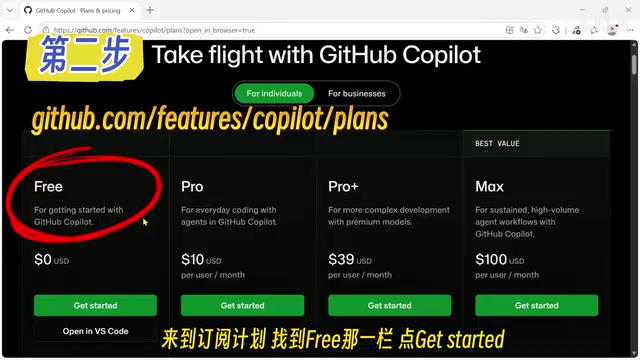
The setup takes just five steps:
- Register a GitHub account — just use any email to receive a verification code;
- After registration, go to the subscription plan page, find the Free tier, and click Get Started;
- Follow the prompts to download and install VS Code (installer available directly from the official website);
- Once installed, click Sign in next to the search bar at the top of VS Code;
- After logging in, you'll be redirected back to Copilot — open a new chat window and start using it.
Here's some background on VS Code: VS Code (Visual Studio Code) is a free, open-source code editor developed by Microsoft. Since its release in 2015, it has become the most widely used code editing tool among developers worldwide. It supports virtually all mainstream programming languages and has a rich extension plugin ecosystem. VS Code became the primary platform for Copilot because both belong to the Microsoft ecosystem, offering the highest level of integration — Copilot can directly read the editor's file structure, open tabs, terminal output, and other contextual information to provide more accurate code suggestions.
An important caveat: GitHub has never publicly disclosed exactly how many credits the free tier provides. In testing, the creator had it build a basic racing game, and that single task consumed 21% of the monthly allowance. The free version limits available model tiers and call frequency, resulting in higher consumption ratios when handling complex tasks. This means that while free, the allowance only supports one or two small tasks per month — suitable for light experimentation rather than daily heavy use.
Method 3: Pay-As-You-Go via API Relay Platforms
API relay platforms are well-suited for users who only need a single function like writing or image generation. One misconception needs to be cleared up: relay platforms aren't all sketchy operations — the key is choosing established platforms that take their service seriously.

The business model of relay platforms (also called API proxies or shared subscription platforms) is essentially resource pooling — operators purchase ChatGPT official API credits or multiple Plus/Pro accounts, then split these resources and resell them to multiple end users at lower unit prices. Technically, relay platforms typically run their own proxy server: user requests first reach the relay server, which then forwards them to the official OpenAI API.
The core advantage of relay platforms is: access to official models without paying full price or setting up complex environments. They essentially spread the cost of a ChatGPT membership across multiple users, letting you pay only for what you actually need — whether that's GPT for writing or image models for generation, everyone gets what they need.
Taking the 2233 platform mentioned in the video as an example: each user has an independent account and conversation history, can save their own GPTs, supports Artifacts preview, project creation, and other features. They even offer standalone image model plans with capabilities like selection editing, inpainting, and branching — all matching the original product. For context, Artifacts is a feature OpenAI introduced in ChatGPT that allows model-generated code, web pages, documents, and other content to be previewed and run in real-time in a separate panel, rather than appearing only as text within the conversation flow. For users whose daily needs are Q&A, writing, and image generation, shared access is extremely cost-effective.
Method 4: Domestic Models as ChatGPT Alternatives for Coding
For coding users, the good news is that domestic Chinese models' programming capabilities are rapidly improving, becoming highly competitive money-saving options.

Top pick — Kimi K3: Its front-end capabilities benchmark against GPT 5.6, but its API price is only about half. Kimi K3 is developed by Moonshot AI, a company known for its long-context processing capabilities — their model first gained fame for supporting 200,000-character long-text input. K3 excels in front-end code generation (HTML/CSS/JavaScript), demonstrating the ability to understand design intent and generate runnable interface code.
Runner-up — DeepSeekAd V4 Flash: Real-world testing shows its capabilities benchmark against GPT 5.5, while its API price is only about one-quarter of GPT 5.6. DeepSeek V4 Flash is developed by DeepSeek and uses a MoE (Mixture of Experts) architecture — this architecture completes inference tasks by activating only a subset of parameters, dramatically reducing the computational cost per call. This is the technical foundation enabling its API pricing to be one-quarter of GPT's. Even more noteworthy, DeepSeek has directly adapted to Codex this time, with no need for CC Switch to connect — significantly lowering the barrier for production deployment.
Here it's worth explaining the concepts of Codex and CC Switch: Codex here refers to OpenAI's autonomous programming Agent platform launched in 2025 (distinct from the earlier code completion model), which can independently complete entire development workflows — code writing, testing, debugging — within a cloud sandbox environment. CC Switch (Cursor/Cline Switch) is a commonly used model switching configuration in the developer community that allows users to replace the default OpenAI model with other compatible models in AI programming tools like Cursor and Cline. DeepSeek's ability to connect to Codex without CC Switch means it natively supports Codex's task scheduling protocol — developers can switch model backends without modifying existing code, making migration costs extremely low.
However, the creator also offers a practical reminder: Coding costs should be evaluated on total cost, not just API pricing alone. While domestic models have lower listed prices, if your usage volume is massive, subscribing to an official GPT plan might actually be more cost-effective in the long run. This reminds users to calculate based on their actual real-world usage when choosing, rather than fixating solely on unit prices.
Summary: Choose the Best Option Based on Your Needs
Across all four methods, here's a clear decision framework:
- Best experience, sufficient budget: Subscribe directly to official Plus/Pro via WeChat;
- Only occasional small tasks, zero cost: GitHub Copilot free credits;
- Only need a single function like writing or image generation: Choose a reputable relay platform;
- Primarily coding, cost-conscious: Try Kimi K3 and DeepSeek V4 Flash first, consider official plans for heavy usage.
The barrier to using ChatGPT in China is fundamentally a problem of payment access and information gaps. As proxy subscription services and relay platforms mature, and as domestic models catch up in programming capability, users now have far richer options than before. The key is understanding your actual use case and real usage volume to find that sweet spot of "most affordable and most hassle-free."
Related articles

GPT-Next Leak, Gemini 4 Argon Imminent: AI News Roundup
GPT-Next leak suggests extreme efficiency; OpenAI's 28-day shipping pledge boosts speed 50%; Gemini 4 Argon nears release; Anthropic subscription value report sparks debate.

GPT-Next Leaked, Gemini 4 Argon Speeds Up, Fable 5.5 May Launch Today
OpenAI's GPT-Next model leaks, expected to be extremely low-cost and possibly part of the 28-day release plan; Gemini 4 Argon internal testing accelerates, NanoBanana 2.1 is live; Semi Analysis tests show Claude Max's equivalent API value is about 5 times that of ChatGPT Pro; Fable 5.5 may launch today.

Gemini 4 Argon Launches Globally: Key Highlights from the AI Daily Brief
Google opens Gemini 4 Argon globally across Pro and Ultra subscriptions and the API, and demonstrates robot control. This article rounds up open-source models, Agent infrastructure, cost transparency, and safety governance updates.