4 Years in AI Automation: Which Business Processes Are Actually Worth Automating?

A 4-year AI automation veteran shares what's worth automating, the real hard parts, and how to go from freelancer to SaaS.
A practitioner with a background in software engineering and cybersecurity summarized four years of building AI process automation for SMBs on Reddit. Starting as a side hustle earning $1,100–$3,800/month, he later paused client work to spend three years building a reusable system — evolving from custom outsourcing to productized SaaS. His core framework: tasks worth automating must be high-frequency, cross-system, and involve human judgment. The real technical challenge isn't content generation — it's legacy systems hidden behind login walls with no open APIs, whose integration and maintenance costs are widely underestimated.
A practitioner who has been building AI-powered process automation for small and medium businesses since ChatGPT's public launch in 2022 shared four years of hands-on experience on Reddit. With a background spanning software engineering, machine learning, and cybersecurity, he started by automating his coworkers' workflows and eventually went full-time. The post skips the technical showboating and offers something more valuable: a grounded perspective on which tasks are actually worth automating — and which aren't.
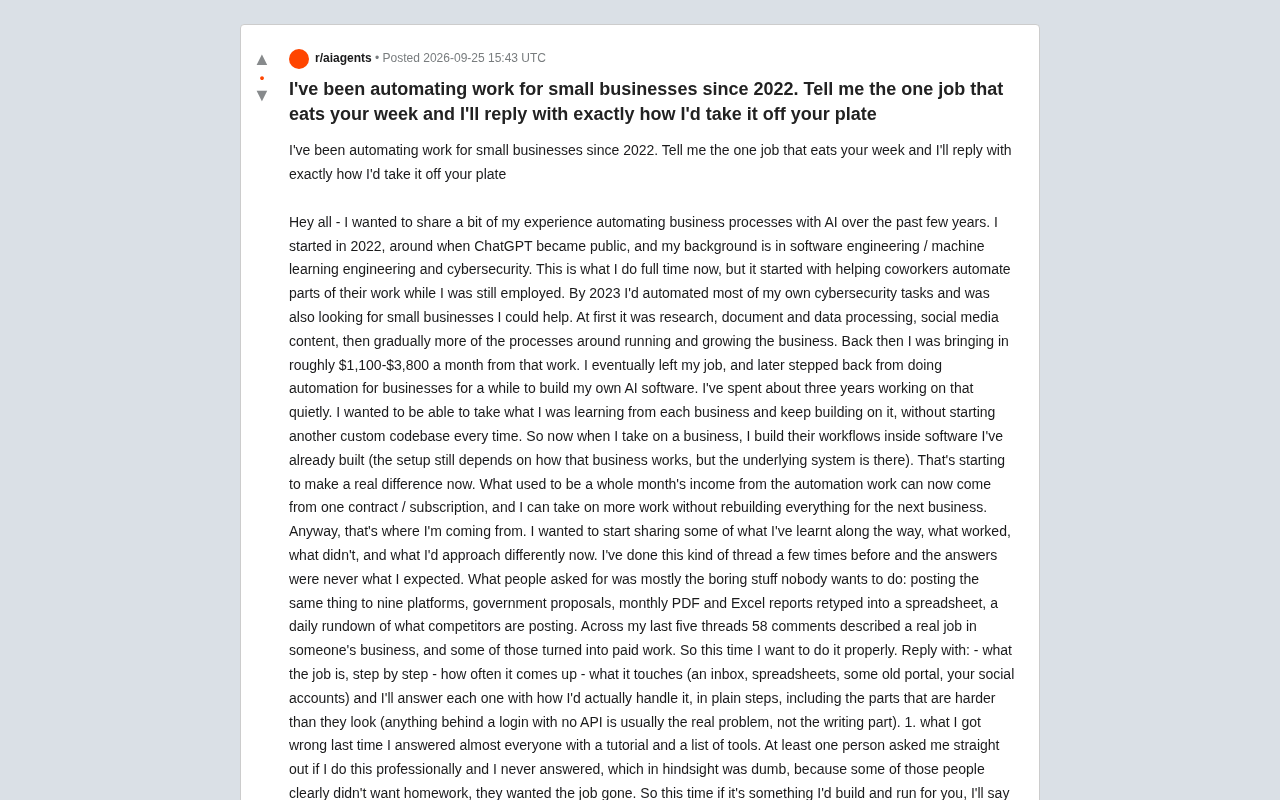
From Side Hustle to Full-Time: A Real Path in Automation Entrepreneurship
His story is pretty typical of how this career path unfolds. When ChatGPT launched publicly in 2022, he was still employed full-time in cybersecurity, automating repetitive tasks on the side for colleagues. By 2023, he had automated most of his own security work and started seeking small business clients.
His early projects clustered around a few areas: research, document and data processing, and social media content generation — later expanding into operational and growth-related workflows. During this phase, his monthly automation income ranged from roughly $1,100 to $3,800. That figure is a useful reference point for understanding the real ceiling for individual developers doing AI outsourcing: it confirms there's genuine demand, while also making clear that pure custom project work is hard to scale.
Why He Stepped Back and Spent Three Years Building a Product
One of the most noteworthy decisions in the post is that he eventually paused his client-facing automation work and spent about three years quietly developing his own AI software.
The reason was straightforward: every new client meant building a custom codebase from scratch, with no way to compound the lessons learned from each engagement. He wanted a foundational system where new client workflows could be built on top of existing software rather than rebuilt from the ground up each time.
This shift produced a noticeable change in economics. He noted that what used to take a full month's worth of automation income could now be captured in a single contract or subscription — while simultaneously serving more clients without rebuilding systems from scratch. This illustrates the commercial evolution from "custom outsourcing" to "productized SaaS": moving from selling time per project to selling system value.
In business model terms, this maps directly to the core advantage of SaaS (Software as a Service): marginal cost approaching zero. In a custom outsourcing model, each new client consumes proportional time and energy, and income is capped by personal capacity. With a productized system, the same underlying platform can serve dozens or hundreds of clients, and the cost of adding each new user is far lower than the first. For independent developers, this means shifting from "selling time" to "selling access" — the system keeps running and generating revenue even when the founder is offline. This is precisely why many technical consultants, once they've accumulated enough domain expertise, choose to "stop and productize": rather than selling the same solution a hundred times over, it makes more sense to package it into a tool that a hundred people can subscribe to.
What People Actually Want to Automate: The Boring Stuff
He's run several "what do you want to automate?" threads, and the answers are consistently surprising. The tasks people most want to escape are almost universally the tedious, repetitive work that nobody wants to do:
- Posting the same content to nine different platforms
- Writing government procurement proposals
- Manually re-entering monthly PDF and Excel reports into spreadsheets
- Compiling daily competitor activity summaries
Across five previous posts, 58 comments described real tasks that exist inside actual businesses — some of which converted into paid projects. This detail underscores something important: the real market for AI automation isn't in the flashy use cases, but in the operational grunt work of day-to-day business.
A Framework for Deciding What's Worth Automating
The most valuable part of the post is his decision framework. He admits to a past mistake: he used to respond to almost everyone by dumping a pile of tutorials and tool lists on them — when some people didn't want to do "homework" at all. They just wanted the work to disappear.
Tasks Not Worth Automating
If a task happens only twice a month and takes ten minutes each time, it's not worth automating. The cost of building and maintaining the automation will exceed the time saved.
Tasks That Are Actually Worth Automating
He identifies three shared characteristics:
- High frequency: happens daily or weekly
- Cross-system: involves more than one tool (inbox, spreadsheet, legacy portal, social accounts, etc.)
- Judgment in the middle: e.g., "Is this invoice overdue or did they give advance notice?" or "Is this email actually urgent?"
The third point is especially critical — the places where time is truly consumed are almost always at these human-judgment checkpoints.
The Underrated Hard Part: Systems Behind Login Walls
Many people assume the hardest part of AI automation is generating content, but this practitioner points out that the real heavy lifting usually involves systems hidden behind login screens with no API.
This is a practical and frequently overlooked technical reality. Whether it's a government procurement portal or an aging internal enterprise system, the absence of an open interface transforms automation from a straightforward API call into a complex operation involving simulated interactions and data extraction. When evaluating the feasibility of any automation project, this should be among the first things considered.
Technically, there are two main approaches to dealing with "login-walled, API-less systems." The first is browser automation — tools like Playwright and Selenium that programmatically control a real browser to simulate human clicks, form submissions, and screenshots in order to interact with web systems that offer no open interface. The second is RPA (Robotic Process Automation), with tools like UiPath and Automation Anywhere, designed specifically for legacy enterprise systems and capable of simulating keyboard and mouse actions at the desktop application level. Both approaches share a critical weakness: fragility. If the target website or system updates its UI, the automation script often breaks and requires maintenance. This explains why these projects typically command higher rates than pure API integration work — the hidden maintenance costs are significant. In recent years, some AI agent frameworks have begun experimenting with vision models that "look" at the screen directly to reduce dependence on fixed UI structures, but engineering stability remains a challenge.
Takeaways for Practitioners and Business Owners
This post takes the form of a call for submissions, but it inadvertently serves as a practical guide to AI process automation.
For business owners: identifying workflows that are high-frequency, cross-system, and contain judgment steps is the best way to find the highest-value automation opportunities. Showing restraint around low-frequency small tasks — avoiding automation for automation's sake — is equally important.
For independent developers and freelancers: this case illustrates a clear growth trajectory — from writing custom scripts for clients, to building a reusable foundational system, to making the leap into productized revenue. The real moat isn't how many tools you know; it's whether you can turn accumulated experience into a system that delivers repeatable value.
Related articles

Apple HomeView Hands-On Review: Is the $300 Smart Home Hub Worth It?
Apple HomeView hands-on: a $300 smart home hub with facial recognition for quick account switching, but no App Store or voice recognition. Is the wall-mounted version worth it? Should you buy the first generation?

Meta Muse Wonder Launch: What It Means for Meta's Return to the Frontier AI Race
Meta releases Muse Wonder and WonderFull, benchmarks reach the frontier, community feedback is polarized. An in-depth look at Meta's return to the frontier AI race, its personal agent strategy, and Zuckerberg's different path.

Apple Home Smart Home Lineup Leaked: LG and Schneider Team Up, UWB Door Lock on Board
Apple Home ecosystem gains new LG and Schneider devices: UWB smart lock with proximity unlock, 2.5K dual-camera doorbell, privacy indoor camera, and AirPods-like seamless pairing.