5 Must-Have Plugins for DeepSeek: Solving Token Burn, Outdated Info, and Verbose Answers
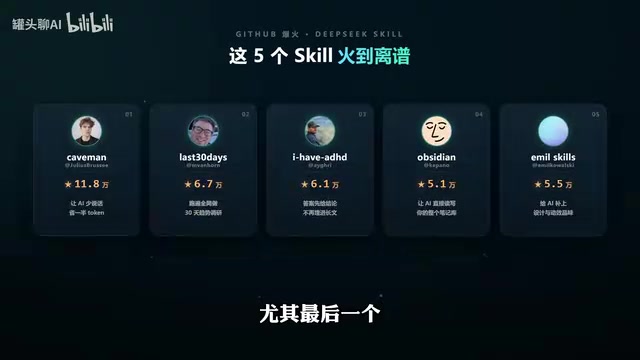
A Bilibili UP host shares five skill plugins solving token burn, outdated info, verbosity, note structure damage, and poor aesthetics in large models.
The article introduces five DeepSeek skill plugins shared by Bilibili UP host "大肥鱼," targeting high-frequency pain points in large model usage: Kaiman compresses repetitive logs to cut token consumption; last3odays retrieves recent discussions from GitHub, Reddit, and YouTube; I have adhd enforces concise "where/how/verify" output; obsidian skill preserves links, properties, and canvas structure for batch note processing; emilkawaski design skills unify layout, color, and mobile adaptation. The common logic: shortcomings are at the work-habit level, not intelligence, and skills turn best practices into reusable rules.
When using large models like DeepSeek for work, the moments that really raise your blood pressure often aren't when it can't answer—it's when it does something with utmost seriousness that makes you want to smash your keyboard: you ask it to find a bug but it burns through a huge chunk of tokens without locating the problem, you search for a new tool and it digs up a tutorial from three years ago, you ask it to change one line of code and it writes an 800-word thought report first. The five skill plugins shared by Bilibili UP host "大肥鱼" happen to target these high-frequency pain points.
These five plugins cover five directions: token consumption, information timeliness, answer style, note structure, and frontend aesthetics. The approach isn't to make the model smarter, but to make it more like a well-behaved work partner.
1. Kaiman: Specifically for Mindless Token Burning
Throw in thousands of lines of logs, and before you've located the problem, your wallet is already emptied—this is the real experience many people have when using large models to troubleshoot issues. In massive logs, the truly useful parts are often just those few key error lines; the rest is repetition and noise.
The "Kaiman" plugin mentioned by the UP host automatically compresses repetitive content and retains only key error information. According to the description, after installing it, the model talks less nonsense and no longer treats the context window as an unlimited buffet. The value of this approach lies in the fact that token consumption and answer quality aren't always positively correlated—the more redundant information you feed in, the more easily the model gets led astray and misses the real error clues. Purifying information first and then letting the model reason is both cheaper and more accurate.
Tokens and context windows are the prerequisite for understanding the "token burning" problem. A token is the basic unit of text processed by the model; a Chinese character typically corresponds to 1–2 tokens, and an English word to about 1.3 tokens. The model's context window has a hard limit (e.g., 128K tokens), and anything beyond that gets truncated or requires segmented processing. More importantly, billing is calculated by token count—both input and output cost money. Stuffing thousands of lines of logs in not only costs more but also dilutes the weight of key information in the attention mechanism—the model's recall for the middle portion of long contexts is naturally lower (the "lost in the middle" phenomenon). Therefore, compressing redundancy first and retaining only key errors is essentially information purification, allowing the limited context window to carry higher-density effective signals.
2. last3odays: Specifically for Information Archaeology

Ask AI to recommend a new tool, and it digs up a tutorial from three years ago—this kind of "archaeological answer" is almost fatal when chasing trends. The model's knowledge cutoff determines that it's naturally bad at answering "what's new recently."
The "last3odays" plugin's approach is to simultaneously search recent discussions on GitHub, Reddit, and YouTube, aggregate the latest developments from multiple platforms, and then hand them to the model for organization. According to the Bilibili UP host, while others are still searching the world for topics, people using this skill have already started editing videos. The significance of multi-source retrieval isn't just speed—it's cross-validation: a single platform's popularity may be distorted, but looking at GitHub's code activity, Reddit's genuine discussions, and YouTube's practical demonstrations together lets you judge whether a tool is truly hot or just superficially so.
Knowledge cutoff is an unavoidable limitation of large models: training data has a fixed cutoff date, the model knows nothing about what happened afterward, and it won't proactively declare "I don't know the latest situation." Retrieval-augmented generation (RAG) is a common remedy, but ordinary web search often returns summaries from a single source. last3odays' approach is closer to multi-source real-time retrieval: simultaneously querying GitHub (code activity), Reddit (community discussion heat), and YouTube (practical demonstrations), then handing the results to the model for integration. This cross-validation effectively filters out inflated or outdated information from a single platform—GitHub's commit frequency reflects whether a project is still maintained, Reddit's discussion quality reflects real user feedback, and YouTube's demonstrations verify whether a tool is actually usable.
3. I have adhd: Specifically for Endless Rambling

Ask the model to change one line of code, and it first writes an 800-word thought report, explains the causes and consequences, and the bug is still sitting there. This complaint probably resonates with many people. The model tends to show "I understand comprehensively," but for the user, the only useful information is three things: where to change, how to change, and how to verify.
The "I have adhd" plugin directly adds concise response rules, forcing the model to output in the structure of "first say where to change, then say how to change, and finally tell you how to check." You're paying it to do work, not to run for department manager. This kind of style constraint seems simple but has high practical returns—in iterative development workflows, the reading time saved each time accumulates into a considerable efficiency difference.
System prompts and style constraints are the technical foundation of such plugins. Large models default to "comprehensively demonstrating the understanding process," because high-quality answers in training data often come with reasoning steps. But in engineering scenarios, this default behavior causes information overload. Forcing the model via system prompt to follow the three-part structure of "where to change → how to change → how to verify" is essentially moving the output format contract to before the conversation starts, rather than correcting sentence by sentence afterward. Compared with manually writing a long prompt each time, the skill mechanism solidifies such constraints into reusable configurations, significantly reducing communication costs in iterative development workflows.
4. obsidian skill: Specifically for Note Vault Collapse
The Obsidian knowledge base you painstakingly built—let the model organize it once, and bidirectional links break, properties fly away, canvas structure gets messed up, and the scene looks like a typhoon passed through. The reason is that the model doesn't naturally understand Obsidian's formatting conventions; it rewrites content in what it considers a reasonable way, which destroys the original links and metadata.
This skill makes the model process content according to Obsidian's original format, organizing bidirectional links, note properties, and canvas structure as they are. According to the UP host, organizing a note vault used to take half a day, but now the model can batch-process hundreds of notes according to the rules. For heavy note users, "not destroying the original structure" is far more important than "organizing it beautifully," because the value of a knowledge base is precisely built on link relationships.
Obsidian's formatting conventions include bidirectional links ([[note name]]), YAML frontmatter, and the JSON structure of canvases, etc. These formats aren't naturally understandable to models—they tend to rewrite content in generic Markdown, easily breaking [[ ]] link syntax, losing frontmatter fields, or rewriting canvas structures into plain text. The core value of the obsidian skill lies in format preservation: making the model strictly follow the original syntax conventions when organizing content, optimizing only at the content level without touching the structural level. For heavy users who rely on link relationships to build knowledge graphs, this is far more important than "organizing it beautifully."
5. emilkawaski design skills: Specifically for Aesthetic Failures
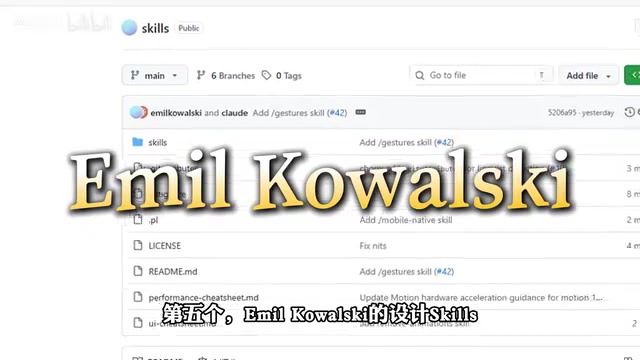
Ask the model to make a website, and it can indeed deliver in three minutes, but the result looks like a knockoff webpage from ten years ago: messy fonts, tacky colors, and uglier buttons one after another. Between code that runs and a product that's usable, there's an aesthetic gap.
This set of design skills is equivalent to giving the model a professional designer, unifying specifications from page layout, color schemes, and interactive animations to mobile adaptation. The UP host specifically mentioned mobile experience—this is the part most easily overlooked in AI-generated frontends; it looks okay on desktop, but the layout falls apart on mobile. Moving design specifications forward into a skill is far more efficient than correcting sentence by sentence afterward.
The Common Logic of These Five Plugins
Taken apart, they're five tools; combined, they're actually the same judgment: many of the current shortcomings of large models aren't at the intelligence level but at the work-habit level. Token burning, archaeology, rambling, structure destruction, and poor aesthetics are all default behaviors when the model lacks constraints and specifications.
The value of mechanisms like skills lies precisely here—it doesn't change the model itself but solidifies domain best practices into reusable rules. For ordinary users, there's no need to write a long prompt every time to correct the same problem; install once and it takes effect long-term.
The UP host's advice at the end of the video is quite practical: don't just bookmark them—pick the one you need most and install it today to try. After all, raising a large model is about making it work for you, not spending money to raise an ancestor you still have to serve yourself. From an input-output perspective, solving the token-burning and rambling problems first gives the most direct improvement in experience.
One-line Summary
A Bilibili UP host shares five skill plugins that solve five major pain points of large models: token burning, outdated information, verbose answers, destroyed note structure, and poor aesthetics.
Paragraph Summary
The article introduces five DeepSeekAd skill plugins shared by Bilibili UP host "大肥鱼," targeting high-frequency pain points in large model usage: the Kaiman plugin automatically compresses repetitive log content and retains only key errors to reduce token consumption; last3odays simultaneously retrieves recent discussions from GitHub, Reddit, and YouTube to solve outdated information; I have adhd forces the model to output in a concise structure of "where to change, how to change, how to verify"; obsidian skill preserves bidirectional links, properties, and canvas structure in the original format, supporting batch note processing; emilkawaski design skills unify layout, color schemes, and mobile adaptation specifications. The article points out that the common logic of these five plugins is: many current shortcomings of large models are at the work-habit level rather than the intelligence level, and the skill mechanism solidifies domain best practices into reusable rules that take effect long-term after one install.
Related articles

AI Teams Up with Mathematicians to Attack the Riemann Hypothesis: 17 Million Lines of Code Tear Open a 167-Year Gap
In November 2026, Anthropic mathematicians and Claude claimed to have discovered a proof of the Riemann Hypothesis, publishing 17 million lines of Lean formalized code that passed machine verification. This article analyzes the event's impact on mathematics and cryptography, and the deeper questions raised by the separation of discovery and understanding.
AI Claims Formal Proof of the Riemann Hypothesis — But Machine Verification Isn't a Mathematical Proof
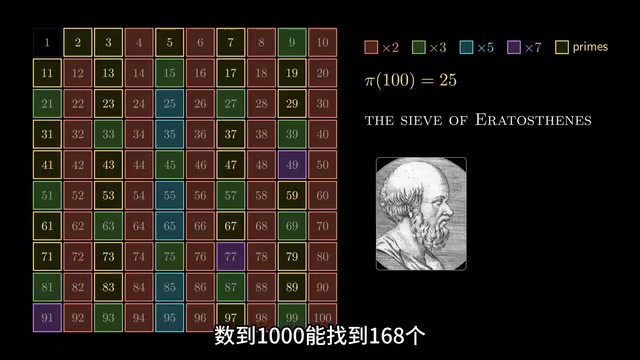
In Nov 2026, Anthropic's Levent Alpöğe released a Riemann Hypothesis proof of 175,000 code files that passed machine formal verification. But machine verification isn't a mathematical proof: the kernel can't confirm the proposition is the Riemann Hypothesis humans understand, and there's no human-readable paper. This article breaks down how ζ function zeros determine prime-count deviation, and the core of the controversy.

Anthropic Raises Over $80 Billion in IPO, DeepSeek Secures $100 Billion in Funding: AI Weekly Roundup
This week in AI: Anthropic's Nasdaq IPO raises $93.5B in the largest ever, DeepSeek closes ~100B yuan round, AI claims formal Riemann proof, MiniMax breaks crypto candidates in seconds.