50,000 CC0 Assets + Game Systems, Callable by Codex in One Click

A resource library with 50,000 CC0 assets and open-source game systems, directly callable by AI agents like Codex via CLI and MCP.
The project curates the largest CC0 open-source asset library to date, containing 50,000 3D models, textures, 2D assets, Gaussian splats, sound effects, and music, with over 5,000 created in-house and the rest integrated from multiple open-source stores. All assets are commercially usable, browsing requires no login, and downloading only requires a free registration. Besides assets, the team has open-sourced game systems like procedural dungeons, a physics engine, crowd navigation, car driving, terrain and tree generation, serving as high-level building blocks for agents. The project offers CLI and MCP interfaces for coding agents like Codex to search and reference assets on demand, greatly lowering the barrier to game and website prototyping and demonstrating a viable paradigm for AI agents connecting to external resource libraries.
Opening: When AI Coding Meets a Massive Game Asset Library
Recently I came across a very interesting project on Reddit: someone has curated and released what is currently the largest CC0 open-source asset library, containing 50,000 3D models, textures, 2D assets, splats (Gaussian splatting), sound effects, and music that can be used directly in games and websites. More than 5,000 of these assets were created in-house by the team, while the rest come from multiple open-source asset stores, all integrated into a single entry point searchable via CLI and MCP (Model Context Protocol). This means coding agents like Codex can easily access the entire toolbox.
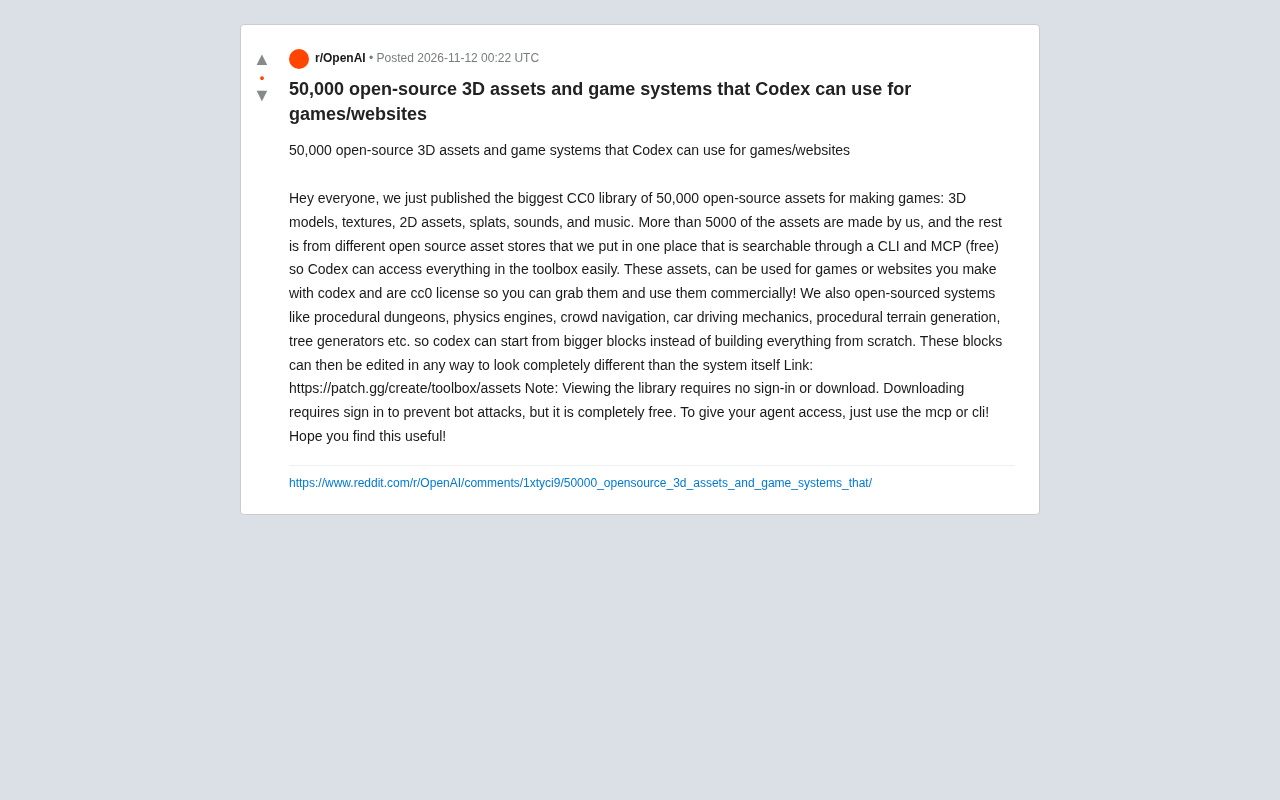
The most appealing aspect of this project is that all assets are under the CC0 license, can be used commercially, and can be browsed without logging in. Downloads only require login to prevent bot attacks, and everything is completely free. For indie developers or rapid prototyping teams, this essentially eliminates the barrier to acquiring assets.
CC0 (Creative Commons Zero) is a copyright waiver agreement in which the author voluntarily relinquishes all copyrights and contributes the work to the public domain. Under CC0, users can copy, modify, and distribute the work, even for commercial purposes, without attribution and without obtaining additional authorization. This differs from open-source software licenses like MIT and Apache—the latter still require retaining copyright notices, whereas CC0 eliminates usage restrictions as thoroughly as legally possible. For content assets such as 3D models, textures, and sound effects, the appeal of CC0 lies in the fact that developers can embed them into closed-source commercial games without worrying about maintaining attribution pages or tracing the original authors of the assets. However, it's worth noting that CC0 only covers copyright and related rights. If an asset contains recognizable trademarks, likenesses of people, or patented technology, it may still be subject to other legal constraints. Therefore, large commercial projects typically still run a trademark and likeness screening when using CC0 assets.
Not Just Assets: Out-of-the-Box Game Systems
Even more noteworthy is that the team has also open-sourced a series of game systems, including procedural dungeon generation, a physics engine, crowd navigation, car driving mechanics, procedural terrain generation, tree generators, and more. These systems can serve as "large building blocks" that let Codex start from a higher baseline rather than reinventing the wheel. Moreover, these blocks can be edited arbitrarily, and the final result can look completely different from the original system—this gives developers enormous room for secondary creation.
According to the post, when combined with the asset library, these systems enable Codex to quickly build playable prototypes or website scenes. For example, you can directly invoke the procedural dungeon system to generate levels, then populate the scene with 3D models from the asset library—all done automatically through MCP or CLI.
Procedural Generation refers to dynamically generating game content through algorithms rather than manual placement, with typical applications including dungeon layouts, terrain, vegetation distribution, and level structures. The procedural dungeon generators mentioned in the article are typically based on room-corridor stitching, BSP trees, or graph search algorithms to generate connected and playable levels at runtime; procedural terrain commonly uses noise functions (such as Perlin noise, Simplex noise) stacked with heightmaps, combined with erosion simulation and biome rules. Tree generators often use L-systems (Lindenmayer systems) or space colonization algorithms to recursively grow branch structures. The value of these systems lies in the fact that they give agents "generation rules" rather than "generation results"—Codex only needs to call the parameter interface to obtain infinite variations, while the asset library provides materials and model appearances. Since the system code itself is editable, developers can modify the generation logic to make the final output completely different from the original template.
Technical Implementation: The Clever Combination of CLI and MCP
The project provides two ways for AI agents to access the asset library: CLI and MCP. MCP is a recently prominent protocol designed to let AI models securely connect to external tools and data sources. Here, MCP serves as a bridge between the asset library and Codex, enabling agents to search, filter, and reference assets on demand without manual downloading and importing.
CLI provides a command-line interface for developers to script operations. Both are free and require no complex configuration—the post mentions that "to give an agent access, just use mcp or cli." This low-barrier design allows even those unfamiliar with 3D pipelines to get started quickly.
MCP (Model Context Protocol) is a standard protocol proposed and open-sourced by Anthropic for connecting AI models to external tools and data sources in a structured way. You can think of MCP as the "USB-C interface for AI agents": it defines the communication specification between servers (providing resources, tools, and prompt templates) and clients (the agent runtime), enabling models to dynamically discover and invoke external capabilities at runtime without stuffing all data into the context window in advance. In the asset library scenario, the MCP server can expose tools such as "search assets," "get asset metadata," and "download assets," and agents like Codex make requests through the MCP client to retrieve subsets of the 50,000 assets on demand. Compared to traditional API integration, MCP's advantages include a unified protocol, clear permission boundaries, and the ability for the same server to be reused by different agents. The protocol has already been adopted by tools like Claude Desktop and Cursor, and the ecosystem is still rapidly expanding.
License and Usage: The Commercial Friendliness of CC0
All assets use the CC0 license, meaning you can copy, modify, distribute, and even use them in commercial projects without attribution. This is very friendly to game developers, especially indie developers and small teams, as it helps avoid copyright disputes. However, note that downloading requires login (free) to prevent bot attacks, while browsing is completely open.
The post also mentions that these assets can be used for "games or websites you make with Codex," hinting at deep integration with AI coding tools. Although only Codex is mentioned so far, in theory any agent that supports MCP can benefit.
Gaussian Splatting is a 3D scene representation and rendering technique that has emerged in recent years, differing from traditional meshes or neural radiance fields (NeRF). It approximates scenes using millions of 3D Gaussian ellipsoids with position, covariance, color, and opacity, and during rendering projects these Gaussians onto the screen and blends them through differentiable rasterization. Its advantages include fast training and rendering speeds and high visual quality, making it especially suitable for reconstructing real scenes from multi-view photos. In game and website development, splats are often used for background environments, product showcases, or VR scenes, but drawbacks include large file sizes and difficulty participating directly in physics collisions and traditional lighting pipelines. The asset library in the article lists splats as a separate category, meaning agents can pick ready-made Gaussian splatting backgrounds for scenes without training from scratch, greatly lowering the barrier to building realistic scenes.
Significance for AI-Assisted Development
This project reflects a trend in AI coding: agents are no longer just writing code but are beginning to connect to vast external resource libraries. When Codex can directly search 50,000 assets and invoke game systems, the improvement in development efficiency is orders of magnitude. Developers can focus their energy on creativity and logic rather than repetitive labor.
Of course, this is still a community project, and asset quality and consistency may vary (despite the team creating 5,000+ in-house), so filtering may be needed in actual use. But regardless, it provides a reusable paradigm for combining large models with game development.
How to Get Started
Visit the project link (https://patch.gg/create/toolbox/assets) to browse the asset library without logging in. To download or give agents access, you need to register a free account and use MCP or CLI. The post author encourages people to try it and provide feedback, hoping this tool can help more people.
For developers who want to quickly validate game ideas, this is undoubtedly a resource worth bookmarking.
One-line Summary
A resource library with 50,000 CC0 assets and open-source game systems, directly callable by AI agents like Codex via CLI and MCP.
Paragraph Summary
This project curates the largest CC0 open-source asset library to date, containing 50,000 3D models, textures, 2D assets, Gaussian splats, sound effects, and music, of which over 5,000 were created in-house and the rest integrated from multiple open-source stores. All assets are commercially usable, browsing requires no login, and downloading only requires a free registration. In addition to assets, the team has also open-sourced game systems such as procedural dungeons, a physics engine, crowd navigation, car driving, terrain and tree generation, which can serve as high-level building blocks for agents to combine. The project provides two interfaces—CLI and MCP—for coding agents like Codex to search and reference assets on demand, greatly lowering the barrier to developing game and website prototypes and demonstrating a viable paradigm for AI agents connecting to external resource libraries.
Related articles
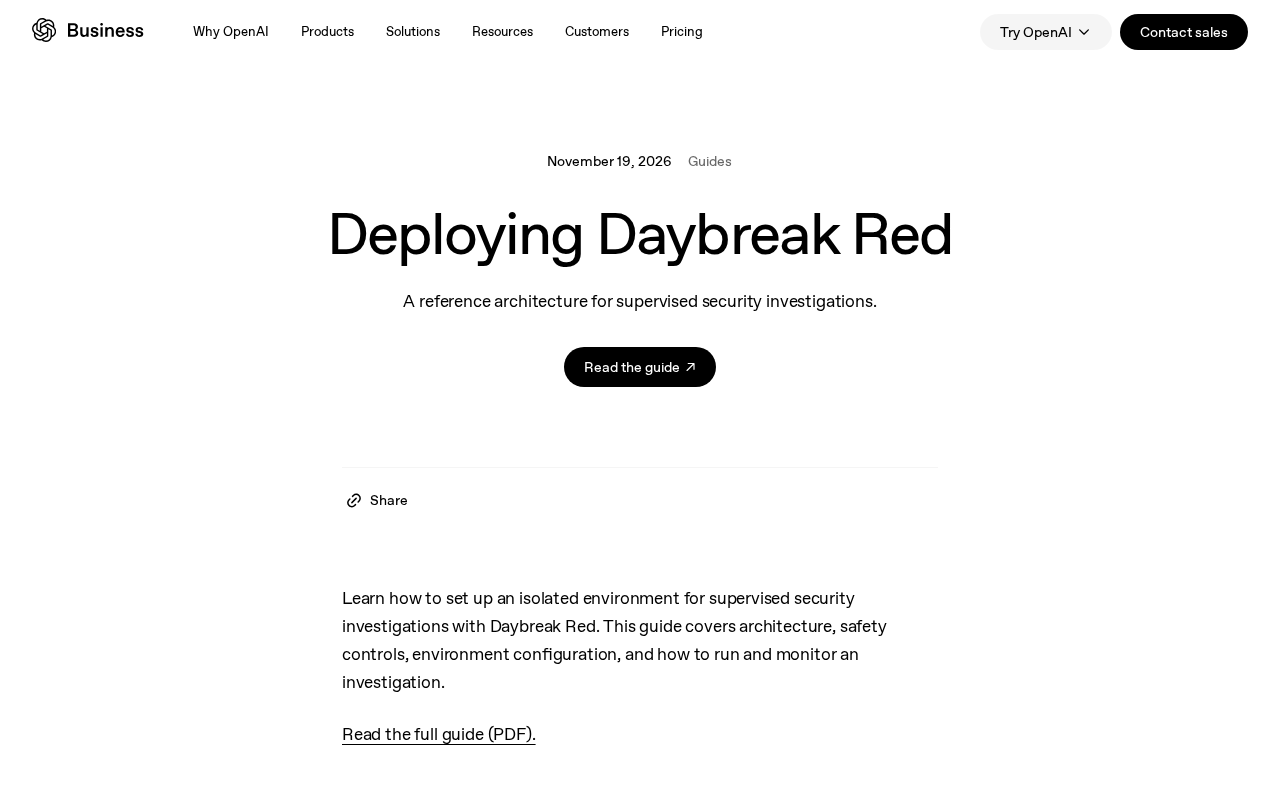
Daybreak Red Deployment Guide: A Reference Architecture for Supervised Security Investigation
A breakdown of the Daybreak Red reference architecture: security control design, deployment configuration process, and runtime monitoring for supervised security investigation.
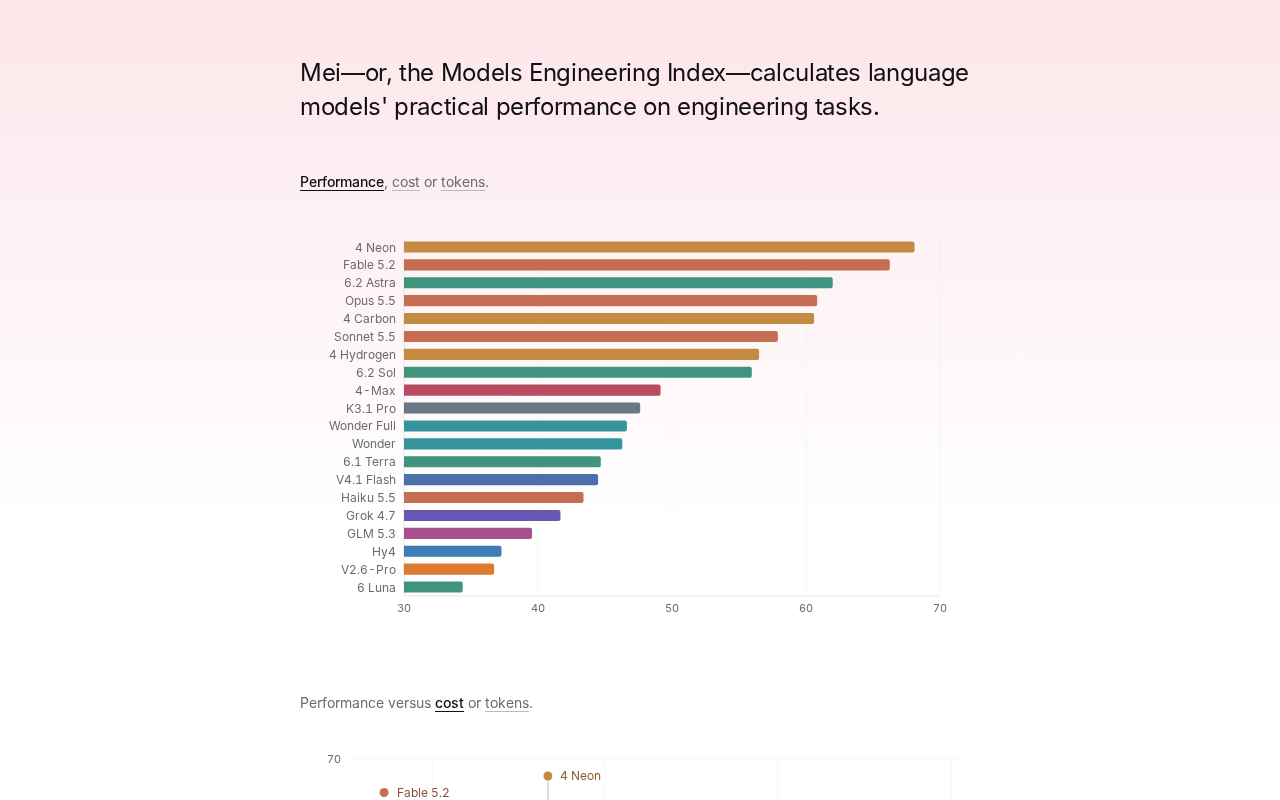
Gemini 4 Neon Tops the Models Engineering Index
Gemini 4 Neon tops the Models Engineering Index, sparking Hacker News debate over ranking credibility and evaluation methods. Here's what it means for developers.

Apple's Self-Developed AI Agent: An Agent That Can Operate Your Mac Is Coming
Apple is reportedly developing an AI agent that can operate a Mac, targeting Meta Muse, Claude, OpenAI Dots, and others. This article analyzes Apple's system-level advantages, the competitive landscape, and likely rollout paths in the agent race.