500B Tokens Later: Can an AI Agent Reverse-Engineer an FPS Game?
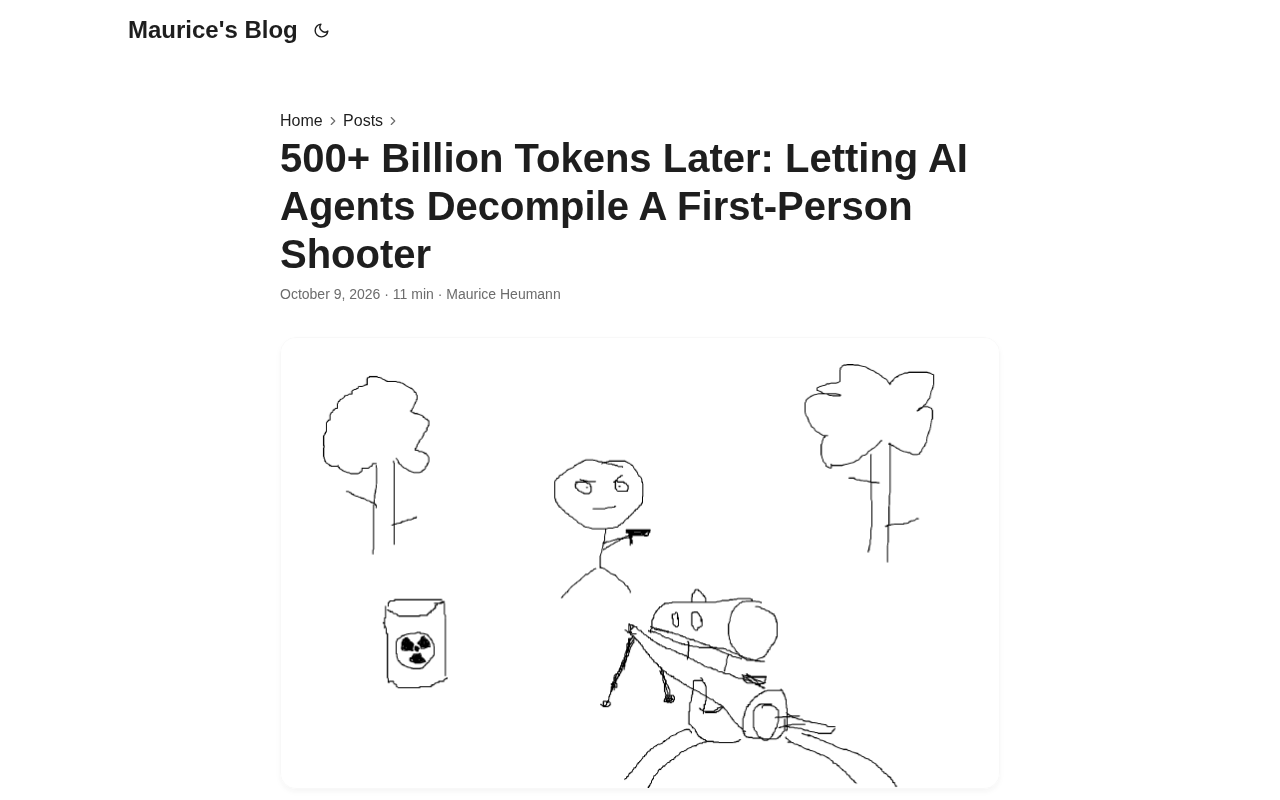
An AI agent burned 500B tokens trying to reverse-engineer an FPS game, exposing both its potential and its efficiency limits.
An experiment called '500B Tokens Later' had an AI agent autonomously attempt to decompile a first-person shooter game — with no continuous human guidance — consuming up to 500 billion tokens in the process. Decompiling an FPS involves tightly coupled subsystems spanning rendering, physics, and game logic, making it an extreme test of long-horizon reasoning and architectural understanding. The results were double-edged: they demonstrated that large model agents can sustain work on complex, extended tasks, while also exposing severe efficiency and cost challenges. The key engineering lessons are threefold: complex tasks must be effectively decomposed, a runnable validation feedback loop is essential, and token efficiency should be a core design metric for any agent system.
When AI Agents Meet Reverse Engineering
Reverse engineering has long been one of the most demanding and labor-intensive disciplines in software engineering. Reconstructing readable, maintainable source code from compiled binaries typically takes seasoned engineers months — sometimes years. An experiment called "500B Tokens Later" set out to answer an ambitious question: if you hand this task to an AI agent and give it a budget of up to 500 billion tokens, can it independently decompile a first-person shooter (FPS) game?
The number alone is staggering. 500 billion tokens means an enormous volume of model inference calls, backed by massive compute and cost. This isn't just a technical proof-of-concept — it's a stress test of current large model agents' (AI Agents) capability boundaries on complex, long-horizon engineering tasks.
Why an FPS Game Makes the Perfect Test Bed
Decompiling a complete game is far more complex than fixing a single bug or generating a function. It requires understanding multiple subsystems — memory layout, rendering pipeline, physics engine, input handling, game logic — all of which are tightly coupled.
Choosing an FPS game as the target means the AI must handle:
- Large volumes of low-level graphics and rendering code
- Game loop logic with extreme real-time requirements
- Complex state management and data structure reconstruction
- Inferring high-level semantic intent from assembly/bytecode
This kind of task places severe demands on the AI's capacity for "long-horizon reasoning" — it can't just translate code segment by segment; it must maintain a coherent understanding of the overall architecture. That difficulty is precisely what makes it an ideal benchmark for evaluating an agent's real-world engineering capabilities.
Technical Background: Decompilation and Reverse Engineering
Decompilation is the core step in reverse engineering: converting a compiled binary (machine code or bytecode) back into human-readable high-level source code. Because compilation is a lossy process — variable names, comments, type information, and high-level control flow are all discarded — decompilation is fundamentally an "information reconstruction" problem with no single correct answer. Traditional tools like IDA Pro and Ghidra can convert binaries into C-like pseudocode, but the output is typically littered with auto-generated, meaningless variable names (e.g., var_18, sub_4A3F00), making it far from truly maintainable source code. For complex software like games — running into millions of lines — manually producing a compilable decompilation result has historically been a multi-year effort for entire teams. Famous community reverse-engineering projects include classic titles like Duke Nukem 3D and Quake. The challenge the AI agent faces is reconstructing a semantically correct, complete codebase from pure binary, with no original symbol information whatsoever.
What 500 Billion Tokens Reveal About Capabilities and Limits
The critical variable in this experiment's design is that the AI operates autonomously. The agent must plan its own steps, invoke tools, verify results, and iterate — rather than proceeding under step-by-step human guidance. This is the central question in current AI Agent research: can a model continuously advance an open-ended, large-scale task with minimal human intervention?
The 500B token consumption carries two layers of meaning. On one hand, it shows that modern large models do have the potential to sustain work across extremely long tasks — continuously building context and trying multiple approaches. On the other hand, such astronomical token expenditure raises serious efficiency concerns: if a task requires this much inference compute, its economic viability and practical deployment value must be reassessed.
In other words, the value of experiments like this rarely lies in whether the AI "succeeded or not" — it lies in exposing at what cost, where it got stuck, and where it surprised us.
Putting Token Consumption in Perspective
500 billion tokens is a number that needs concrete reference points to feel intuitive. Based on current mainstream large model pricing, GPT-4-class API calls range from a few dollars to tens of dollars per million tokens. Even at the conservative rate of $1 per million tokens, 500 billion tokens would cost roughly $500,000. In terms of content volume, 1 token corresponds to roughly 0.75 English words, meaning 500B tokens is equivalent to approximately 375 billion words — about 4 million times the entire Harry Potter series. That this much was consumed on a single task implies the agent went through massive cycles of "explore → fail → retry" rather than making linear progress. This corroborates a well-known characteristic of current AI agents tackling open-ended complex tasks: the search space is enormous and convergence is inefficient — making token efficiency a critical dimension for evaluating the practical viability of any agent system.
Implications for Real-World AI Engineering
This experiment reflects a universal dilemma in the autonomous agent space: the capability ceiling keeps rising, but cost and reliability remain towering obstacles to real-world deployment.
For developers and organizations, a few takeaways are worth considering:
- Task decomposition remains essential: The more complex an engineering task, the more it demands a well-designed breakdown strategy. Relying purely on the model to "brute-force" its way through tends to be prohibitively expensive.
- A validation feedback loop is non-negotiable: Determining whether decompiled output is correct requires compilable, runnable feedback signals to drive iteration — placing real demands on the agent's tool-use capabilities.
- Cost-awareness must come first: The 500B token scale is a reminder that when designing agent systems, token efficiency and task convergence speed should be core metrics, not afterthoughts.
Conclusion
The value of experiments like "500B Tokens Later" lies in using an extreme real-world case to simultaneously illuminate both the capabilities and the limitations of AI agents. Reverse-engineering an FPS game may be a niche scenario, but the "long-horizon, tightly-coupled, high-complexity" nature of the task is precisely the kind of benchmark that measures how mature general-purpose agents really are.
As large model reasoning capabilities continue to evolve, hard-core engineering tasks once considered impossible to automate are gradually entering AI's reach. But the true dividing line may not be whether AI can complete such tasks — it may be whether AI can complete them reliably, at a reasonable cost.
Related articles

CSS Anchor Positioning: A New UI Positioning Approach Without JavaScript
A deep dive into CSS Anchor Positioning: from anchor-name and position-anchor to the anchor() function, position-area shorthand, position-try-fallbacks, anchor-size, and upcoming anchor queries.

New AI Chart Interaction: Continuous Follow-up Questions and Visualization in Conversation
Explore a new AI interaction method for continuously generating charts in conversation. Use the /visualize command to ask follow-up questions and visualize answers in the same chat window, improving data analysis efficiency.

Cursor Merges Into X Subscription: Paid Plans Share Unified Usage Pool, Grok Model Coding Usage Doubled
Cursor joins The X Subscription with a unified usage pool and doubled Grok coding quota. Third-party models shift to API pricing. Existing users can keep or migrate plans.