51% of USAA Home Insurance Claims Pay Nothing: The Industry Truth Behind Insurance Claims
51% of USAA Home Insurance Claims Pay …
51% of USAA home insurance claims pay nothing—exposing the structural crisis behind insurance claims.
USAA closes 51% of home insurance claims with zero payout. This article unpacks the causes—high deductibles, coverage gaps, and disputed denials—alongside the industry's structural crisis driven by climate risk, reinsurance pressures, and insurance retreat, plus how consumers can protect themselves.
A Set of Alarming Numbers
Recently, a statistic about the well-known American insurer USAA sparked discussion across tech communities like Hacker News: as many as 51% of USAA home insurance claims close with no payout whatsoever. In other words, more than half of policyholders who file a claim end up receiving not a single cent.
USAA (United Services Automobile Association) was founded in 1922, originally established by 25 U.S. Army officers to provide mutual insurance services specifically for the military community. Unlike stock insurance companies, mutual insurers have no external shareholders—the policyholders themselves are the owners. In theory, company profits should be returned to members in the form of dividends or premium discounts. This model is thought to better align the interests of policyholders and insurers, and historically it helped USAA build a customer base with relatively homogeneous risk profiles, accumulating strong word-of-mouth and trust. However, as USAA's asset base has expanded to over $200 billion, whether its operating logic still adheres to the mutual-aid spirit of its founding has itself become a topic of industry debate. Its membership is strictly limited to active-duty and retired military personnel and their immediate family members. In third-party satisfaction surveys such as those by J.D. Power, USAA has long ranked at the top for property insurance customer satisfaction. It is precisely for this reason that the "51% zero-payout" figure appears so anomalous—it stands in stark tension with the high-service-standard image USAA has long cultivated, which makes the data all the more impactful in public opinion, serving as an entry point for re-examining the entire industry.
For a company that has long served military members and their families with a relatively good reputation, this number is especially jarring. It concerns not just USAA as a single enterprise, but reflects the deep contradictions facing the entire American home insurance industry against a backdrop of rising costs and intensifying climate risk.
What Does 51% Zero-Payout Mean
First, we need to clarify a core concept: "closed with no payout" is not the same as "claim denial." In insurance claims statistics, a claim closed with "no payment" typically encompasses the following scenarios.
The Deductible Eats the Payout
Home insurance commonly includes a deductible. The deductible is the amount of loss the policyholder must bear before the insurer begins paying out, typically falling into two categories: a fixed-dollar deductible (e.g., $1,000) and a percentage deductible (e.g., 1%-5% of the insured amount). The latter is especially common in specific catastrophe coverages such as hurricane and windstorm insurance. Take a home valued at $500,000: if the windstorm deductible is 2%, the policyholder must bear the first $10,000 of loss.
The deductible design has a rigorous theoretical foundation in actuarial science: its core function is to filter out "moral hazard"—the behavioral tendency to reduce self-protection efforts once the risk is borne by another party after purchasing insurance—while also effectively eliminating small claims where administrative costs are high but payout amounts are low. In recent years, however, this mechanism has degenerated from a risk-management tool into a means of shifting costs. Data from the Insurance Information Institute (III) shows that between 2010 and 2023, the average deductible for standard home insurance rose in real terms by more than twice the rate of inflation, with standard deductibles in some markets jumping from $500 to $2,500 or even higher. When deductibles are systematically set too high, the insurance product essentially degenerates into "catastrophe coverage" that only triggers in the event of catastrophic loss, severely diverging from the psychological expectations consumers had when purchasing it.
In recent years, as premiums have continued to rise, many policyholders have proactively chosen higher deductibles to lower their premiums. When the actual loss amount is below the deductible, even if the claim is valid, the insurer does not need to pay—and the claim is closed as "zero payout." This is one of the important structural reasons behind the high percentage.
The Loss Is Not Within the Coverage Scope
Disasters such as floods and earthquakes often require separate rider policies. If a homeowner mistakenly believes their standard policy covers such losses and files a claim, it ultimately gets closed with zero payout because it exceeds the coverage scope. Such situations are fairly common in an insurance market marked by information asymmetry.
The problem of information asymmetry in insurance markets drew academic attention as early as 1970, when economist George Akerlof proposed the "market for lemons" theory. In the insurance field, this asymmetry manifests in two directions: policyholders understand their own risk profile better than insurers (adverse selection), while insurers possess complex terms and underwriting standards that policyholders find difficult to interpret (information concealment). Notably, the U.S. state insurance regulatory system is highly fragmented, with each state's insurance department regulating separately, and the reporting standards each state requires of insurers vary significantly—some states require disclosure of claim approval rates, categorization of denial reasons, and average resolution times, while others have extremely limited disclosure requirements. By contrast, the UK's Financial Conduct Authority (FCA) has, since 2021, mandated that insurers disclose key metrics such as claim acceptance rates—cited by some U.S. consumer advocacy groups as a regulatory model worth emulating. It is precisely because of insufficient regulatory transparency that consumers can hardly obtain decision-making reference information such as a "zero-payout rate" before purchasing a policy.
Disputed Denials
This is the most criticized part. Some claims may be denied because the insurer disagrees with the policyholder over the cause or extent of the loss, or on the basis of technical clauses. When the zero-payout rate is abnormally high, outsiders have reason to ask whether overly stringent underwriting standards are mixed in.
The Loss Ratio is a key contextual indicator for understanding how strict underwriting is, calculated as: payout amount ÷ premium income × 100%. The industry generally considers a loss ratio maintained in the 60%-70% range to be healthy. When the loss ratio exceeds 100%, it means the insurer has fallen into a loss from its underwriting business alone and must rely on investment returns to cover the gap. In recent years, hit by extreme weather, the loss ratios of several mainstream U.S. property insurers have broken through 80% or even 100%. This pressure is closely linked to the transmission dynamics of the global reinsurance market—reinsurance is "insurance for insurance companies," whereby the primary underwriter transfers part of its risk to global giants such as Munich Re and Swiss Re to spread the risk of extreme losses. Between 2017 and 2023, global catastrophe losses repeatedly broke historical records, driving reinsurance prices sharply higher, with premium increases exceeding 50% in some high-risk regions, forcing primary underwriters to tighten underwriting standards in tandem to control payout exposure. For this reason, underwriting teams face internal pressure to strictly control the scale of payouts, and a rising proportion of "zero-payout closures" becomes a predictable outcome.
Structural Industry-Wide Pressure
Zooming out from USAA reveals that the entire U.S. property insurance market is under enormous pressure.
Climate Risk Drives Up Payout Costs
The frequent hurricanes, wildfires, hail, and storms of recent years have caused insurers' payout expenditures to keep climbing. The impact of climate change on the U.S. property insurance market has moved beyond the level of individual companies, evolving into a systemic industry crisis. Take California as an example: due to continuously rising wildfire risk, leading insurers such as State Farm and Allstate have successively announced they would stop accepting new policies or would refuse to renew policies on a large scale, forcing hundreds of thousands of residents to turn to the state-backed FAIR Plan (Fair Access to Insurance Requirements)—but that plan's coverage limits and scope are far inferior to commercial insurance. Florida, meanwhile, due to rising hurricane frequency and intensity compounded by a flood of fraudulent claims litigation, has seen its local underwriting market nearly collapse, with premiums rising more than threefold within five years.
This trend is called "insurance retreat" in climate science circles, and its geographic distribution shows significant unevenness: when the private insurance market withdraws from a region, the risk exposure often falls on economically weaker groups—those who can neither afford to relocate to lower-risk areas nor bear catastrophic losses on their own. Although the National Flood Insurance Program (NFIP) run by the Federal Emergency Management Agency (FEMA) exists as a backstop mechanism, it has long been in financial deficit, with cumulative debt at one point exceeding $20 billion. Some scholars point out that if the pace of insurance market withdrawal continues to accelerate, property values in some U.S. coastal and wildfire high-risk regions will face systemic revaluation, evolving into a macro risk affecting financial stability—meaning some regions are becoming "uninhabitable" from the insurance market's perspective.
In high-risk regions such as California, Florida, and Texas, some insurers have even withdrawn from the market outright or drastically tightened underwriting conditions. To control loss ratios, it is almost inevitable that insurers become conservative in the underwriting process.
High Deductibles Become a Common Strategy
Faced with premiums rising year after year, consumers and insurers have to some extent "colluded" to push deductibles higher—consumers want to save on premiums, and insurers want to reduce the burden of small claims. The direct consequence is that more and more small losses fall below the deductible, generating a large number of zero-payout cases.
The Absence of Transparency and Trust
For ordinary policyholders, macro data such as "51% zero payout" is nearly impossible to obtain. Although the National Association of Insurance Commissioners (NAIC) works to promote data standardization, its enforcement power is limited, and such data often comes from third-party data-mining firms or academic researchers rather than a unified official source. Policyholders often only truly experience the various limitations of policy terms when they encounter a disaster and genuinely need to file a claim. This information asymmetry is precisely the core root of the insurance industry's trust crisis.
The Data Needs Rational Interpretation
Although the 51% figure is alarming, we still need to remain cautious before drawing conclusions:
- Data from a single time period is subject to chance. If a certain type of disaster erupted in concentration during a particular period, or a large number of small cases were reported at once, either could push the ratio up.
- Lack of horizontal comparison. Without contemporaneous data from other major insurers, it is impossible to judge whether USAA is a significant outlier or merely reflects an industry-wide norm.
- Definitional differences. Different data sources may define "closure" and "zero payout" differently, making direct comparison prone to misleading conclusions.
Therefore, this data should be viewed as a signal worth investigating further, rather than a definitive verdict on any single company.
How Consumers Can Protect Themselves
Regardless of the true reasons behind the data, the following practical tips are worth keeping in mind for ordinary homeowners:
- Understand the deductible setup. Low premiums often correspond to high deductibles. Before purchasing, be sure to understand at what loss threshold you can actually receive a payout. Percentage deductibles in particular need to be converted into concrete dollar amounts to avoid misjudging the coverage scope.
- Confirm the coverage scope item by item. Common high-risk disasters such as floods and earthquakes usually require additional coverage—never assume your standard policy covers everything.
- Preserve complete evidence and file appeals proactively. When facing zero payout or a disputed denial, detailed loss records, photos, and written appeals are key means of protecting your rights.
- View macro data rationally. A jarring percentage can remind you to stay vigilant, but what truly protects you is still a clear understanding of your own policy terms.
Conclusion
The reason USAA's "51% of home insurance claims pay nothing" figure can spark such wide discussion is precisely that it touches on a universal, real-world question—how much of the protection we pay for can actually be delivered when it matters most.
Behind this lie both structural factors such as deductible design and coverage scope definition, and the era's backdrop of intensifying climate risk and industry cost pressures. From "lemon market"-style information asymmetry, to the underwriting capacity contraction triggered by reinsurance market price transmission, to the climate-change-driven "insurance retreat" and the increasingly conservative underwriting standards under loss-ratio pressure, these forces have together shaped the reality consumers face in today's insurance market. It reminds us: in insurance, a field of high information asymmetry, staying rational and vigilant, and understanding every policy in your hands, will always be the consumer's most effective form of self-protection.
Key Takeaways
Related articles

M&M's Spent Millions Replacing Artificial Blue Dye — Why Is It So Hard?
Mars spent millions trying to replace artificial blue dye in M&M's with spirulina, but thick material clogs pipes and residue risks mold, forcing a full production-line rebuild. Here's the engineering behind the reformulation.

Teammate Wanted for Meta Global AI Developer Hackathon: Computer Vision & Medical AI
A Reddit developer seeks teammates for the Meta Global AI Developer Hackathon, focusing on computer vision and medical AI. This article analyzes the track logic, skills-complementarity needs, and topic selection strategy behind this teaming signal.
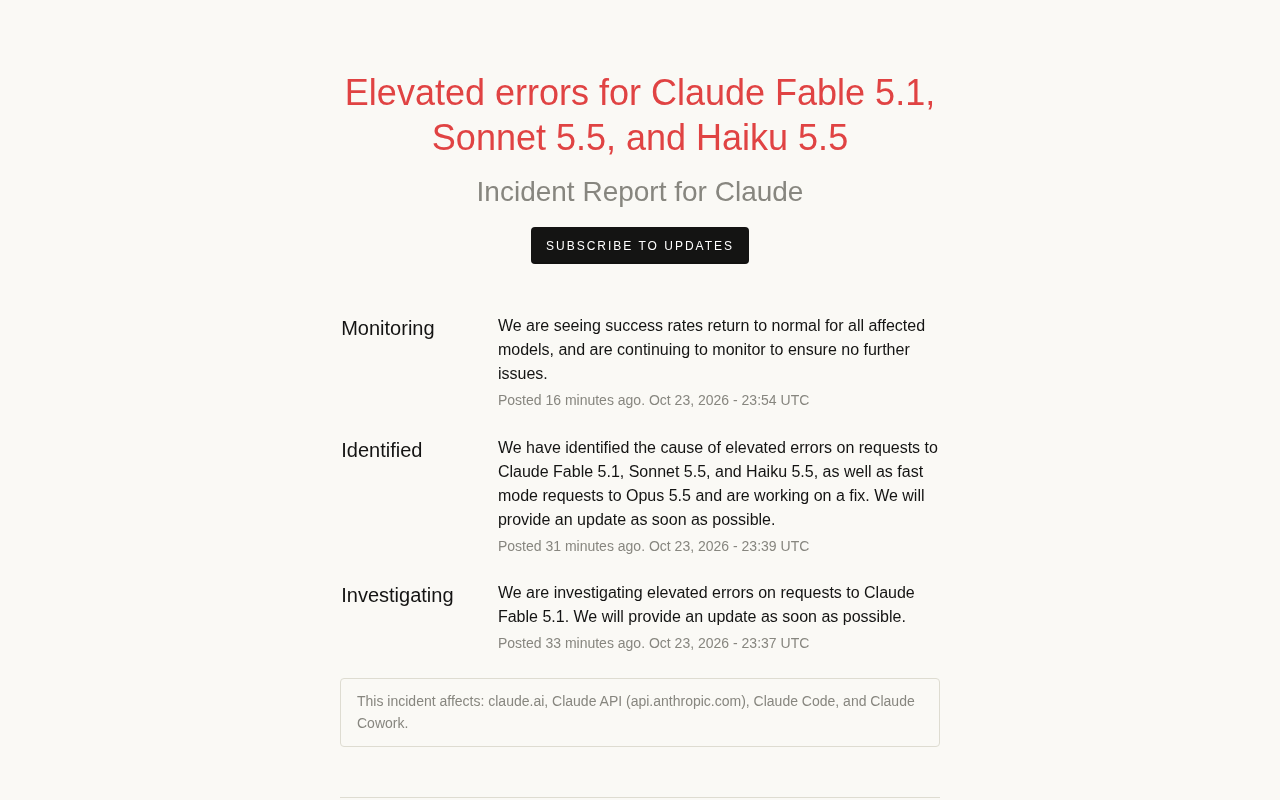
Multiple Claude Models Hit by Errors: A Postmortem of Fable 5.1, Sonnet 5.5, and Haiku 5.5
Claude Fable 5.1, Sonnet 5.5, Haiku 5.5, and Opus 5.5 fast mode saw elevated errors; Anthropic identified and resolved the issue in 17 minutes. This postmortem covers the timeline, the technical reasons for the multi-model cascading failure, and practical lessons for retry and degradation strategies.