56k.rip: Reliving the Nostalgic Dial-Up Internet Experience of 1996

56k.rip recreates the 1996 dial-up internet experience, hitting Hacker News and sparking cross-generational nostalgia in the tech community.
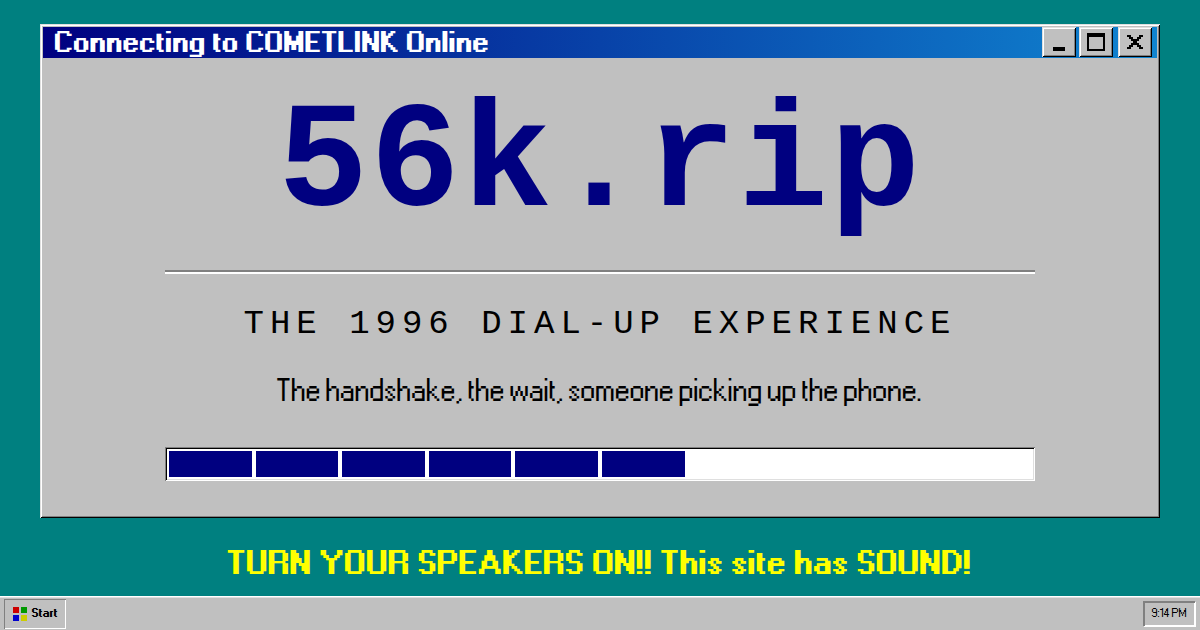
56k.rip is a project dedicated to recreating the full 1996 dial-up internet experience, centered on the iconic 56Kbps modem — complete with handshake sounds, throttled loading, and period-accurate aesthetics. It hit the top of Hacker News with 229 upvotes and 94 comments, proving the strong appeal of nostalgia-driven projects in tech circles. Beyond sentiment, the article argues this collective nostalgia carries real lessons: the extreme optimization mindset forged under severe bandwidth constraints stands in sharp contrast to today's bloated web, and remains genuinely relevant for mobile and emerging-market contexts.
Dialing Back to the Internet of 1996
In today's era of gigabit fiber and ubiquitous 5G, few people miss the days of listening to a modem's screeching handshake while waiting for a single image to load line by line. Yet a project called 56k.rip exists for exactly that purpose — to bring users back to the dial-up internet experience of 1996.
The project recently hit the top of Hacker News, earning 229 upvotes and 94 comments, a clear sign of the resonance it struck within the tech community. For those who lived through that era, this isn't just a technical recreation — it's an emotional homecoming.
What Exactly Does 56k.rip Recreate?
As the name suggests, "56k" refers to the theoretical maximum speed of the era's mainstream modems — 56Kbps. In those bandwidth-scarce times, getting online meant tying up your phone line, paying by the minute or the megabyte, and waiting through agonizingly slow page loads.
The core concept behind 56k.rip is to simulate the complete dial-up experience through technical means. This typically involves several key elements: the iconic modem handshake sound, throttled loading speeds, and a web interface aesthetic faithful to the period. For younger users, it's a window into internet history; for veterans, it's a rare trip down memory lane.
Why 56Kbps Became a Generational Memory
The 56Kbps dial-up modem was the dominant home internet solution of the late 1990s. Its significance went beyond raw speed — it marked the moment the internet began entering ordinary households. Many of the internet cultures that formed in that era — from crude personal homepages and flickering GIF animations to the byte-counting habits of web optimization — left a lasting imprint on everything that followed.
From a technical standpoint, 56Kbps modems (using the V.90 and V.92 standards) achieved their theoretical downstream peak by leveraging the telephone company's digital signal infrastructure, bypassing the noise limitations of analog-to-digital conversion. In practice, however, users typically experienced speeds of only 28–48Kbps, constrained by line quality, distance, and central office equipment. To put those speeds in perspective: downloading a 200KB image took roughly 30 seconds; a 3MB MP3 could eat up nearly 10 minutes. This extreme bandwidth scarcity gave rise to engineering practices that look remarkably clever in hindsight — images compressed to the bone, HTML pages avoiding deeply nested tables, and even dedicated "text-only" mirror sites for low-speed connections. These constraints instilled a performance mindset in early Web developers whose core logic — reducing requests, compressing assets, prioritizing critical content — maps directly onto today's Core Web Vitals optimization philosophy.
The Tech-Cultural Phenomenon Behind Nostalgia Projects
56k.rip is far from alone. In recent years, projects recreating early internet and computing experiences have proliferated — from restoring vintage OS interfaces to emulating early browsers and BBS systems. Their popularity reflects a collective longing within the tech community for the internet's "prehistoric" era.
This nostalgia isn't purely sentimental. It serves as a reminder of how early developers created real value through minimal design and ruthless optimization under severe bandwidth constraints. Against the backdrop of today's bloated web pages that casually load megabytes of resources, looking back at the discipline and efficiency of the 56Kbps era carries genuine reflective value.
Strong Reactions from the Tech Community
The 94-comment thread on Hacker News speaks to how readily these projects spark engagement among technical audiences. Veterans share personal memories of those early online days; newcomers marvel at how dramatically the internet has evolved. This cross-generational exchange is itself one of the most valuable things such recreation projects produce.
Similar projects have formed a small but thriving ecosystem in the tech community. The Internet Archive's Wayback Machine has preserved billions of historical web page snapshots; Wiby.me indexes the minimalist personal websites of the old web; and oldweb.today lets you run ancient browsers like Netscape Navigator 3.0 directly in your browser and visit archived pages. The shared value of these projects lies in "digital archaeology" — preserving slices of once-vibrant, now-vanished internet culture, allowing later generations to viscerally experience the arc of technological evolution rather than merely reading about it. For scholars studying the history of human-computer interaction, Web standards, or digital culture, these projects offer irreplaceable first-hand experiential material.
Real-World Lessons Beyond Nostalgia
From 56Kbps to today's gigabit networks, internet access speeds have increased by orders of magnitude in just a few decades. 56k.rip makes that technological leap feel tangible in an intuitive and playful way.
For content creators and developers, the project also serves as a mirror: a reminder that web performance optimization has never gone out of style. The mindset of extreme optimization born from bandwidth scarcity remains practically relevant today in contexts like mobile networks and emerging markets.
Given the limited source material available on the project, specific details about its technical implementation and full feature set are best discovered firsthand. Visit 56k.rip and experience those "screeee-bong-screee" dial-up days for yourself.
Related articles

GPT-Next Leak, Gemini 4 Argon Imminent: AI News Roundup
GPT-Next leak suggests extreme efficiency; OpenAI's 28-day shipping pledge boosts speed 50%; Gemini 4 Argon nears release; Anthropic subscription value report sparks debate.

GPT-Next Leaked, Gemini 4 Argon Speeds Up, Fable 5.5 May Launch Today
OpenAI's GPT-Next model leaks, expected to be extremely low-cost and possibly part of the 28-day release plan; Gemini 4 Argon internal testing accelerates, NanoBanana 2.1 is live; Semi Analysis tests show Claude Max's equivalent API value is about 5 times that of ChatGPT Pro; Fable 5.5 may launch today.

Gemini 4 Argon Launches Globally: Key Highlights from the AI Daily Brief
Google opens Gemini 4 Argon globally across Pro and Ultra subscriptions and the API, and demonstrates robot control. This article rounds up open-source models, Agent infrastructure, cost transparency, and safety governance updates.