6 Months of Self-Taught Machine Learning: A Complete Roadmap from Zero to Job-Ready
A real 6-month self-taught ML roadmap: from math foundations to hand-writing a Transformer, plus the gap to being job-ready.
A self-learner spent six months progressing from math foundations to core ML and deep learning, even hand-writing a decoder-only Transformer and implementing gradient boosting from scratch. This article dissects the highlights and blind spots of this real roadmap, revealing why engineering skills and direction choice are the true gaps to being job-ready.
One Self-Learner's Real Progression Path
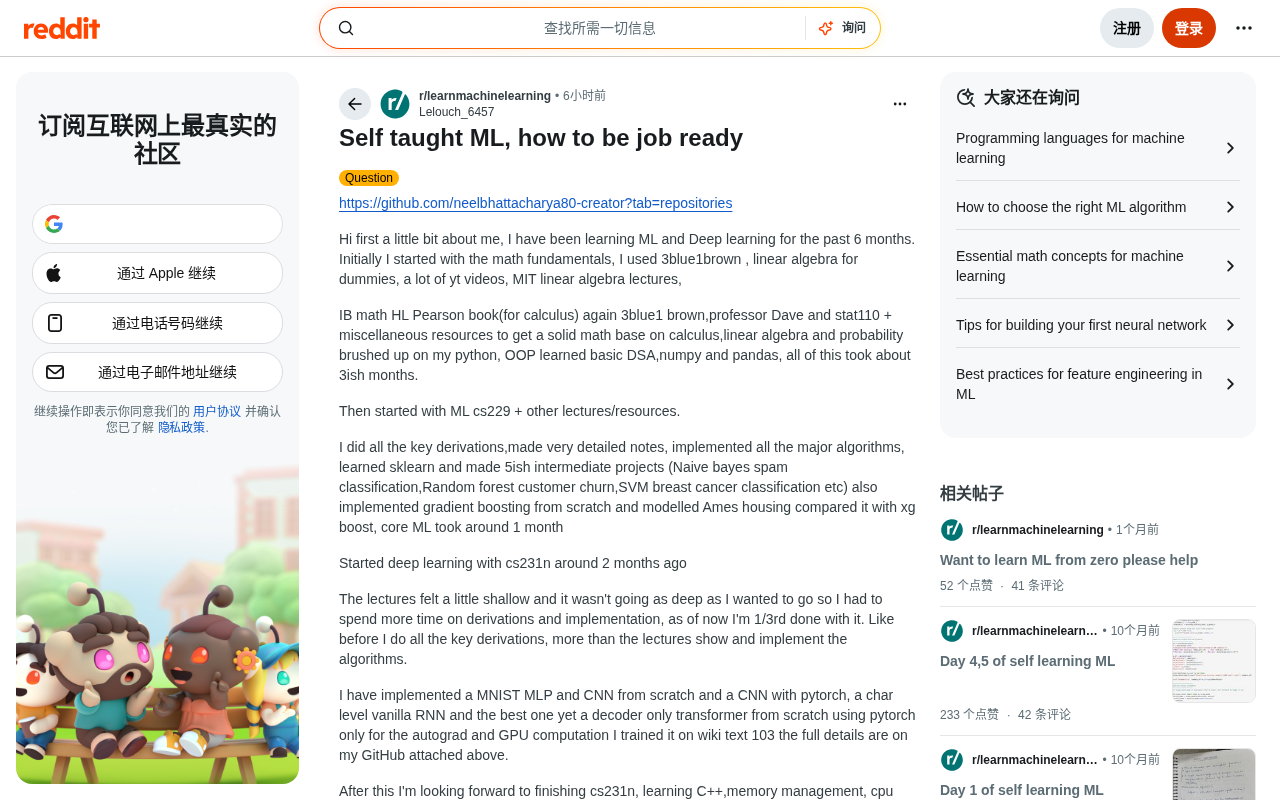
In Reddit's machine learning community, a self-taught learner shared his learning journey over the past six months and earnestly asked: how far is he from being "job-ready"? This question touches the core anxiety of countless career-changers and self-learners. Rather than just a plea for help, it offers a valuable sample of a self-taught machine learning roadmap.
This learner's path is clear and solid: starting with mathematical foundations, moving through core machine learning, and then into deep learning—the entire process well-organized. His experience deserves careful study by anyone wanting to teach themselves ML—not only because he did many things right, but also because the "blind spots" he exposed are precisely the parts self-learners most easily overlook.
Mathematical Foundation: Three Months of Hard Work
He spent about three months solidifying his mathematical foundations, covering calculus, linear algebra, and probability theory. The resources he used can be called the "golden combination" for self-learners: 3Blue1Brown's intuitive visualizations, MIT's linear algebra open course, Statistics 110 (Harvard's probability course), and more.
About 3Blue1Brown's visual math education: 3Blue1Brown is a math education YouTube channel created by Grant Sanderson, famous for its unique animated visualization style. The channel uses its self-developed Python animation library Manim to transform abstract mathematical concepts into intuitive geometric animations. Its "Essence of Linear Algebra" and "Essence of Calculus" series have become standard resources for self-learners worldwide, with cumulative views exceeding 500 million. The value of this visual teaching approach lies in this: traditional textbooks often only present symbolic operations, while 3Blue1Brown helps learners build geometric intuition—for example, understanding matrix multiplication as spatial transformation, and derivatives as local linear approximation. For machine learning learners, this intuition is crucial, because backpropagation is essentially an application of the chain rule to computational graphs, and gradient descent is stepping along the negative gradient direction in multidimensional space.
That said, he systematically reviewed Python, object-oriented programming, and fundamental data structures and algorithms, and mastered NumPy and Pandas.
The value of this stage lies in this: many self-learners rush into model training, only to get stuck when encountering the mathematical details of backpropagation and gradient descent. Spending three months laying the foundation may seem "slow," but it actually saves enormous rework time later when deeply understanding algorithm principles—this is the most easily skipped, and least skippable, step in a self-taught machine learning roadmap.
From Core ML to Deep Learning: Building Hands-On Experience
Building on his mathematical foundation, he completed his core machine learning study in one month, primarily relying on Stanford's classic course CS229. CS229 is Stanford's machine learning course taught by Andrew Ng, long regarded as one of the most theoretically rigorous public ML courses. Unlike the simplified version on Coursera, CS229 requires students to master complete mathematical derivations, including maximum likelihood estimation, the EM algorithm, and the Lagrangian dual of support vector machines. Its lecture notes remain a reference for many industry researchers today. His approach is especially commendable: not just attending lectures, but completing all key derivations, keeping detailed notes, and implementing major algorithms from scratch.
Project-Driven Learning
He completed about five medium-difficulty machine learning projects, including:
- Naive Bayes spam classification
- Random forest customer churn prediction
- SVM breast cancer classification
- Implementing Gradient Boosting from scratch and comparing it with XGBoost on the Ames housing dataset
About the technical background of gradient boosting and XGBoost: Gradient boosting is an ensemble learning method proposed by Jerome Friedman in 2001. Its core idea is to iteratively train weak learners (usually decision trees), with each new tree fitting the residuals of the previous round (more precisely, the negative gradient of the loss function with respect to the current predictions). XGBoost (Extreme Gradient Boosting) is an engineering-optimized implementation proposed by Tianqi Chen in 2014, introducing innovations such as regularization terms, column sampling, and approximate split algorithms, and it has long dominated tabular data tasks in Kaggle competitions. Implementing gradient boosting from scratch means understanding: how to compute first- and second-order gradient statistics, how to build regression trees, and how to control step size via the learning rate to prevent overfitting—this is fundamentally different from directly calling xgb.train(). The former demonstrates mastery of algorithm mechanics, while the latter is merely tool-usage ability.
This combination of "understanding principles + implementing from scratch + comparing with industrial-grade libraries" carries far more weight than simply calling sklearn's .fit(). Being able to implement gradient boosting from scratch and compare it with XGBoost shows he truly understands the internal mechanics of the algorithm, rather than stopping at the API-call level—this is precisely where the biggest gaps appear in machine learning job interviews.
Deep Learning: Not Satisfied with the Course Depth
About two months ago, he began studying CS231n (Stanford's computer vision course). CS231n was developed by Fei-Fei Li's team and is the most influential public course in computer vision. Its assignments require students to implement core components such as backpropagation and Batch Normalization from scratch. This "implement-from-the-ground-up" training method cultivates a deep understanding of the internal mechanisms of deep learning frameworks. Interestingly, he found the course "a bit shallow," so he proactively did more derivations and implementations than the course required. So far he has completed:
- Implementing an MLP and CNN for MNIST from scratch
- Implementing a CNN with PyTorch
- A character-level raw RNN
- Implementing a decoder-only Transformer from scratch, using only PyTorch's autograd and GPU computation, and training it on WikiText-103
About the technical significance of the decoder-only Transformer: The Transformer architecture was proposed by Vaswani et al. in the 2017 paper "Attention Is All You Need," completely replacing the previously mainstream RNN/LSTM sequence models. The decoder-only variant is the foundational structure of modern large language models such as the GPT series, LLaMA, and Mistral. Its core mechanism is causal self-attention: each position's token can only attend to tokens before it, achieving autoregressive generation through an attention mask. Implementing it from scratch requires hand-writing multi-head attention, positional encoding, feed-forward networks, residual connections, and Layer Normalization, and correctly implementing the attention mask to ensure no information leakage during training. WikiText-103 is a Wikipedia text dataset containing about 100 million words, commonly used for language model benchmarking. Being able to complete a full training pipeline on it shows this learner has substantial ability to understand the underlying mechanisms of contemporary LLMs.
This final Transformer project is the most impressive part of the entire portfolio. In an era where "everyone can call a Transformer library," being able to implement one by hand and complete full training is itself powerful proof of a rare capability.
His Plans and Potential Blind Spots
Looking ahead, he laid out an ambitious plan: finish CS231n, learn C++, memory management, CPU architecture, strengthen DSA, fill gaps in software engineering, learn CUDA and Triton, and model deployment.
Sufficient Technical Depth, but Engineering Ability Is the Weak Point
A key signal emerges from his account: he only encountered basic Git on the first day he started learning, and admitted he "doesn't know where his software engineering blind spots are." This is exactly the common weakness of many self-learners—solid algorithmic foundations, but weak engineering capability.
In a real industrial environment, ML engineers not only need to understand models, but also need to:
- Use Git for version control and team collaboration
- Write maintainable, testable, production-grade code
- Understand CI/CD, containerization (Docker), and cloud platform deployment
- Handle data pipelines and experiment management (such as MLflow, Weights & Biases)
About the industry background of the MLOps toolchain: MLOps (Machine Learning Operations) is a practice system that brings DevOps concepts into machine learning engineering, aiming to solve full-lifecycle management of models from experiment to production. MLflow is an open-source platform developed by Databricks, providing experiment tracking, model registry, and deployment functions, allowing teams to record hyperparameters, metrics, and artifacts of each training run for reproducibility. Weights & Biases (W&B) is known for its powerful visualization dashboards and team collaboration features, widely used in both academia and industry. In ML scenarios, CI/CD includes not only code testing but also data validation, model performance regression testing, and automated retraining pipelines. Docker containerization ensures consistency between training and inference environments, avoiding the "it works on my machine" problem. Together, these tools form the engineering foundation of industrial-grade ML projects and represent the core capability boundary that distinguishes "can build models" from "can deliver."
These "non-algorithmic" skills are often the real chasm between "can do projects" and "job-ready," and also where ML engineer career transitions most easily get stuck.
Choosing a Direction: Research-Oriented or Engineering-Oriented?
His skill stack shows a clear "research inclination"—extensive mathematical derivation, from-scratch implementation, and focus on underlying principles. Meanwhile, the CUDA, Triton, C++, and CPU architecture he plans to learn point toward ML systems and low-level optimization.
About the positioning differences between CUDA and Triton: CUDA (Compute Unified Device Architecture) is a parallel computing platform launched by NVIDIA in 2006, allowing developers to directly program GPUs using C/C++, and it is the core infrastructure for the underlying operations of deep learning frameworks. Mastering CUDA means being able to write custom GPU kernels, optimizing memory access patterns, warp scheduling, and shared memory usage for specific hardware architectures. Triton is a high-level GPU programming language developed by OpenAI, aiming to let researchers write GPU kernels approaching CUDA performance using Python-like syntax. The underlying torch.compile introduced in PyTorch 2.0 relies heavily on Triton to generate optimized code. The two differ in positioning: CUDA is suited for low-level engineering requiring extreme performance optimization, while Triton is more suited for researchers to rapidly experiment with custom computation patterns.
There is a fork in the road worth serious thought here:
- ML engineering / MLOps direction: Prioritize filling gaps in software engineering, cloud deployment, and system design; CUDA can wait.
- ML systems / inference optimization direction: CUDA, Triton, and C++ are core, and his low-level interest aligns highly with this.
- Research / algorithm direction: He should consider reproducing cutting-edge papers, participating in open-source projects, and gradually building an academic or industrial research background.
Trying to master all directions at once tends to scatter one's energy. Locking onto a target role and then targeting the needed skills is a more efficient machine learning job strategy.
Four Core Takeaways for Self-Learners
This learner's case offers several directly reusable lessons for self-learners at large:
First, the mathematical foundation cannot be skipped. Three months of math investment may seem long, but it is the bedrock for later deep understanding and an unavoidable threshold for getting started with deep learning. Combining intuitive understanding (such as the geometric perspective provided by 3Blue1Brown) with rigorous derivation (as required by CS229) is what truly internalizes mathematical tools into the ability to analyze models.
Second, implementing from scratch beats calling libraries a hundred times. Hand-writing a Transformer and implementing gradient boosting from scratch—these kinds of projects truly demonstrate ability and are the most persuasive bonus points in interviews and portfolios. Being able to explain the geometric meaning of the Q, K, V matrices in the self-attention mechanism is far more valuable than memorizing API parameters.
Third, don't ignore engineering ability. Algorithmic ability is the entry ticket, but Git, coding standards, and deployment ability are the baseline for team collaboration. The MLOps toolchain (MLflow experiment tracking, Docker containerization, CI/CD pipelines) is standard infrastructure for industrial ML projects. Engineering gaps should be filled early, not realized only when job-hunting.
Fourth, clarify your direction before pushing forward. The ML field has many branches—research, engineering, and systems each have their own focus—and the skill stacks needed by an MLOps engineer and a CUDA kernel developer barely overlap. Rather than casting a wide net, it's better to lock onto a direction and invest precisely. This is also the key to whether a self-taught machine learning project can translate into job-market competitiveness.
In terms of technical depth, this self-learner's achievements over six months are already quite impressive, even surpassing many students with formal degrees. But "job-ready" is not only a technical question—it also covers engineering practice, direction positioning, and portfolio presentation. After filling engineering gaps and clarifying his career direction, the distance between him and his goal may be much closer than he imagines.
Key Points
Related articles
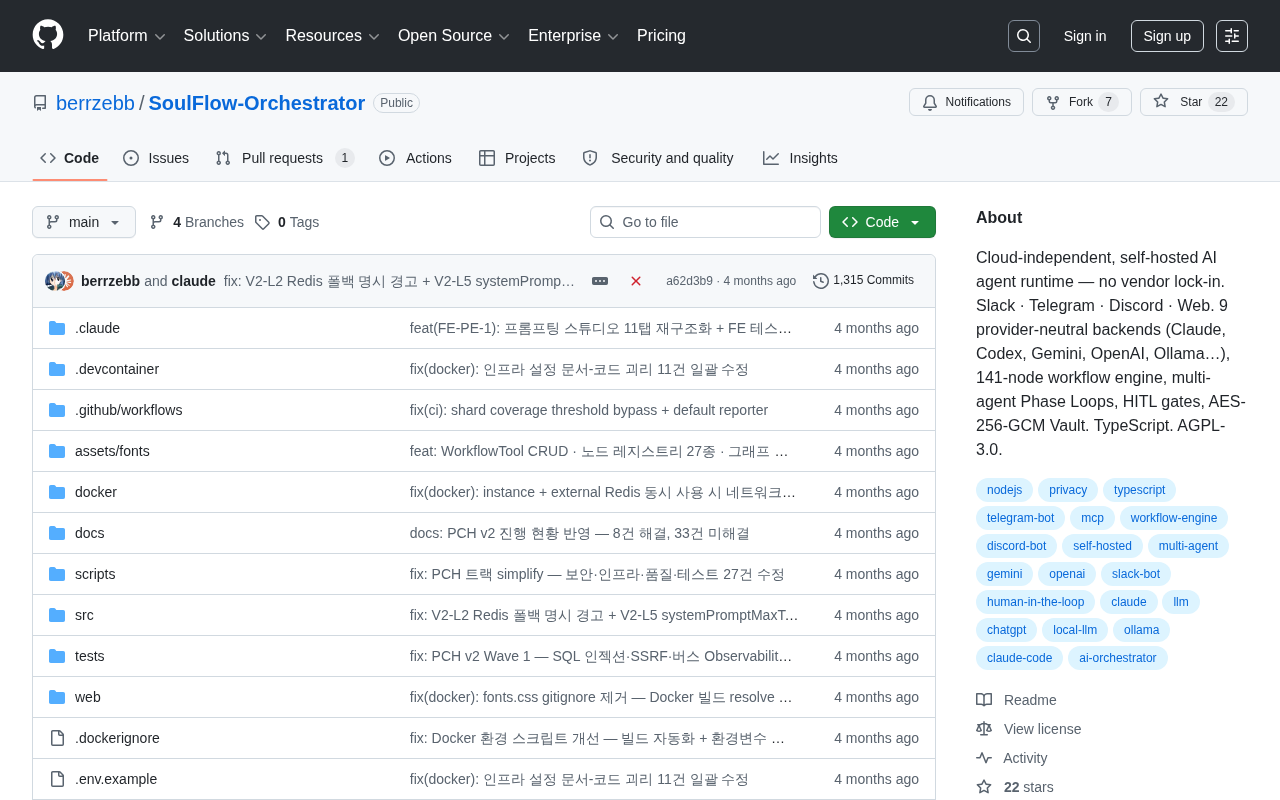
SoulFlow-Orchestrator: A Self-Hosted, Vendor-Lock-In-Free AI Agent Runtime
SoulFlow-Orchestrator is an open-source, self-hosted AI agent runtime with no vendor lock-in. Supports 9 neutral backends (Claude, OpenAI, Ollama), 141-node workflow engine, multi-agent loops, and HITL gates.
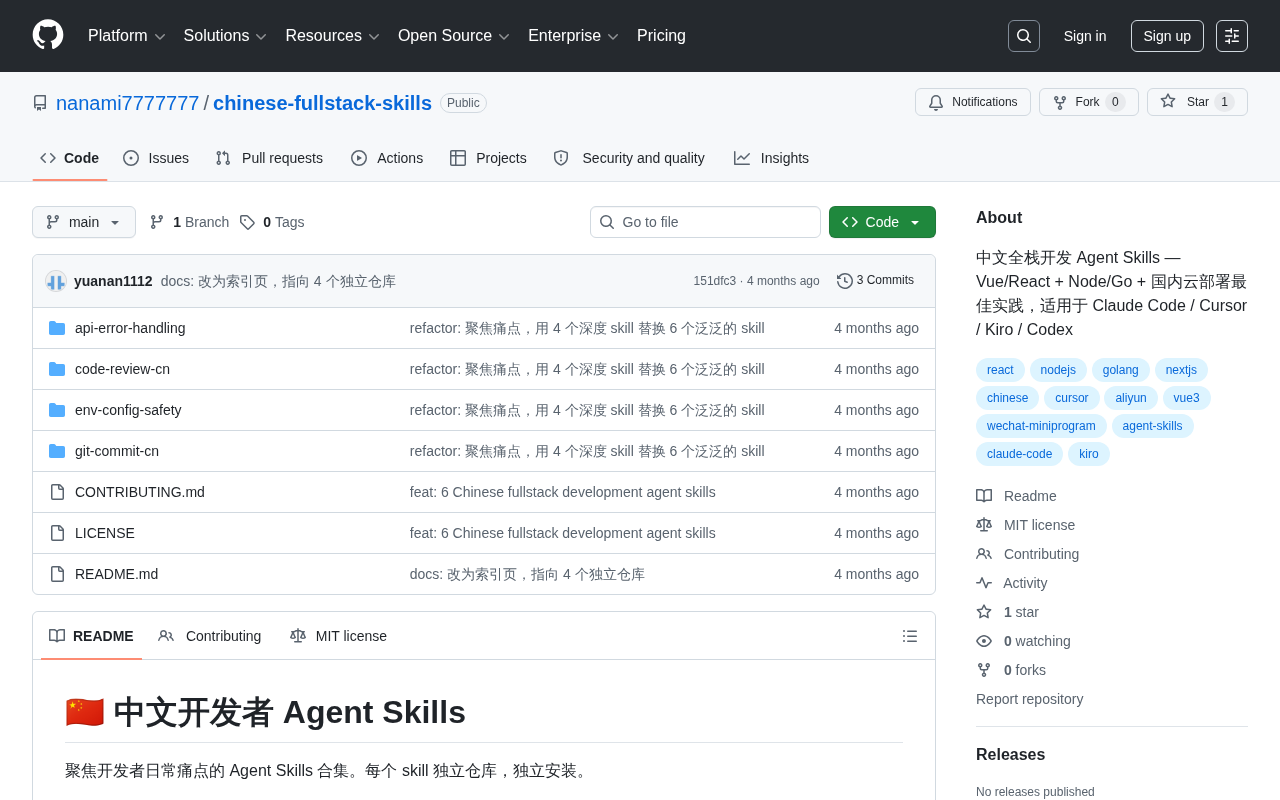
Chinese Full-Stack Agent Skills: A Skill Library Tailored for Domestic AI-Assisted Development
chinese-fullstack-skills is an Agent Skills library for Chinese full-stack development, covering Vue/React, Node/Go, and domestic cloud deployment best practices. Compatible with Claude Code, Cursor, Kiro, and Codex.
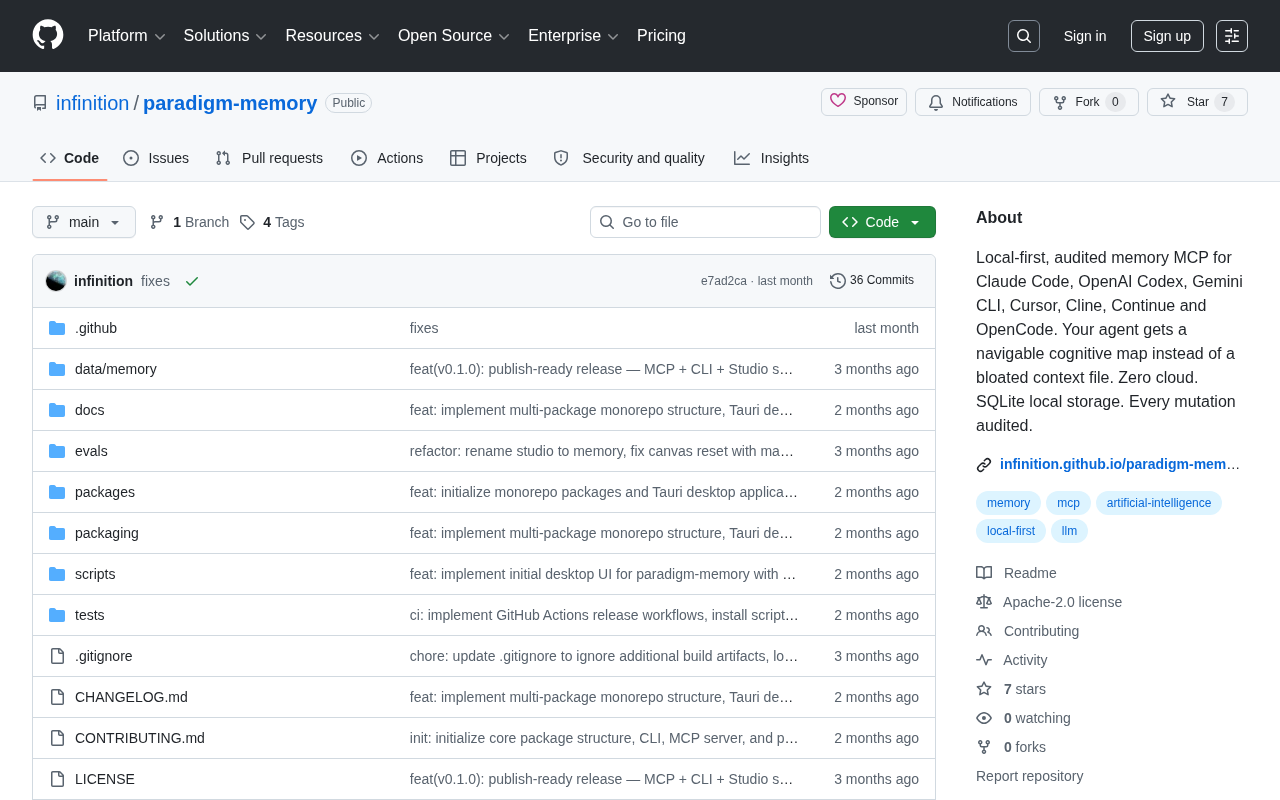
Paradigm Memory: A Local-First Memory System for AI Coding Assistants
paradigm-memory is a local MCP memory tool for Claude Code, Cursor, and Cline. It uses SQLite local storage, zero cloud, full audit trails, and a navigable cognitive map instead of bloated context files.