65 AI Viewers Gang Up on a Claude Player: An AI Streamer Experiment

65 AI viewers watch an AI player game, exposing the real state of multi-agent systems.
A developer had Claude Opus play a game while 65 Sonnet-driven AI viewers watched and roasted it in Twitch chat. The experiment used a three-layer structure: three Sonnet agents each managed haters, trolls, and chaos trolls factions, with each viewer having an independent persona and memory file, picking one line from candidates each round. AI viewers spontaneously formed inside jokes like "who asked," showing that persona emergence depends on memory accumulation and group interaction rather than a single prompt. Most alarming was the Moderator role: it blocked only 3 out of 1,060 messages and missed a fake link and a real name. The experiment shows multi-agent performance is convincing enough to pass as real, but moderation fallback and system reliability still require human intervention—performance and reliability must be evaluated separately.
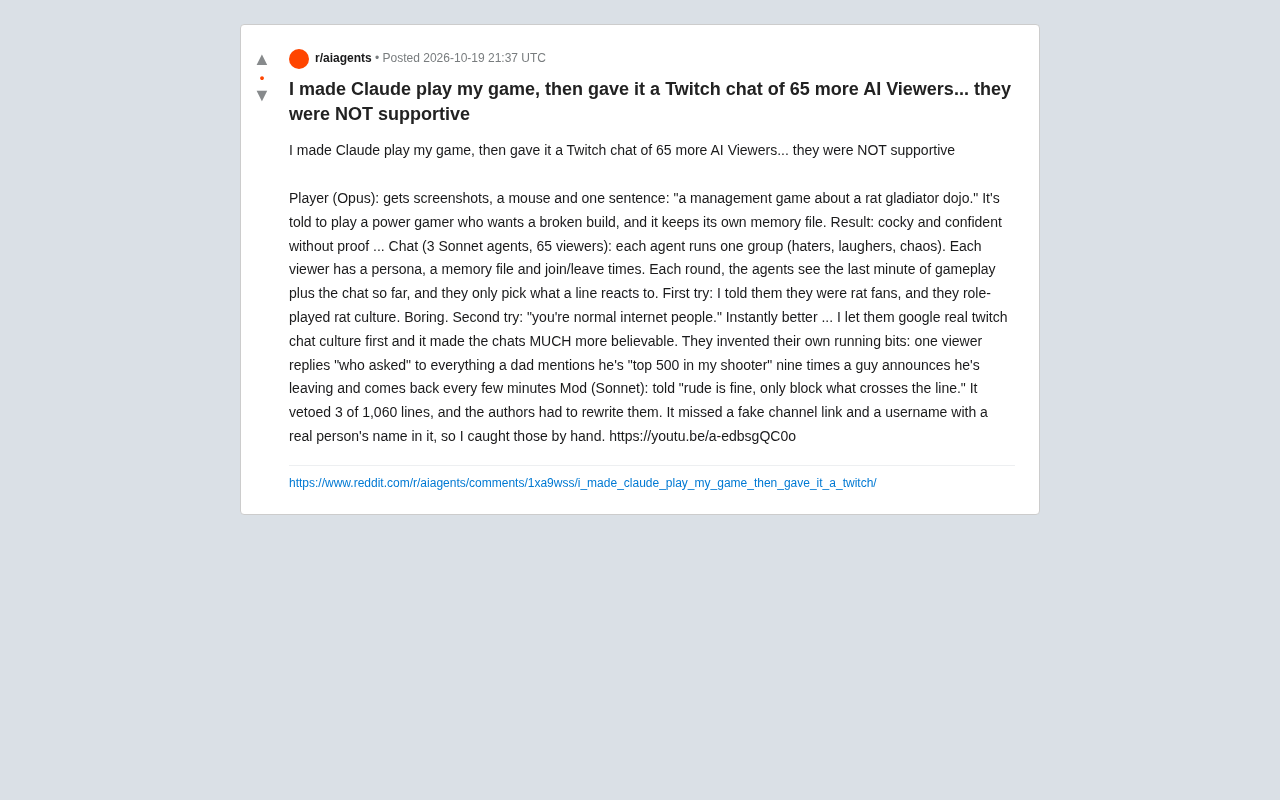
A developer turned Claude Opus into a player, then dropped 65 Sonnet-powered AI viewers into a Twitch chat room to watch and roast the AI player's gameplay. The results of this experiment say more about the real state of today's multi-agent systems than any single-AI benchmark—they can act convincingly, but they're still orders of magnitude away from "trustworthy" in terms of engineering detail.
Experiment architecture: one player, three chat legions, sixty-five faces
The player side was just Claude Opus, with minimal input: game screenshots, a mouse control interface, and a one-line setup—"a management game about a mouse gladiator gym." It was asked to play a hardcore gamer pursuing a "destructive build" and to maintain its own memory file. How did it perform? The original's assessment was blunt: "cocky and confident without proof."
The chat side used a three-layer structure. Three Sonnet agents each commanded a faction: haters, trolls, and chaos trolls. Each viewer had an independent persona, memory file, and entry/exit times. Each round, the three agents could only see the last minute of gameplay footage and the existing chat log, then picked one line from a set of candidate lines to send. This "select, don't write" design constrained generation freedom and made the chat pace closer to a real livestream.
You might not have noticed: the first version's setup was "you are mouse fans," and the AIs earnestly role-played mouse culture—painfully boring. After switching to "you are just ordinary netizens," quality took off immediately. The developer also had them search real Twitch chat culture first, which greatly improved chat believability.
Why use a "select, don't write" line-selection mechanism
Letting the LLM freely generate chat lines directly creates two problems: first, high generation latency—65 viewers each writing a line per round is hard to bear in both cost and time; second, style drift—models tend to write complete, polite, overly informative sentences, unlike real bullet comments. The developer changed it so each viewer "picks a line" from a preset pool of candidate lines—essentially downgrading a generation task to a classification/ranking task. The benefits: a single call only needs to output one choice, greatly reducing latency and token consumption; meanwhile, candidate lines are pre-polished by humans or stronger models, guaranteeing a floor for chat style. The cost: diversity is limited by the size of the line pool, viewers' room for "improvisation" is compressed, and emergent behavior manifests more in "when to pick which line" than in "what to say." This also explains why inside jokes form—the same line being repeatedly selected is itself a reinforcement mechanism.
AI viewers grew their own "memes"
The really interesting part is that these AI viewers spontaneously developed inside jokes. One viewer replied "who asked" to any dad-post mentioning "I'm top 500 in shooter games," and that line was used nine times. Another viewer announced "I'm leaving" every few minutes, then immediately came back. These behaviors weren't hardcoded in the prompt; they emerged from multiple agents interacting through memory files and context.
This points to an underappreciated fact: the "personality" of a multi-agent system isn't shaped by a single prompt, but grows through memory accumulation and group interaction. A single AI struggles to maintain long-term consistency, but when each viewer has a memory file and can see each other's chat logs, repetitive behavior self-reinforces, forming a style similar to a real community.
However, the original doesn't provide stability data for these emergent memes—whether they can be reproduced across different sessions remains unknown.
The limits of the moderation AI: only 3 out of 1,060 blocked
The most alarming finding from the whole experiment came from the Moderator role. The developer's instruction was "rudeness is fine, only block content that crosses the line." Out of 1,060 chat messages, it only vetoed 3, forcing the original author to rewrite. But more critical were the ones that slipped through: a fake channel link and a username containing a real person's name—the Moderator blocked neither, and they were only caught by human review.
This result aligns with the general industry understanding of LLM content moderation—models are sensitive to explicit profanity but struggle with violation types requiring external knowledge comparison, such as disguised links and doxxing information. The developer's own conclusion acknowledges that human fallback is indispensable.
From an engineering perspective, the value of this experiment isn't proving AI can be a streamer or viewer, but exposing the most easily overlooked links in multi-agent collaboration—memory management, group persona emergence, and moderation fallback—all in a controllable sandbox. The performance of 65 AI viewers is already convincing enough to pass as real, but the two items the Moderator missed remind everyone: performance quality and system reliability are two things that must be evaluated separately.
See the original link for the full experiment video.
The capability boundaries of LLM content moderation
Using an LLM for content moderation is essentially treating it as a zero-shot classifier: given a rule description and text to review, determine whether it violates rules. This approach performs reasonably on semantic-level violations (hate speech, harassment, explicit profanity) because pretraining corpora make models sensitive to these patterns. But what's truly dangerous in moderation tasks are categories requiring "external fact-checking": phishing links disguised as normal text, spliced and obfuscated names and contact information, and known violating accounts that can only be identified via platform blacklists. Such content is semantically harmless, and the model has no reason to block it unless connected to a URL reputation database, PII detector, or rule engine for secondary verification. The common industry practice is a three-layer pipeline: "LLM initial review + rule/blacklist hard blocking + human spot checks"—a single Moderator role is essentially only the first layer. Blocking only 3 out of 1,060 could mean the rules were too loose, or the model over-generalized "rudeness is fine" into "let almost everything through."
Memory files in multi-agent systems
Each AI viewer maintaining an independent memory file is the key design that enabled this experiment to produce long-term consistent behavior. LLMs are stateless by nature with limited context windows; stuffing all history into the prompt every time would cause costs and noise to spiral out of control. The common approach for memory files is compressing historical interactions into structured entries (e.g., "this user once said X," "this user hates Y"), then retrieving relevant fragments to inject into the prompt before each round of generation. This lets agents still remember "I said I was leaving last time" dozens of rounds later, thereby reproducing the same behavior. But memory also brings risks: erroneous memories get repeatedly reinforced, forming hard-to-correct biases; the chat logs shared across multiple agents also create an "echo chamber" where a meme self-amplifies within the group. The emergent inside jokes mentioned in the original are precisely the result of memory accumulation and group visibility working together, but stability data for cross-session reproduction is currently lacking.
One-line Summary
65 AI viewers watch an AI player game, exposing the real state of multi-agent systems.
Paragraph Summary
A developer had Claude Opus play a game while 65 Sonnet-driven AI viewers watched and roasted it in a Twitch chat. The experiment used a three-layer structure: three Sonnet agents each managed haters, trolls, and chaos trolls factions, with each viewer having an independent persona and memory file, picking one line from candidates each round. AI viewers spontaneously formed inside jokes like "who asked," showing that persona emergence depends on memory accumulation and group interaction rather than a single prompt. Most alarming was the Moderator role: it blocked only 3 out of 1,060 messages and missed a fake link and a real name. The experiment shows multi-agent performance is convincing enough to pass as real, but moderation fallback and system reliability still require human intervention—performance and reliability must be evaluated separately.
Related articles

WorkBuddy Full Tutorial: Build an AI Office Automation Agent from Scratch
A complete WorkBuddy tutorial: installation, three working modes, multimodal picture book video practice, expert team agent building, and workflow configuration for low-cost AI office automation.

WorkBuddy Agent Complete Guide: From Beginner to Automation in 7 Days
Based on Bilibili's 256-episode WorkBuddy masterclass, this systematically breaks down Tencent's AI office workbench core capabilities: Agent principles, Skill encapsulation, cross-platform connectors, scheduled automation, knowledge bases, and zero-code development, with learning path recommendations.

8 AI Accounts, 7 Failed: An Honest Review of Using AI to Get Work Done
Only 1 of 8 AI-run Bilibili accounts succeeded. We break down the real difference between "performing AI" and "using AI to get work done."