7.8x More Expensive: US Tech Giants Are Collectively Pivoting to Chinese Open-Source AI

US enterprises shift AI workloads to open-source as closed-source models cost 7.8x more per token.
Per Financial Times, CNBC, and AI gateway data, US enterprises are undergoing a real AI cost migration: open-source model token share jumped from 7% to 56% on one gateway in eight months, with Chinese open-source models hitting 57–67% weekly share on OpenRouter. The primary driver is price — closed-source averages 7.8x the cost of open-source per token. AT&T, PNC, Siemens, and others have moved 40%+ of workloads to open-source, with data security as an additional hard requirement. DeepSeek, Qwen, and Zhipu AI lead the open-weight market, now competitive even on coding tasks.
A migration happening in production environments is reshaping the cost landscape of AI. This is no longer a rallying cry from developer communities — it's reality being written into the earnings calls of American corporations. Based on first-hand data from the Financial Times, CNBC, and AI gateway platform Fireworks, a set of verifiable numbers paints a clear picture of a collective shift among US enterprises.
Four Numbers That Define a Real-Money Migration
The first number comes from an AI gateway platform: open-source models now account for 56% of tokens processed on that gateway, up from just 7% — an eightfold increase in eight months. The second comes from OpenRouter — during the week of mid-September, Chinese open-source models captured 57% to 67% of usage. The third is the most direct: for the same token, the average price of closed-source models is approximately 7.8 times that of open-source models. The fourth comes from dating app Tinder, whose AI bill surged from $1 million per year to $10 million per year within six months.
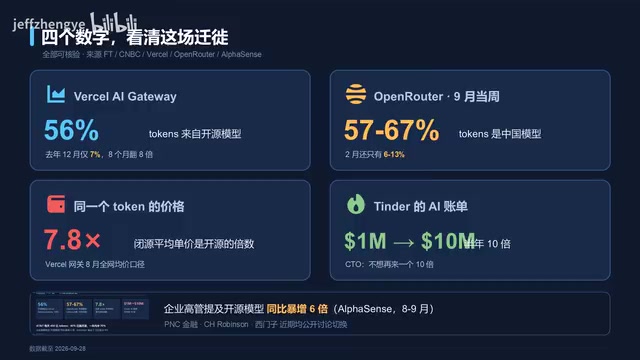
It's worth emphasizing that OpenRouter's data covers the US, Europe, and 82 developing countries, with US enterprises contributing roughly half of total usage. This is not a regional phenomenon of "Chinese users running Chinese models" — it's a genuine substitution happening in production environments worldwide. The number of times enterprise executives publicly mentioned open-source models surged sixfold year-over-year. Verbal endorsement is turning into actual API call volume.
Why Switch? The Core Reason Is Simple: Cost
The primary driver of this migration is cost. For the same token, closed-source models average 7.8 times the price of open-source alternatives — a gap that gets dramatically amplified at scale.
Tinder's CTO was blunt about it: in January, the bill was in the $1 million per year range; by July, it had climbed to $10 million per year. His judgment is even more telling — frontier model intelligence is "good enough" for 90% of tasks, and once open-source models catch up on those tasks, he may no longer need closed-source models at all.
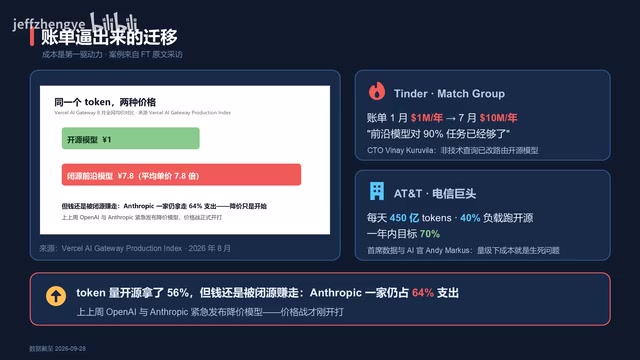
Telecom giant AT&T has gone even further. Processing roughly 45 billion tokens per day, it has already shifted 40% of its workloads to open-source models and plans to reach 70% within a year. There's an interesting paradox, though: while open-source has captured half the volume, closed-source vendors are still taking most of the money — Anthropic alone accounts for 64% of spending. This is precisely why OpenAI and Anthropic both rushed out discounted models in the same week. The price war has only just begun.
Who's Switching — And Cost Isn't the Only Motive
The list of enterprises actively making the switch carries real weight: AT&T in telecom, PNC in finance, C.H. Robinson in logistics, Siemens in industrial, and Digital Realty in data center operations.
Beyond cost, data security is another hard requirement. Digital Realty's head of architecture put it plainly: customer data never touches a closed-source frontier model. They have already built an internal chat interface using open-source models, routing requests between the two model types based on data sensitivity.
The technical path for migration is also well-established: take an open-source model, fine-tune it on proprietary data, achieve performance that matches or even exceeds closed-source models on specific tasks — at a fraction of the cost. This "open-source fine-tuning + sensitivity-based hybrid routing" approach is quickly becoming the enterprise standard.
The technical logic behind this approach is worth unpacking. Fine-tuning refers to taking a pre-trained large model and running a second training pass using a company's own domain-specific data, enabling significantly better performance on targeted tasks without the massive compute costs of training from scratch. Hybrid routing adds an orchestration layer at the application level that automatically decides — based on request type, data sensitivity, or required intelligence level — whether to send a request to a local open-source model or a cloud-based closed-source model. Sensitive customer data stays on local open-source infrastructure; only complex tasks requiring top-tier reasoning get routed to frontier closed-source models. This architecture lets enterprises strike a dynamic balance between compliance, cost, and capability, rather than making a binary either-or choice.
One Month: Data, Policy, and Narrative All Fall Into Place
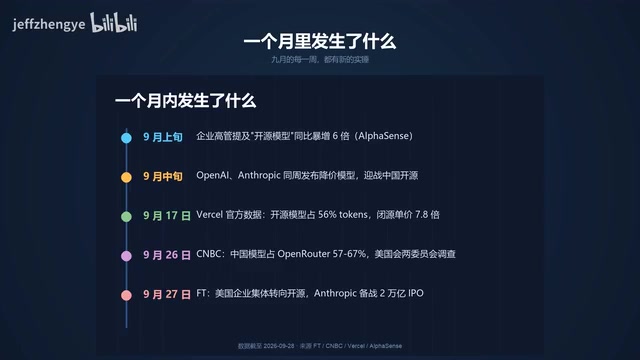
Looking at September's timeline in sequence, the pace is striking. In early September, executive mentions of open-source models surged sixfold year-over-year. In mid-September, OpenAI and Anthropic released discounted models in the same week to counter Chinese open-source competition. On September 17, gateway platform data showed open-source capturing 56% of tokens. On September 26, CNBC reported on Chinese models' share on OpenRouter, prompting two congressional committees to launch investigations. On September 27, the Financial Times published a piece framing the story as "US enterprises collectively pivoting." Within a single month, the data, regulatory attention, and mainstream narrative all fell into place.
Supply Side: Chinese Companies Lead the Open-Weight Model Market
In the race to build open-weight large models, Chinese companies are currently out front, with DeepSeekAd, Zhipu AI, and Alibaba's Qwen series leading the pack. France's Mistral and NVIDIA are also competing on the same track.
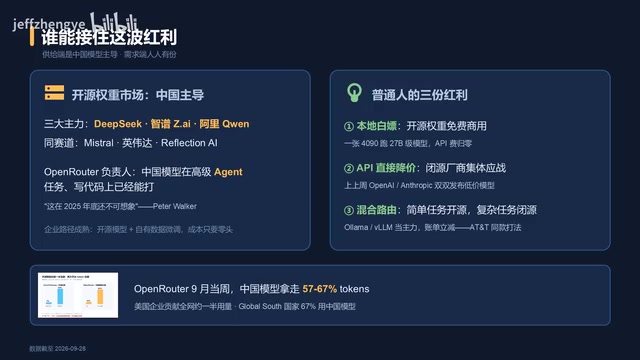
OpenRouter's head of insights noted that Chinese models are now "competitive" on advanced agentic tasks — coding in particular — something that would have seemed unimaginable not long ago. This explains why enterprises now feel confident handing off critical tasks like programming to open-source models.
The term "open-weight model" refers to models where, after training, the developer publicly releases the neural network's parameter weights — the numerical representation of everything the model has learned — under an open license. Unlike traditional open-source software that only releases code, publishing weights means anyone can download the complete model, run it on their own hardware, fine-tune it with private data, and pay zero per-call fees to the original developer. Models like DeepSeek-R1 and the Qwen series are released in this form, which is the technical prerequisite for enterprise self-deployment and eliminating API costs entirely. By contrast, OpenAI's GPT series and Anthropic's Claude series only offer API access — users cannot obtain the weights, cannot run them on independent infrastructure, and must have their data processed through the vendor's servers. This is the fundamental reason why data-security-sensitive enterprises like Digital Realty are choosing the open-source route.
What's in It for Everyday Users?
This migration affects the wallets of anyone using AI. Ordinary users stand to gain at least three things.
Local deployment: Open-weight models are free for commercial use. A single RTX 4090 can run models with up to 27 billion parameters, bringing API costs to zero.
Price cuts: Closed-source vendors are universally dropping prices, meaning the same budget now goes further.
Hybrid routing: Routing simple tasks to open-source and complex ones to closed-source — the same playbook AT&T is running — balances cost and capability.
Conclusion: Cloud Computing's Old Playbook Is Repeating
In eight months, open-source models have captured half the traffic on major gateways. Closed-source costs 7.8 times more per token. US giants have moved from verbal endorsement to formal discussion in earnings calls. The cost curve of AI is replaying the same logic that once saw cloud computing displace on-premises data centers — and the price war has only just begun.
Data as of September 28, 2026. Sources: Financial Times, CNBC, and AI gateway platform official data. Some company and platform names may have transliteration uncertainties based on original source material.
The article's comparison of this migration to cloud computing replacing on-premises infrastructure has a specific historical referent. Between roughly 2006 and 2015, enterprise IT infrastructure underwent a massive shift from "buy your own servers, build your own data centers" to "rent compute on demand from AWS, Azure, or GCP." The core driver was the same: a cliff-edge drop in the cost curve combined with maturing technology capabilities. What's happening in AI today is the mirror image of that logic — then it was a shift from high fixed-cost on-premises infrastructure to flexible cloud, now it's a shift from high per-unit closed-source APIs to self-deployable open weights. Both migrations accelerated once the "good enough" performance threshold was crossed. Notably, the cloud migration took nearly a decade to complete, whereas this AI cost shift achieved a leap from 7% to 56% in just eight months — the speed of technology diffusion is simply not comparable.
Related articles

Cursor AI Programming in Practice: Build a Student Management System from Scratch in 30 Minutes
A Bilibili creator demonstrates Cursor AI programming: generating a student management system in 30 minutes with natural language. Details on Agent mode, Claude selection, prompt techniques, and thresholds.

Top 20 AI Coding Tools Ranking: From Rock-Solid to Lackluster, a Scored Matrix
Bilibili creator releases top 20 AI coding tools ranking, tiered T0–T4 from rock-solid to lackluster, with Claude Code and Codex tied at T0. This article details the scoring dimensions (capability, reliability, robustness, durability, cost, domestic availability) and tool performances to help developers choose the right AI coding assistant.

Vibe Coding Systematic Tutorial: Master AI-Assisted Programming from Zero
A three-month Vibe Coding tutorial from a Bilibili creator covering Codex, ClaudeCode, and Cursor, from core logic to commercial project practice for beginners.