Top 20 AI Coding Tools Ranking: From Rock-Solid to Lackluster, a Scored Matrix

Bilibili creator uses a six-dimension weighted scoring system to tier 20 AI coding tools from T0 to T4, with Claude Code and Codex tied at the top.
The article breaks down the Bilibili creator's ranking of 20 AI coding tools. The scoring system is weighted by coding capability (30%), reliability on routine tasks (20%), robustness (15%), durability (10%), cost controllability (10%), domestic availability (10%), and 5% subjective model experience, attempting to quantify a tool's overall strength rather than just coding capability. The ranking is divided into five tiers: Claude Code and Codex tied at T0 with 8.4 points; Cursor and Gemini in T1; Kimi, Copilot, and others forming the T2 mainstay; Continue, Baidu Comet, and others in T3; T4 is not recommended. The article also analyzes each tool's highlights and shortcomings, emphasizing availability and cost as two practical thresholds for domestic developers, and notes that the ranking is for reference only—choice should consider network, budget, and compliance scenarios.
AI coding tools are launching left and right, but which ones are actually good? In a recent tutorial, a Bilibili creator scored 20 tools on a table ranging from "rock-solid" to "lackluster," and laid out detailed scoring dimensions and weights. This article breaks down the logic behind that ranking based on the video content and shares the notable tool performances worth paying attention to.
Scoring Dimensions: A Six-Dimension Weighted Game
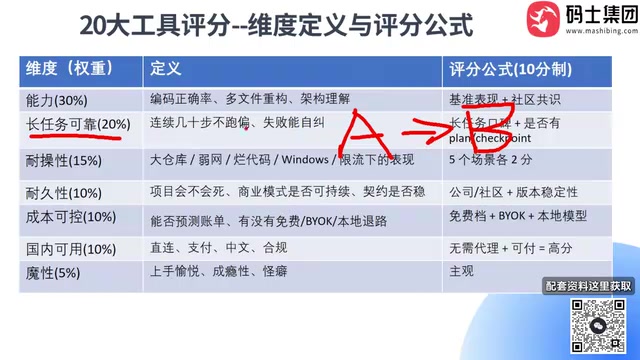
The creator breaks scoring into six dimensions, each with a different weight: coding capability (30%), reliability on routine tasks (20%), robustness (15%), durability (10%), cost controllability (10%), and domestic availability in China (10%), plus a 5% model experience score (subjective feeling). The composite score is the weighted sum of all dimensions.
- Capability: Examines code correctness rate, multi-file refactoring, and architectural understanding, scored based on public benchmarks and community consensus.
- Reliability on routine tasks: Focuses on whether the tool "goes off track" during tasks spanning dozens of consecutive steps, and whether it can self-correct after errors. Scoring mainly looks at community reputation and whether the tool's source code includes mechanisms like plan/checkpoint.
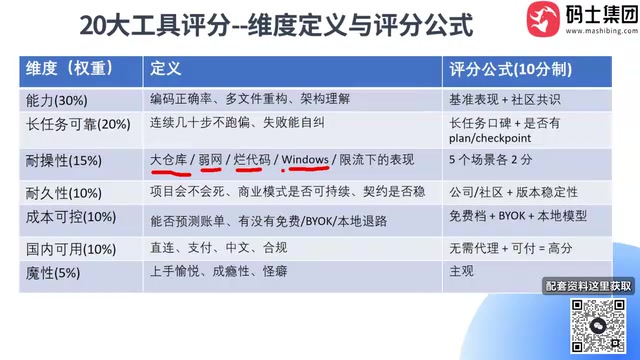
- Robustness: Takes the two highest scores across five scenarios (large repositories, weak networks, messy code, Windows compatibility, rate limiting), reflecting engineering ruggedness.
- Durability: Assesses whether the company or community behind the tool can sustain maintenance, including business model and version stability.
- Cost controllability: Whether it's free, whether it supports BYOK (bring your own model key), and whether it can be deployed locally.
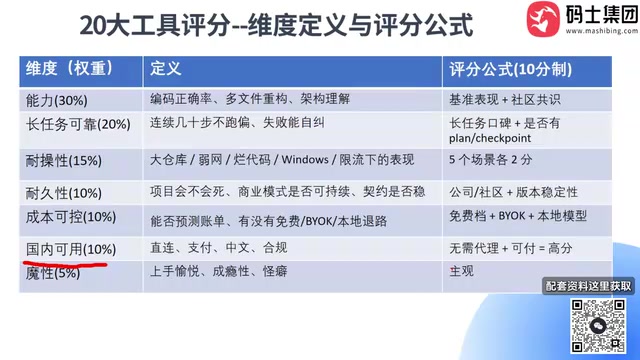
- Domestic availability in China: Whether a proxy is needed, whether payment is convenient, Chinese-language scenario support, and enterprise compliance.
This system attempts to quantify a tool's overall strength rather than just coding capability alone.
BYOK (Bring Your Own Key) refers to users bringing their own model API key to access the tool, rather than being forced to purchase the tool's official subscription or quota. For developers, BYOK means freely choosing the underlying model (such as using a domestic model key instead of an overseas model), paying based on actual token usage with more transparent and controllable costs; it also avoids the price hikes or service shutdown risks that come with a tool being locked to a single model vendor. The ranking treats BYOK as an important bonus in the "cost controllability" dimension precisely because it gives users the initiative in cost flexibility and model replaceability.
Local deployment refers to running the model or tool on your own servers, private cloud, or even personal computer, keeping data within the internal network. It is both a cost measure (marginal cost of open-source models approaches zero) and a compliance measure—code doesn't pass through third-party servers, avoiding data export and confidentiality risks. The trade-off is that you need to provide your own compute, model capability is usually weaker than cloud flagship models, and you bear the maintenance costs yourself.
Ranking Tiers: T0 Rock-Solid, T1 Near-Top, T2 Mainstay, T3 Ordinary, T4 Lackluster
Based on composite scores, the 20 tools are divided into five tiers:
T0 Rock-Solid (8.4 points)
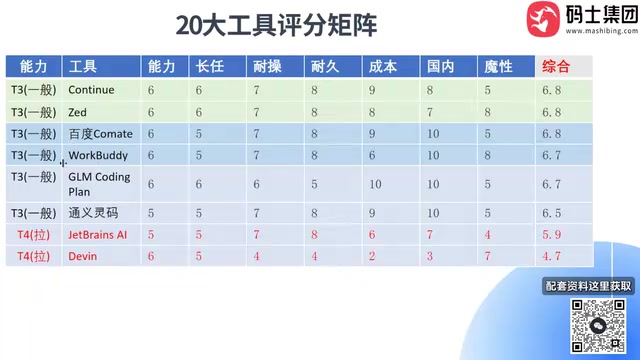
Only two tools: Claude Code and Codex, both with a composite score of 8.4. They score near-perfect (9+) on coding capability and reliability on routine tasks, representing the current highest level of AI coding tools and directly usable in production environments.
T1 Near-Top (7.5–7.8 points)
Cursor (7.8) and Gemini (7.5). They are production-ready but still have a gap with T0. Cursor scores highest on model experience with strong user stickiness; Gemini relies on Google's ecosystem.
T2 Mainstay (around 7 points)
Includes Kimi, Kilo, Codeium, OpenCloudTrain, Copilot, Adder, DeepSeekAd Harness, and others. These tools are basically sufficient for daily use but lack core competitiveness, making them suitable as aids.
T3 Ordinary (around 6 points)
Continue, Zed, Baidu Comet, WorkBody, GLM Tongyi Lingma, and others. They are often only suitable for specific scenarios, with overall capability a notch lower. The video mentions WorkBody has been popular recently, but because it leans toward AI office work rather than pure coding, it scores low on a coding ranking.
T4 Lackluster (not recommended)
Only two tools are listed; the creator says that if expanded to 30 or 40 tools, the not-recommended list would be longer.
The terms "rock-solid" (夯) and "lackluster" (拉) in the ranking are internet slang: "夯" originally means tamping the foundation, extended to mean solid, reliable, and genuinely capable; "拉" is short for "拉胯," meaning poor performance and falling short. The creator's T0-to-T4 layering borrows the common tier ranking method from gaming or hardware circles, where T0 is the highest tier and larger numbers mean lower tiers. The advantage of this layering is that it's more intuitive than a single score—tools within the same tier have little difference, while crossing tiers means a capability gap, making it easy for readers to find their match.
Tool Highlights and Shortcomings: The Story Behind the Data
Claude Code and Codex score extremely high on coding capability and reliability on routine tasks, and their durability (backed by large companies) is guaranteed, but domestic availability in China is limited by proxy and payment issues.
Cursor has the highest model experience score, strong user stickiness, and good cost controllability (supports BYOK), but its robustness is not top-tier.
DeepSeek Harness, as a domestic open-source model tool, scores high on domestic availability, but its durability is low because the version is still unstable (preview version).
Copilot scores high on durability (backed by Microsoft), but coding capability lags behind T0.
WorkBody scores average on coding dimensions due to its positioning in office collaboration, but may be more suitable for document processing.
Domestic tools like Tongyi Lingma and Baidu Comet have advantages in Chinese scenarios and payment convenience, but overall capability still needs improvement.
Harness in the AI coding context usually refers to the "scaffolding" or runtime framework wrapped around the model, responsible for breaking user instructions into multi-step operations, calling tools, reading/writing files, executing commands, and retrying on errors. The same underlying model paired with different harnesses can have vastly different actual coding performance, so the ranking evaluates such tools separately rather than comparing models alone.
Preview version refers to a release stage where features are not yet fully stable and APIs and behavior may change with version iterations. It is usually free or low-cost, suitable for early adoption and evaluation, but not recommended for long-term reliance in critical production workflows—one reason DeepSeek Harness scores low on "durability."
Special Concerns for Domestic Developers: Availability and Cost
For domestic developers, domestic availability and cost controllability are two practical thresholds. The creator points out that many overseas tools require proxies, which not only add costs but also carry account ban risks; enterprise compliance is also a consideration—uploading code to overseas servers may violate regulations.
On cost, tools supporting BYOK and local deployment are more flexible. For example, Claude Code and Codex can be configured with keys for domestic models like DeepSeek, paying by usage; some open-source tools allow local deployment with marginal costs approaching zero.
Conclusion: The Ranking Is a Reference; Choose Based on Your Scenario
The value of this scoring matrix lies in providing a quantifiable evaluation framework. While T0 tools are strong, they may not suit every team—network environment, budget, and compliance requirements all affect the choice. For beginners, starting with T2 tools for practice and gradually transitioning to T0 may be a more pragmatic path. The creator will continue to detail each tool one by one, which is worth following.
One-line Summary
The Bilibili creator uses a six-dimension weighted scoring system to divide 20 AI coding tools into five tiers from T0 to T4, with Claude Code and Codex tied at the top.
Paragraph Summary
The article breaks down the Bilibili creator's ranking of 20 AI coding tools. The scoring system is weighted by coding capability (30%), reliability on routine tasks (20%), robustness (15%), durability (10%), cost controllability (10%), domestic availability (10%), and 5% subjective model experience, attempting to quantify a tool's overall strength rather than just coding capability. The ranking is divided into five tiers: Claude Code and Codex tied at T0 with 8.4 points; Cursor and Gemini in T1; Kimi, Copilot, and others forming the T2 mainstay; Continue, Baidu Comet, and others in T3; T4 is not recommended. The article also analyzes each tool's highlights and shortcomings, emphasizing availability and cost as two practical thresholds for domestic developers, and notes that the ranking is for reference only—choice should consider network, budget, and compliance scenarios.
Related articles

Andrew Ng Teams Up with Anthropic: A Complete Walkthrough of the Claude Code Hands-On Tutorial
Andrew Ng and Anthropic launch a Claude Code short course covering clear context, parallel sessions, MCP servers, and three hands-on projects: a RAG chatbot, Jupyter data analysis, and Figma-to-frontend.

Only Three Agent Recommendations for Beginners: ZeroStack, Claude Code, and DeepSeek Harness
Bilibili creator recommends three beginner Agents: ZeroStack for lightweight devices, Claude Code with a mature ecosystem, and DeepSeek Harness for easy plugin integration. This article outlines use cases and practical tips for each tool.

How Does an AI Agent Control Your Computer? A Full Breakdown of Hermes' Three-Layer Toolchain
Bilibili creator Xiaoyou breaks down Hermes' three-layer toolchain for operating a computer: the built-in Terminal, file modification, and code execution foundation; optional web search, vision analysis, speech synthesis, and browser/desktop control; and an external ecosystem freely extended via CLI and MCP—plus why SSH connects but still can't operate.