748-Episode AI Agent Development Course on Bilibili: A Complete Guide from Beginner to Enterprise-Level Practice

Breaking down the four-phase framework of the 748-episode AI Agent course on Bilibili, with pragmatic learning advice.
This article outlines the four-phase framework of a 748-episode AI Agent development course on Bilibili: Fundamentals builds a solid foundation in LLM API calls and environment setup; Advanced constructs an Agent system around RAG, Tool Use, memory management, and multi-agent collaboration, involving LangChain and AutoGen; Practical accumulates demonstrable experience through projects like intelligent customer service, information collection, data analysis, and office automation; Bonus provides companion materials. The article notes that the 748-episode volume is better suited as a reference library than for linear binge-watching, points out that "RAC" is a typo for RAG, and recommends hand-writing core logic with native APIs before returning to frameworks.
A 748-episode AI Agent development course on Bilibili has recently drawn attention, claiming to cover everything from environment setup all the way to enterprise-level project deployment. For developers who want to systematically master agent development but are frustrated by scattered resources, this kind of long-form structured course truly hits a pain point. This article breaks down the course's four-phase framework and, combined with the current learning path for Agent development, offers some pragmatic analysis and suggestions.
Four-Phase Course Framework: A Complete Path from Fundamentals to Practice
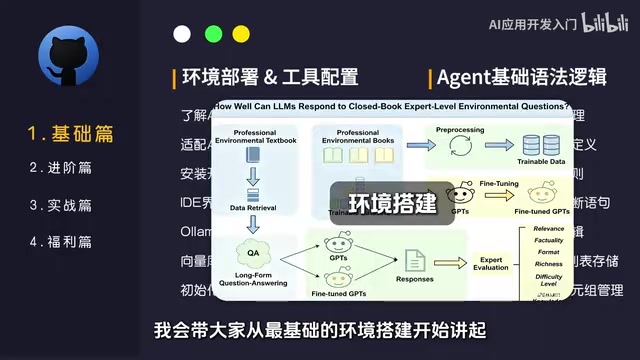
The course divides the learning route into four sections: Fundamentals, Advanced, Practical, and Bonus. The overall logic follows a progressive approach: "understand the principles first, then build the system, then do projects."
Fundamentals: Building a Solid Foundation in LLM API Calls
The Fundamentals section starts from the most basic environment setup, covering core topics such as the fundamental principles of large models, prompt engineering, and API calling methods. The course emphasizes cultivating correct AI development thinking and engineering standards, with the goal of enabling learners to independently call LLM interfaces and get their first AI application running.
This part may seem simple, but it's actually where many beginners stumble—environment configuration, key management, request parameter tuning—any single misstep can stall subsequent learning. Building a solid foundation is more valuable than rushing to use frameworks.
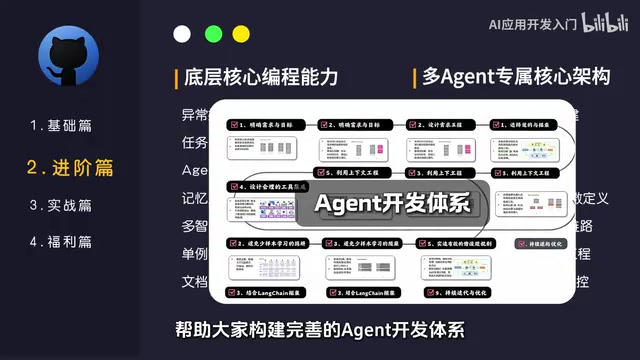
Advanced: Building a Complete Agent Development System
The Advanced section is the technical core of the entire course, covering RAG knowledge base construction, Tool Use, memory management, multi-agent collaboration, and extending to advanced features of mainstream frameworks like LangChain and AutoGen.
A note: the original text's "RAC knowledge base" is a typo for RAG (Retrieval-Augmented Generation)—learners need to identify such terminology errors on their own when following along. The value of the Advanced section lies in connecting scattered technical points into a system: RAG solves knowledge injection, Tool Use solves external capability invocation, memory management solves context continuity, and multi-agent collaboration solves complex task decomposition—these four pieces form the backbone of current Agent engineering practice.
RAG (Retrieval-Augmented Generation) is a technical paradigm that combines external knowledge bases with large models: the system first splits documents, vectorizes them, and stores them in a vector database. When a user asks a question, the most relevant fragments are retrieved and sent to the LLM along with the question to generate an answer. It solves the problems of outdated knowledge, hallucinations, and inability to access private data in large models, and is one of the most common components in enterprise-level Agent deployment. The key to understanding RAG lies in mastering chunking strategies, embedding model selection, retrieval recall, and re-ranking—any poorly designed link will lead to "answers that miss the point."
Tool Use refers to the ability of large models to autonomously decide to call external functions or APIs (such as search, computation, database queries) based on user intent and integrate the returned results. It enables Agents to break through the limitations of pure text generation and truly possess "agency." Implementation typically relies on the model's native function calling capability or on prompt constraints to output structured call instructions. The quality of tool descriptions, parameter validation, and exception handling are the main challenges in engineering Tool Use.
Multi-agent collaboration is about decomposing complex tasks among multiple role-based Agents (such as planner, executor, reviewer) working in coordination through message passing or shared state. LangChain leans toward chain-based orchestration and tool integration, while AutoGen focuses on multi-Agent conversational collaboration. Both have thick abstraction layers, making it easy for beginners to "know how to use the framework but not understand the principles." It's recommended to hand-write the core logic once using native APIs before returning to the frameworks.
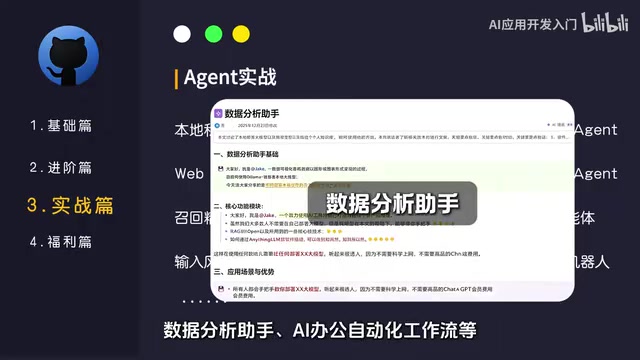
Practical: Accumulating Experience with Demonstrable Projects
The Practical section transitions from simple cases to advanced projects, including intelligent customer service Agents, automated information collection Agents, data analysis assistants, and AI office automation workflows. The course specifically emphasizes "accumulating real, demonstrable project experience"—this positioning is correct: Agent development is a typically practice-driven field, and without working projects, it's hard to prove your abilities in interviews or when taking on client work.
Things to Know Before Starting This Course
Content Volume and Learning Pace
The 748-episode volume means the content is extremely granular, suitable as a reference library rather than something to binge linearly from start to finish. A more reasonable approach: first build an index by the four sections, then locate the corresponding episodes when specific problems arise, and digest them through hands-on practice. Watching the entire course without writing code will greatly diminish the learning effect.
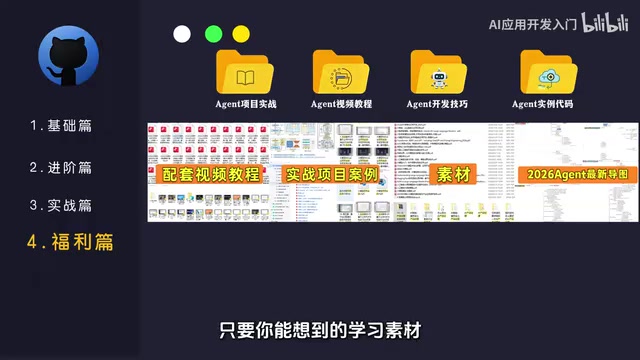
Companion Materials and Free Bonuses
The course promises companion courseware, project practice e-books, mind maps, and study plans, available for free by commenting in the comments section. For self-learners, mind maps and study plans can indeed reduce planning costs, but be mindful of whether the companion materials' versions are synchronized with the course updates.
Practical Considerations for Framework Selection
The course covers LangChain and AutoGen. Both frameworks have mature ecosystems but thick abstraction layers, making it easy for beginners to "know how to use the framework but not understand the principles." It's recommended to take time during the Advanced section to hand-write simple tool calling and memory management logic using native APIs before returning to the frameworks—the understanding will be much deeper.
LangChain is currently the Agent development framework with the largest ecosystem, providing modules such as model abstraction, tool wrappers, memory components, and retrieval chains. Its advantages are quick onboarding and many integrations; its disadvantages are multiple abstraction layers, frequent version iterations, and long debugging chains. AutoGen, launched by Microsoft, centers on enabling multiple configurable Agents to collaborate on tasks through conversation, suitable for research-oriented and multi-role scenarios. The two are not mutually exclusive and are often used together in actual projects. When learning, it's recommended to first master native API requests, function calling, and context management, then understand which layer the framework encapsulates—this way, you won't be at a loss when encountering version changes or framework migration.
Who Should Take This Course
The course is positioned as a systematic introductory course for beginners, suitable for three types of people: beginners with no Agent development experience who need a clear learning path; developers with programming foundations but no exposure to LLM application development; and technical managers who want to quickly understand the overall Agent technology landscape to inform team technology selection.
For developers with some experience, the Fundamentals section can be quickly skipped, focusing instead on the framework practice in the Advanced section and the project design ideas in the Practical section.
Some Pragmatic Judgments
"The most comprehensive and easiest to understand on the internet" is the creator's self-assessment; the actual effect depends on individual hands-on investment. The Agent development field iterates quickly, and the framework usage and best practices in the course may change with version updates—learners should cross-verify against official documentation. What truly determines learning outcomes is not how many episodes you've watched, but whether you can independently design and run an Agent that solves a real problem.
Treating this course as a roadmap and learning material library, combined with continuous hands-on practice, is the right way to approach this kind of long-form course.
One-line Summary
Breaking down the four-phase framework of the 748-episode AI Agent course on Bilibili, with pragmatic learning advice.
Paragraph Summary
This article outlines the four-phase framework of a 748-episode AI Agent development course on Bilibili: the Fundamentals section builds a solid foundation in LLM API calls and environment setup; the Advanced section constructs an Agent system around RAG, Tool Use, memory management, and multi-agent collaboration, involving LangChain and AutoGen frameworks; the Practical section accumulates demonstrable experience through projects like intelligent customer service, information collection, data analysis, and office automation; and the Bonus section provides companion materials. The article notes that the 748-episode volume is better suited as a reference library than for linear binge-watching, points out that "RAC" in the original text is a typo for RAG, and recommends learners hand-write core logic with native APIs before returning to frameworks. It concludes by defining the target audience and advocating a pragmatic attitude of cross-verifying with official documentation.
Related articles

ICLR 2027 Is Still Sending Rejection Letters: Academia's Long Struggle with AI-Generated Slop
ICLR 2027 continues to issue desk rejects for low-quality submissions, with Reddit voicing support. This article analyzes the initial screening pressure on academic conferences amid the flood of AI-generated papers, the incentive distortions in evaluation systems, and how researchers should respond.
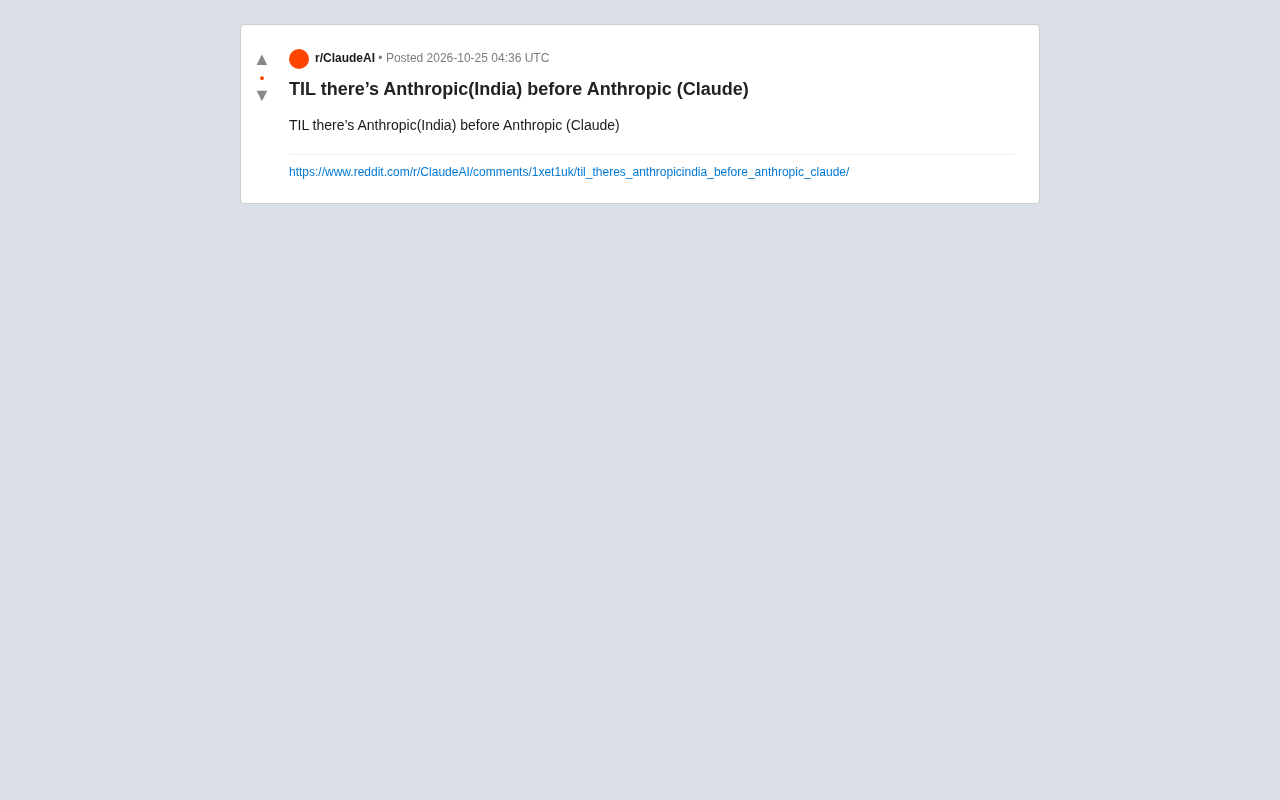
Anthropic India Predates Claude? A Curious Case Sparked by a Name
Reddit users discovered an Indian company named Anthropic that predates the AI company Anthropic, sparking discussions on brand naming and trademark protection. This article explores the story and its implications.

Qwen Image 2.1 Local 32-Test Review: Counting Fails, Anime Style Surprisingly Strong
Bilibili UP host Luke's DevLab ran 32 local tests of Qwen Image 2.1 on an RTX 5090: spelling and spatial layout are reliable, apple counting fails, anime style beats realistic human anatomy, and geometry like bicycle wheel spokes is a clear weak spot. A purple mark suspected to be training data residue appears repeatedly in generated images.