8-Node DGX Spark Cluster: A New Paradigm for Running Frontier LLMs Locally

NVIDIA builds a desktop cluster from 8 DGX Spark nodes to run frontier LLMs locally, signaling a shift from single-model calls to multi-model orchestration.
The article examines NVIDIA's developer blog experiment: an 8-node DGX Spark desktop cluster running frontier large models locally. Its significance lies not in a hardware launch but in a forming work pattern — developers orchestrate multiple models, chain inference calls, and run parallel experiments locally. It analyzes how the 8-node cluster breaks single-machine memory limits via layer or tensor partitioning, supports parallel multi-model serving and comparison experiments, and notes data sovereignty and fast iteration benefits alongside communication overhead and operational complexity. The key takeaway: desktop AI hardware is being judged less on single-machine performance and more on cluster coordination and workflow support.
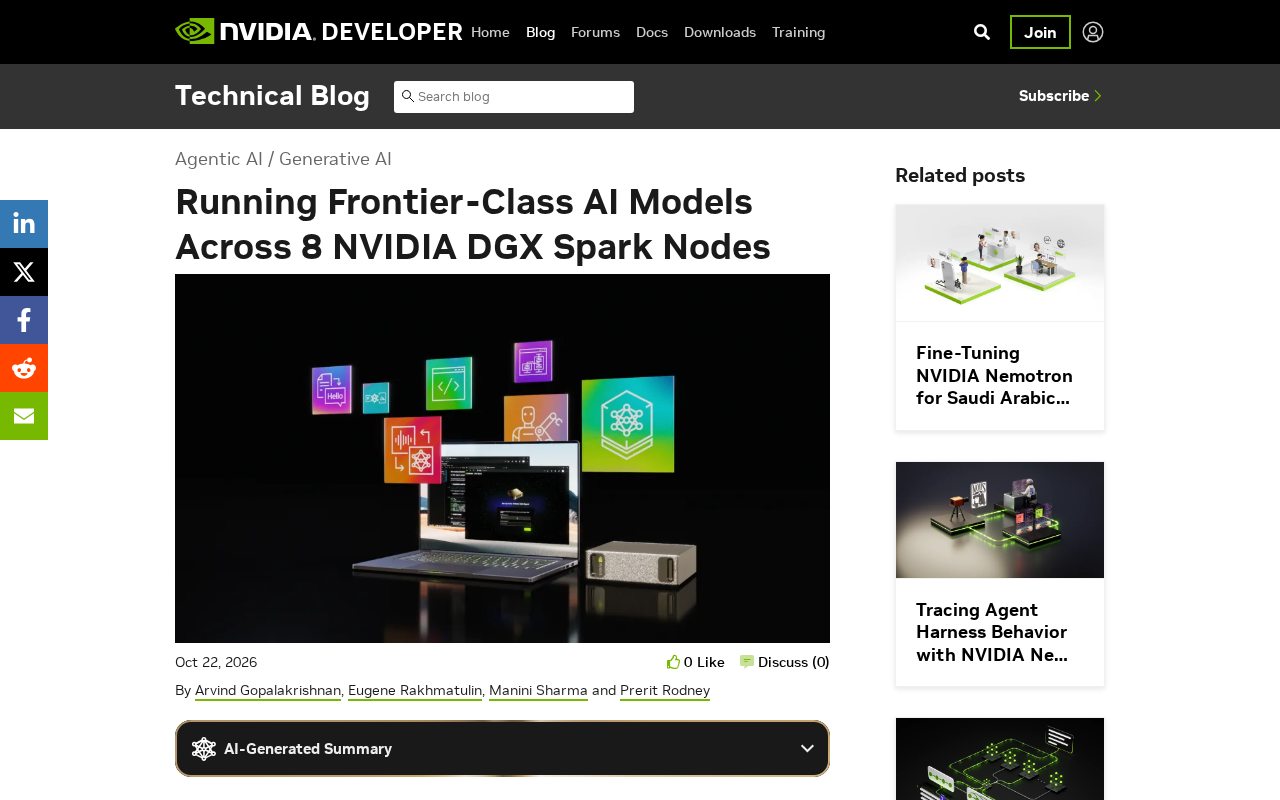
NVIDIA's developer blog recently showcased a fairly representative experiment: using 8 DGX Spark nodes to form a cluster that runs frontier-class large models locally. The significance here isn't "yet another AI workstation launch" — it points to a working pattern that is taking shape: developers no longer just call a single model, but orchestrate multiple models locally, chain inference calls, and run experiments in parallel.
From single-model calls to multi-model orchestration
The original article opens with an accurate observation: AI developers are no longer satisfied with running just one model. Multi-model parallelism, chained inference calls, and rapid experimental iteration are becoming everyday practice. This shift imposes different compute requirements than before — not peak single-GPU performance, but inter-node coordination and scalability.
DGX Spark is positioned precisely as a desktop-class AI computing device for this kind of need. Organizing 8 such nodes together essentially builds a miniature cluster at your desk, making it possible to run multi-model workloads locally that would otherwise require data center resources.
What an 8-node cluster solves
The bottleneck of running large models on a single workstation is clear: memory capacity determines how large a model you can fit, and memory bandwidth determines inference speed. When model parameter counts exceed what a single machine can hold, or when multiple models need to reside simultaneously, scaling out becomes the natural choice.
The value of an 8-node cluster shows up on several levels: models can be split across nodes by layer or by tensor, breaking through the single-machine memory ceiling; multiple models can be distributed across different nodes serving in parallel, supporting orchestration-style applications; in experimental scenarios, different nodes can run different configurations for comparison, accelerating the tuning cycle. None of these are new concepts, but compressing the scale down to desktop-class devices changes the barrier to entry entirely.
Tensor parallelism and pipeline parallelism are the two main partitioning approaches for scaling out large-model inference. Tensor parallelism (TP) splits a single weight matrix by row or by column and distributes it across devices; each layer's computation requires All-Reduce synchronization between nodes, making it extremely sensitive to interconnect bandwidth. Pipeline parallelism (PP), by contrast, cuts the model into segments by layer, with each node responsible for one segment; intermediate activations pass sequentially between nodes, so communication volume is small but pipeline bubbles and uneven device utilization easily arise. The "split by layer or by tensor" mentioned in the original article corresponds to these two strategies. Real deployments often combine the two and pair them with cross-node unified memory addressing or high-speed interconnects (such as NVLink, InfiniBand, or high-speed Ethernet); otherwise communication overhead can significantly erode the gains from scaling.
Memory capacity and memory bandwidth are two distinct dimensions constraining single-machine large-model operation. Memory capacity determines whether the parameter count plus KV Cache can fit on the device; memory bandwidth (e.g., HBM's terabyte-per-second throughput) determines the speed of weight reads during each token generation in the decoding phase, and thus directly determines inference latency. When parameters exceed the single-machine capacity ceiling, scaling out solves the "doesn't fit" problem; when insufficient bandwidth causes "runs slowly," the remedy is higher per-node bandwidth or increased parallelism. Only by understanding the difference between the two can you judge whether an 8-node cluster is compensating for a capacity shortfall or a speed shortfall.
Practical implications for developers
The most direct change is data sovereignty and iteration speed. Model weights, inference logs, and experimental data all stay local — friendlier for privacy-sensitive or compliance-heavy scenarios. At the same time, a local cluster eliminates cloud instance queuing and billing concerns, allowing experiments to run at higher frequency.
The costs are real too. Multi-node orchestration itself carries engineering complexity, communication overhead eats into some of the scaling gains, and cluster operations and cooling require additional investment. The 8-node approach suits teams with clear multi-model needs — not every developer.
Chained inference calls (inference orchestration) refers to linking multiple models or multiple inference calls in dependency order — for example, a retrieval model recalls candidates, a large model generates, and finally a validation model reviews, forming a multi-stage processing pipeline. Compared with single calls, orchestration-style applications are characterized by high concurrent request volume, widely varying resource needs across stages, and end-to-end latency determined by the slowest stage. This is exactly where multi-node clusters shine: different models can reside persistently on different nodes to avoid repeated loading, and each stage can scale independently. Correspondingly, the maturity of orchestration frameworks (such as LangChain, LlamaIndex, or custom schedulers) and the overhead of inter-stage data transfer directly affect overall throughput and latency.
Signals worth watching
NVIDIA's choice to showcase this usage on its developer blog sends a signal more important than the technical details: the narrative around desktop-class AI hardware is shifting from "can run models" to "can run workflows." As multi-model orchestration becomes mainstream development practice, the criteria for evaluating AI workstations will shift accordingly — cluster interconnect capability, inter-node bandwidth, and orchestration tool maturity — topics that once belonged to the data center will increasingly appear on developers' desks.
For teams focused on local AI deployment, experiments like this provide a valuable reference point: running frontier models locally is no longer merely a theoretical possibility.
Related articles

Build an AI Super Employee System at Zero Cost: A Full Breakdown of Automated Agent Workflows
A deep breakdown of the AI super employee system demoed on Bilibili: agent orchestration, digital human voiceovers, map and enterprise lead generation, 24/7 customer service, and legal modules. We analyze the business logic and compliance risks behind zero-cost signup to help entrepreneurs judge the real ROI of this AI digital employee system.

The Essential Difference Between Chatbots and AI Agents: Crossing from Conversation to Execution
What's the difference between a chatbot and an AI agent? Based on the MCP series on the Learn Tech channel, this article uses examples like booking flights and summarizing notes to explain: a chatbot only gives answers, while an agent actually completes tasks through a think-act-observe loop. It breaks down the four core components—model, tools, memory, and goal—as well as MCP's role as a bridge, and discusses agents' applicable boundaries and permission risks.

Free GitHub Repo: 342 Hours of AI Courses, from Math to MCP Servers
A free GitHub repo offers 342 hours of AI courses: 523 lessons across 20 phases, from math fundamentals to agent building and MCP servers. Nearly 100,000 learners have started.