A 12GB GPU Running a 125B Parameter Model? Stratavie Setup & Benchmark Walkthrough

Stratavie runs a 125B-parameter MoE model on a 12GB gaming GPU using sparse activation and layered hardware.
Alibaba's Qwen3.8 Flash Next has 125 billion parameters and weighs 354GB at full precision — normally requiring workstation hardware. The open-source Stratavie engine makes it run on a 12GB gaming GPU by combining MoE sparse activation (only 6B parameters active per token), GSQ-RCO layer-wise quantization (compressing to 66–84GB), a four-tier storage system across GPU/RAM/CPU/SSD, and speculative decoding for a 1.6–1.8× speed boost. An RTX 5070 achieves 94 tokens/sec. Trade-offs include some precision loss, limited concurrency, startup latency, and model-architecture lock-in.
How a Gaming GPU Can Run a Flagship Model
A 125-billion-parameter model weighs in at 354GB in full precision — conventional wisdom says you'd need workstation-grade hardware to run it. But Bilibili creator "大树大" offered a different answer in a recent setup video: a gaming GPU with just 12GB of VRAM, paired with 64GB of system RAM, is enough to run this flagship model on a regular gaming PC, achieving a measured generation speed of 94 tokens per second.
The topic caught fire partly because of a Zhihu trending question — "How can 12GB possibly run 125 billion parameters?" — which has since racked up 46,000 views, 15 answers, and 211 upvotes on the top response. The core logic isn't magic: it's not about cramming 125 billion parameters into 12GB of VRAM — it's about turning the entire PC into a storage and compute system for the model, with each component playing its own role.
The star of this episode is Stratavie 0.1.41, an open-source inference engine released under the MIT license. It has over 18,400 GitHub stars and 216 contributors, and is purpose-built for running large MoE (Mixture of Experts) models locally. The model it targets is Alibaba's Qwen3.8 Flash Next — 125 billion total parameters, only 6 billion activated per token, with native support for a 262,000-token context window.
Four Numbers That Explain It All
To understand this setup, break the key specs down into four numbers:
- 125 billion — total parameter count; 354GB in full precision
- 6 billion — parameters actually activated per token, less than 5% of the total
- 24,576 — total number of experts; each token only calls about 10 of them
- After quantization — model size is compressed to 66–84GB

The compression comes down to the quantization method. Traditional quantization applies a single uniform precision across all layers. Here, GSQ-RCO assigns precision layer by layer based on sensitivity — higher precision for critical layers, heavy compression for redundant ones, like a "needs-based allocation" system.
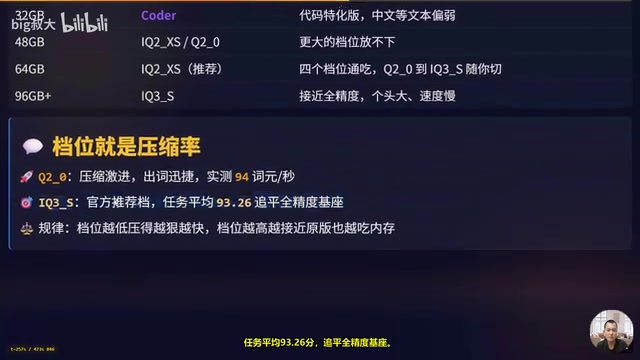
How well does it work? According to Hugging Face benchmark data cited in the video, the IQ3_S variant scores an average of 93.26 on tasks, nearly matching the full-precision baseline's 93.12. In short: cut the size by more than half, barely lose any benchmark performance.
MoE (Mixture of Experts) is the foundational concept behind this whole approach. A traditional dense model activates all its parameters for every token during inference. An MoE model splits its parameters into many independent "expert" sub-networks, with a lightweight router deciding at each step which experts to call — the rest sit idle. Qwen3.8 Flash Next has 24,576 experts, and each token activates only about 10 of them, meaning less than 5% of the total parameters are actually involved in any given computation. For inference hardware, the critical VRAM bottleneck shifts from "store all the parameters" to "quickly locate and call the right experts." This architectural difference is the fundamental reason a 12GB GPU can theoretically handle a 125B-parameter model.
GSQ-RCO (a layer-sensitivity-aware quantization scheme) then solves the "fit it on disk" problem. Standard uniform quantization (e.g., all INT4 or INT8) treats every layer identically, which can introduce large errors in critical layers. GSQ-RCO pre-analyzes how sensitive each layer's parameters are to output quality, preserving higher bit-width precision for important layers while aggressively compressing redundant ones — achieving a better size-vs-accuracy trade-off. That's how it gets from 354GB down to 66–84GB while benchmark scores barely budge.
Four-Tier Storage: Where Does Everything Live at Runtime?
Quantization solves the size problem, but where do all these parameters actually live when the model is running? The creator explains it with a "four-tier warehouse" analogy.
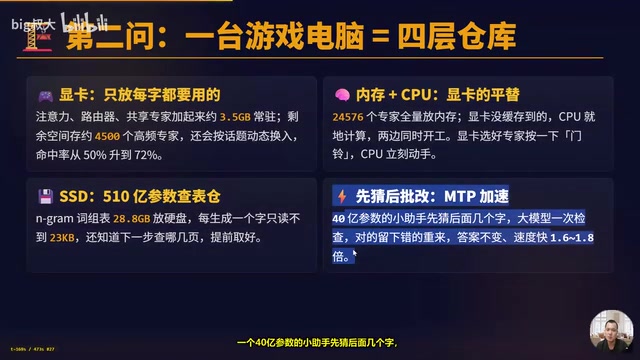
Tier 1 — GPU (~3.5GB resident): Only what's needed for every single token lives here — attention mechanisms, the router, and shared experts. The remaining VRAM caches roughly 4,500 high-frequency experts, which are dynamically swapped based on topic, boosting expert cache hit rate from 50% to 72%.
Tier 2 — RAM + CPU: Think of this as a fallback for the GPU. All 24,576 experts are loaded into system RAM; anything the GPU hasn't cached gets computed by the CPU on the spot. Both run simultaneously — after the GPU selects its experts, it "rings the doorbell" and the CPU immediately gets to work. Neither sits idle.
Tier 3 — SSD: About 28.8GB of parameter lookup tables and N-gram continuation tables live on the drive. Each token generation reads less than 23KB, and the engine can predict what it'll need next and prefetch it in advance.
There's also an acceleration trick called "draft then verify": a 4-billion-parameter small model guesses several upcoming tokens, the large model checks them all at once, keeps the correct ones, and redoes the wrong ones. The output is identical, but the process runs 1.6–1.8× faster.
"Draft then verify" is technically known as Speculative Decoding. The inherent bottleneck of autoregressive generation in large language models is that only one token can be produced at a time, and each must complete before the next can begin — leaving the GPU underutilized. Speculative decoding introduces a much smaller "draft model" that quickly generates several candidate token sequences, which the main model then verifies in parallel: accepted tokens are kept, rejected tokens are discarded and regenerated from the point of divergence. Since verifying multiple tokens in parallel costs roughly the same as verifying one, overall throughput improves significantly. In this setup, the 4B draft model comes from the same model family as the 125B main model, so their knowledge distributions are closely aligned and hit rates are high — delivering a real-world 1.6–1.8× speedup. The final output is mathematically equivalent to pure main-model inference, with no additional precision loss.
One-Click Installation and Tier Selection
The installation barrier is low: 12GB+ VRAM, 32GB RAM minimum (64GB recommended for all quantization tiers), 80GB of disk space (SSD preferred), Windows 10/11 or Linux, and the latest GPU drivers.
On Windows, unzip the repo and double-click the start-here batch file. On Linux, run ./setup. Just hit Enter to accept recommended options throughout. The ~70GB model downloads automatically with resume support if interrupted. On first launch, the engine loads 35–55GB into RAM, which causes 1–3 minutes of system sluggishness — that's normal. The creator also mentions a convenient shortcut: paste the install instructions directly into an AI coding assistant like Claude Code or Cursor and let it handle the setup while you walk away.
Tier selection depends on how much RAM you have:
- 32GB RAM: Recommended to use the Coder variant (specialized for code, but weaker at Chinese and other text tasks)
- 48GB RAM: Can run IQ2_XS or Q2_0
- 64GB RAM: All four tiers available, freely switching between Q2_0 and IQ3_S
- 96GB+: Go straight to IQ3_S for near-full-precision quality
The pattern is simple: lower tiers are more compressed, faster, and use less RAM; higher tiers are closer to the original model and more memory-hungry.
Benchmark Results: What Can a 12GB GPU Actually Do?
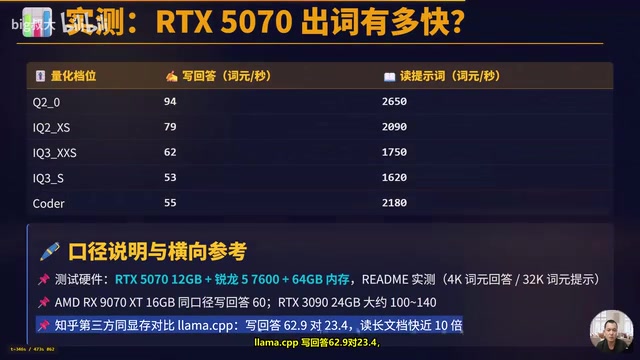
Test platform: RTX 5070 (12GB) + Ryzen 5 7600 + 64GB RAM. Test conditions: 4,000-token response, 32,000-token prompt.
Generation speed (tokens/sec):
- Q2_0: 94
- IQ2_XS: 79
- IQ3_XXS: 62
- IQ3_S: 53
- Coder: 55
Prompt processing speed drops from ~2,650 t/s on Q2_0 to ~1,620 t/s on IQ3_S.
For context: an AMD RX 9070 XT (16GB) achieves around 60 t/s generation at the same tier; an RTX 3090 (24GB) lands around 100–140. A third-party same-VRAM comparison on Zhihu shows Stratavie generating at 62.9 t/s versus Llama.cpp's 23.4, and nearly 10× faster on long-document ingestion.
Hardware compatibility is broad: NVIDIA covers RTX 20-series through 50-series; AMD covers RX 7900/7800/7700/9060/9070/6800/6900 series and more. Running two 16GB cards together also works well. Community benchmarks show an RTX 5070 Ti laptop reaching 83 t/s, an RTX 5090 desktop (32GB) hitting 207 t/s, and gaming laptops with 96GB RAM performing competitively.
Where This "Budget Setup" Hits Its Limits
Being able to run it doesn't mean there are no trade-offs. The creator honestly lists four caveats:
1. Precision gap remains: With only 12GB VRAM, you're limited to 2–3-bit quantization tiers. There is a gap from full precision. If you want the genuine full-quality experience, you still need more VRAM.
2. Concurrency is limited: By default, only one request is processed at a time; multiple requests queue up. While parallel mode can be enabled, every request will slow down on a 12GB card. The sub-agent feature in coding agents is also recommended to be disabled.
3. Startup cost: The 1–3 minute loading stall on first launch is real, and 64GB of RAM is itself a meaningful expense — you might save on the GPU, but don't forget to budget for memory.
4. Model lock-in: This approach is optimized specifically for models like Qwen3.8 Flash Next, where the active parameter count per token is low enough to fit comfortably on 12GB. Other models with a similar activation footprint (~12GB) still require a 24GB-class GPU. Support for Qwen4 is reportedly in progress.
The model lock-in caveat deserves extra emphasis. Stratavie's current optimization path depends heavily on the characteristic of "enormous total parameters, but a tiny fraction activated at any one time" — the activation ratio must be low enough that the GPU only handles a small amount of actual computation. Qwen3.8 Flash Next activating 6 billion parameters falls right in the comfort zone for a 12GB GPU. If you swap in a dense-architecture model of similar post-quantization size (where activation ratio approaches 100%), VRAM requirements multiply several times over, and the 12GB approach breaks immediately. This approach has limited applicability beyond "ultra-large sparse MoE" architectures. Before committing, verify the target model's active parameter count — not just its total parameter count or quantized file size.
A Four-Point Recap
Putting it all together: with a 12GB GPU and 64GB of RAM, a 125-billion-parameter model can run locally, with data never leaving your machine:
- Sparse activation + GSQ-RCO quantization — lets 125B parameters fit in a 12GB context
- Four-tier storage across GPU / RAM+CPU / SSD — splits the workload, speculative decoding boosts speed
- One-click setup via
start-hereor./setup— local API endpoints ready to go (OpenAI-compatible at/v1, Anthropic-compatible at/v1/messages) - Match your tier to your RAM, check your GPU against the requirements — size things up before you install
For users who want to run large MoE models locally without workstation-grade hardware, Stratavie offers a genuinely low-cost path worth exploring. But go in with clear eyes: it trades some speed and precision to make "flagship model on a gaming PC" possible. There's no free lunch here.
Related articles

Uber Deploys ChatGPT Work Company-Wide: AI in the Workplace Enters the Scaled Implementation Phase
Uber deploys ChatGPT Work to 30,000+ employees, extending it from engineering to all roles. We analyze its expert-engineer pairing, end-to-end automation, and questions of AI control and power concentration—insights for scaling AI in the workplace.

Shift at Midnight Hands-On: When "ID Verification" Becomes Alien Hunting
Shift at Midnight blends ID verification with horror survival in a four-player co-op game. We break down its inspection mechanics and chaotic humor.

Zelensky Recounts the Outbreak of War: I Need Ammunition, Not a Ride
Zelensky recalls the first day of war in a YouTube interview: farewell to family, rejecting Biden's evacuation offer with "I need ammunition, not a ride," and how Bucha shaped his stance on compromise and peace talks.