A 284B Model Running on a MacBook: The Real Breakthrough and Barriers of Local DeepSeek Inference

A 284B-parameter model runs locally on a MacBook Pro, breaking three long-held AI infrastructure assumptions.
Redis creator Salvatore Sanfilippo built a pure C inference engine that compresses the 284B-parameter DeepSeek V4 Flash model to 76GB using asymmetric quantization, achieving 26 tokens/sec on a MacBook Pro M3 Max. The breakthrough leverages MoE architecture (only 13B parameters active per token), Apple's unified memory, and a strategy of preserving routing layer precision while aggressively quantizing expert layers. Despite real barriers — $3K+ hardware costs, quantization quality tradeoffs, and geopolitical concerns — this marks the first time local inference becomes viable for serious production work.
Something That "Shouldn't Have Happened" Just Did
A 284-billion-parameter model just ran on a MacBook Pro you can buy at the Apple Store — not a cloud server, not a data center rack, but a laptop. Redis creator Salvatore Sanfilippo built a pure C engine that compresses DeepSeek's full frontier model to 76GB and achieves local inference at roughly 26 tokens per second.
What makes this remarkable is that it shatters three long-held assumptions simultaneously: frontier-scale parameters require cloud GPU clusters; open-weight Chinese models are just budget alternatives; local inference is a hobbyist's toy. And all of this comes from one model and one engine built by a single person.
This article breaks down the technical logic behind this breakthrough, the community reaction, and the real-world barriers hidden beneath the hype.
Two Events in Quick Succession
Part one of the story: DeepSeek released V4 Flash, a 284-billion-parameter model with open weights under the MIT license. This means you can download it, run it, and even ship products built on it — no additional authorization required.
The key lies in its architecture — Mixture of Experts (MoE). In simple terms, the large model is divided into many smaller, more specialized sub-networks ("experts"). For any given token, the routing layer activates only a handful of them. So while the total parameter count reaches 284 billion, only about 13 billion parameters are actually involved in computation for each token.
The theoretical roots of MoE architecture trace back to the Mixture of Experts system proposed by Jacobs et al. in 1991, originally applied to ensemble learning frameworks for shallow machine learning models. In the large language model era, Google's Switch Transformer (2021) brought MoE back into the mainstream, demonstrating the feasibility of trillion-parameter-scale sparse models. The core mechanism is "Conditional Computation": a learnable Router network dynamically decides which expert sub-networks to activate at each forward pass, rather than engaging all parameters in every computation. The deeper value of this mechanism is that it breaks the linear constraint of "parameter count = compute cost" — a model can expand its knowledge capacity by adding more experts while inference costs barely increase linearly.
DeepSeek V4's MoE implementation introduces two key innovations on top of this foundation: Fine-grained Expert Segmentation splits each expert into smaller but more numerous units, improving routing precision; Shared Expert retains a subset of experts that always participate in computation, responsible for capturing cross-domain general knowledge and preventing the knowledge fragmentation that pure sparse routing can cause. These two improvements significantly enhance routing decision quality without changing the total parameter count. Compared to dense-architecture models of the same scale, MoE can reduce theoretical floating-point computation during inference by 5 to 10 times — this is the fundamental reason local deployment becomes possible.
This is the technical fulcrum of the entire story: you get the knowledge breadth of a large model while only paying the compute cost of a small one.
Part two arrived within two weeks. Sanfilippo released an inference engine called DS4 (Dwarf Star 4), written in pure C and purpose-built to run DeepSeek V4 Flash locally on 128GB unified memory machines. A MacBook Pro M3 Max or NVIDIA's DGX Spark can handle it — no cloud, no API key, no GPU cluster needed.
The fundamental reason a MacBook Pro M3 Max can handle this task is Apple's M-series chip Unified Memory Architecture (UMA). In traditional PC platforms, CPU memory (DRAM) and GPU memory (VRAM) are two physically isolated subsystems. Consumer GPUs typically max out at 24GB of VRAM (e.g., RTX 4090), and data transfer between CPU and GPU is severely constrained by the roughly 64GB/s bidirectional bandwidth of PCIe 4.0 x16. When model weights can't fit entirely in GPU memory, the system must shuttle data back and forth between memory and VRAM, causing inference speeds to plummet due to IO bottlenecks.
Apple's UMA integrates CPU cores, GPU cores, the Neural Engine, and memory controllers onto a single SoC, all sharing one memory pool. A 128GB configuration means GPU compute units can directly address the entire memory space without cross-bus data transfers, with measured memory bandwidth reaching 400GB/s — far exceeding PCIe transfer bottlenecks. This allows the 76GB quantized model weights to reside entirely in GPU-accessible memory, with inference limited only by memory bandwidth rather than data scheduling latency. Notably, this architectural advantage isn't exclusive to Apple: High Bandwidth Memory (HBM) technology similarly eliminates this bottleneck by stacking memory on the processor die, which is the core reason A100 and H100 GPUs can support large model inference — they just cost far more than consumer products. To achieve the same effect on traditional x86 platforms requires multiple A100 (80GB VRAM) or H100 GPUs interconnected via NVLink — costing hundreds of thousands of dollars, which is precisely the commercial logic behind NVIDIA's DGX Spark.
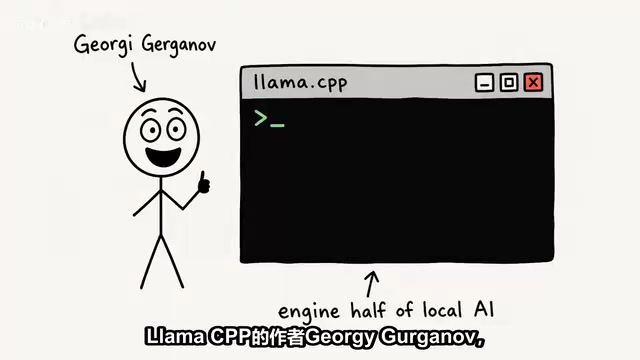
The project garnered over 13,000 GitHub stars in roughly one month. Even llama.cpp author Georgi Gurganov took notice, as did Y Combinator's CEO. When the people building standard tools and funding startups both stop to watch, something genuinely unusual is happening.
Asymmetric Quantization: Spending Bits Where They Matter
The real engineering challenge is memory. A 284-billion-parameter model at full precision requires roughly half a terabyte of memory — no laptop can hold that. Quantization is therefore essential — storing each weight with fewer bits. Going from 16-bit to 4-bit shrinks the model roughly 4x.
Model quantization is essentially a lossy compression process that maps floating-point weights to low-bit integer representations, aiming to maximize compression ratio while minimizing precision loss. Understanding this process requires distinguishing two fundamentally different quantization targets: weight quantization targets model parameters themselves, which are static during inference and can be carefully analyzed offline; activation quantization targets intermediate computation values during inference, which vary dynamically with input data and are significantly harder to handle.
Early Post-Training Quantization (PTQ) methods primarily targeted INT8, using calibration datasets to statistically analyze activation value distributions for determining quantization parameters. As large model scales ballooned, the engineering community pushed toward INT4: the GPTQ algorithm proposed by Tim Dettmers et al. in 2023 uses second-order Hessian matrix information to minimize quantization error layer by layer, becoming the mainstream industrial method for offline quantization, widely implemented in Hugging Face's AutoGPTQ library. Subsequently, the QuIP# algorithm introduced "Incoherence Processing" and vector quantization, pushing INT4 quality limits further; AQLM brought Additive Quantization Lookup Tables into weight compression, achieving superior rate-distortion performance at extremely low bit counts.
The 2-bit quantization used by DS4 sits at the extreme challenge frontier of both academia and engineering — most research shows that global 2-bit quantization leads to significant capability degradation. DS4's key insight aligns closely with Rate-Distortion Theory from information theory: given a tolerable level of distortion, the optimal encoding strategy should concentrate limited bit budget on the parts with highest information density, rather than spreading it uniformly thin.
But compression comes at a cost: quantize too aggressively and the model degrades — it starts hallucinating, looping, losing instruction-following ability. The conventional approach is to uniformly quantize all layers and accept the corresponding quality loss.
Sanfilippo didn't do that. He employed an asymmetric quantization strategy: analyzing the model structure to determine which parts can be aggressively compressed while maintaining performance, and which cannot.
- Expert layers (the bulk of the 284 billion parameters) are compressed to extreme 2-bit precision
- Routing layers, shared experts, and projection layers retain full 8-bit precision
The logic is clear: experts are numerous and redundant, with only a few called per token — losing precision on individual experts is tolerable. But routing layers have no backup — if the router errs and calls the wrong experts, every downstream answer will be skewed, no matter how precise the experts themselves are. The deeper insight of this strategy is that MoE architecture itself provides a natural redundancy buffer: even if a particular expert's weights are distorted by 2-bit quantization, the router, given enough experts to choose from, still has the opportunity to find an expert combination of sufficient quality for the current problem. This is fundamentally different from dense model quantization logic — in dense models, every parameter participates in every computation, with nowhere to "borrow" from.
In other words, spend bits on the critical path, save bits on the redundant path. The final model occupies roughly 76GB. On a 128GB MacBook Pro M3 Max, independent benchmarks show generation speeds of 26.68 tokens per second — already a fluid interactive experience, faster than human reading speed. A frontier-scale model, on your desk, powered by battery, answering questions in real time.
Correctness First, or Flexibility First?
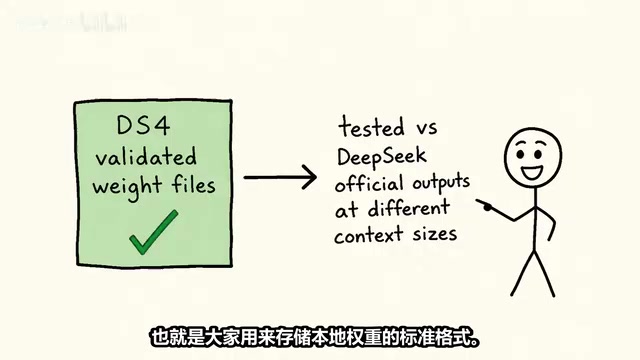
DS4's design philosophy has sparked a divide in the community. It's not a general-purpose tool: it can't run arbitrary models or load arbitrary GGUF files (the universal standard format for local weights). It ships with rigorously validated weight files that have been compared token-by-token against DeepSeek's official outputs across different context lengths. It runs those files and nothing else.
GGUF (GPT-Generated Unified Format) is a weight storage format introduced by the llama.cpp project in August 2023, replacing the earlier GGML format, which was criticized for incomplete architecture metadata and poor version compatibility. GGUF's core design goal is self-describing: a single file embeds complete model architecture information (layer count, attention heads, context length), tokenizer vocabulary, quantization scheme parameters, and all tensor data through header key-value pairs, allowing any compatible tool to correctly load and run inference without external configuration files. This design philosophy shares a kinship with container images: packaging all dependencies into a single distributable unit, eliminating the "it works on my machine" environment discrepancy problem.
This "one file as a complete system" design dramatically lowers distribution and deployment barriers. GGUF's widespread adoption spawned a vast local inference ecosystem: Ollama wraps GGUF model distribution in a container-like approach; LM Studio provides a graphical frontend for non-technical users; Jan focuses on a privacy-first local chat interface. Hugging Face currently hosts tens of thousands of community-contributed GGUF quantized versions, covering virtually all mainstream open-source models. DS4's deliberate refusal to support GGUF means voluntarily severing ties with this entire ecosystem — a decision that reflects a fundamental tension recurring throughout software engineering history: embrace interoperability for long-tail ecosystem scale effects, or achieve verifiable deterministic behavior through vertical integration? From Unix's modular philosophy to Apple's walled garden, this choice has never had a single correct answer.
Critics call this "lock-in." The local AI ecosystem already has a tangle of tools and formats intertwined, and another hot project refusing to be compatible with any existing standard is a legitimate complaint.
But Sanfilippo's rebuttal is sharper: local inference has remained at the hobbyist stage for years precisely because of the "run everything" approach. You can load any model with any backend and any quantization method, but nobody can guarantee output quality — quality itself is undefined, and users are left guessing.
By controlling the entire inference pipeline — one model, one set of validated quantization parameters, one engine — DS4 can actually guarantee it works as claimed. This is the essential difference between a toy tool and a production-ready system: deliberately choosing correctness over flexibility.
And DS4 isn't a simple wrapper: it comes with an HTTP API, supports tool calling, includes a built-in coding agent, and features disk-persistent KV cache — the model's working memory of conversations can be saved across sessions. Close the laptop, come back the next day, and the context is still intact.
KV Cache (Key-Value Cache) is a core optimization mechanism for Transformer architecture inference, rooted in the computational structure of self-attention. During autoregressive generation, every time the model generates a new token, it needs to compute attention weights between it and all historical tokens — this requires accessing the Key and Value matrices at every position in the historical sequence. In a naive implementation, these matrices are recomputed at every generation step, resulting in computational complexity proportional to the square of the sequence length. KV cache stores previously computed Key-Value pairs in a memory buffer, reducing incremental generation complexity from O(n²) to O(n), serving as a critical engineering technique that improves actual inference speed by several times or even orders of magnitude. From a memory consumption perspective, KV cache itself isn't "free": for long-context scenarios (e.g., 128K tokens), KV cache memory usage can exceed the model weights themselves, which is why memory bandwidth rather than compute power often becomes the real bottleneck for long-context inference.
In standard implementations, KV cache is a purely in-memory data structure bound to the inference process lifecycle — when the process exits, the cache is destroyed. DS4's disk persistence scheme must solve several non-trivial engineering problems: how to efficiently serialize large-scale tensor data to minimize write latency; how to handle cache invalidation when model versions update; and how to verify that cache loaded across sessions is consistent with current model weights, avoiding silent errors introduced by quantization parameter changes. For coding agent scenarios that need to track project context long-term, persistent KV cache saves the token computation cost of re-feeding all context at every new session; for 128K or even longer context windows, this represents significant savings in both inference time and API-equivalent costs.
These details indicate this is a product built by a serious engineer for actual production use.
From "Fallback" to "First Choice"
The most noteworthy data point isn't a benchmark score, but a statement from Sanfilippo himself: he's been playing with local models for years, but this was the first time he found himself using a local model for serious work — the kind of task he'd normally hand to Claude.
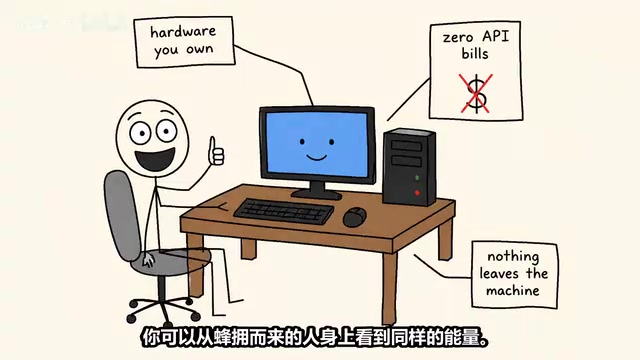
Local models have long been "the fallback when you can't use a good model." Now, the gap has narrowed enough to make local models the first choice for real tasks: running on your own hardware, zero API bills, data never leaving your machine.
The same energy is visible across the community: a Japanese engineer spent 12 days squeezing maximum performance from a DGX Spark; contributors on NVIDIA forums ported custom quantization schemes to CUDA within the day; Metal, CUDA, and AMD ROCm branches all became active within weeks. This isn't hype — it's builders spontaneously mobilizing because "the thing actually works."
The competition among underlying compute backends for local inference reflects the larger GPU ecosystem landscape. NVIDIA's CUDA (Compute Unified Device Architecture), through over a decade of ecosystem accumulation since 2007, has established near-monopolistic dominance in AI computing: cuBLAS provides highly optimized matrix operation libraries, cuDNN deeply tunes convolution, normalization, and other neural network operations, NCCL enables multi-GPU communication, and mainstream frameworks like PyTorch and TensorFlow all treat CUDA as their first-tier GPU backend. CUDA's moat lies not just in the technology itself, but in its massive research community — virtually all deep learning papers published at top conferences are first implemented and validated on CUDA, creating a strong positive feedback loop between technical accumulation and ecosystem scale.
AMD's ROCm (Radeon Open Compute Platform) is an open-source GPU compute ecosystem alternative led by AMD, with HIP (Heterogeneous-compute Interface for Portability) as its core programming interface — HIP code can be compiled for both CUDA and AMD native backends, greatly reducing code porting costs. ROCm has made significant progress in PyTorch adaptation in recent years, and the MI300X accelerator's 192GB single-card VRAM makes it quite competitive for large model inference scenarios, though it still trails CUDA in operator coverage completeness, numerical precision consistency, and community ecosystem breadth. Apple's Metal Performance Shaders (MPS) is a high-performance compute framework optimized specifically for Apple silicon GPUs; the llama.cpp community has achieved inference efficiency on M-series chips close to CUDA through the Metal backend, providing the underlying support for DS4's Apple platform performance.
If the ROCm backend matures in DS4, high-memory workstations with AMD GPUs will enter the competitive picture — only then will hardware democratization of local inference truly take its critical step.
Stripping Away the Hype: Facts That Must Be Stated Clearly
That said, the hype has genuinely gotten ahead of itself in several areas.
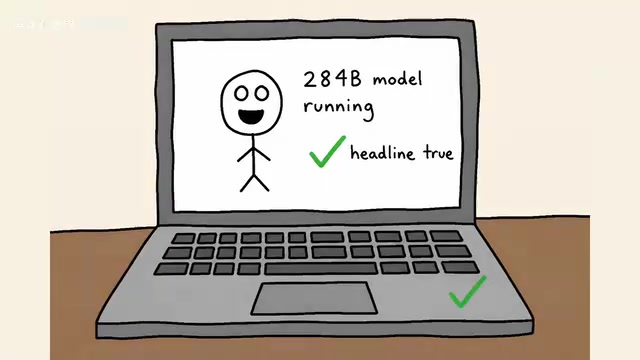
The hardware barrier is real. It does run on a laptop, but a 128GB MacBook Pro M3 Max costs $3,000 to $4,000, and the DGX Spark is NVIDIA's high-end device positioned as a "personal AI supercomputer." The so-called "democratization" is real, but with a price threshold far above most developers' everyday setups. This won't run on your old ThinkPad.
Quantization quality has a cost. Compressing expert layers to 2-bit precision isn't a free lunch. Calling V4 Flash a "near-frontier" model comes from qualitative impressions rather than rigorous head-to-head testing against top-tier cloud models. Reviewers have documented real issues: KV cache edge cases, silent performance degradation from certain quantization configurations. The weight of the word "near" should not be underestimated.
This is the Flash model, not the full flagship. DeepSeek's full V4 Pro has 1.6 trillion parameters, and official documentation explicitly states it requires extremely high memory configurations — not a laptop. The headline is true, but from "a usable local model" to "fully replacing the cloud" is still a long road. Frontier models still live in data centers.
Geopolitical risks remain unresolved. DeepSeek is a Chinese lab, and while the MIT license is permissive, questions about training data provenance and supply chain risk remain open. Open weights solve the data privacy problem — data never leaves your machine — but can't answer geopolitical concerns. It's worth adding that the MIT license's permissiveness covers only the usage and distribution rights of weight files, making no commitments about copyright ownership or compliance of training data. In regulated industries (finance, healthcare, legal), due diligence on training data provenance remains an unavoidable compliance obligation before deploying such models in production.
After Clearing the Hype, What Has Actually Changed
Strip away the noise, and the lasting change is clear: three long-held assumptions were shattered simultaneously in a single month.
For builders, the action path is concrete. If you've been paying per-token API fees for Flash-level work — text summarization, content classification, coding agent loops, internal tools — there's now a credible path: deploy a comparable model on an internal workstation, zero marginal cost, data stays local. This is a real line item that just changed.
The decision logic isn't complicated:
- If you need absolute top-tier 1.6-trillion-parameter-class models, or can't justify the hardware investment, choose the cloud;
- If your tasks are Flash-level, call volumes are high enough that API bills are painful, or data privacy is non-negotiable, local deployment of DS4 is worth serious evaluation.
A month ago, this wasn't even an option.
What's truly worth watching next comes down to two things: whether CUDA and ROCm backends can mature enough to run on more affordable hardware, since the price barrier is the real bottleneck preventing mass adoption; and whether Sanfilippo's "single model, full control" approach or Gurganov's "run everything" approach will win in the next round of local inference competition — that remains an open question.
But the question itself has changed. It used to be "can local inference become serious?" Now it's "how fast will it get cheap?"
Related articles

Step-by-Step Guide: Connecting DeepSeek to Claude Code Desktop
Complete guide to connecting DeepSeek to Claude Code Desktop — covering account-free setup, CC Switch config, API Key setup, Chinese localization, and custom Skill installation.

The 5-Step AI Programming Method: A Complete Workflow from Requirements to Delivery
Learn the 5-step AI programming workflow: environment setup, product design, technical design, implementation, and manual verification for reliable software delivery.
Behind the $1 Insurance Surcharge: How…
Behind the $1 Insurance Surcharge: How Flock's License Plate Surveillance Network Quietly Spread Across America
U.S. lawmakers quietly added a $1 auto insurance surcharge funding Flock Safety's ALPR camera network, raising major privacy and accountability concerns.