A Beginner's Guide to Claude Code: Why Is It More Powerful Than Cursor and Trae?

Why Claude Code's Agent architecture and full-context understanding make it the strongest AI coding tool.
Claude Code is Anthropic's local AI programming assistant built on an Agent architecture. Unlike conversational AI, it reads your entire codebase, auto-generates and debugs code, and delivers accuracy far above Cursor and Trae. This guide explains its technical foundations and why it leads the field.
What Is Claude Code?
Claude Code is an AI programming assistant launched by Anthropic, and it differs fundamentally from the conversational AI coding tools we're familiar with. There's no need to log into any website—simply install it locally on your computer, and you can invoke it within your development tools to complete project development.
From a technical architecture standpoint, Claude Code is not a simple chatbot but rather an autonomous programming system built on an Agent architecture. The so-called Agent architecture refers to AI's ability to autonomously formulate plans, invoke tools, execute multi-step tasks, and dynamically adjust its strategy based on intermediate results—which is fundamentally different from traditional "question-and-answer" style interaction. The core value of the Agent architecture lies in granting AI "autonomy": it no longer waits for every human instruction, but can break down goals on its own, select tools, handle exceptions, and ultimately complete complex multi-step tasks. Achieving this capability depends on three key components: the planning module (breaking down high-level goals into executable subtasks), the memory mechanism (maintaining working state and intermediate results during task execution), and the tool integration layer (the interface connecting to external execution environments).
The technical foundation of this architecture stems from the "ReAct" (Reasoning + Acting) paradigm, proposed in 2022 by Google researcher Shunyu Yao and others, and published at top-tier academic conferences such as NeurIPS. The core idea of ReAct is to interweave the language model's reasoning process with external tool-calling actions: the model no longer "answers questions in one shot," but instead enters an iterative loop of "think → act → observe → think again." Before ReAct emerged, a language model's reasoning (Chain-of-Thought) and action (tool calling) were two separate technical paths—the former made the model "think more clearly," the latter made it "do more things," but the two failed to work in concert. ReAct's breakthrough lies in unifying the two within the same generation sequence: in a single forward inference pass, the model produces both "thought content" and "action instructions," allowing the reasoning process to be corrected in real time based on action feedback, fundamentally improving AI's reliability in dynamic tasks. The key enabling technology of this architecture is the Tool Use / Function Calling mechanism—the model outputs structured instructions, an external executor performs operations such as file reading/writing, code execution, and network requests, and then feeds the results back to the model to continue reasoning. Before each action, the model performs chain-of-thought reasoning, outputting a "think → act → observe" loop sequence until the goal is achieved. Claude Code deeply binds this framework with concrete tools such as file reading/writing, command-line execution, and code running, enabling it to behave just like a real programmer: reading files, running commands, observing output, and fixing errors until the task is complete. Compared with early Agent systems, Claude Code's breakthrough lies in its planning capability for long-horizon tasks and its error-recovery ability—when a step fails, it can understand the cause of the failure and reformulate its strategy, rather than simply throwing an error and stopping.
This "out-of-the-box" nature makes it one of the AI tools closest to programmers—especially to zero-experience developers. There's no need to master advanced technical principles; you can get started right away, which is an important reason it quickly became popular in the developer community.

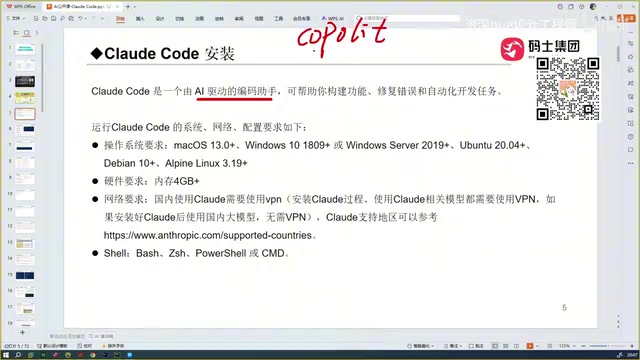
In terms of system compatibility, Claude Code has certain requirements for its runtime environment, but the vast majority of mainstream operating systems are supported, and the installation barrier is not high.
Core Differences Between Claude Code and Conversational AI Coding
Many people ask: can't I just write code with DeepSeekAd or ChatGPT? Why do I still need Claude Code?
The difference is crucial. When doing conversational coding in the DeepSeek or ChatGPT web interface, the AI can usually only provide a code snippet—you need to copy it back into your project to run and test it, and if it fails, return to make adjustments, potentially requiring multiple rounds of communication before getting a correct result.
More importantly, conversational AI cannot read through the complete context of the project. Suppose your project has 100 code files—the AI cannot read them directly; you have to manually paste in the relevant content and explain each part.
The root of this limitation lies in how the Context Window is used. The context window is the maximum amount of information a large model can process in a single pass, measured in "tokens" (roughly, 1,000 Chinese characters ≈ 1,500 tokens; for English code, one token corresponds to about 4 characters). A token is essentially the smallest processing unit in the model's vocabulary, produced by a tokenizer splitting text. Different languages have different splitting efficiencies, which is the fundamental reason why Chinese code comments consume more tokens. Mainstream tokenization schemes (such as BPE, Byte Pair Encoding) build their vocabulary by counting high-frequency character combinations in the corpus. English naturally has higher compression efficiency, whereas although Chinese characters have high semantic density, they are often split into individual characters in a BPE vocabulary, causing Chinese content of the same information volume to consume far more tokens than its English counterpart.
The capacity limit of the context window is essentially determined by the self-attention mechanism of the Transformer—each token needs to compute attention weights with all other tokens in the window, and the computational complexity grows quadratically with sequence length (O(n²)). This means that expanding the context from 100,000 tokens to 1,000,000 tokens increases the computation by 100 times, not 10 times. Engineering approaches to address this include using Sparse Attention, sliding window attention, or linear attention approximations to reduce computational cost. The context windows of modern top-tier models have expanded from the early GPT-3's 4K tokens to 200K tokens or even higher in the Claude 3 series, theoretically capable of holding hundreds of thousands of characters of code. However, simply enlarging the window is not enough—Stanford University's 2023 research paper Lost in the Middle revealed a key phenomenon: when the input content is too long, the model's utilization of information located in the middle of the sequence is significantly lower than at the beginning and end—the so-called "Lost in the Middle" problem. The cause of this phenomenon relates to positional bias in the attention mechanism: during pretraining, the text samples the model is exposed to are usually relatively short, resulting in relatively weak ability to encode information in the middle positions of long sequences; in addition, the "recency effect" of autoregressive generation also makes the model more inclined to use information at the end of the sequence. This means that simply enlarging the context window does not linearly improve comprehension quality.
Claude Code's key innovation lies in its ability to automatically load the entire project codebase into the context, while using intelligent file prioritization and incremental loading strategies—placing the most relevant code files in the high-attention regions of the context (usually the beginning or end of the sequence)—so that the large model generates code with a global perspective, rather than answering questions about isolated fragments like "a blind man feeling an elephant." This is precisely where it differs most fundamentally, technically, from web-based AI tools.
Claude Code is entirely different:
- Reads through all project content: it reads all code files in the project and passes them to the large model as context
- Automatically generates business code: based on the complete context, it generates code that truly meets the project's requirements
- Automatically debugs and corrects errors: it automatically runs, debugs, and ultimately produces an accurate, error-free version of the code
In other words, Claude Code is an automated programming tool, not merely a code suggestion tool.
The Evolution of AI Programming Assistants
To understand the value of Claude Code, it's worth reviewing the development trajectory of AI programming assistants. The entire industry has gone through three clear paradigm shifts: the first stage was the "intelligent completion" era represented by GitHub Copilot, where the AI predicted the next line of code based on the current cursor position; the second stage was the "conversational generation" era represented by Cursor, where developers could describe requirements in natural language and the AI would generate complete functions or modules; the third stage is the "autonomous Agent programming" era represented by Claude Code, where the AI can independently complete the full development loop from understanding requirements, writing code, to testing and debugging, transforming the developer from a "code writer" into a "requirement proposer and quality gatekeeper."
From Copilot to Cursor
GitHub Copilot (based on OpenAI technology) first appeared as a plugin, and its auto-completion capability was disruptive at the time, amazing many developers. Copilot's core technology is based on the Codex model (a code-specialized fine-tuned version of the GPT series), pretrained on tens of billions of lines of open-source code (mainly from public GitHub repositories), then combined with the file content and cursor position in the current editor to predict and complete code in real time. Codex's training data covers dozens of programming languages such as Python, JavaScript, TypeScript, Ruby, and Go, and it uses Fill-in-the-Middle (FIM) technology to train the model to make predictions using both the code before and after the cursor, rather than relying solely on the prefix—this greatly improves completion quality, enabling the model to understand "I'm writing the middle of this function, and here's the context on both sides" rather than "here's some existing code, what should come next." FIM technology works by randomly "blanking out" a segment of a code snippet during training, feeding the prefix and suffix after the blanking simultaneously into the model, and having the model learn to predict the removed middle portion—this training method aligns closely with real completion scenarios and is the key reason Copilot's completion quality far surpasses early prefix-only prediction approaches. Although its functionality was relatively basic, it was the first to turn "AI pair programming" from a concept into a daily production tool, profoundly changing developers' working habits.
Then Cursor burst onto the scene—smarter than Copilot, capable of automatically completing coding work, with capabilities that can rival Claude Code. Cursor's differentiation lies in its deep integration of Codebase Indexing technology, whose underlying implementation relies on a Retrieval-Augmented Generation (RAG) architecture: in the offline phase, the system splits project code into semantic chunks, uses an embedding model (such as OpenAI's text-embedding-ada-002 or the open-source BGE series) to convert each code chunk into a high-dimensional vector, and stores it in a local vector database (based on FAISS or a similar engine); in the online phase, when a user asks a question, the system vectorizes the query in the same way and uses an approximate nearest neighbor (ANN) search algorithm (such as HNSW) to complete cosine similarity retrieval in milliseconds, recalling the most relevant code snippets and splicing them into the context to send to the large model.
It's worth noting that the RAG architecture faces a unique challenge in code scenarios: semantic units of code (functions, classes, modules) have complex call-dependency relationships, and pure semantic similarity retrieval may recall fragments that are semantically close but broken in their call chains. To address this, tools like Cursor layer Code Graph technology on top of RAG—building function call graphs and class inheritance relationships through static analysis, supplementing vector retrieval with structured dependency tracking to ensure that recalled code snippets form a logically complete context. This technical approach allows the AI to quickly locate relevant files when answering questions, and to effectively handle projects even when their size exceeds the context window limit, to some extent breaking through the bottleneck of information volume that can be processed in a single pass. Compared with Claude Code's full-context loading strategy, the RAG approach is an engineering trade-off of "exchanging retrieval precision for scalability"—the former guarantees global reasoning consistency in small-to-medium projects, while the latter has an irreplaceable advantage in extremely large codebases (millions of lines of code).
Trae and OpenCode
Trae (available in international and domestic versions) followed. Here's a detail worth mentioning: the domestic version of Trae has undergone extensive optimization for Chinese, and its understanding of Chinese intent is very accurate, making it friendly for domestic developers. The technical logic behind this is that the domestic version of Trae integrates a Chinese language model self-developed or deeply optimized by ByteDance, specially trained for Chinese programming needs, Chinese commenting habits, and mainstream domestic tech stacks (such as Java Spring Boot, WeChat Mini Program frameworks, etc.). Such domain fine-tuning targeting specific languages and tech stacks is a common industry practice: a general-purpose large model injects domain knowledge through the Supervised Fine-tuning (SFT) stage, then further aligns with Chinese users' expression habits and preferences through Reinforcement Learning from Human Feedback (RLHF)—the combination of these two stages significantly improves both the accuracy of converting Chinese natural language to code and the ability to understand user intent, far surpassing the results of directly invoking a general-purpose model.
Specifically, the SFT stage typically uses tens of thousands to hundreds of thousands of high-quality "Chinese instruction-code" paired datasets to fine-tune the base model, enabling it to master the basic paradigm of "translating Chinese requirements into code"; the RLHF stage collects real users' preference feedback on different code outputs, trains a reward model to capture "which code style better matches the habits of domestic developers," and then uses the PPO (Proximal Policy Optimization) algorithm to reinforce this preference. The result of the two stages working together is that the model possesses both domain knowledge and high alignment with the target user group's expression habits and aesthetics. However, both the international version of Trae and Cursor are paid products.

There's also OpenCode, but it's relatively difficult to use and not recommended for beginners.
Why Is Claude Code Currently the Most Powerful AI Programming Tool?
After actually using multiple tools such as Copilot, Cursor, and Trae, Claude Code is considered currently the most powerful AI programming tool—a full level above Trae.
The Key Lies in the Underlying Large Model's Capability
The capability of these programming assistants ultimately depends on the level of the large model behind them. Claude Code relies on Anthropic's Claude (Sonnet) series models, which perform excellently in code generation.
What's worth noting is that Anthropic differs markedly from OpenAI in its model training philosophy. Anthropic uses the Constitutional AI (CAI) training method—an important improvement over traditional RLHF. Traditional RLHF relies on a large number of human annotators ranking model outputs by preference, which is costly and whose annotation quality is affected by the annotators' subjective judgment. CAI was proposed by Anthropic in 2022 and published in the paper Constitutional AI: Harmlessness from AI Feedback. Its innovation lies in replacing large amounts of human annotation with "AI-assisted automatic feedback": first, a clear set of behavioral guidelines (the "constitution") is established, covering principles such as honesty, harmlessness, and instruction-following; then in the SL-CAI stage, the model self-critiques and revises its own initial outputs based on these guidelines, generating revised dialogue pairs for supervised fine-tuning; finally, in the RL-CAI stage, the AI-generated preference data is used to train a reward model, and then the policy model is optimized through reinforcement learning algorithms such as PPO, replacing large amounts of human annotation.
The deeper value of CAI lies not only in reducing annotation costs but also in its Scalable Oversight characteristic: as the model's capabilities improve, the quality of the AI-generated feedback also improves, forming a positive loop—this solves a fundamental dilemma faced by traditional RLHF: when the model's capabilities surpass those of human annotators, humans can no longer accurately judge which output is better. By having AI self-supervise, CAI can theoretically break through this ceiling. This mechanism makes the Claude series models stand out in the consistency of logical reasoning and the strictness of instruction-following. For programming tasks, this means that when handling complex multi-step tasks, Claude is less likely to "go off track" or ignore the user's key constraints (such as "don't use a certain library" or "must be compatible with Python 3.8"), which is precisely one of the underlying reasons for its higher code accuracy. In addition, Anthropic has long invested in research in long-text understanding and multi-step reasoning, giving Claude a natural advantage when handling large codebases.
Code Accuracy Is the Biggest Advantage
Compared with Cursor and Trae, Claude Code's most significant advantage is its extremely high accuracy. Although all three tools can perform automatic programming, the code Claude Code produces is noticeably more accurate.
A horizontal comparison:
- Trae: being free is its biggest advantage, but its code accuracy is mediocre, and it tends to run into problems with slightly more complex tech stacks
- Cursor: powerful but paid
- Codex (based on OpenAI GPT-5): also very powerful, considered comparable to Claude Code
After comparing with domestic models such as Tongyi Qianwen and Kimi, the conclusion remains: Claude Code is the smoothest to use.
Insights and Recommendations for Developers
For programmers, Claude Code brings both opportunity and pressure. It can automatically complete a large amount of work that originally required repeated manual debugging, which does bring a certain "sense of crisis."
From a macro industry perspective, this transformation is just like every major technological wave in history: the emergence of assembly language transformed machine-code engineers, the popularization of high-level languages upgraded assembly programmers, and the maturation of IDEs and frameworks allowed "wheel builders" to focus on "building products." The rise of AI programming tools is not the end of the programmer profession, but a redefinition of the programmer's core value—shifting from "how to write code" to "what code to write, why to write it, and how to verify it once written." Developers who master AI programming tools are essentially using less time to leverage higher-dimensional creativity.
Under this trend, Prompt Engineering and AI output quality assessment are becoming developers' new core skills. Prompt engineering has evolved from the early "skillful adjustment of wording" into a systematic engineering methodology: a high-quality programming prompt usually includes a clear task boundary definition (functional scope, input/output format), explicit technical constraints (language version, dependency library restrictions, performance requirements), relevant context information (existing code architecture, data models), and the desired output format. The field of prompt engineering has already developed several mature structured frameworks, such as the CRISPE framework (Capacity, Role, Insight, Statement, Personality, Experiment) and Chain-of-Thought Prompting—the latter significantly improves the model's performance on complex reasoning tasks (including code debugging) by adding "think step by step" instructions to the prompt, and its effectiveness has been empirically verified in multiple research papers from Google and DeepMind. "AI output quality assessment," meanwhile, involves new dimensions of code review: beyond traditional logical correctness, attention must also be paid to common pitfalls in AI-generated code—over-reliance on hallucinated APIs (library functions fabricated by the model), omission of boundary condition handling, security vulnerabilities (such as SQL injection and XSS cross-site scripting attacks), and compatibility issues with the existing architecture.
Worth special attention is the "hallucinated API" problem—one of the most insidious risks in AI-generated code. The generation by a language model is essentially statistical-probability-based pattern matching. When it encounters an unfamiliar library or version, the model may confidently "fabricate" function names or parameter formats that seem reasonable but don't actually exist; the code is syntactically completely correct, and only at runtime will it throw a "function not found" error. Effective prevention strategies include: explicitly specifying the library's version number in the prompt, requiring the model to provide documentation links as supporting evidence for its output, and focusing during code review on verifying that all external dependency API calls are consistent with the official documentation.
How to translate vague business requirements into clear technical instructions, how to identify potential security vulnerabilities and logical flaws in AI-generated code, how to design effective test cases to verify the AI's output—the value of these abilities is surpassing that of purely "hand-writing code," becoming an important component of a programmer's core competitiveness in the AI era.
But from another angle, mastering tools like Claude Code is precisely the essential skill for developers to boost productivity and adapt to the AI era. It lowers the barrier to programming, allowing zero-experience developers to get started quickly; at the same time, it frees senior developers from tedious debugging work, letting them focus on higher-level architecture and design.
In summary, Claude Code's core competitiveness is reflected in three points: local, out-of-the-box readiness; deep understanding of a project's complete context; and industry-leading code accuracy. For developers who want to embrace AI programming, Claude Code is worth trying first.
Key Takeaways
Related articles

Cursor AI Programming in Practice: Build a Student Management System from Scratch in 30 Minutes
A Bilibili creator demonstrates Cursor AI programming: generating a student management system in 30 minutes with natural language. Details on Agent mode, Claude selection, prompt techniques, and thresholds.

Top 20 AI Coding Tools Ranking: From Rock-Solid to Lackluster, a Scored Matrix
Bilibili creator releases top 20 AI coding tools ranking, tiered T0–T4 from rock-solid to lackluster, with Claude Code and Codex tied at T0. This article details the scoring dimensions (capability, reliability, robustness, durability, cost, domestic availability) and tool performances to help developers choose the right AI coding assistant.

Vibe Coding Systematic Tutorial: Master AI-Assisted Programming from Zero
A three-month Vibe Coding tutorial from a Bilibili creator covering Codex, ClaudeCode, and Cursor, from core logic to commercial project practice for beginners.