A Beginner's Guide to Prompt Engineering: A Complete Cognitive Framework from Concept to Practice

A comprehensive beginner's framework for prompt engineering covering concepts, workflow, and limitations.
This article provides a systematic introduction to prompt engineering, covering what prompts are, how they differ from prompt engineering as a discipline, a practical six-step workflow (decompose, design, test, evaluate, iterate, reuse), and four key metrics for measuring effectiveness. It also honestly addresses prompt limitations — including AI capability ceilings, output instability, hallucinations, and real-world deployment challenges — helping readers build a balanced cognitive framework for AI applications.
In an era where AI has permeated everyday work, there's a fascinating phenomenon: given the same large language model, some people can only produce elementary school-level essays, while others generate professional industry reports. The difference isn't in the AI itself — it's in the prompts you feed it. Based on a systematic introductory tutorial on prompt engineering from Bilibili, this article distills the core cognitive framework for this "foundational skill of the AI era."
What Is a Prompt: The Most Direct Way to Control AI
The definition of a prompt is actually quite simple — any text you send to an AI, whether it's a question or a description, is a prompt. The tutorial uses a vivid analogy: a prompt is like a "neural signal" you send to the AI. Whatever signal you send determines the direction the AI thinks in. It is, bar none, the most direct means we have of controlling AI.
The role of prompts can be broken down into four dimensions:
- Communication bridge: Translating the vague, hard-to-articulate needs in your head into clear instructions the AI can understand. It's like ordering food delivery — you can't just say "bring me something to eat." You need to specify the dish, spice level, and whether you want extra rice.
- Task navigation: Telling the AI exactly what to do. If you say "help me process this document," the AI doesn't know whether you want statistical analysis, visualization, or a summary. It can only pick one at random, and chances are it won't be what you wanted.
- Style control: This is often overlooked but extremely important. Writing a business email and crafting a social media post require completely different styles. Through prompts, you can have AI write commentary in Lu Xun's style, a diary entry in a child's voice, or a paper in rigorous academic language.
- Boundary constraints: This is one of the most effective ways to prevent AI from "making things up." Without constraints, the AI can veer wildly off-topic and fabricate nonexistent content.
Basic Prompt vs. Optimized Prompt: A Direct Comparison
The tutorial gives an example of writing an article about spring. The basic prompt — "Write an article about spring" — is too vague. Northern or southern spring? Essay or preface? How long? What style? The AI can only guess, producing generic, cookie-cutter results.
The optimized prompt provides a clear structure: identity (you are an essay writer), word count (800 words), setting (spring in Jiangnan), and style (beautiful and lyrical language, focusing on the misty, rain-soaked ambiance of a water town). Essentially, it transforms vague requirements into specific, actionable rules.
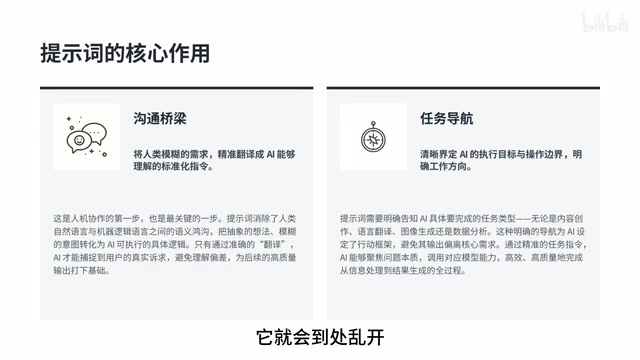
Prompt vs. Prompt Engineering: One-Off Tricks vs. Systematic Methodology
Many people conflate "prompts" with "prompt engineering," but the difference is enormous.
A prompt is a one-time thing — like writing a single line of code to solve a single problem. It might work this time, but switch to a different problem and it could fail entirely. The tutorial specifically warns: so-called "universal prompts" are a myth. There are no universal prompts, only prompts suited to specific scenarios.
Prompt engineering, on the other hand, is a complete workflow. Its core philosophy is: without modifying the AI's code or parameters, design input instructions to make the AI consistently produce the desired results. It doesn't solve a single problem — it solves an entire category of problems.
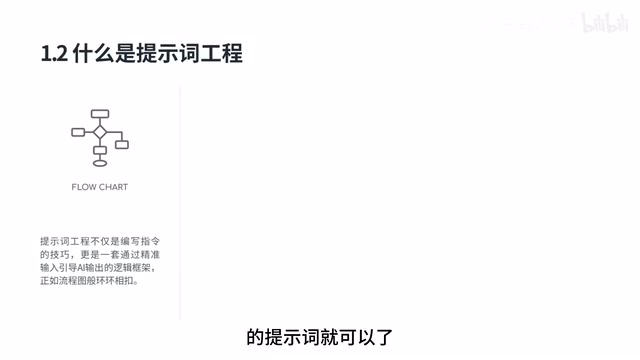
The Six-Step Practical Workflow of Prompt Engineering
- Requirement decomposition: Break complex, large problems into smaller ones the AI can handle
- Solution design: Design corresponding prompts and roles for each decomposed problem
- Execution and testing: Actually run it and see how it performs
- Evaluate results: Judge the output quality against specific criteria
- Iterative optimization: Continuously refine what doesn't work
- Document and reuse: Save effective solutions for direct reuse when similar problems arise
This workflow closely mirrors software development — except you're writing natural language instead of code.
Four Standards for Measuring Prompt Engineering Effectiveness
Prompt engineering ultimately pursues four goals, which also serve as criteria for evaluating solutions:
- Improve accuracy: Make the AI output exactly what you want
- Reduce hallucinations: Minimize fabricated content
- Enhance stability: Produce consistent results regardless of who uses it or when
- Lower costs: Achieve the best results with the fewest tokens
Why You Should Learn Prompt Engineering Now
The tutorial's reasoning is straightforward: AI is already very powerful, but most people don't know how to use it properly. Data shows that over 90% of users only use AI for basic Q&A — like buying a sports car but only driving in first gear.
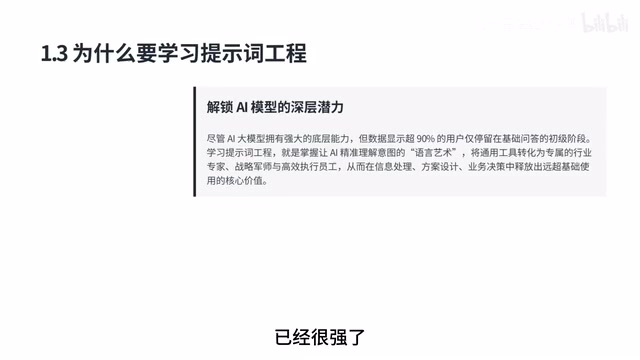
The learning curve for prompt engineering is extremely low — no programming required, no need to understand algorithms. If you can articulate things clearly, you can learn it. The most immediate benefit is a productivity boost: work that used to take a full day might only take an hour.
Beyond efficiency, it also has clear commercial value:
- Side income opportunities: Businesses and content creators need people who know how to use AI — optimizing prompts and generating content for them
- Lower barriers to entrepreneurship: Work that used to require an entire team can now be done by one person, drastically reducing the cost of experimentation
- Faster content production: Content creators who used to write 10 articles a month can now produce dozens without sacrificing quality
The Limitations of Prompts: They're Not a Magic Key
This is the most easily overlooked — yet most critical — part of the entire tutorial. Prompts are a great tool, but they are absolutely not a magic key.
First, they cannot exceed the AI's capability ceiling. If the model's training data has a cutoff date, no amount of prompt optimization will make it answer questions beyond that data. If the AI can't solve a complex math problem, it simply can't — no prompt will change that.
Second, outputs can be unstable. Sometimes changing a single word produces completely different results. If a prompt is too long, the AI may "forget" things — it loses track of earlier instructions.
Third, hallucinations cannot be eliminated entirely. Prompt optimization can reduce hallucinations but cannot eradicate them. Every large language model will fabricate information to some degree. For anything important, always verify the output yourself.
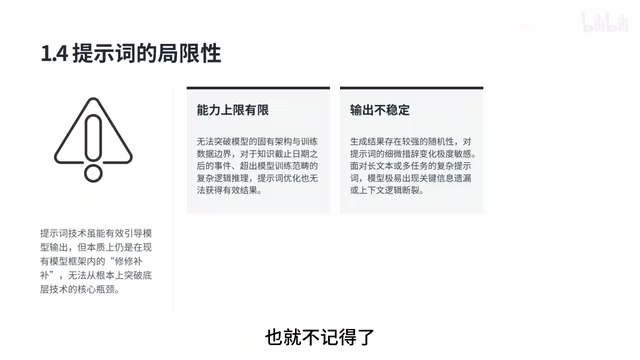
Three Hard Technical Constraints
- Limited context length: Think of it like a phone's RAM — open too many apps and the system starts clearing background processes. Chat too long, and the AI will forget your initial instructions.
- Instability with complex tasks: Multi-step calculations and plan drafting are prone to skipped steps and broken logic. You must break them down into smaller tasks first.
- No true long-term memory: Every conversation starts from scratch. The AI can't remember your preferences — that requires external databases.
Three Real-World Implementation Challenges
- Safety and alignment restrictions: Illegal or unethical content absolutely cannot be generated, but sometimes legitimate requests get mistakenly flagged and blocked.
- Prompts alone can't scale to production: Using prompts for personal tasks is fine, but turning them into a product for hundreds or thousands of users requires version control and issue tracing. Enterprise applications always combine prompts with code.
- Cost traps: AI charges by the token — the longer the prompt, the higher the cost. With high-frequency calls, hidden costs can become alarming. That's why prompts should always be concise.
Conclusion: Build the Right Mental Model Before Learning Specific Techniques
The core value of this tutorial's first chapter isn't teaching you to write fancy prompts — it's helping you build the right cognitive framework: Prompts are the most direct means of controlling AI. Prompt engineering is the systematic method for turning general-purpose models into solutions for specific business problems. And it ultimately has boundaries — what needs human judgment still needs human judgment.
For anyone looking to get started with AI applications, understanding "what it can do" and "what it can't do" is far more important than rushing to memorize prompt templates. The detours you avoid are often hidden within these foundational insights.
Related articles

Uber Deploys ChatGPT Work Company-Wide: AI in the Workplace Enters the Scaled Implementation Phase
Uber deploys ChatGPT Work to 30,000+ employees, extending it from engineering to all roles. We analyze its expert-engineer pairing, end-to-end automation, and questions of AI control and power concentration—insights for scaling AI in the workplace.

Shift at Midnight Hands-On: When "ID Verification" Becomes Alien Hunting
Shift at Midnight blends ID verification with horror survival in a four-player co-op game. We break down its inspection mechanics and chaotic humor.

Zelensky Recounts the Outbreak of War: I Need Ammunition, Not a Ride
Zelensky recalls the first day of war in a YouTube interview: farewell to family, rejecting Biden's evacuation offer with "I need ammunition, not a ride," and how Bucha shaped his stance on compromise and peace talks.