A Beginner's Guide to Reinforcement Learning: Complete Roadmap from Zero to RLHF

A complete learning roadmap for reinforcement learning, from foundational theory to RLHF practice.
This guide provides a systematic reinforcement learning roadmap for learners with deep learning backgrounds aiming for RLHF. It covers the three-layer RL knowledge framework (foundational theory, classical algorithms, deep RL), recommends core resources including Sutton & Barto's textbook, David Silver's course, OpenAI Spinning Up, and Hugging Face's Deep RL Course, and outlines the progression path from PPO mastery to RLHF implementation.
Why Reinforcement Learning Is Worth Deep Study
Among the three major paradigms of machine learning, Reinforcement Learning (RL) is often the most intimidating branch. Unlike supervised learning that relies on labeled data, or unsupervised learning that mines the inherent structure of data, reinforcement learning enables an Agent to learn optimal strategies through continuous interaction with the environment, trial and error, and reward feedback.
Fundamentally, the three paradigms differ in the source and nature of the learning signal. Supervised learning learns mappings from manually labeled input-output pairs; unsupervised learning discovers hidden structures like clustering and dimensionality reduction from unlabeled data; while reinforcement learning's learning signal is a delayed, sparse scalar reward. This difference determines the unique challenges RL faces: the credit assignment problem (which historical decisions should a reward signal be attributed to) and the exploration-exploitation dilemma (whether to try new strategies or stick with known good ones). It's precisely these fundamental challenges that make RL's algorithm design philosophy fundamentally different from the other two paradigms.
As RLHF (Reinforcement Learning from Human Feedback) has become the core technology for large language model alignment, more and more practitioners are realizing that truly understanding modern AI training mechanisms requires mastering reinforcement learning. RLHF is the core alignment technology adopted by OpenAI in InstructGPT and ChatGPT. Traditional language models are pretrained by maximizing next-token prediction probability, but this objective function doesn't directly optimize for "helpfulness" or "safety." The core idea of RLHF is: first, have human annotators rank multiple model outputs by preference, use this preference data to train a Reward Model, then use the reward model's output as a reward signal to fine-tune the language model's policy through RL algorithms like PPO. This paradigm allows model behavior to be aligned toward human expectations without requiring precise supervision labels for every desired behavior.
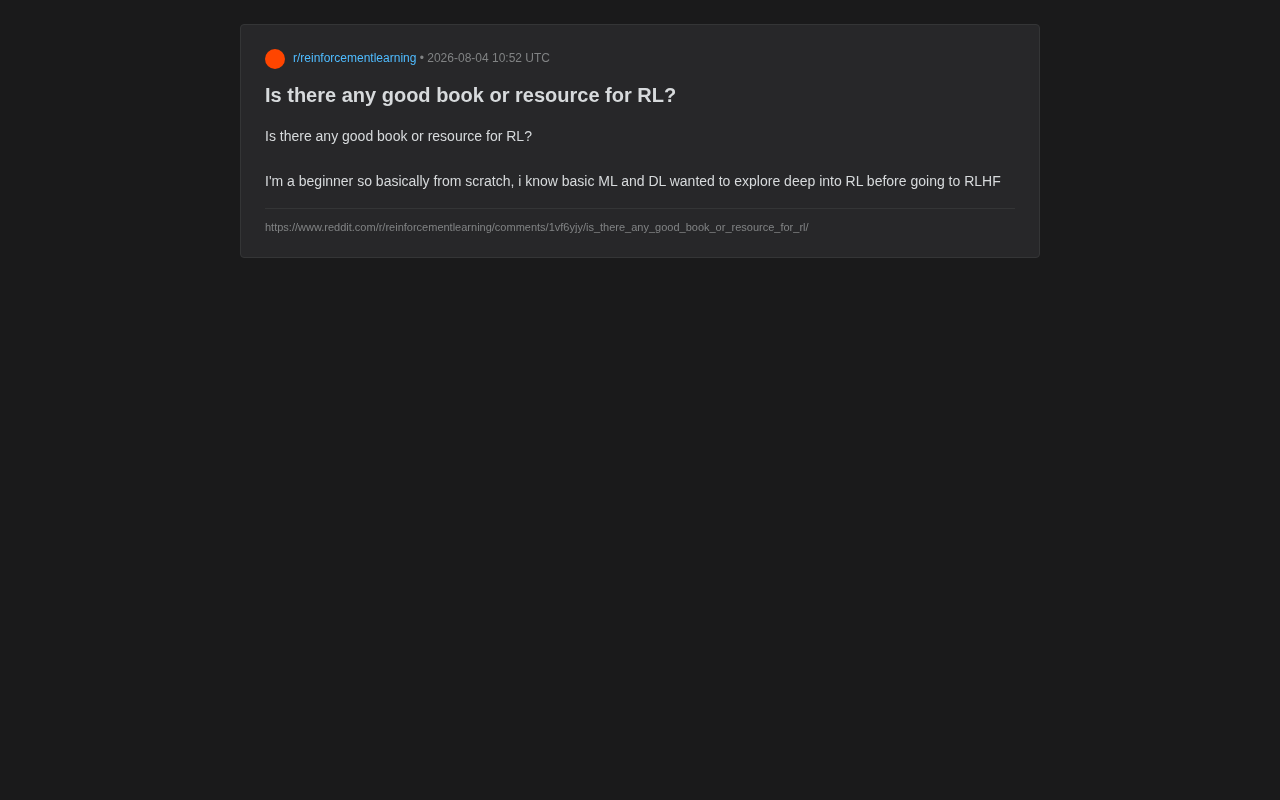
Recently, a Reddit user posed a very typical question: "I've already mastered basic machine learning and deep learning knowledge, and want to study RL in depth before moving into RLHF — are there any good books or resources to recommend?" This seemingly simple question captures the real predicament of many beginners — RL resources are scattered and complex, lacking a clear learning path. This article will address this need by outlining a systematic reinforcement learning roadmap.
Knowledge Framework and Learning Goals for Reinforcement Learning
First, Clarify Your Learning Goals
Before piling up resources, clarifying your learning goals is crucial. For learners whose ultimate goal is RLHF, the learning path differs from those focused purely on robotics control or game AI. RLHF is built upon algorithms like Policy Gradient and PPO (Proximal Policy Optimization), so during the foundation-building phase, you don't need to get overly bogged down in dynamic programming or Monte Carlo methods — but these classical theories remain necessary stepping stones for understanding modern algorithms.
RL's Core Concept Layered Framework
The knowledge system of reinforcement learning can be roughly divided into three layers:
- Foundational Theory Layer: Core concepts including Markov Decision Processes (MDP), Bellman equations, value functions, and policy functions.
- Classical Algorithm Layer: Dynamic programming, Monte Carlo methods, Temporal Difference Learning (TD Learning), Q-Learning, and SARSA.
- Deep Reinforcement Learning Layer: DQN, policy gradient methods, Actor-Critic, PPO, SAC, etc. — this layer connects directly to RLHF.
In the foundational theory layer, the Markov Decision Process (MDP) is the mathematical foundation framework for all of reinforcement learning, defined by the five-tuple (S, A, P, R, γ): S is the state space, A is the action space, P is the state transition probability function, R is the reward function, and γ is the discount factor. The core assumption of MDP is the Markov property — future states depend only on the current state and action, independent of history. The Bellman equation describes the recursive relationship of value functions: the value of the current state equals the immediate reward plus the discounted expected value of successor states. This equation is the theoretical cornerstone of virtually all classical RL algorithms, including dynamic programming and Q-Learning.
In the deep reinforcement learning layer, Actor-Critic is a class of hybrid algorithm architectures that combines the advantages of policy gradients (Actor) and value function estimation (Critic). The Actor is responsible for selecting actions based on the current policy, while the Critic evaluates the value of the current state or state-action pair. The Critic's value estimate is used to compute the Advantage Function — how much better or worse a particular action is compared to average performance — thereby significantly reducing the variance of policy gradient estimates. Modern deep RL algorithms like PPO, A3C, and SAC are all built on the Actor-Critic framework. Understanding this architecture is the key cognitive bridge from classical RL to deep RL.
Understanding this layered structure helps beginners know "where they are" in their learning journey, avoiding getting lost in the vast sea of resources.
Core Book and Course Recommendations for Reinforcement Learning
The Bible: Sutton & Barto's Reinforcement Learning: An Introduction
When it comes to introductory RL books, Reinforcement Learning: An Introduction by Richard Sutton and Andrew Barto is almost universally the top recommendation. Known in the field as the "RL Bible," its second edition is freely available online. It systematically covers the complete progression from MDPs to temporal difference methods, from tabular methods to function approximation.
For beginners, the book's strengths are its theoretical rigor and gradual progression; its weakness is the heavy mathematical derivations and limited coverage of deep learning. The recommended approach is: don't try to read every word — focus on mastering the core concepts in the first 6-7 chapters to build intuition about value functions and policies, then use later chapters as a reference manual as needed.
Deep Reinforcement Learning Practical Resources
Since learners already have a deep learning foundation, they can quickly transition to Deep RL after establishing solid classical RL theory. Here are several high-quality resources:
- OpenAI Spinning Up: A free, open-source tutorial designed specifically for people wanting to get started with deep reinforcement learning. It covers mainstream algorithms including VPG, TRPO, PPO, DDPG, and SAC, with clear code implementations. Especially friendly for learners targeting RLHF, since PPO is the core algorithm in RLHF.
- David Silver's RL Course: A lecture series by DeepMind researcher and AlphaGo key contributor David Silver. It's many people's introductory course, with engaging explanations that work best when paired with Sutton & Barto reading.
- Hugging Face Deep RL Course: A free, hands-on course that combines learning with practice, ultimately guiding learners to understand RLHF principles — highly aligned with the end goal.
The Advanced Path from Reinforcement Learning to RLHF
Bridging Classical Theory and Cutting-Edge Applications
RLHF is essentially the application of reinforcement learning to language model fine-tuning. Its tech stack can be decomposed into: Reward Model training + PPO-based policy optimization. Therefore, solidly mastering PPO is the key stepping stone to RLHF.
PPO (Proximal Policy Optimization) was proposed by OpenAI's John Schulman in 2017 and is one of the most widely used policy gradient algorithms today. It solves the high variance problem of early policy gradient methods (like REINFORCE) and the excessive computational complexity of TRPO (Trust Region Policy Optimization). PPO's core idea is to limit the magnitude of each policy update by clipping the objective function, ensuring the new policy doesn't deviate too far from the old one. Specifically, it uses a probability ratio r(θ) = π_θ(a|s) / π_θold(a|s) and clips it within the range [1-ε, 1+ε]. This simple yet effective constraint mechanism makes PPO both stable and efficient in practice, making it the standard choice for fine-tuning language models in RLHF.
The recommended learning sequence is: first understand the mathematical essence of value functions and policy gradients through Sutton & Barto, then implement PPO hands-on through Spinning Up, and finally read the InstructGPT paper and related RLHF technical blogs to connect RL algorithms with real-world language model applications.
InstructGPT (2022, Ouyang et al.) is the landmark application of RLHF technology on large-scale language models. The paper details a three-stage training process: Stage 1 performs supervised fine-tuning (SFT) using high-quality responses written by human annotators; Stage 2 collects human preference ranking data on model outputs to train a reward model; Stage 3 optimizes the language model policy using PPO, with a KL divergence penalty term to prevent the policy from deviating too far from the SFT model. This paper is not only essential reading for understanding ChatGPT's training mechanism but also the best bridge connecting RL theory knowledge with real LLM applications.
Hands-On Practice: Setting Up Your RL Experiment Environment
Reinforcement learning is an extremely practice-dependent discipline. Reading books and watching videos alone is far from sufficient, because RL training is filled with practical issues like hyperparameter tuning traps, reward design challenges, and convergence instabilities. Beginners are recommended to set up an experiment environment using Gymnasium (formerly OpenAI Gym) as early as possible, starting with simple tasks like CartPole and gradually progressing to more complex scenarios.
Gymnasium (forked from OpenAI Gym in 2022, maintained by the Farama Foundation) is the standard experimental platform for RL research. It provides a unified API interface to define an environment's observation space, action space, state transitions, and reward mechanisms, allowing algorithm researchers to seamlessly switch between different environments. The classic CartPole task requires the agent to balance an inverted pendulum by moving a cart left and right. Although the state space is only 4-dimensional (position, velocity, angle, angular velocity), it fully embodies RL's core elements: sequential decision-making, delayed rewards, and unstable dynamic system control. Progressing from CartPole to Atari games, MuJoCo physics simulations, and other complex environments is the typical path for building deep RL practical experience.
Stable-Baselines3, an open-source library, provides reliable implementations of mainstream algorithms and is ideal for beginners to study alongside and quickly validate ideas.
Learning Tips and Common Pitfalls
Avoid the "Resource Hoarding" Trap
Faced with abundant learning resources, the most common mistake beginners make is starting multiple books and courses simultaneously, only to scratch the surface of each. A more effective strategy is to commit to one main textbook (like Sutton & Barto) + one practical course (like Spinning Up or the Hugging Face course), complete them, and then expand horizontally.
The Importance of Mathematical Foundations
Reinforcement learning requires a solid foundation in probability theory, linear algebra, and calculus — especially the policy gradient section, which involves extensive expectation and gradient calculations. The core expression of the policy gradient theorem, ∇J(θ) = E[∇log π_θ(a|s) · Q(s,a)], involves gradients with respect to policy parameters, log-probabilities, and expectation operations. Understanding this formula requires solid probability theory foundations (expectations, conditional probability) and calculus skills (chain rule, logarithmic differentiation). If you encounter obstacles while reading, taking time to supplement relevant mathematical knowledge is often more efficient than pushing through.
Summary: A Clear Reinforcement Learning Roadmap
For learners who already have machine learning and deep learning foundations and are targeting RLHF, a clear path is: Build theoretical foundations with Sutton & Barto → Solidify intuition through David Silver's course → Implement deep RL algorithms hands-on with Spinning Up or the Hugging Face course → Finally dive into RLHF-related papers and practice. The learning curve for reinforcement learning is steep, but once you cross it, you'll hold the key to understanding modern AI system training mechanisms. Stay patient, write more code — that's the only true path to mastering reinforcement learning.
Related articles

Uber Deploys ChatGPT Work Company-Wide: AI in the Workplace Enters the Scaled Implementation Phase
Uber deploys ChatGPT Work to 30,000+ employees, extending it from engineering to all roles. We analyze its expert-engineer pairing, end-to-end automation, and questions of AI control and power concentration—insights for scaling AI in the workplace.

Shift at Midnight Hands-On: When "ID Verification" Becomes Alien Hunting
Shift at Midnight blends ID verification with horror survival in a four-player co-op game. We break down its inspection mechanics and chaotic humor.

Zelensky Recounts the Outbreak of War: I Need Ammunition, Not a Ride
Zelensky recalls the first day of war in a YouTube interview: farewell to family, rejecting Biden's evacuation offer with "I need ammunition, not a ride," and how Bucha shaped his stance on compromise and peace talks.