A Challenger to Backpropagation? Augmented Lagrangian Predictive Coding Explained
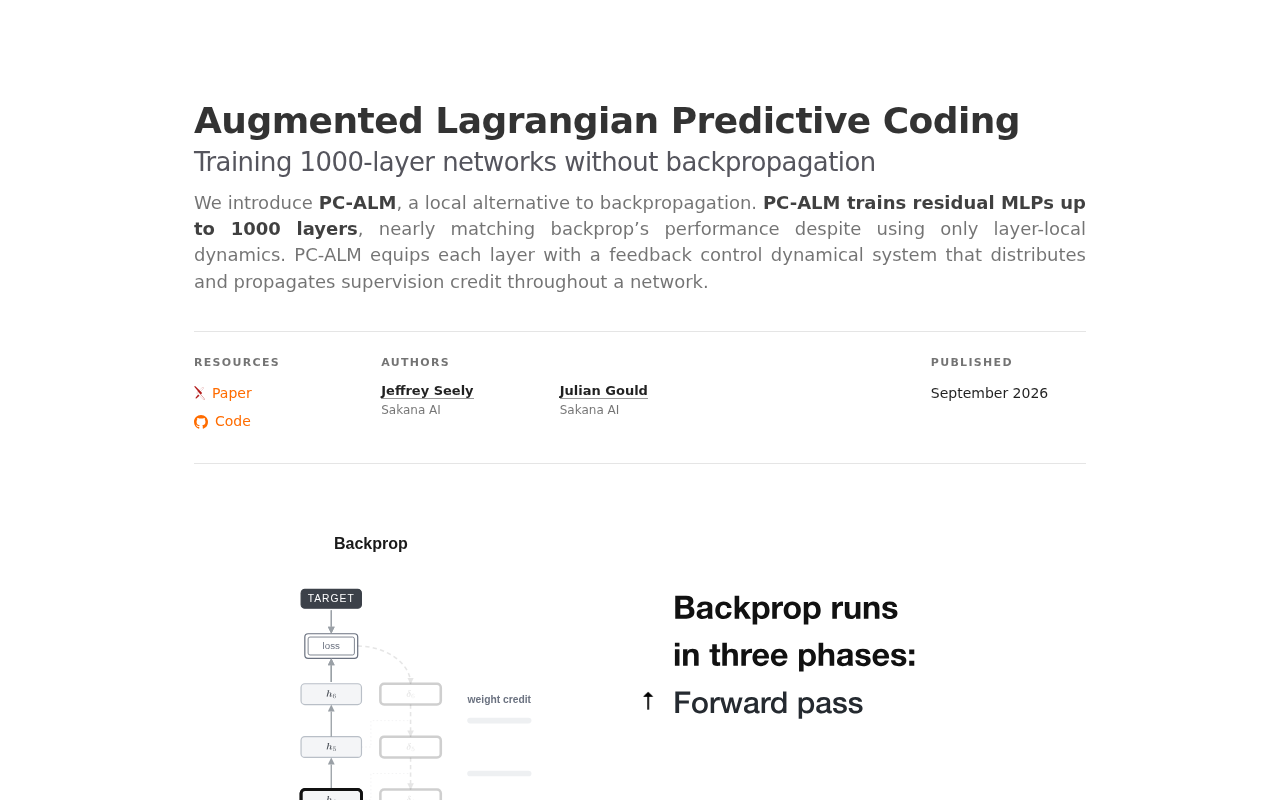
Augmented Lagrangian Predictive Coding fuses constrained optimization with bio-inspired learning to challenge backpropagation.
While backpropagation remains the core engine of deep learning, it carries inherent limitations in biological plausibility, memory usage, and parallelization. This article examines research combining the Augmented Lagrangian method — a mature constrained optimization tool — with predictive coding, a neuroscience-inspired learning paradigm that relies on local error signals. By introducing Lagrange multipliers to enforce inter-layer consistency as exact constraints rather than soft penalties, the approach theoretically improves convergence stability in deep networks. Though promising in hardware compatibility, memory efficiency, and biological plausibility, it remains early-stage research, and whether it can match decades-refined backpropagation at scale still awaits empirical proof.
An Algorithmic Challenge to Backpropagation
Since its inception, backpropagation has been the core engine powering deep neural network training, and nearly every mainstream deep learning framework is built on top of it. Yet the algorithm has long been accompanied by controversy — it requires a global error signal to propagate backward through the network layer by layer, which introduces notable limitations in biological plausibility, memory overhead, and parallelization.
Recently, a piece titled Backprop Alternative: Augmented Lagrangian Predictive Coding sparked discussion on Hacker News (14 points, 2 comments). This work proposes a training approach based on Augmented Lagrangian Predictive Coding, aiming to offer an alternative optimization framework to backpropagation.
Predictive Coding: A Learning Paradigm Closer to the Brain
Predictive Coding originates from computational neuroscience. Its central hypothesis is that the brain continuously generates predictions about sensory inputs and updates its internal representations by minimizing the "prediction error" between those predictions and actual inputs. This mechanism differs fundamentally from backpropagation — it relies primarily on local information for updates, rather than requiring a top-down global gradient signal that flows through the entire network.
In recent years, researchers have found that predictive coding can approximate — and under certain conditions even be equivalent to — backpropagation. This has made it one of the most closely watched "biologically plausible" alternatives in deep learning. Its appeal lies in the fact that local updates imply better parallelization potential, reduced dependence on a complete forward-backward chain, and a more natural fit with neuromorphic hardware.
What the Augmented Lagrangian Approach Adds
The key innovation in this work is the introduction of the Augmented Lagrangian, a classical technique from constrained optimization.
In traditional predictive coding frameworks, inter-layer consistency is typically maintained through soft constraints — for example, adding penalty terms to the loss function. The Augmented Lagrangian method, by contrast, explicitly models these inter-layer relationships as a constrained optimization problem: it retains the penalty term to ensure numerical stability while introducing Lagrange multipliers to satisfy constraints exactly.
This approach has been well-established in the optimization literature as converging more stably and accurately than pure penalty methods. Applying it to predictive coding theoretically holds promise for alleviating the convergence difficulties and hyperparameter sensitivity that predictive coding commonly faces when training deep networks — thereby bringing such non-backpropagation methods closer to practical viability.
Why This Is Worth Paying Attention To
The search for alternatives to backpropagation is not merely academic curiosity. There are several concrete motivations behind it:
- Hardware: The global gradient propagation required by backpropagation is ill-suited for large-scale parallel or asynchronous computation, whereas local learning rules align more naturally with the design philosophy of emerging neuromorphic chips.
- Memory efficiency: Backpropagation must cache intermediate activation values from the forward pass to compute gradients — a heavy memory burden for very large models. Learning methods based on local error signals have the potential to reduce this overhead.
- Biological plausibility: Backpropagation requires assumptions like weight symmetry that are difficult to realize in biological neural systems, while predictive coding-style methods are considered more consistent with how the brain actually operates.
Augmented Lagrangian Predictive Coding follows this line of thinking, seeking a better balance between theoretical elegance and training feasibility.
A Note of Caution: The Real Limits of Early-Stage Research
It is important to recognize that alternative training algorithms of this kind remain firmly in the research and exploration phase. Given the level of attention on Hacker News (14 points, 2 comments), it has yet to become a hot topic in the broader community.
The core challenges that non-backpropagation methods have long faced remain unresolved: whether they can genuinely match backpropagation — refined over decades of engineering — in terms of convergence speed, final accuracy, and engineering robustness at scale is still an open question. The additional multiplier variables and update steps introduced by the Augmented Lagrangian approach may also bring new computational complexity.
For practitioners interested in the underlying mechanics of AI, the value of this work lies more in its methodological inspiration — it demonstrates how well-established constrained optimization theory can be used to reshape biologically inspired learning frameworks. Whether it can leave the lab and influence real-world model training practices will require more empirical results and community validation.
Conclusion
Augmented Lagrangian Predictive Coding represents an intriguing direction in foundational deep learning optimization research: one that is dissatisfied with backpropagation's dominance, yet strives to make alternatives reliable through rigorous mathematical tools. While current evidence remains limited, explorations of this kind carry long-term significance — both for deepening our understanding of learning itself, and for paving the way for the next generation of AI hardware.
Related articles

Claude Code v2.1.271 Update Deep Dive: Fast Mode, Sandbox Security, and Enterprise Improvements
Claude Code v2.1.271 adds fast mode for remote sessions, per-command sandbox network controls, enterprise policy fixes, MCP protocol improvements, and terminal/IDE enhancements.

AI Giants Collectively Hit the Brakes: Safety Protocol or Industry Cartel?
OpenAI, Anthropic, Google DeepMind, and SpaceX leaders agree to slow AI development. Is this a responsible safety pact — or an oligopolistic cartel in disguise?

Apple Home Gets AI Camera Features with iOS 27: Up to $60/Month
iOS 27 and tvOS 27 bring Apple Intelligence to Apple Home with AI video summaries for HomeKit Secure Video — but unlocking them costs up to $60/month via subscription.