Claude Code v2.1.271 Update Deep Dive: Fast Mode, Sandbox Security, and Enterprise Improvements
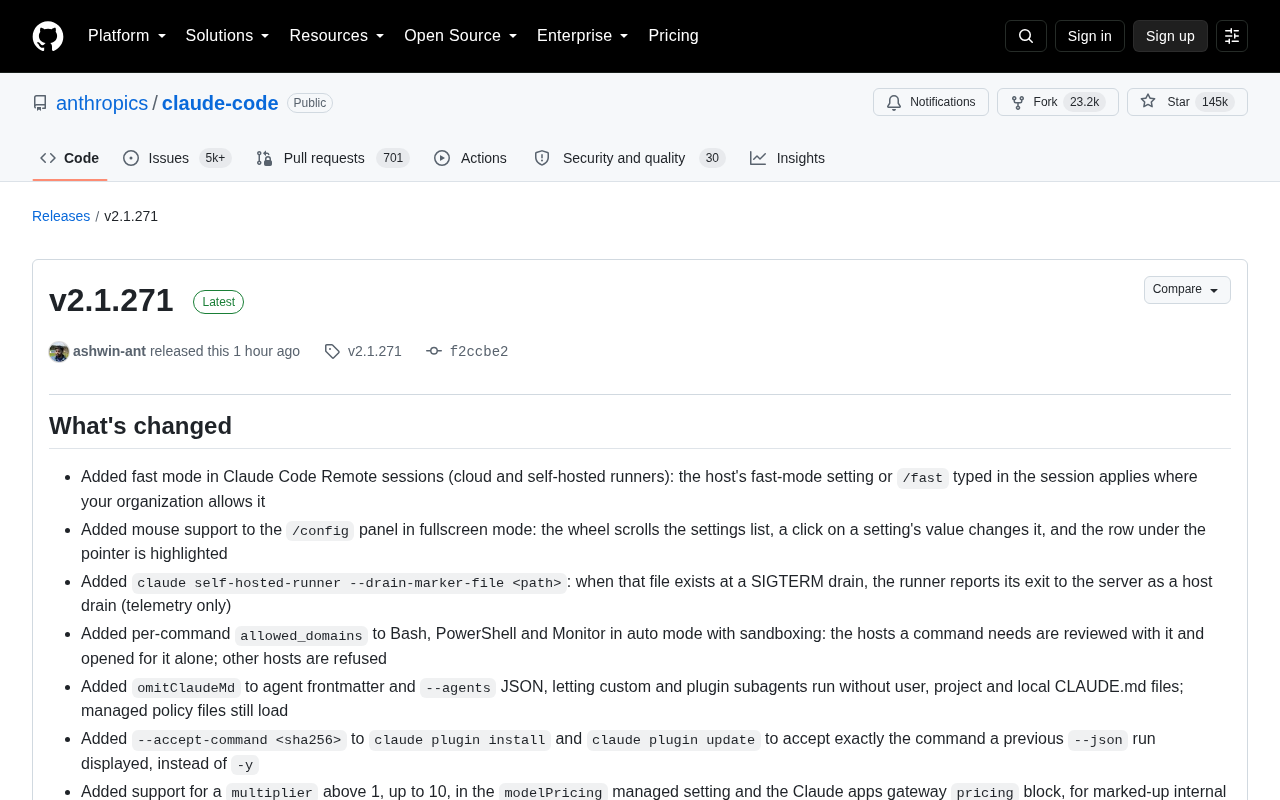
Claude Code v2.1.271 brings fast mode, per-command sandbox network controls, enterprise policy fixes, and MCP improvements.
Claude Code v2.1.271 is a significant release focused on quality fixes and enterprise capability enhancements. Remote sessions gain fast mode, enabled via the `/fast` command on both cloud and self-hosted runners. On the security front, auto mode introduces per-command `allowed_domains` network sandbox controls, and several Bash permission check vulnerabilities have been patched. For enterprises, organization policies now refresh immediately after credential changes, `managed-mcp.json` parse failures no longer silently pass, and a new `modelPricing` multiplier supports internal cost chargeback. MCP fixes address OAuth registration race conditions, bare-name tool search matching, and high CPU usage from `list_changed` events. Terminal experience improvements include faster large diff rendering, friendlier hook status feedback, and a new file-attach toggle in the VSCode extension.
Claude Code v2.1.271 Update Deep Dive
Anthropic's AI coding tool Claude Code has received a v2.1.271 update. As a popular project with 145,000 GitHub stars and 23,000 forks, this release brings a wide range of improvements spanning remote sessions, sandbox security, enterprise policies, the MCP protocol, and overall terminal experience. Here's a breakdown of the most noteworthy changes.
Fast Mode and Remote Session Enhancements
One of the highlights of this update is the addition of fast mode to Claude Code Remote sessions, available on both cloud-hosted and self-hosted runners. Users can enable it via the host's fast-mode setting or by typing /fast within a session, provided the organization permits the feature.
Several edge cases around fast mode have also been fixed: when an organization disables fast mode, /fast off previously responded with "fast mode unavailable" instead of simply turning it off; sessions launched with CLAUDE_CODE_SKIP_FAST_MODE_ORG_CHECK would repeatedly resend requests after an API rejection — rejections are now correctly retained and the reason displayed. When usage limits are hit, fast mode now correctly falls back to standard speed rather than failing the entire turn.
On the Remote Control front, unstable network connections will leave fewer empty sessions on claude.ai, and the messaging when a browser can't connect is clearer — it now first suggests the computer may be asleep before recommending the app installation.
Sandbox Security and Permission Check Upgrades
Security is a major focus of this update. The team has introduced per-command allowed_domains for Bash, PowerShell, and Monitor in auto mode: the hosts a command needs to access are reviewed alongside the command itself and opened individually, while all other hosts are denied. This fine-grained network control significantly tightens the security boundary for automated execution.
Bash permission checks have also been patched in several areas: files read after options in commands like fmt and column were previously missed; files expanded by wildcards (e.g., grep -v dir/* file) were skipped during checks; and shell variable declaration flags could be used to disguise the actual commands being executed. These fixes close potential permission bypass paths.
Additionally, the new omitClaudeMd field allows custom and plugin sub-agents to run without loading user, project, or local CLAUDE.md files, while managed policy files continue to load normally — balancing flexibility with compliance.
The fine-grained control offered by
allowed_domainsis a practical application of Network Sandboxing. The core principle behind sandbox security is the Principle of Least Privilege: a process or command is only granted the permissions necessary to complete its current task, and any access beyond that scope is denied. In AI code execution scenarios, allowing all outbound network requests could let malicious prompts or compromised dependencies exfiltrate source code, secrets, or internal data to external servers. Opening domains at a per-command level means that whencurl https://api.example.comis executed, onlyapi.example.comis temporarily permitted — all other hosts remain blocked, compressing the attack surface to a single-operation level. TheomitClaudeMdfield represents another layer of isolation: sub-agents don't inherit the user's personal configuration, preventing sensitive local instructions from being read by plugins or third-party agents — a design aligned with zero-trust architecture principles.
Enterprise and Policy Management Improvements
For enterprise users, the team has fixed several persistent issues with organizational policies. After switching accounts, organizations, or API keys, cached organization policies were previously reused incorrectly until the hourly check refreshed them; credential changes now trigger an immediate policy update. Tool and command lists also update correctly when policies finish loading or change mid-session.
For enterprise managed-mcp.json files that can't be read or parsed, the system no longer silently ignores them. Instead, it retains exclusive MCP control (user, project, and plugin servers are not loaded) and issues a startup warning — preventing security policies from being silently bypassed.
The new modelPricing managed setting supports multiplier values greater than 1 (up to 10), which — combined with the pricing configuration in the Claude apps gateway — enables internal cost chargeback scenarios. Self-hosted runners also gain a new --host-config-snapshot disk|memory option, addressing silent configuration loss in sessions where the host config directory exceeds 64 MiB.
managed-mcp.jsonis a policy file used in Claude Code enterprise deployments to centrally control the list of MCP servers. It is distributed by IT administrators at the organization level and takes precedence over user and project-level configurations. Its design logic is similar to configuration profiles in enterprise Mobile Device Management (MDM): administrators can specify which external tools are accessible, preventing employees from privately connecting to unaudited third-party services. ThemodelPricingmultiplier feature serves internal chargeback scenarios — when an enterprise provides AI capabilities to departments through a unified gateway, it can layer operational or service costs on top of API costs and distribute them across business units at a configured rate, satisfying financial compliance requirements. The 64 MiB limit addressed by--host-config-snapshot disk|memorystems from early implementations that stored config snapshots in memory or restricted storage areas; large monorepo configurations (containing many CLAUDE.md files and tool definitions) would easily exceed this limit and be silently truncated.
MCP Protocol and Tool Search Fixes
MCP (Model Context Protocol) fixes make up a significant portion of this release. When an MCP server sent list_changed notifications in a tight loop, it previously caused sustained high CPU usage and repeated tool list requests — this has been fixed. MCP OAuth client registration handling has also been corrected, resolving a series of issues including forced re-registration on authorization rejection and concurrent writes accidentally deleting valid registrations.
For tool search, when Claude selected an MCP tool by its bare name rather than the full mcp__server__tool format, it previously returned no match — this is now fixed. Resumed claude -p sessions where all tools come from MCP servers no longer fail with a defer_loading error.
MCP (Model Context Protocol) is an open standard proposed by Anthropic to establish a unified communication interface between AI models and external tools and data sources. Analogous to USB for hardware peripherals, MCP allows developers to avoid writing custom integration code for each AI application. Instead, through a standardized server-client architecture, models can invoke external capabilities such as file systems, databases, browsers, and APIs. In Claude Code, MCP servers run as independent processes and expose callable functions via a tool list; Claude identifies needs during a conversation and invokes them using the
mcp__server__toolnaming format. The OAuth mechanism handles authorization on MCP servers that require authentication, ensuring secure management of client registration and tokens. The high CPU issue fromlist_changedthat was fixed in this release stemmed from the client lacking debounce logic when servers frequently notified of tool list changes, causing repeated fetches to form a hot loop.
Session Resume and Workflow Optimization
Numerous details around /resume and /continue have been polished. Previously, only 1–2 sessions were displayed in full-screen mode on short terminals — this has been fixed. More importantly, a security improvement has been made: /resume and /teleport previously retained file read tracking records from the previous conversation, potentially allowing Claude to edit files it had never actually read — this risk has been eliminated.
Dynamic workflows now pause when usage limits are reached and automatically resume after the quota resets, rather than discarding affected agents outright. The default dynamic workflow size for Pro plans has been adjusted to small, and the guidance on agent count for medium-scale workflows has been reduced from 15 to 10, better reflecting actual resource constraints.
Terminal and IDE Experience Improvements
Terminal rendering performance has been improved, with large diffs and long conversation histories rendering faster with less stuttering. Startup time has also been slightly improved by skipping redundant validation of built-in model data.
Hook feedback is now more user-friendly: when SessionStart, UserPromptSubmit, PreToolUse, or SessionEnd hooks are running, a spinner displays the status and elapsed time, and pressing Esc cancels a waiting prompt. During extended thinking, the spinner displays "deep in thought" after 45 seconds, and "picking the thought back up" when recovering from an output token limit — a thoughtful touch.
The VSCode extension adds an Attach Open File setting; when disabled, open files are no longer automatically added to messages (selected text is still attached). Claude Code on the web has redesigned the Routines page with Yours and Templates tabs and a two-column card layout, and adds a custom network access option for cloud environments.
Overall Assessment
This extensive changelog makes clear that Claude Code is steadily maturing toward enterprise production readiness. The broader availability of fast mode, fine-grained sandbox network controls, and reliability fixes for organizational policies all signal Anthropic's investment in security and compliance. For individual developers, improvements to terminal performance, session resumption, and hook feedback deliver tangible day-to-day gains. This kind of high-frequency, quality-focused iteration cadence is exactly what a mature developer tool should look like.
Related articles

AI Giants Collectively Hit the Brakes: Safety Protocol or Industry Cartel?
OpenAI, Anthropic, Google DeepMind, and SpaceX leaders agree to slow AI development. Is this a responsible safety pact — or an oligopolistic cartel in disguise?

Apple Home Gets AI Camera Features with iOS 27: Up to $60/Month
iOS 27 and tvOS 27 bring Apple Intelligence to Apple Home with AI video summaries for HomeKit Secure Video — but unlocking them costs up to $60/month via subscription.

AI Race Becomes a Matter of National Security: How the US and China Are Framing Tech Competition as an Existential Struggle
US Treasury Secretary frames losing the AI race to China as existential. China calls it a pretext for tech hegemony. Analysis of how AI competition became a survival narrative.