A Decade of Drone Shows: Damoda Pivots to Low-Altitude Embodied Intelligence

Damoda centers on equipment sales, leverages low-altitude media and overseas growth, and bets on embodied intelligence and IPO for its next decade.
Damoda systematically articulates its business logic at its tenth anniversary: drone formation shows have shifted from festive garnish to a traffic necessity for cities and brands. Chongqing's low-altitude media experiment achieved a normalized, market-driven closed loop—over 11 million spectators in nearly a year, 41.9 billion yuan in cultural tourism consumption, and over 40 million yuan in project revenue fully covering investment. Overseas equipment sales grew 45x in five years, with orders jumping from 200–300 drone trials to single orders of 5,000 units across over 50 countries, with equipment sales accounting for about 70% of revenue. Technologically, it has achieved full domestic production and advanced automation and an AI script editor that generates scripts for 1,000 drones in 25 minutes, lowering the barrier from B2B to B2C. The company disclosed its second product line for the first time: a low-altitude swarm embodied intelligence system for GPS-denied enclosed spaces, with a demo expected between year-end and early next year. On the capital front, it has completed shareholding reform, with valuation up nearly 10x from Series A, and plans to file for IPO in 2027, holding about 36% global market share in performance swarms—ranking first.
Even if you've never heard of Damoda, you've likely seen its drone formation shows—it has appeared on CCTV's Spring Festival Gala seven times and been featured on Xinwen Lianbo multiple times. Yet the company has long kept a low profile in the public eye, only beginning to systematically articulate its business logic around its recent tenth anniversary.
From the viral performances across Nanchang, Yichang, Kunming and other cities during the National Day holiday, to the first disclosure of its embodied intelligence second product line, Damoda is trying to answer one question: when drone formation shows transition from a novelty to urban marketing infrastructure, where does the next increment of growth lie?
Low-Altitude Media: Performances Shift from Nice-to-Have to Traffic Necessity
Damoda's assessment of its performance business has undergone a fundamental shift. Deputy General Manager Qin Haiqun laid out the logic plainly: with traffic prices sky-high today, the cost of one drone show corresponds to hundreds of millions—even billions—of impressions across the internet. This means drone shows are transitioning from a garnish on festive events to a traffic necessity for brands and cultural tourism clients.
The data from four National Day city projects supports this judgment. According to official reports cited by the company, the Nanchang show stayed on Douyin's trending list for seven consecutive days, generating around 5 billion impressions across the web, with out-of-town visitors accounting for over 50% on October 1 alone; the Yichang show drew approximately 700,000 on-site spectators; the Kunming show, with no advance announcement, made it onto Xinwen Lianbo the very night of the performance.
What truly holds industry benchmark value is Chongqing's low-altitude media experiment. The 3,000-drone execution for the 2025 CCTV Spring Festival Gala Chongqing sub-venue was the starting point—rehearsals were held in the early morning hours to minimize spoilers, yet the venue was still packed. Chongqing subsequently launched regular performances, scaling from 2,000 drones to 5,000 drones stationed weekly on Saturdays and holidays, becoming the world's largest long-term resident performance by drone count, supported by drone nests and automatic charging for unlimited continuous flight.
Even more groundbreaking is the market-driven mechanism. According to official Chongqing reports, during the operating period the drone shows drew over 11 million on-site spectators in nearly a year, with 11 billion impressions on official platforms; they drove 41.9 billion yuan in cultural tourism consumption in Nan'an District, up about 9% year-on-year, and Spring Festival restaurant revenue in the core Two Rivers and Four Banks area rose nearly 30%. The government treats the night sky as an aerial billboard for commercial solicitation, with brands like Changan, Tencent, and Mixue Bingcheng coming on board. The project generated over 40 million yuan in total revenue, fully covering its investment.
This normalized, market-driven, traffic-oriented model has already been deployed in Hong Kong, Jinan, Yangzhou and other cities. For governments, it represents a shift from a fiscally funded project to a self-sustaining traffic business; for Damoda, the performance venue is also a natural showcase for equipment sales.
Low-altitude media is an industry concept that has emerged in recent years, referring to the use of aircraft within low-altitude airspace (such as drone formations, airships, eVTOL, etc.) as media carriers to deliver brand communication, city image promotion, public information dissemination and other functions—essentially turning the "sky" into an operable outdoor billboard and communication channel. Compared with traditional outdoor advertising, low-altitude media is characterized by strong instantaneous impact, high secondary dissemination efficiency on social platforms, and the ability to combine with festivals and city landmarks to create event marketing. Its business model typically involves the government or venue providing airspace and site resources, the operator handling content production and execution, and brands paying for naming rights or placements, forming a multi-party structure of "government sets the stage, enterprise operates, brands pay." Damoda's Chongqing project is a typical example of this model, converting one-off events into sustainable traffic assets through regular resident performances, and moving low-altitude media from concept to a replicable commercial closed loop.
Going Global: 45x Growth in Five Years, Order Structure Transformed
Overseas is Damoda's fastest-growing line. Entering the market in 2020, it achieved 45x growth in five years, covering over 50 countries and regions, with core markets in North America, Europe, and the Middle East.
More informative than the growth rate itself is the change in order structure. Before 2025, overseas clients typically tested the waters with 200 or 300 drones; in 2026, a clear leap in order magnitude emerged. A major German LED screen manufacturer, looking to supplement its display product line, purchased 800 drones last November, repurchased 1,000 at the start of the year, and its most recent order reached 5,000 units directly. In Uzbekistan, a new client bought drones in July and flew them the following month, with a single video garnering tens of thousands of likes on TikTok and Instagram; a Thai client's video of Vietnam's 50th anniversary celebration surpassed one million likes on TikTok.
In its overseas strategy, Damoda typically only sells equipment and supporting technology, not execution services. Qin Haiqun explained that overseas customs clearance can take up to two weeks, and equipment like batteries is difficult to ship back once exported, making time costs far higher than domestically; meanwhile, the company opens its design resources, pilot resources, and a library of tens of thousands of creative scripts to partners, delivering script design capability alongside. "Overseas clients think more actively—they can even create better content than we can. That's a virtuous cycle."
Equipment sales account for about 70% of total revenue, a ratio that makes clear Damoda's core identity is an equipment and technology systems provider, not a performance executor. Performances are just the calling card; equipment is the business.
Technology Foundation: Three Main Lines—Domestic Substitution, AI, and Unmanned Operations
Supporting the above businesses is a full-stack self-developed technology system. The company currently has over 300 employees, with R&D staff accounting for about 40%.
At the hardware level, Damoda has completed the switch from imported core components to full domestic production. Qin Haiqun recalled that early third-generation products used foreign F9P positioning modules—expensive, and there was always the worry that they might stop selling to you one day. By the later third-generation and fourth-generation products, domestic chips fully met requirements and were compatible with BeiDou. Currently, its drone hardware localization rate is 100%.
Automation is another main line forced by overseas labor costs. The earliest performances required one pilot per 100 drones to position and calibrate with measuring tapes. Clients in Australia and the US reported that labor costs exceeded the cost of the drones themselves. This drove the development of the V3 box-style takeoff and landing system in 2022, which disrupted the industry and was subsequently widely adopted. Then came the V4-based intelligent vehicle-mounted performance system: once the vehicle is in position, a single button opens the bay, calibrates, takes off, and recovers—all in about 60 seconds, compared to the traditional model requiring 5 people and 3 hours to set up. One scenic area in Shandong now operates 500 drones with just one person.
The AI script editor is a key product released this year. Users with no design background can input text commands—such as "500 drones, happy birthday, a certain pattern"—and generate a flight script within 1,000 drones executable directly by the ground station in 25 minutes, whereas a professional team previously needed about a week. The introduction of AI-powered technology dramatically lowers the programming and design threshold, seen as key to moving from B2B to B2C. It is reported that this ToC model is gradually being rolled out to the market.
Embodied intelligence refers to an intelligent form in which an agent interacts with the environment in real time through a physical body, completing tasks within a perception-decision-action closed loop—as opposed to software intelligence that operates only in digital space. Drone swarms are one of the important carriers of embodied intelligence: each drone must perceive its own attitude and surrounding environment, make obstacle-avoidance and path decisions, and execute actions through flight control, while multiple drones must also coordinate and divide labor. Unlike performances in open areas relying on GPS, embodied intelligence in enclosed spaces places higher demands on positioning and navigation, typically relying on multi-sensor fusion of vision, LiDAR, UWB, etc., to achieve GPS-free positioning. Damoda's proposed "low-altitude swarm embodied intelligence" refers to migrating swarm coordination capabilities from performance scenarios to inspection, warehousing, hazardous area operations and other task scenarios—a key concept in the leap from "performance tool" to "productivity tool."
The Second Curve: Low-Altitude Swarm Embodied Intelligence Disclosed for the First Time
Building on its mature drone swarm control technology platform and over 66 million flight sorties of data, Damoda is developing a new drone swarm system for enclosed, narrow spaces and hazardous areas where GPS signals are weak or absent.
Unlike existing products that perform preset flight paths in open areas, the second product line targets enclosed spaces with no GPS signal and limited lighting. Through multi-sensor fusion positioning and autonomous navigation, drones can autonomously perform obstacle avoidance and decision-making in complex environments after initial mapping. The core remains the word "swarm": individual drones can operate independently, while multiple drones coordinate, divide labor, and continue operations in relay. The single-drone flight control and swarm control systems can be directly migrated and reused; the main new challenges to overcome are enclosed-space navigation and autonomous obstacle avoidance.
The second product line doesn't start from scratch—a decade of single-drone and swarm technology accumulation and 66 million flight sorties of data are already in place. A demo of the project is expected between the end of this year and early next year. This is also one of the landing points for Damoda's brand upgrade to a low-altitude swarm embodied intelligence industry-level solutions provider—from "flying more beautifully" to "flying more intelligently."
This direction happens to intersect with two major hotspots: the low-altitude economy and embodied intelligence. The company's attitude is open: "More players joining shows the market is big enough; we have a first-mover advantage in the swarm dimension, are more flexible, and can enter through customized niche segments."
IPO Path and Industry Landscape
On the capital front, Damoda has given clear milestones. The company has completed its shareholding system reform and plans to file for industrial and commercial registration changes soon; it completed multiple financing rounds this year, with valuation up nearly 10x from Series A, attracting several top-tier investment institutions with central SOE backgrounds. Another financing round will be advanced by year-end, with plans to file for IPO in 2027.
According to QY Research data cited by the company, its global drone performance swarm market share is about 36%, ranking first in the industry. Based on institutional estimates, the global market size for this track is in the tens of billions, expected to maintain double-digit compound growth over the next five years. If its subsequent filing is accepted, Damoda will become one of the few IPO candidates in the low-altitude swarm and swarm embodied intelligence track.
Amid increasingly tightening regulatory policies, safety and operational records are becoming the deepest moat for leading companies. According to Damoda's public disclosures, the company has completed over 30,000 performances with no safety incidents on public record; it has also publicly released the "Drone Formation Flight Performance Safety Standards." The threshold for regular, large-scale operations is actually rising.
Ten years ago, Damoda completed China's first formation performance, "The Red Star Shines Over China," with 80 drones in Yudu, Jiangxi. At the time, the team's meeting discussion was whether drone swarms could make money. Ten years later, the performance business has proven viable, equipment and overseas expansion underpin revenue, and embodied intelligence and IPO point to the next decade. Whether this fleet of drones that wants to "get to work" can open up new industrial space remains to be answered by next year's demo and subsequent capital market developments.
Shareholding system reform is a necessary step before a company enters the capital markets. A limited liability company must convert to a joint-stock company, clarifying share capital structure, shareholder rights and obligations, and governance mechanisms, laying the foundation for subsequently introducing strategic investors and filing for IPO. Completing the reform typically means the company has entered the substantive stage of IPO preparation, but it still needs to go through coaching and filing, application acceptance, exchange inquiries, listing committee review, CSRC registration and multiple other stages, often taking over a year. A valuation increase of nearly 10x from Series A reflects investors' comprehensive pricing of its revenue scale, industry position, and second-curve expectations. In the current context of tightening regulation and safety records becoming a core threshold, leading companies' compliance and operational data accumulation is translating into competitive barriers difficult for latecomers to replicate in the short term—which is the deeper reason Damoda emphasizes its 30,000+ incident-free performances and publicly released safety standards.
Related articles

M&M's Spent Millions Replacing Artificial Blue Dye — Why Is It So Hard?
Mars spent millions trying to replace artificial blue dye in M&M's with spirulina, but thick material clogs pipes and residue risks mold, forcing a full production-line rebuild. Here's the engineering behind the reformulation.

Teammate Wanted for Meta Global AI Developer Hackathon: Computer Vision & Medical AI
A Reddit developer seeks teammates for the Meta Global AI Developer Hackathon, focusing on computer vision and medical AI. This article analyzes the track logic, skills-complementarity needs, and topic selection strategy behind this teaming signal.
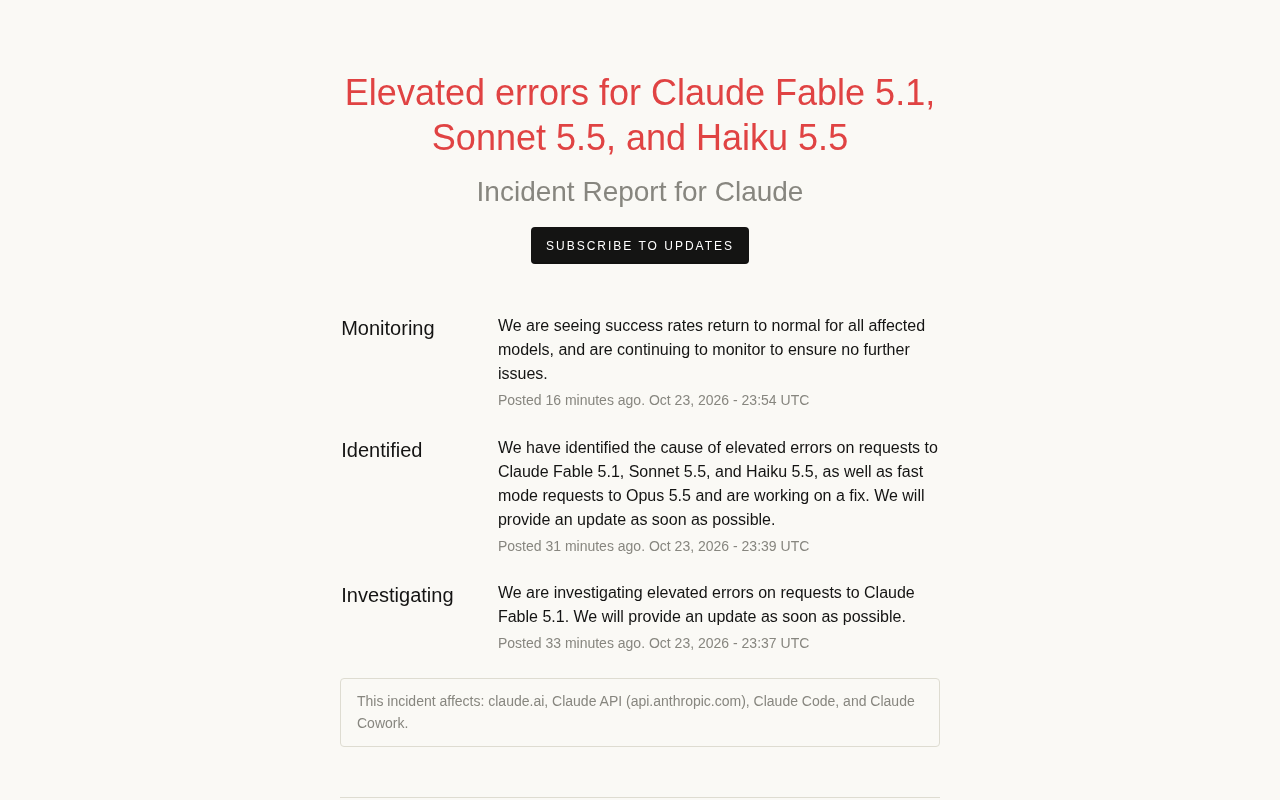
Multiple Claude Models Hit by Errors: A Postmortem of Fable 5.1, Sonnet 5.5, and Haiku 5.5
Claude Fable 5.1, Sonnet 5.5, Haiku 5.5, and Opus 5.5 fast mode saw elevated errors; Anthropic identified and resolved the issue in 17 minutes. This postmortem covers the timeline, the technical reasons for the multi-model cascading failure, and practical lessons for retry and degradation strategies.