A DeepSeek Kernel Engineer's Confession: Being Replaced by the AI I Trained
A DeepSeek kernel engineer admits AI has gone from doc assistant to kernel master in one year, forcing developers from craftsmen into agent managers.
A DeepSeek engineer who personally wrote the V4.1 Flash attention kernel candidly describes how AI has visibly closed in on — and may surpass — his own expertise in GPU kernel development within just one year. He documents AI's evolution from a documentation tool to an independent kernel developer, backed by model prices collapsing 1,000x in 18 months. Caught in a paradox where better kernels accelerate his own obsolescence, he still gives it his all — out of love for the craft, and because competitors won't stop regardless. The piece ultimately asks how knowledge workers can preserve meaning in their work as AI turns craftsmen into productivity-driven agent managers.
A recent blog post by a DeepSeek kernel engineer has sparked widespread discussion. This engineer personally wrote the core attention kernel for DeepSeek V4.1 Flash — and then candidly admitted in the post that AI is catching up to, and possibly surpassing, him in writing GPU kernels at a visible pace. This isn't a technical brag piece. It's a sober self-examination by a developer standing at the very frontier of the AI wave, reflecting on the fate of his own career.
Within One Year: From Documentation Assistant to Kernel Master
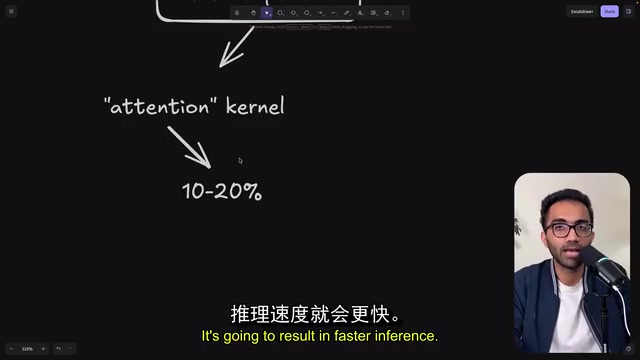
The author uses his own domain — GPU kernel design and optimization — as a front-row seat for observing AI's evolution. This is one of the most expensive and performance-critical parts of running large models. Even a 10–20% speedup in an attention kernel translates directly into faster inference, faster training, and lower costs — enormously valuable work.
The transformation he describes is striking: in just one year, AI went from "a small assistant that could only help me look up docs, read code, and find bugs" to "a kernel master capable of independently handling a large portion of core development work." He predicts that within the next six months to a year, AI will be able to independently design kernel schedules, evaluate performance trade-offs between different scheduling strategies, and implement and optimize them — which happen to be the hardest parts of his job.
This feeling isn't unique to kernel engineers. Whether you're a frontend, backend, or mobile developer, or a UI/UX designer, almost every in-demand role has been significantly reshaped by AI. The only difference is whether AI is doing 20%, 30%, or 50% of your work.
A GPU attention kernel is the core computational unit when running large language models. It executes the self-attention mechanism in the Transformer architecture — enabling the model to "attend" to other relevant tokens in the input sequence while processing each token. This computation is extremely intensive, often consuming 30–60% of total compute during both training and inference. A kernel engineer's job is to translate this abstract algorithm into low-level code that runs efficiently on GPU hardware, requiring deep expertise in CUDA programming models, GPU memory hierarchies (registers, shared memory, VRAM), and thread block scheduling. Because of the high degree of hardware parallelism and limited memory bandwidth, kernel optimization demands careful balancing of compute and memory access — any misstep can drastically reduce GPU utilization. Due to its high specialization and scarcity, kernel engineering has long been considered a top-tier technical role in AI infrastructure, commanding salaries and influence at the very top of the industry pyramid.
The Price Collapse: 1,000x in a Year and a Half
The video's author added a striking set of figures to illustrate AI's acceleration. When OpenAI's O1 Pro model launched a year and a half ago, it was priced at $150 per million input tokens and $600 per million output tokens, with a 200K context window. Today, OpenAI's most advanced model, GPT-6 Astra, is priced at $10 input and $50 output per million tokens, with a context window in the millions — a roughly 10x cost reduction for flagship models in just a year and a half.
If you compare against a high-value model like DeepSeek V4.1 Flash, the gap is even more staggering: its input price is just $0.15 per million tokens — nearly 1,000 times cheaper than O1 Pro at launch. A thousand-fold price drop in a year and a half is extraordinary by any industry's standards.
Understanding this price collapse requires familiarity with the concept of "tokens" in LLM pricing. A token is the basic unit by which models process text — roughly half an English word or one to two Chinese characters. "Per million tokens" is the standard unit for API pricing. When O1 Pro launched at $150 per million input tokens, processing roughly 750,000 English words (about a mid-length novel) cost $150. DeepSeek V4.1 Flash compresses that same input cost to about $0.15 — a thousand-fold reduction. This trend is partly driven by open-source models pressuring closed-source vendors on pricing, and partly by rapid iteration in inference efficiency techniques such as KV caching, quantization, and distillation. Notably, price collapse doesn't mean reduced capability — in fact, lower prices often come paired with longer context windows and stronger reasoning, making the improvement in the "performance per dollar" curve far greater than the raw price reduction figures suggest.
"I Personally Accelerated My Own Obsolescence"
The most affecting part of the article is the author's almost contradictory feelings toward his own work. He clearly sees a cruel logic at play: the better he writes the kernel, the faster new models train and run inference, the faster model capabilities improve, and the sooner he gets replaced. Since he works directly on the models themselves, this self-obsolescence loop is unusually short.
So why does he still give it everything he's got? He offers two reasons. First, writing kernels feels to him "like playing a video game" — the satisfaction of inventing new techniques and seeing his kernel outperform the official version is no different from a speedrunner breaking their own record. Second, and more practically: even if he slacked off or deliberately slowed things down, models at other companies would still improve and eventually replace him anyway.
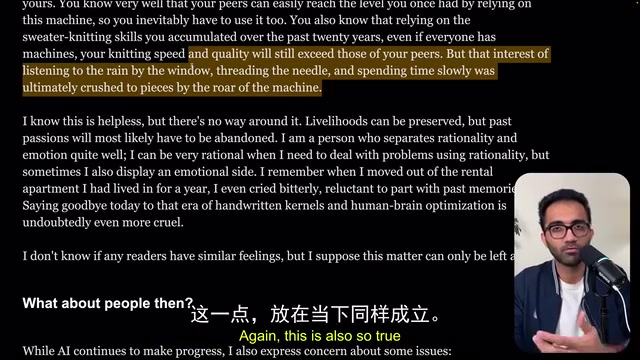
The video's author strongly relates to this. He recalls the "flow state" programmers used to experience before AI — headphones on, music playing, six to ten hours immersed in a codebase, no need to open Stack Overflow or Google, everything running in your head as you thought through database schemas, application structure, data flow, and performance implications. That feeling of finishing a session not exhausted but energized — it's now being crushed by an "output-above-all" reality.
From Craftsman to "Mech Pilot"
The author is clear-eyed about his own future: he probably won't lose his job, but he will have to "change careers." The industry's demand has shifted from "people who can write high-performance kernels" to "people who can use AI to produce high-performance kernels faster." That means walking away from the kernel design work he spent years mastering and genuinely loves, and becoming instead a "mech pilot for AI agents."
He uses a beautifully apt analogy: a master weaver who loves sitting by the window, drinking tea, watching the mountains, and spending an afternoon quietly knitting a sweater. Then someone invents an automatic knitting machine that produces comparable quality at far greater speed, needing only yarn and a pattern. Knowing that peers will easily match his former output with the machine, he reluctantly adopts it himself — but the joy of "knitting to the sound of the rain" is ultimately drowned out by the machine's roar.
This is precisely what has happened over the past few months to nearly every developer. The successive releases of models from Opus to GPT-5.6, Astra, Fable, and others have pushed everyone across the software stack — frontend, backend, full-stack, mobile — onto the same new track: produce faster with AI. The video's author admits that, having realized the world is in the midst of a "code explosion," he himself stepped back from most hands-on coding over the past few months, because "generating more AI slop output is not the right use of your time."
A Divergence on AI's Future
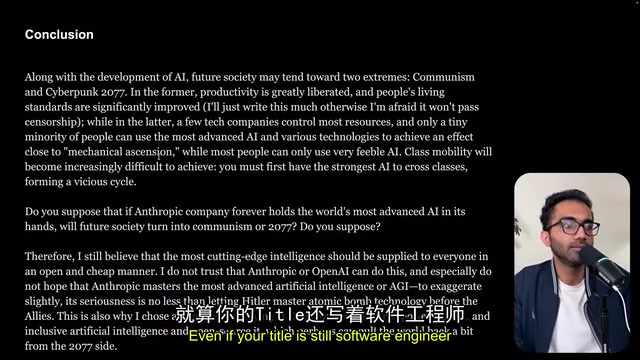
At the end of the blog post, the author makes a sharp political-economic prediction: AI development may lead to one of two extremes — an "ideal society" where productivity is vastly liberated and living standards dramatically improve, or a Cyberpunk 2077-style dystopia where a handful of tech companies monopolize the most advanced AI and social mobility becomes increasingly difficult. He explicitly states he doesn't trust Anthropic or OpenAI to fairly distribute frontier intelligence to everyone, going as far as an extreme analogy: allowing a single company to monopolize AGI would be no less dangerous than "letting Hitler get the atomic bomb before the Allies." He emphasizes this is exactly why he chose to stay at DeepSeek — to work on AI that is powerful, fast, accessible, and open-source, "perhaps to pull the world back a little from the 2077 side."
The video's author takes a different view. He argues that in a competitive, information-free environment like the United States — especially California, which doesn't enforce non-compete agreements — talent and knowledge flow freely as employees change jobs, making it unlikely that any single company could permanently monopolize the space. But he also acknowledges an interesting paradox: it's precisely because people like this engineer are willing to stay at open-source labs and work hard to "disprove their own prophecy" that his optimistic view of a non-monopolized future has any chance of being true. The two positions are, in fact, mutually dependent.
The "AGI" (Artificial General Intelligence) mentioned in the article is a concept in the AI field without a universally agreed-upon definition — it generally refers to an AI system that can match or surpass human performance across nearly all intellectual tasks, distinct from today's "narrow AI" that excels only in specific domains. Governance debates around AGI have become central to AI policy: Anthropic and OpenAI represent one camp, arguing that safety alignment research must proceed carefully in closed environments and that premature open-sourcing could spread dangerous capabilities; DeepSeek, Meta, and others represent the opposing view, contending that open-sourcing helps distribute power, accelerate safety research, and reduce monopoly risk. The legal detail about California not enforcing non-compete agreements is also worth noting: it means Silicon Valley employees can freely change jobs without legal constraints, taking their technical experience with them — effectively creating a knowledge diffusion mechanism that the video's author cites as a key institutional reason why no single company can permanently monopolize AI.
A Final Thought
What makes this confession resonate so widely is that it transcends the technical, touching on a reality every knowledge worker is facing or will soon face: AI isn't just changing efficiency — it's changing the emotional bond we have with our work. When "the thing you love" becomes "the thing AI does better," when programmers go from immersed craftsmen to output-driven "agent managers," the capacity that may matter most is the ability to live with change and trust yourself to adapt to whatever comes next. As the video's author puts it: you don't have to wait until you're unemployed to understand this — but this transformation is coming for everyone.
Related articles
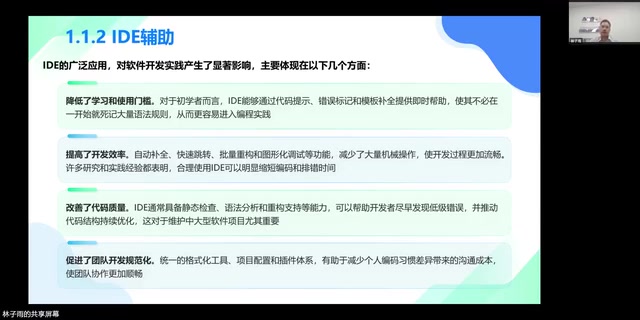
AI Programming at Xiamen University: A Full Breakdown from Textbook to Teaching
Xiamen University's Lin Ziyu shares how he built an AI programming course — covering three coding eras, Claude Code's production-ready milestone, three methodologies, and a fully free, reproducible curriculum design.
A DeepSeek Researcher's Confession: The AI He Trained Is About to Replace Him
DeepSeek V4.1 kernel engineer Liu Shengyu admits the AI he trained will surpass his own skills within a year—yet he keeps pushing forward. Here's why.

n8n Automation in Practice: How AI Workflows Help SMBs Cut Costs and Boost Efficiency
Learn how SMBs use n8n and AI tools to automate multi-platform messaging, AI customer service replies, and bulk exam data entry — real-world workflows for cutting costs.