AI Programming at Xiamen University: A Full Breakdown from Textbook to Teaching
Xiamen University launches a free AI programming course using local models and industry-grade methodologies.
Associate Professor Lin Ziyu of Xiamen University shared the development of his course *AI Programming and Intelligent Agent Development*, tracing programming's evolution from manual coding to AI collaboration and marking Claude Code's OPUS release as the production-ready inflection point. The nine-chapter textbook introduces three progressive methodologies drawn from front-line industry practice. The course launched in fall 2026 for 111 undergraduates, using Google's Gemma local model and ByteDance's Trae IDE — entirely free, no API tokens required.
AI Programming Is Reshaping How Software Gets Built
The explosion of large language model technology is fundamentally changing the underlying logic of software development. At the 152nd session of the Big Data Hundred Lectures livestream, Lin Ziyu — Associate Professor and Director of the Experimental Teaching Center at Xiamen University's School of Informatics — shared his experience building the course AI Programming and Intelligent Agent Development. This is the sixth course he has developed at Xiamen University, and like its predecessors, it relies entirely on self-authored textbooks that have been successfully adopted beyond campus. Behind it lies a broader reconstruction of the content boundaries of computer science education.
Lin argued that the evolution of programming languages follows a historical inevitability: from machine code and assembly to high-level languages, and now to AI programming — where natural language descriptions prompt AI to generate code. Each leap has lowered the barrier to entry and increased development efficiency. In his view, AI programming will inevitably become dominant, replacing both manual coding and IDE-assisted development.
Three Eras: From Manual Coding to Human-AI Collaboration
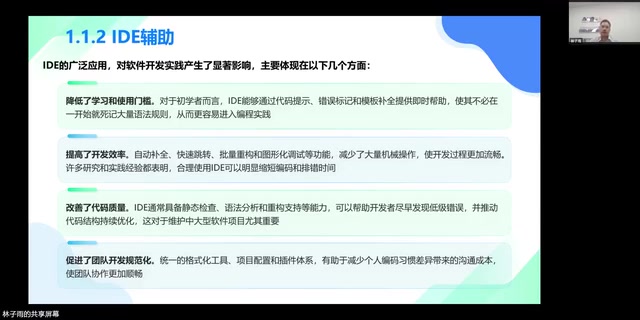
Lin organizes the history of software development into three distinct phases. Manual coding, which began in the 1950s and continues today, relies entirely on human thinking, with computers serving only as instruction executors. While manual coding remains irreplaceable in performance- and security-critical contexts — such as system internals, the Linux kernel, and embedded development — its efficiency bottlenecks are increasingly apparent for repetitive tasks like CRUD operations and standardized interface definitions.
The IDE-assisted phase emerged in the 1990s. From Turbo C and Visual Studio to Eclipse, IntelliJ IDEA, and the lightweight VS Code, IDEs reduced the mechanical burden on developers through syntax highlighting, auto-completion, and debugging tools. But Lin emphasizes that IDEs never changed the core fact that humans remain the primary producers of code — tools played a supporting role, nothing more.
The AI programming phase brings a fundamental shift: the division of labor itself has changed. Developers increasingly take on responsibility for defining requirements, decomposing tasks, evaluating results, and maintaining system-level oversight — while actual code generation, boilerplate completion, and basic test writing are handed off to AI. Lin further divides AI programming into three sub-phases: AI-assisted programming (AI executes human decisions, e.g., GitHub Copilot), AI-collaborative programming (humans and AI make decisions together, e.g., Claude Code, Cursor Composer), and AI-autonomous programming (humans act only as supervisors — still exploratory).
The Inflection Point: Claude Code and Production-Ready Code
Lin offered a key temporal judgment during the lecture. He noted that the Transformer architecture, the release of GPT-1, and the 2021 launch of GitHub Copilot set the technical stage — but the real turning point came when Claude Code, the world's top-ranked coding model, released its OPUS version. That moment marked AI programming's transition to generating code that is genuinely production-ready, not just a toy.
It was this signal that prompted Lin's team to launch the course just one month after Claude Code's maturation. He compared it to 2013, when his team recognized the dawn of the big data era early and authored China's first big data textbook, which went on to be adopted by over a thousand universities.
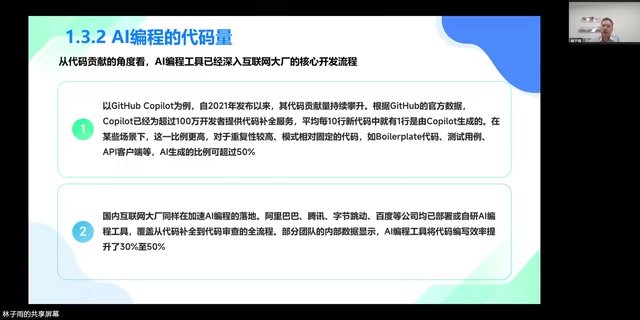
The industry data backs this up. According to API usage statistics Lin cited from multiple vendors, code generation accounts for over 30% of token consumption — the highest of any use case. Domestically, major Chinese internet companies report 30–50% of their code being AI-generated. Tencent executives have disclosed that 70% of new code at the company is AI-written, while Google and Microsoft have announced plans to push AI-generated code past 90% within three to five years. A Stack Overflow survey found that over 84% of developers use or plan to use AI coding tools.
Background: The Transformer architecture was introduced by Google in 2017 in the paper Attention Is All You Need. Its key innovation — replacing recurrent neural networks with a self-attention mechanism — allowed models to process sequence data in parallel and capture long-range dependencies. This architecture became the foundation for virtually all major LLMs, including GPT, BERT, and Claude. Claude Code is a command-line AI coding tool from Anthropic that integrates directly into the terminal environment. It can read an entire codebase's context, execute shell commands, modify files, and run tests — distinguishing it from IDE plugins like Copilot that focus primarily on code completion. "Production-ready" means the generated code not only has correct syntax but also meets engineering standards for error handling, edge case coverage, performance, and maintainability — code that can be merged directly into a real codebase, not just used for demos or prototypes.
Textbook Design: Three Methodologies Grounded in Industry Practice
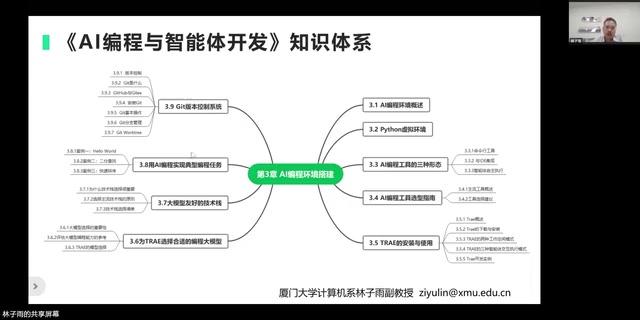
The textbook at the heart of this lecture — AI Programming and Intelligent Agent Development, to be published by Posts and Telecom Press with an expected November release — spans nine chapters. It starts with large model fundamentals, progresses through an overview of AI programming, environment setup, three programming methodologies, and intelligent agents, and concludes with LangChain and LangGraph, two of the most widely used agent frameworks.
The three-methodology progression is the textbook's standout feature:
- Prompt-based AI programming: Suited for individual developers; covers prompt engineering frameworks, coding rule configuration, and maintaining existing codebases
- Spec-based AI programming: Designed for team collaboration; introduces tools like SpecKit and OpenSpec, with a four-step workflow: exploration, proposal, implementation, and archiving
- Workflow-based AI programming: For enterprise-scale projects; covers the Spec Workflow seven-step process and quality assurance mechanisms
Lin repeatedly stressed that the textbook's content wasn't invented from scratch — it was drawn from front-line practices compiled by one of his former students, now a senior expert at a top-three Chinese internet company, who also served as a full technical advisor. The goal is explicitly to bridge "the last mile from university to industry." Every chapter pairs theory with hands-on case studies.
Background: LangChain is the most widely used framework for LLM application development, offering standardized components for chaining (Chain), tool calling (Tool), and memory management (Memory) — helping developers connect LLMs to external data sources, APIs, and business logic. LangGraph, built by the LangChain team, is a more advanced framework that uses a directed graph structure to describe agent decision flows: each node represents a processing step or sub-agent, and edges represent state transition conditions. It's suited for workflows that require cyclic reasoning, multi-agent collaboration, or complex conditional branching. Compared to LangChain's linear chain structure, LangGraph handles high-uncertainty tasks that require dynamic rollback and iteration — making it one of the leading choices for building agent systems today. The two frameworks have very different learning curves, which is why the textbook makes deliberate tradeoffs in how deeply each is covered.
Teaching in Practice: A Free, Reproducible Course Design
In the fall semester of 2026, Xiamen University officially launched the course for second-year computer science undergraduates. 111 students enrolled — far more than a typical elective. The course runs 48 hours (16 theory + 32 lab), with grading structured as 40% attendance, 40% lab work, and a final project — no traditional written exam. Lin was explicit: this course doesn't test students' ability to write code by hand. It tests their ability to direct AI to do the work, which requires an entirely new evaluation model.
On the question everyone cares most about — cost — Lin gave a clear answer: the entire course is free. Students don't need to purchase any API tokens. The local model is Google's open-source Gemma series in a small-parameter version (approximately 4 billion parameters), chosen to ensure the workflow runs rather than to maximize output quality. The coding tool is Trae, developed by ByteDance and already used by 8 million developers in China, which can automatically route tasks to free models via its auto mode. This design directly addresses the controversy surrounding a previous incident where students reportedly withdrew over token costs.
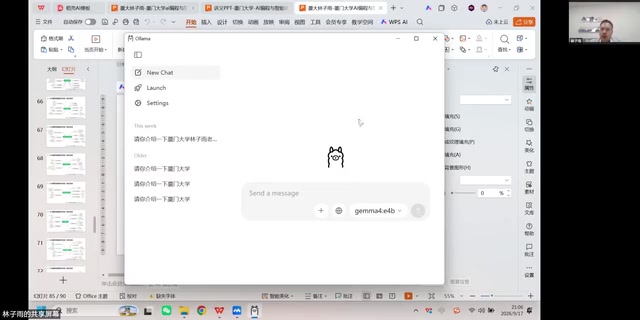
On the choice of Trae over Claude Code, Lin explained the adoption logic: while Claude Code ranks first globally, it charges per token and has repeatedly blocked Chinese users — making it unsuitable for a nationwide, cost-free rollout to universities. On hardware, he recommends lab machines with at least 16GB of RAM and 20GB of free disk space; no GPU is required. He also noted that some case projects can take very long to run, so he recommends students bring their own laptops and use the lab only for power and internet access, so experiments can continue back in the dorm.
Background: Gemma is an open-source lightweight LLM series released by Google DeepMind in 2024, designed to run on consumer-grade hardware. The smallest version is 2B (2 billion parameters); the ~4B version used in this course (Gemma 4B / Gemma2 2B variants) can run inference on a standard laptop CPU with 16GB of RAM — no discrete GPU needed. Trae is ByteDance's AI coding IDE, built on a VS Code core with built-in multi-model routing. Its "Auto mode" routes tasks to different free models based on task type, providing zero-cost access for Chinese users. Claude Code, by contrast, charges per token, and Anthropic has repeatedly restricted registration from mainland Chinese IP addresses and phone numbers for compliance reasons — leading to account bans and payment obstacles for large-scale university use. This is the fundamental reason Lin chose a domestic alternative over the globally top-ranked tool.
Scope, Positioning, and Open Questions
Lin repeatedly clarified a key point: this course is not a replacement for first-year Python or C courses — it's an advanced course that builds on existing programming foundations. Students must already have a programming mindset before stepping into AI programming. He likened it to "an upgraded version of programming languages," and argued that every computer-related major — including big data, IoT, AI, software engineering, and cybersecurity — should incorporate AI programming and agent development into its core curriculum.
In the Q&A, Lin was candid about his team's limitations: they specialize in teaching, and have limited hands-on experience with enterprise-scale agent development. The textbook therefore makes deliberate cuts to complex features of frameworks like LangGraph to keep the learning curve manageable for students. This tradeoff reflects the fundamental difference in positioning between a university textbook and an industry engineering reference.
Related articles

A DeepSeek Researcher's Confession: The AI He Trained Is About to Replace Him
DeepSeek V4.1 kernel engineer Liu Shengyu admits the AI he trained will surpass his own skills within a year—yet he keeps pushing forward. Here's why.
n8n Automation in Practice: How AI Workflows Help SMBs Cut Costs and Boost Efficiency
Learn how SMBs use n8n and AI tools to automate multi-platform messaging, AI customer service replies, and bulk exam data entry — real-world workflows for cutting costs.
DeepSeek Harness Hands-On: Build Your Own Coding Agent for Free
DeepSeek Harness hits 190K GitHub stars as a free Claude Code alternative. This hands-on review covers installation, plugin models, full traceability, and driving Claude Code as a subprocess.