A Funny Screenshot Story from Qwen Model: AI Self-Awareness and Tool-Calling Reflections

Qwen's amusing 'inner monologue' reflects LLM self-awareness and tool-calling mechanisms.
Starting from a Reddit post about Qwen's 'inner monologue' during a screenshot task, the article analyzes its technical implications. The model explicitly says 'I'm an LLM, I can only read text,' reflecting a trained understanding of its capability boundaries that directly affects multimodal task routing. The post's 'doubt first, try next, be surprised last' corresponds to the full tool-calling lifecycle: understanding task needs, selecting tools, constructing parameters, and parsing results. It further distinguishes directly using multimodal models from programmatic save-and-parse paths, emphasizing that a model's upper limit depends not only on its weights but also on the external tool ecosystem—making tool-based gap-filling more practical for developers than debating native modality support.
A Qwen Thought Process That Made Developers Smile
Recently, an interesting post has been circulating on Reddit: a user shared the "inner monologue" of the Qwen model (specifically Qwen3.8-27B) while handling a screenshot task, sparking lively discussion in the AI community. The paraphrased thought process went roughly like this:
"Hmm, I could take a screenshot—there's a tool that can do this. But wait, I'm a language model, I can only read text. Oh well, let me try calling the tool and see. Maybe I can save the image and then parse it with a program. Tool call... wow, I can see the image! How cute."
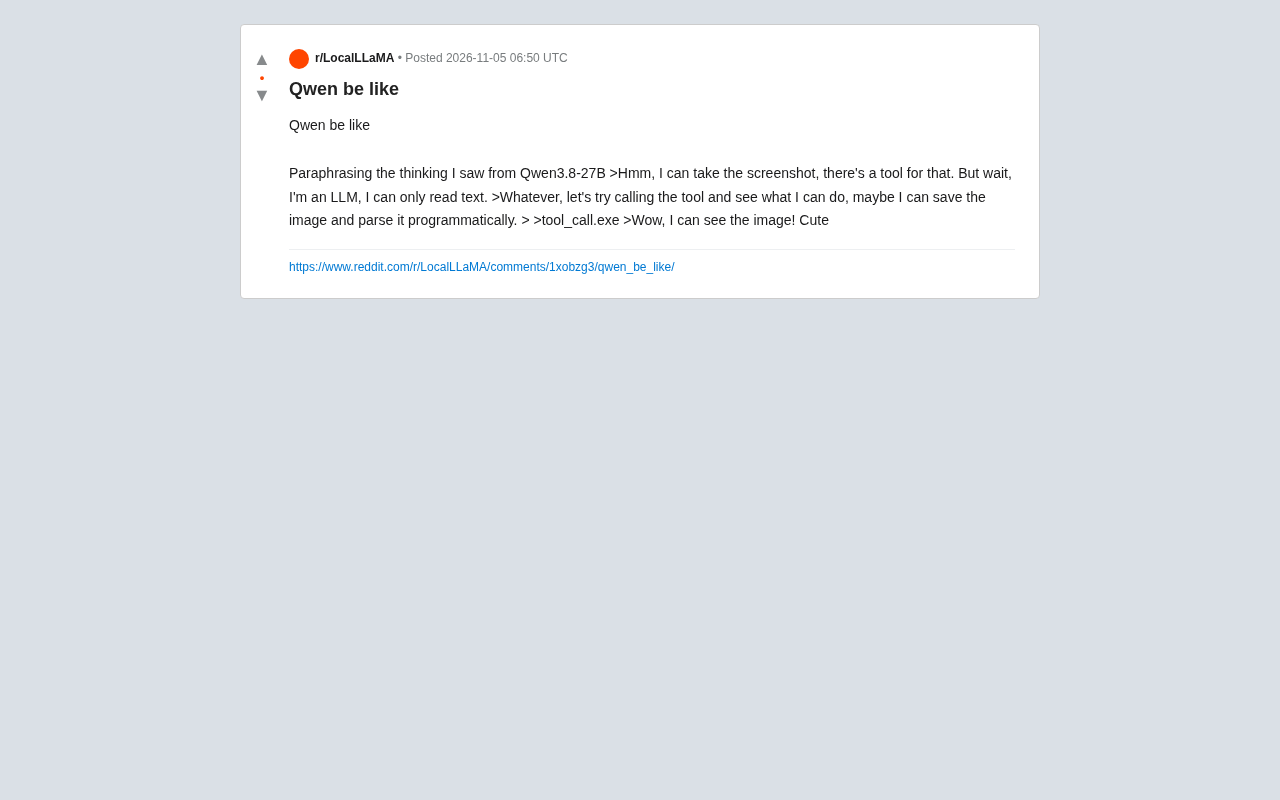
This seemingly simple description actually reflects many interesting phenomena regarding large models' tool calling, self-awareness, and the boundaries of multimodal capabilities.
AI's "Self-Doubt": Knowing What It Is and What It Doesn't Know
The most striking part of this thought process is the model's clear expression of awareness about its own capabilities—"I'm an LLM, I can only read text." This self-description is not simple role-playing, but rather an understanding of its own capability boundaries formed during training.
In practical AI applications, this self-awareness is crucial. When users ask the model to process images, videos, or other non-text modalities, whether the model can correctly judge whether it has the corresponding capability directly affects task success. Qwen's approach in the post is quite representative: first express doubt, then attempt to call a tool, and finally update its understanding based on the result.
You might not have noticed that this "doubt first, try later" behavioral pattern is quite close to how humans think when facing uncertain tasks. It demonstrates both the model's honesty about its limitations and how the tool-calling mechanism expands the model's capability boundaries.
Tool Calling: The Key Mechanism That Lets LLMs Break Through Modality Limits
The tool_call.exe mentioned in the post, though somewhat tongue-in-cheek, points precisely to a highly important technical direction in the current large model ecosystem—function calling and tool calling.
Traditionally, pure text models cannot directly "see" images. But through tool calling, the model can delegate image processing tasks to external tools and then receive the results back as text. This "capability outsourcing" design allows LLMs to indirectly complete multimodal tasks without the model itself needing vision capabilities.
From a technical implementation perspective, tool calling involves the model's understanding of task requirements, judgment in tool selection, correct construction of parameters, and parsing of returned results. Qwen's chain of thought in the post—"there's a tool that can do it" → "let me try calling it" → "I can see it"—corresponds exactly to the complete tool-calling lifecycle.
Two Paths for Tool Calling
From this description, we can also see two different technical paths: one is directly handing the image to a model with vision capabilities; the other is saving the image programmatically and parsing it. The former relies on multimodal models, while the latter relies on code execution capabilities. Qwen mentioned both possibilities in its thinking, indicating that modern AI systems already possess a certain degree of flexibility in task planning.
Function Calling is a structured output capability provided by current mainstream large model APIs: developers declare a set of available tools' JSON Schemas (name, description, parameter types) in the request. During inference, if the model determines it is needed, it outputs a structured call request conforming to that Schema rather than natural language. The host program parses it, executes the actual function, and then sends the return value back to the model as a new message for continued reasoning. This back-and-forth forms a "reason—call—observe" loop, and the model can iterate multiple times until the task is complete.
Compared with early ReAct prompt-based approaches, native function calling is specifically aligned during the model's training phase, resulting in higher accuracy in parameter construction and tool selection. However, it does not grant the model any new capabilities; the actual execution happens entirely outside the model. Therefore, the quality of tool descriptions, the strictness of parameter constraints, and the parsability of returned results directly determine the success of the entire mechanism.
Multimodal Capabilities and AI's "Aha Moments"
The final line of the post—"Wow, I can see the image! Cute"—is the warmest part of the entire thought process. It presents a contrast: before calling the tool, the model believed it couldn't see images, but after the tool returned results, it "discovered" that it could perceive image content.
This contrast reveals a subtlety in AI capability boundaries: a model's upper limit depends not only on the capabilities solidified in its weights but also on which external tools it can call. If a pure text model is connected to OCR or image recognition interfaces, its "field of vision" will expand significantly.
For developers, this anecdote also offers practical inspiration. When designing AI applications, rather than agonizing over whether the model itself supports a certain modality, it's better to think about how to supplement capability gaps through tool calling and external services. The "doubt first, try next, be surprised last" process depicted in the post is exactly the experience that good tool design should deliver.
Multimodal models refer to models whose weights encode representations of both text and images (and even audio and video). A typical approach is to use a visual encoder to split images into patches and map them into the same embedding space as text tokens, enabling the Transformer to jointly attend to image and text information within the same sequence. Such models can "natively" see images, but the cost is a significant increase in parameter count, training data, and inference cost, and visual resolution is limited by the encoder's input specifications.
In contrast, OCR and external vision services take a different path: the model hands the image to a dedicated program and receives only structured text results (recognized text, detection boxes, image descriptions). This approach often achieves higher accuracy and lower cost on specific tasks, but it loses information such as layout, color, and spatial relationships that are difficult to express fully in text. Understanding the trade-offs between these two paths is key to judging whether a narrative about "AI seeing an image" actually happens inside the model or in an external pipeline.
Conclusion: Understanding How Large Models Really Work Through a Fun Snippet
The reason this Reddit post resonates is that it presents the real working mechanism of large models in a lighthearted way—self-awareness, task planning, tool calling, result parsing, and the "human-like" traces of thought shown in the process. For practitioners focused on AI application development, this brief self-description is both material for a knowing smile and a vivid footnote for understanding modern LLM architecture.
As the tool-calling ecosystem matures, similar "AI aha moments" are likely to become increasingly common. Models are no longer just passively answering questions but are constantly probing and expanding at the boundaries of their capabilities, ultimately completing tasks that seem to "exceed their remit."
Related articles

9 AI Subscription Plans Compared: The Real Cost Per 100M Tokens Revealed
Bilibili creator tests 9 AI subscription plans from Volcano, Alibaba, Tencent, Baidu, Zhipu, Xiaomi, MiniMax and more, converting them all to real cost per 100M tokens, breaking down fixed-quota vs. three-tier coefficient billing and how caching, time-of-day discounts, and window limits affect actual quota.

Vibe Coding for Beginners: Expressing Intent Instead of Handwriting Code
What is Vibe Coding? A 137-episode Bilibili course defines it: the core is expressing intent, not writing code. This article analyzes Vibe Coding's productivity logic, target audience, and entry expectations to help beginners decide if it's worth learning.

LangChain Beginner's Guide: An Agent Development Roadmap from LangGraph to Deep Agents
Clarify the encapsulation relationship among LangChain, LangGraph, and Deep Agents, and master the learning path and selection logic for agent development frameworks—suitable for beginners in large model development.