A New Approach to UAV Channel Prediction: Measurement-Calibrated Synthetic Pretraining Accelerates Adaptation
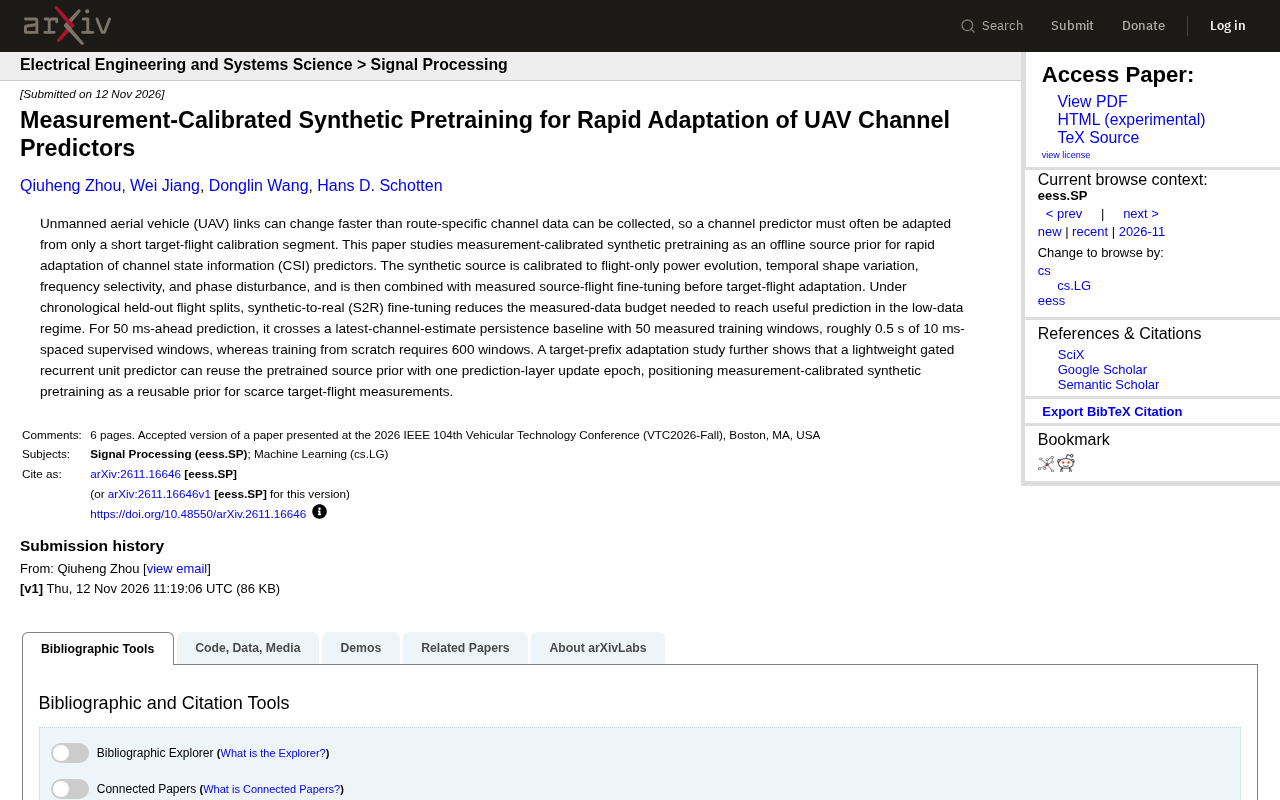
Measurement-calibrated synthetic pretraining cuts measured data needs for UAV channel prediction by an order of magnitude.
To address the problem that measured data collection cannot keep up with channel changes in UAV channel prediction, the paper proposes a measurement-calibrated synthetic pretraining framework. It calibrates synthetic data across flight power evolution, temporal shape variation, frequency selectivity, and phase perturbation, pretrains on a large synthetic source, fine-tunes on measured source flight data (S2R), and adapts with few target flight segments. Experiments show that for 50 ms ahead prediction, S2R fine-tuning needs only 50 measured training windows to surpass the persistence baseline versus 600 for training from scratch—an order-of-magnitude data efficiency gain; a lightweight GRU predictor adapts with just one prediction layer update round. This provides a reusable prior solution for UAV channel prediction under scarce measured data.
UAV communication links often change faster than targeted channel data can be collected, so channel predictors typically can only adapt using short calibration segments from the target flight. A recent paper proposes using measurement-calibrated synthetic pretraining as an offline source prior to significantly reduce the amount of measured data required during the target flight phase and enable rapid adaptation.
Problem Background: Measured Data Can't Keep Up with Channel Changes
UAV channels are highly dynamic. Rapid changes in flight trajectory, attitude, and environmental scattering make collecting and labeling channel state information (CSI) costly. The traditional approach is to collect data separately for each path to train a predictor, but link changes often outpace data collection, making model generalization difficult. The paper focuses on a practical constraint: only short calibration segments from the target flight are available. How to use offline priors to quickly adapt a predictor becomes the key question.
Channel State Information (CSI) is a mathematical description of propagation channel characteristics in wireless communications, typically including parameters such as amplitude, phase, and delay. In UAV communications, CSI is the foundation for beamforming, adaptive modulation, and channel prediction. Due to the high dynamics of UAVs, CSI needs to be continuously collected at millisecond intervals, and each sample must be aligned and labeled with flight trajectory and attitude information, resulting in extremely high data collection and labeling costs. In addition, CSI is highly time-sensitive; outdated data cannot reflect the current channel state, further widening the gap between model training and deployment.
Method Core: Synthetic Source Calibration and Two-Stage Fine-Tuning
The proposed framework consists of two stages: synthetic source pretraining and measured source fine-tuning, followed by a small amount of adaptation on target flight data.
Multi-Dimensional Calibration of the Synthetic Source
Synthetic data is not generated arbitrarily; it is calibrated against four key channel characteristics:
- Flight power evolution: simulates the trend of received power during UAV flight;
- Temporal shape variation: captures the temporal envelope dynamics of the channel impulse response;
- Frequency selectivity: reflects fading differences of wideband channels at different frequencies;
- Phase perturbation: models phase noise and Doppler effects caused by motion.
Through these four types of calibration, the synthetic source can better approximate the statistical properties of real flight channels, providing high-quality prior knowledge for subsequent fine-tuning.
Channel Impulse Response (CIR) is a function describing the multipath effects of a wireless channel in the time domain, i.e., the received signal can be expressed as the convolution of the transmitted signal with the channel impulse response. Its temporal envelope reflects the arrival and decay patterns of multipath components over time, and is one of the key features for channel prediction. Frequency selectivity refers to the different fading depths experienced by wideband signals at different frequencies, arising from multipath delay spread and typically measured by coherence bandwidth. Doppler effect is caused by UAV motion, causing a frequency shift in the received signal, manifesting as rapid phase rotation over time, and is the core physical mechanism for phase perturbation modeling. Understanding these concepts helps grasp why the four-dimensional calibration in the paper can narrow the statistical gap between synthetic and measured channels.
Fine-Tuning Strategy from Synthetic to Real
After synthetic source pretraining, the model is first fine-tuned on measured source flight data (synthetic-to-real, S2R), then transferred to the target flight segment. This two-stage design balances the scale advantage of synthetic data with the authenticity of measured data, avoiding the domain shift problem of going directly from synthetic to target.
Domain shift refers to the distribution difference between training data and target data. In this context, although synthetic data is calibrated, it still has statistical deviations from real flight data; if a model trained directly on synthetic data is deployed to the target flight, performance will degrade significantly due to domain shift. S2R (synthetic-to-real) fine-tuning retrains on measured source data, allowing the model to first adapt to the distribution of real channels before transferring to the target segment, thereby mitigating the direct domain shift from synthetic to target. This two-stage transfer strategy is particularly effective in data-scarce scenarios because it leverages large amounts of synthetic data to learn general representations while using a small amount of measured data to correct distribution deviations.
Experimental Results: Significant Improvement in Data Efficiency
The paper evaluates method performance on held-out flight data split in chronological order, focusing on prediction capability in low-data scenarios.
Breakthrough in 50 ms Ahead Prediction
Taking the 50 ms ahead prediction task as an example, S2R fine-tuning requires only 50 measured training windows (approximately 0.5 seconds of 10 ms interval supervision windows) to surpass the "latest channel estimate persistence" baseline, whereas training from scratch requires 600 windows. This means the measured data requirement is reduced by an order of magnitude, which is significant for rapid deployment scenarios.
One-Round Adaptation for Lightweight Models
The study also finds that a lightweight gated recurrent unit (GRU) predictor can reuse the pretrained source prior and complete target prefix adaptation with only one prediction layer update round. This indicates that the representations learned from synthetic pretraining have good transferability, enabling rapid convergence even with limited model capacity.
Insights and Limitations
The core contribution of this work is the systematic introduction of synthetic pretraining into UAV channel prediction and the narrowing of the gap between synthetic and measured data through multi-dimensional calibration. The improvement in data efficiency provides a practical path for UAV communications with high real-time requirements.
However, the paper also implies some limitations: the calibration of the synthetic source relies on prior modeling of flight power, time-frequency characteristics, and phase perturbation. If the target scenario deviates significantly from the calibration assumptions, the effectiveness of the prior may decrease. In addition, the experiments are based on a specific flight dataset, and cross-scenario generalization capability still needs further validation.
Overall, measurement-calibrated synthetic pretraining provides a reusable prior solution for channel prediction under scarce measured data conditions, and is expected to promote rapid adaptation of UAV communication systems in dynamic environments.
One-line Summary
Measurement-calibrated synthetic pretraining reduces the measured data requirement for UAV channel prediction by an order of magnitude.
Paragraph Summary
The paper addresses the problem that measured data collection cannot keep up with channel changes in UAV channel prediction by proposing a measurement-calibrated synthetic pretraining framework. The method calibrates synthetic data across four dimensions: flight power evolution, temporal shape variation, frequency selectivity, and phase perturbation. It first pretrains on a large-scale synthetic source, then fine-tunes on measured source flight data (S2R), and finally adapts with a small number of target flight segments. Experiments show that in the 50 ms ahead prediction task, S2R fine-tuning requires only 50 measured training windows to surpass the persistence baseline, whereas training from scratch requires 600 windows, improving data efficiency by an order of magnitude; a lightweight GRU predictor can complete adaptation with only one prediction layer update round. This work provides a reusable prior solution for UAV channel prediction under scarce measured data conditions.
Related articles

Average US New Car Price Tops $51,000: How AI and Software-Defined Vehicles Are Driving Up Costs
US average new car prices hit a record $51,000. This article analyzes how software-defined vehicles, central computing, pre-installed sensors, and in-vehicle AI inference costs drive up sticker prices—and what it means for consumers and automakers.

EG-RL: Edge-Gradient Augmentation + Reinforcement Learning for Temporal Graph Link Prediction
An in-depth look at EG-RL: explicitly encoding edge-gradient events (edge births and deaths) and using reinforcement learning to dynamically select the most informative snapshots, significantly improving AUC and AP for temporal link prediction on multiple dynamic graph datasets.
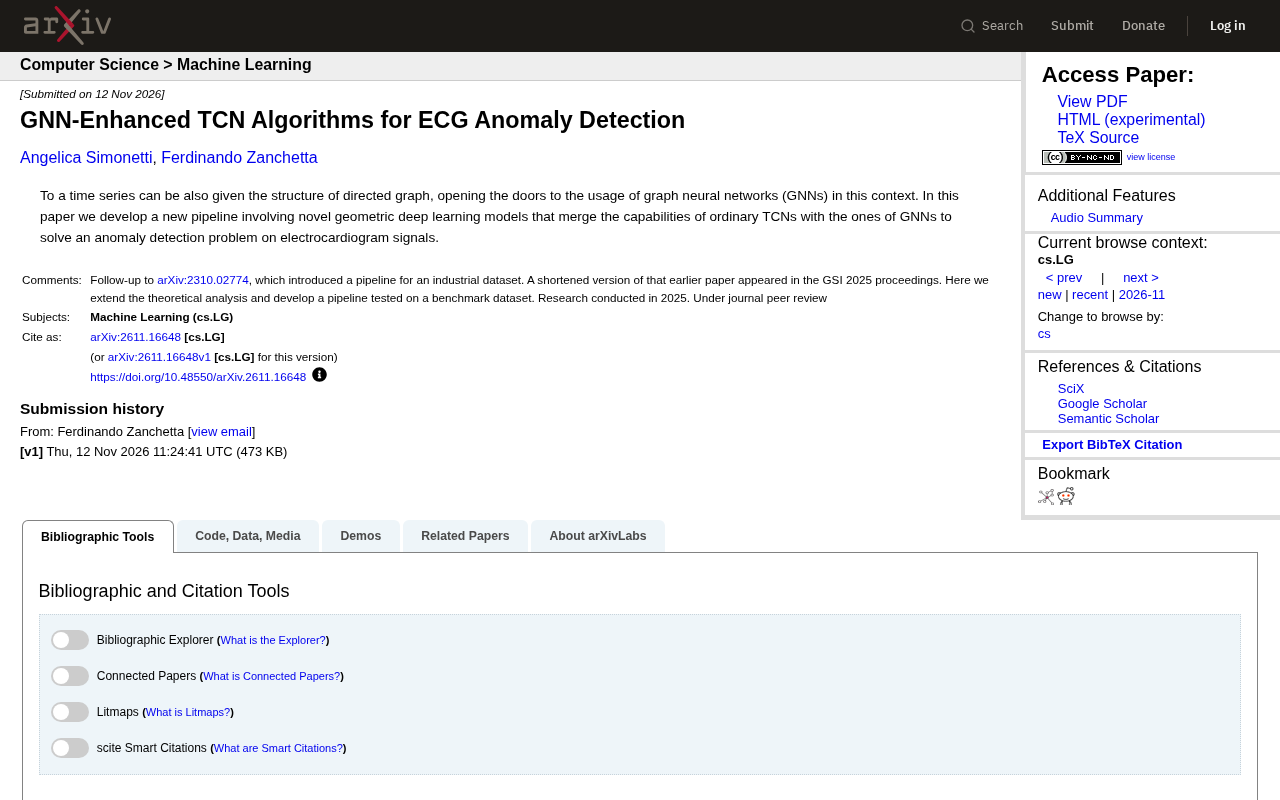
GNN+TCN Fusion Algorithm: A New Paradigm for ECG Anomaly Detection
Explore the innovative application of GNN and TCN fusion algorithms in ECG anomaly detection: transforming time series into directed graphs and using geometric deep learning to simultaneously capture local temporal features and global topological structures, offering a new paradigm for medical AI time-series analysis.