EG-RL: Edge-Gradient Augmentation + Reinforcement Learning for Temporal Graph Link Prediction
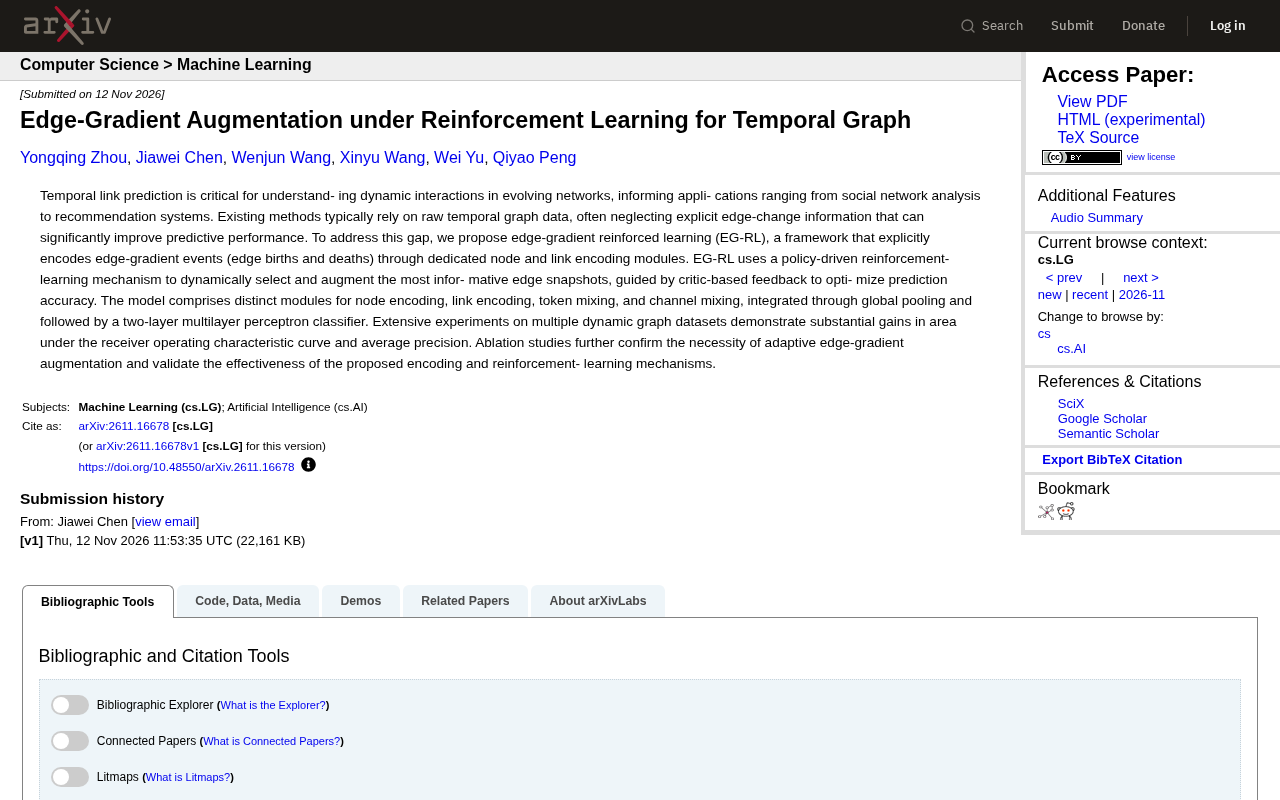
EG-RL explicitly encodes edge births and deaths and uses RL to select key snapshots for better temporal link prediction.
The article introduces EG-RL, an edge-gradient reinforcement learning framework for temporal graph link prediction. Existing methods usually feed raw graph snapshot sequences into models and learn dynamics implicitly, ignoring explicit edge-gradient events like edge births and deaths. EG-RL explicitly encodes these events as first-class signals and uses a policy-driven RL mechanism to select and augment the most informative snapshots, with critic feedback optimizing the policy. The model has independent node and link encoders, token and channel mixing modules, global pooling, and a two-layer MLP classifier. AUC and AP improve substantially on multiple dynamic graph datasets, and ablations confirm the value of adaptive edge-gradient augmentation and RL-based snapshot selection.
Temporal graph link prediction is a key task for understanding node interactions in dynamic networks such as social networks and recommendation systems. Most existing methods use raw temporal graph data directly, yet overlook explicit edge-change information such as edge births and deaths. A recent paper proposes the Edge-Gradient Reinforcement Learning framework (EG-RL), which explicitly encodes edge-gradient events and uses reinforcement learning to dynamically select the most informative edge snapshots, substantially improving prediction performance on multiple dynamic graph datasets.
The Problem: The Overlooked Edge-Gradient Signal
The core characteristic of temporal graphs is that structure evolves over time—edges are born and edges die. These edge-gradient events (edge births and deaths) essentially characterize dynamic changes in local network structure and carry direct indicative value for link prediction. In a social network, for example, the appearance of a new edge often signals the formation of a new relationship; in a recommendation system, the death of a user–item interaction edge may indicate a shift in interest.
However, mainstream temporal graph learning methods typically take raw graph snapshot sequences as input, implicitly letting the model learn change patterns from the data without explicitly modeling edge births and deaths. This "implicit learning" approach is easily drowned out by noise—especially when edge changes are sparse or drastic, the model struggles to capture the truly critical dynamic signals. EG-RL starts precisely from this gap: treating edge-gradient events as first-class citizens to be encoded.
Temporal Graph Snapshot is the basic unit in dynamic graph representation: the continuous time axis is divided into fixed intervals (e.g., days or hours), and the edges and nodes within each time window form a static graph. The snapshot sequence thus approximately captures the graph's evolution. Snapshot granularity is a key hyperparameter—too coarse a granularity smooths away short-term bursty edge changes, while too fine a granularity makes most snapshots too sparse and amplifies noise. The "edge-gradient events" emphasized by EG-RL go a step further beyond snapshot granularity by explicitly marking the birth and death moments of each edge, so the model need not infer changes on its own from sparse adjacency-matrix differences, thereby mitigating the information loss caused by granularity selection.
The EG-RL Framework: Encoding, Selection, and Augmentation
The overall design of EG-RL revolves around two main threads: "explicit edge-gradient encoding" and "reinforcement-learning-based snapshot selection." The model contains several dedicated modules: a node encoding module, a link encoding module, a token mixing module, and a channel mixing module. Information is ultimately aggregated via global pooling and fed into a two-layer multilayer perceptron classifier to produce predictions.
Independent Encoding of Nodes and Links
Unlike the common practice of processing node and edge features together, EG-RL designs separate encoding modules for nodes and links. Node encoding captures the temporal state of each node itself, while link encoding specifically captures edge-level dynamics—especially edge-gradient events. This separated design allows the model to more clearly distinguish "changes in node attributes" from "changes in connectivity relationships," preventing the two types of signals from interfering with each other.
Reinforcement-Learning-Driven Snapshot Selection
Temporal graphs typically contain a large number of snapshots, but not every snapshot is equally important for the current prediction. EG-RL introduces a policy-driven reinforcement learning mechanism that dynamically selects and augments the most informative edge snapshots. Specifically, the policy network decides which snapshots deserve focused attention based on the current state, while critic feedback is used to optimize the selection policy, steering the model toward improved prediction accuracy. This "select-and-augment" loop enables the model to adaptively focus on key time steps rather than treating all historical information uniformly.
The collaboration mechanism between the policy network and the critic is a typical form of the actor-critic framework. Here, the actor (policy network) maps the current graph state to a selection distribution or gating weights over candidate snapshots, deciding "which snapshots to look at"; the critic estimates the expected return of that selection policy (e.g., link prediction accuracy or negative log-likelihood) and computes the advantage function accordingly to update the policy parameters. Since snapshot selection is a discrete decision and not directly differentiable, end-to-end training is usually achieved via REINFORCE-style gradient estimation or Gumbel-Softmax relaxation. This design turns "which historical information to select" from fixed attention weights into a learnable sequential decision, enabling the model to adaptively adjust the time range it focuses on as training progresses.
Token Mixing and Channel Mixing
After encoding, EG-RL further integrates information through token mixing and channel mixing modules. Token mixing handles cross-node and cross-edge information interaction, while channel mixing performs fusion along the feature dimension. These two modules are chained with global pooling and a two-layer MLP classifier to form a complete prediction pipeline. The paper's ablation experiments confirm the necessity of adaptive edge-gradient augmentation and validate the effectiveness of the aforementioned encoding and reinforcement learning mechanisms.
Token mixing and channel mixing draw on the design philosophy of MLP-Mixer-style architectures: decoupling the two dimensions of the feature tensor for separate processing. Token mixing exchanges information along the "sample/node/edge" dimension, effectively letting representations of different nodes and edges attend to one another and capturing structural associations; channel mixing performs per-token linear transformations and nonlinear activations along the feature-channel dimension, responsible for feature recombination. Stacked alternately, the two enable global information integration without relying on explicit graph convolution or self-attention matrices, with computational complexity linear in sequence length—making them well suited to temporal graph scenarios with many snapshots.
Experimental Results: Gains in Both AUC and AP
The paper conducts extensive experiments on multiple dynamic graph datasets, using the area under the ROC curve (AUC) and average precision (AP) as evaluation metrics. Results show that EG-RL achieves substantial improvements on both metrics. Although the original text does not disclose specific numbers, the phrase "substantial gains" and the support from ablation experiments indicate that explicit edge-gradient encoding and reinforcement-learning-based snapshot selection indeed deliver real performance gains.
Ablation studies further break down the contribution of each module: removing adaptive edge-gradient augmentation leads to performance degradation, showing that edge-gradient events are not merely optional auxiliary information; removing the reinforcement-learning selection mechanism likewise affects results, confirming the value of dynamic snapshot selection. Together, these findings point to one conclusion—one of the performance bottlenecks in temporal graph link prediction lies in insufficient utilization of edge-change signals.
Implications: Edge Gradients as a First-Class Signal in Temporal Graphs
The value of EG-RL lies not only in proposing a new model but also in offering a perspective: the dynamics of temporal graphs can be decomposed into node-state evolution and edge-structure change, with the latter long having been handled implicitly. Explicitly encoding edge-gradient events and adaptively selecting snapshots via reinforcement learning opens a more interpretable path for temporal graph learning.
Of course, this framework also raises new questions: What is the extraction cost of edge-gradient events? How stable is reinforcement learning policy training on extremely large-scale graphs? These await answers from future work. But based on current results, EG-RL offers a direction worth attention for temporal link prediction—teaching models to "see" the birth and death of edges.
One-line Summary
EG-RL explicitly encodes edge births and deaths and uses reinforcement learning to select key snapshots, improving temporal link prediction.
Paragraph Summary
This article introduces EG-RL, an edge-gradient reinforcement learning framework for temporal graph link prediction. Existing methods typically feed raw graph snapshot sequences directly into models and learn dynamic patterns implicitly, overlooking explicit edge-gradient events such as edge births and deaths. EG-RL explicitly encodes edge-gradient events as first-class signals and employs a policy-driven reinforcement learning mechanism to dynamically select and augment the most informative edge snapshots, with critic feedback used to optimize the selection policy. The model consists of independent node encoding, link encoding, token mixing, and channel mixing modules, followed by global pooling and a two-layer MLP classifier to output predictions. On multiple dynamic graph datasets, both AUC and AP improve substantially, and ablation experiments validate the necessity of adaptive edge-gradient augmentation and reinforcement-learning-based snapshot selection.
Related articles

Average US New Car Price Tops $51,000: How AI and Software-Defined Vehicles Are Driving Up Costs
US average new car prices hit a record $51,000. This article analyzes how software-defined vehicles, central computing, pre-installed sensors, and in-vehicle AI inference costs drive up sticker prices—and what it means for consumers and automakers.
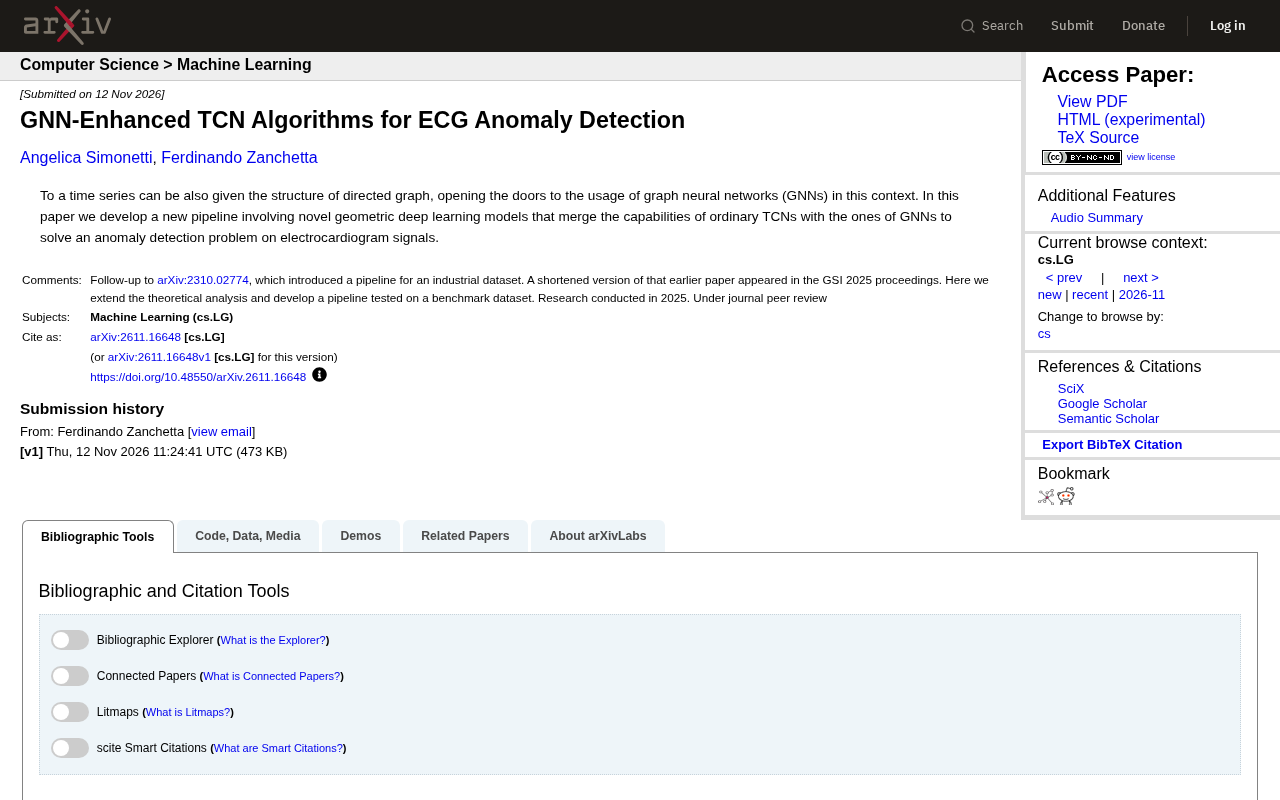
GNN+TCN Fusion Algorithm: A New Paradigm for ECG Anomaly Detection
Explore the innovative application of GNN and TCN fusion algorithms in ECG anomaly detection: transforming time series into directed graphs and using geometric deep learning to simultaneously capture local temporal features and global topological structures, offering a new paradigm for medical AI time-series analysis.
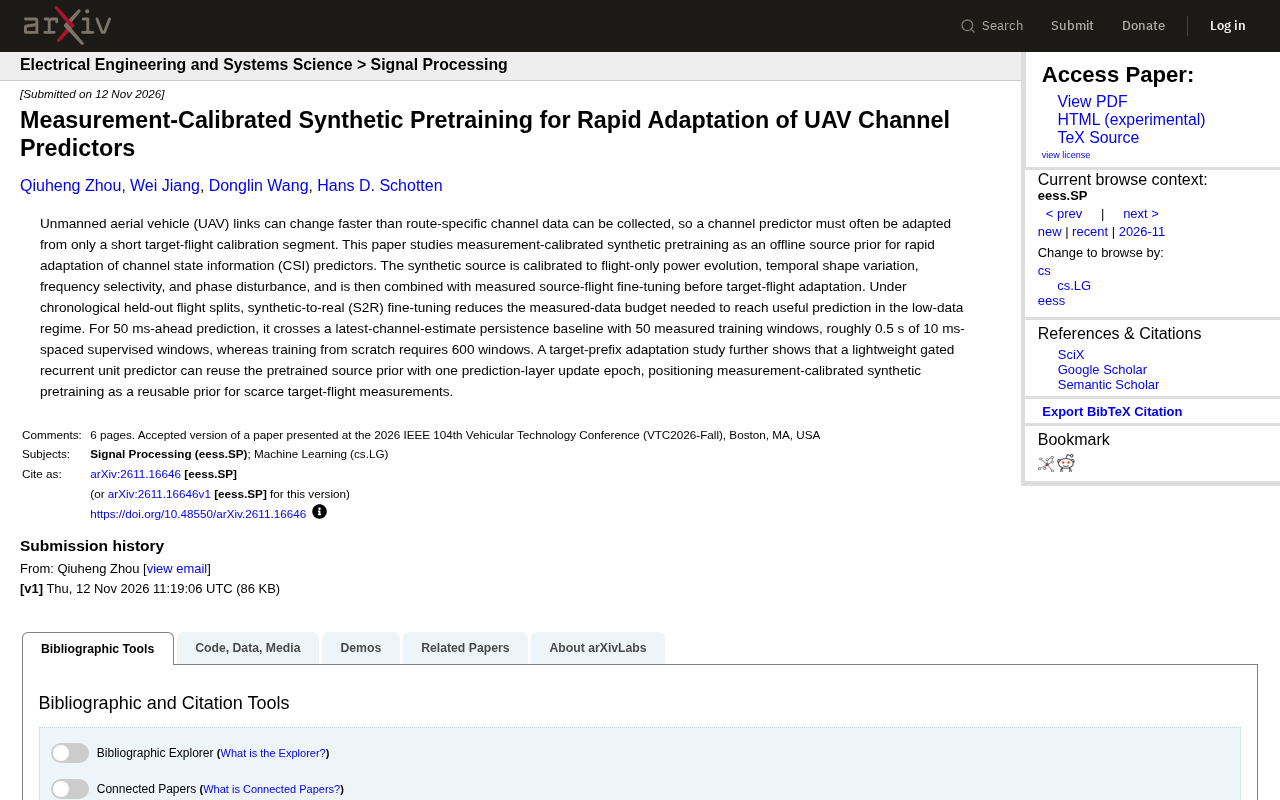
A New Approach to UAV Channel Prediction: Measurement-Calibrated Synthetic Pretraining Accelerates Adaptation
The paper proposes measurement-calibrated synthetic pretraining to accelerate UAV channel predictor adaptation using synthetic source priors. Experiments show 50 ms ahead prediction surpasses the persistence baseline with only 50 measured windows, improving data efficiency by an order of magnitude.