A New Paradigm for Conversational Emotion Prediction: Selective Deviation Forecasting and Conformal Risk Control

New research reframes conversational emotion prediction as selective deviation forecasting with conformal risk control, but guarantees come at the cost of abstention.
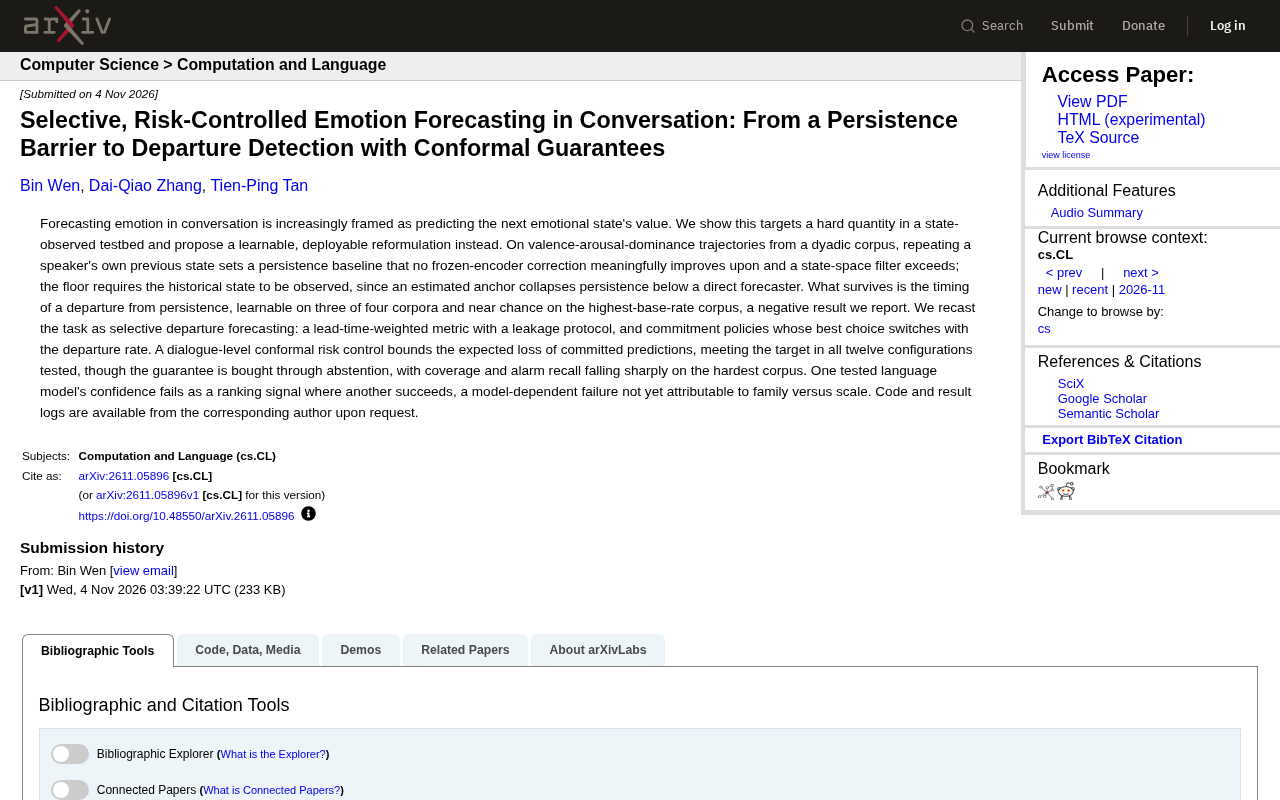
This study challenges the long-dominant goal of predicting the next specific emotion value in conversation. Experiments show the persistence baseline is extremely hard to surpass and depends heavily on state observability. The authors reframe the task as selective deviation forecasting—predicting only when emotion deviates from the baseline—with lead-time-weighted metrics and a leakage protocol. Dialogue-level conformal risk control meets target risk in all twelve configurations, but only through abstention, with coverage and recall dropping sharply on the hardest corpus. LLM confidence as a ranking signal also shows model-dependent failure. The study calls for more pragmatic problem formulations and more honest evaluation protocols.
Emotion prediction in conversation has long been framed as predicting the specific numerical value of the next emotional state. But a new study points out that this goal is inherently extremely difficult to achieve on testbeds where states are observable, and proposes a learnable, deployable alternative: reframing the task as selective deviation forecasting—predicting only when emotion will deviate from a persistence baseline, and using conformal risk control to provide statistical guarantees for committed predictions.
The persistence baseline: a hard-to-beat "floor"
The study is conducted on valence-arousal-dominance (VAD) trajectories from a dyadic conversation corpus. The core finding: repeating the speaker's own previous emotional state constitutes an extremely strong persistence baseline. Corrections with frozen encoders cannot meaningfully surpass this baseline, while state-space filters can exceed it—but only if historical states are observed. If the anchor state is estimated rather than observed, the persistence baseline collapses to performing worse than a direct predictor.
The implication is direct: the difficulty of conversational emotion prediction lies not in the "predicted value" but in the observability of states. When historical states are reliable, continuity itself is the strongest prediction; when states must be estimated, any sophisticated model can be defeated by a simple baseline.
valence-arousal-dominance (VAD) is a three-dimensional emotion representation framework commonly used in affective computing: valence indicates the positive or negative orientation of emotion (pleasant to unpleasant), arousal indicates the degree of activation or calmness, and dominance indicates an individual's sense of control over the situation. Compared with discrete emotion labels (such as happy, angry), VAD can continuously characterize emotional states, making it suitable for dynamic scenarios like conversation. However, VAD annotation usually relies on human ratings, and states in conversation often need to be inferred from text rather than directly observed—which directly bears on the key role of "state observability" in the subsequent discussion.
State-space filters are a class of recursive Bayesian estimation methods, typically represented by the Kalman filter and its nonlinear variants. They assume that a system has a latent state and continuously update the estimate of the current state through observation sequences. In conversational emotion modeling, state-space filters can use historical observations to smooth and predict emotional trajectories, but they are highly sensitive to observation quality: if the anchor state is estimated rather than observed, filter errors accumulate, causing the persistence baseline to fail. This explains why the paper emphasizes that "historical states must be observed."
The truly learnable signal: the timing of deviation
Since numerical prediction is so difficult, the study turns to another learnable quantity: the timing of deviation from the persistence baseline. On three of four corpora, deviation timing is learnable; but on the corpus with the highest base rate, performance is close to random. The authors report this negative result honestly rather than hiding it.
This leads to the paper's core reframing: selective deviation forecasting. The new task no longer requires giving an emotion value at every moment, but rather judging "when it is worth issuing a deviation alert." The accompanying evaluation metric introduces lead-time weighting and designs a leakage protocol to avoid information leakage. The best choice of commitment policies varies with the deviation rate—there is no one-size-fits-all strategy.
Conformal risk control: guarantees come at a cost
The study adopts dialogue-level conformal risk control to constrain the expected loss of committed predictions. Across all twelve configurations tested, the guarantee met the target. But the authors also note that this guarantee is obtained through abstention. On the most difficult corpus, coverage and alert recall drop sharply. In other words, the system does "say what it promises," but at the cost of often choosing not to speak.
This is an important reminder for practical deployment: meeting risk-control metrics does not mean the system is usable. When the abstention rate is too high, the practical value of predictions is greatly weakened. The study does not avoid this trade-off but presents it as one of its core findings.
Conformal risk control is an extension framework of conformal prediction. Conformal prediction can provide confidence intervals or prediction sets for individual predictions and guarantee coverage of the true value at a user-specified error rate; conformal risk control further allows users to define more general loss functions (such as expected false alarm rate) and provides statistical guarantees under finite samples. Its core idea is to use empirical risk on a calibration set to adjust prediction thresholds so that the expected loss on the test set does not exceed the target level. But this guarantee usually relies on the exchangeability assumption, and when the model chooses to abstain, the effective coverage rate changes—this is precisely the technical root of "guarantees at the cost of abstention" in the paper.
LLM confidence: an unreliable ranking signal
The study also tests the effectiveness of language model confidence as a ranking signal. The results show model dependence: the confidence of one tested language model fails as a ranking signal, while another succeeds. The authors cautiously state that this failure cannot yet be attributed to model family or scale—it is an unsolved mystery.
This finding is a warning for engineering practice that wants to directly use LLM confidence to rank emotion alerts: confidence calibration varies enormously across models, and one cannot take for granted that "larger models" or "a certain family" will have more reliable confidence.
Confidence calibration refers to whether the confidence scores output by a model truly reflect the probability that its predictions are correct. For a well-calibrated model, when it says "80% confidence," the actual accuracy should be close to 80%. However, large language models generally suffer from overconfidence or underconfidence, and calibration quality varies greatly with model, task, and prompting method. Therefore, directly using LLM confidence as a ranking signal for emotion deviation alerts carries risk: confidence is not comparable across models, and even the same model's calibration may drift across different conversational contexts. The model-dependent failure observed in the paper is precisely a manifestation of unreliable calibration.
Implications for affective computing
Perhaps the most valuable part of this work is not any specific model but its reexamination of the problem definition. When the entire field is chasing "predicting the next emotion value," the authors use solid baseline experiments to show that this goal may already be unrealistic under current data conditions. Turning instead to predicting "when deviation occurs," combined with quantifiable risk guarantees, is a more pragmatic and deployable path.
At the same time, the paper's candor about negative results—near-random performance on the highest-base-rate corpus, conformal guarantees obtained through abstention, and model-dependent failures of LLM confidence—makes the entire study more credible. The next step for emotion prediction may lie not in stronger encoders, but in smarter problem formulations and more honest evaluation protocols.
One-line Summary
A new study reframes conversational emotion prediction as selective deviation forecasting, using conformal risk control to provide statistical guarantees—but the guarantees come at the cost of abstention.
Paragraph Summary
This study challenges the long-dominant goal in conversational emotion prediction of "predicting the specific emotion value at the next moment." Experiments show that the persistence baseline formed by repeating the speaker's previous state is extremely hard to surpass and depends heavily on the observability of historical states. The authors instead reframe the task as "selective deviation forecasting": predicting only when emotion deviates from the persistence baseline, and introducing lead-time-weighted metrics and a leakage protocol for evaluation. With dialogue-level conformal risk control, all twelve configurations meet the target risk level, but the guarantee is obtained through abstention, with coverage and recall dropping sharply on the most difficult corpus. In addition, LLM confidence as a ranking signal exhibits model-dependent failure. The study calls for more pragmatic problem formulations and more honest evaluation protocols.
Related articles

9 AI Subscription Plans Compared: The Real Cost Per 100M Tokens Revealed
Bilibili creator tests 9 AI subscription plans from Volcano, Alibaba, Tencent, Baidu, Zhipu, Xiaomi, MiniMax and more, converting them all to real cost per 100M tokens, breaking down fixed-quota vs. three-tier coefficient billing and how caching, time-of-day discounts, and window limits affect actual quota.

Vibe Coding for Beginners: Expressing Intent Instead of Handwriting Code
What is Vibe Coding? A 137-episode Bilibili course defines it: the core is expressing intent, not writing code. This article analyzes Vibe Coding's productivity logic, target audience, and entry expectations to help beginners decide if it's worth learning.

LangChain Beginner's Guide: An Agent Development Roadmap from LangGraph to Deep Agents
Clarify the encapsulation relationship among LangChain, LangGraph, and Deep Agents, and master the learning path and selection logic for agent development frameworks—suitable for beginners in large model development.