A New Paradigm for Embodied Intelligence: How Agentic Robotics Is Reshaping Robotic Systems

Agentic Robotics uses foundation models as its decision core, proposing Embodied System 2 and a closed-loop evaluation framework on a roadmap to persistent autonomy.
The article discusses the emerging "Agentic Robotics" paradigm, which uses foundation models as a decision-making core to complete perception, reasoning, skill invocation, and verification in a closed loop instead of training task-specific policies. It introduces "Embodied System 2," composed of a foundation model and an embodied harness, whose challenge is turning general reasoning into verifiable actions under physical constraints. It notes the lack of unified definitions and evaluation, argues for assessing both model capability and closed-loop performance, and sketches a roadmap toward persistent autonomy.
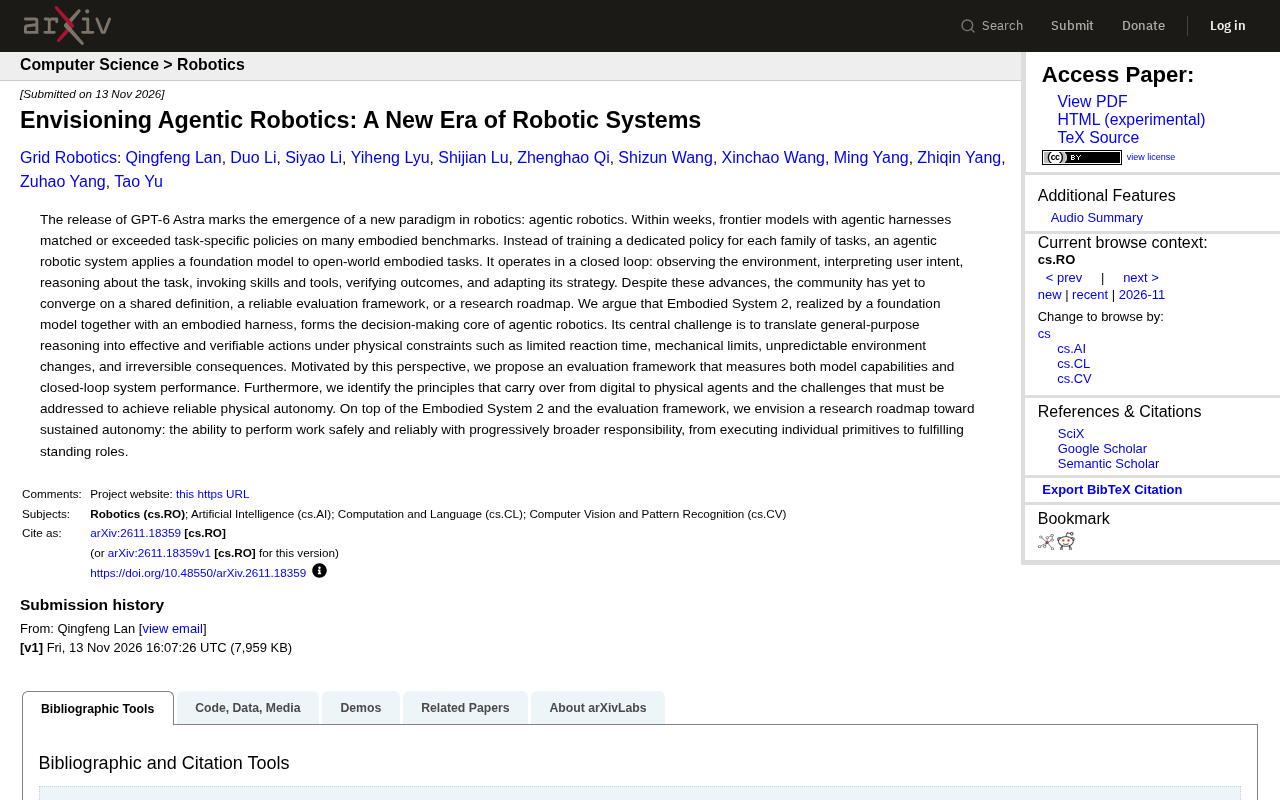
The field of robotics is undergoing a paradigm shift. With the emergence of frontier models endowed with agentic capabilities, a new paradigm known as "Agentic Robotics" is beginning to take shape. Rather than training a dedicated policy for each task category, it applies foundation models to open-world embodied tasks, completing the full loop of perceiving, understanding, reasoning, invoking skills, verifying results, and adjusting strategies in a closed-loop manner.
From Specialized Policies to General-Purpose Agents
Traditional robotic systems rely on task-specific policies: grasping a cup, folding a garment, or walking a stretch of path each tend to correspond to separate models and training pipelines. This approach performs reliably in controlled environments, but its scaling cost in the open world is extremely high. Agentic Robotics takes a fundamentally different approach—it uses foundation models as the decision-making core, letting robots observe the environment, interpret user intent, plan tasks, invoke existing skills and tools, and then verify results and adjust strategies as needed, much like a digital agent.
This closed-loop mode of operation means robots no longer merely execute preset commands but possess a degree of autonomous judgment. The original text notes that frontier models with agentic frameworks have already matched or exceeded task-specific policies on multiple embodied benchmarks, and that this progress has occurred in a very short time.
Embodied System 2: Redefining the Decision-Making Core
The authors propose the concept of "Embodied System 2" as the decision-making core of agentic robots. It is composed jointly of a foundation model and an embodied harness. System 2 in cognitive science corresponds to slow thinking and deliberate reasoning, and what Embodied System 2 must do is translate general reasoning ability into actions that are effective and verifiable under physical constraints.
The physical constraints here cannot be ignored: limited reaction time, mechanical limits, unpredictable environmental changes, and the irreversibility of certain action outcomes. Reasoning in the digital world can iterate through trial and error, but the physical world cannot. Therefore, the core challenge of Embodied System 2 is not whether the model can "think it through," but whether it can "get it right" under constraints and do so in a verifiable way.
The System 1 / System 2 distinction originates from Daniel Kahneman's characterization of dual-process thinking: System 1 is fast, automatic, intuitive response, while System 2 is slow, controlled, deliberate reasoning that requires working memory. In robot control, this pair of concepts is often used to correspond to two types of mechanisms—low-level reactive control loops (such as impedance control and visual servoing) handle millisecond-level stabilization and correction, while high-level task planning and reasoning handle trade-offs among multiple feasible options. Embodied System 2 borrows this framework but emphasizes that reasoning must land on executable physical actions, so it does not reject System 1-style fast skills; rather, it treats the latter as invocable tools.
The embodied harness borrows the term harness from agent engineering, where it originally refers to the runtime code that wraps around a model and is responsible for dispatching tools, managing context, validating outputs, and handling exceptions. In embodied settings, this layer must additionally take on safety monitoring, kinematic feasibility checks, failure rollback, and real-time scheduling. In other words, the foundation model provides general reasoning ability, while the harness determines whether that reasoning can be reliably translated into action sequences under physical constraints—only the combination of the two constitutes a genuinely operational decision-making core.
The Missing Evaluation Framework and Its Reconstruction
The original text explicitly points out that the community has not yet reached consensus on the definition, evaluation framework, and research roadmap for agentic robotics. This gap is no small matter—without a reliable evaluation system, it is impossible to determine whether a system truly possesses autonomous capability or merely overfits to specific benchmarks.
To this end, the authors propose an evaluation framework that measures both model capability and closed-loop system performance. The key point of this approach is that one cannot look only at the accuracy of single-step decisions; one must also examine the performance of the entire loop in real physical environments. Model capability and system performance are two different things—a strong model does not imply a reliable system.
Embodied benchmarks are a common vehicle for evaluating such systems, typically consisting of a simulation environment plus a set of standardized tasks, such as tabletop manipulation, navigation, and multi-object organization, scored by metrics such as success rate, number of steps to completion, and ability to generalize to unseen objects or scenes. The value of such benchmarks lies in reproducibility, but their limitations are also obvious: gaps in perceptual noise, contact dynamics, and latency exist between simulation and the real world, and a high success rate on a benchmark does not automatically translate into real-world reliability.
Closed-loop evaluation, by contrast, requires measuring the model within the complete loop of "perception—decision—execution—feedback," focusing on long-horizon task success rates, recovery ability after failure, and the average number of autonomous steps before intervention, rather than merely single-step action accuracy. The significance of combining the two lies in distinguishing two kinds of failure: one in which the model's own reasoning is insufficient, and another in which the reasoning is correct but the execution framework fails to translate intent into stable action. Without this distinction, evaluation results cannot guide subsequent directions for improvement.
From Digital Agents to Physical Agents
The article also sorts out which principles can be transferred from digital agents to physical agents, and which challenges must be faced anew. Lessons from digital agents—such as tool invocation, task decomposition, and result verification—remain valuable in embodied settings, but the irreversibility and real-time requirements of the physical world mean that simple transfer is often insufficient. The authors argue that achieving reliable physical autonomy requires solving a series of embodied-specific problems on top of these transfer principles.
A Research Roadmap Toward Persistent Autonomy
Building on Embodied System 2 and the evaluation framework, the authors sketch a research roadmap toward "persistent autonomy." Persistent autonomy refers to a robot's ability to safely and reliably take on a gradually expanding scope of responsibility—from executing a single basic action to shouldering a long-term, fixed role-based task. The difficulty of this vision lies in the gradual expansion of responsibility: executing a grasping action and holding down a sustained position impose completely different requirements on system reliability, verifiability, and safety boundaries.
Overall, this work provides a conceptual framework and evaluation approach for agentic robotics, but as the authors acknowledge, the field is still in its early stages, and definitions, evaluation, and roadmaps all still require the community to advance them together.
One-line Summary
Agentic Robotics uses foundation models as the decision-making core, proposes Embodied System 2 and a closed-loop evaluation framework, and sketches a roadmap toward persistent autonomy.
Paragraph Summary
The article discusses the emerging "Agentic Robotics" paradigm in robotics: rather than training dedicated policies for each task category, it uses foundation models as the decision-making core to complete perception, understanding, reasoning, skill invocation, result verification, and strategy adjustment in a closed loop. The authors propose the concept of "Embodied System 2," in which the decision-making core is composed jointly of a foundation model and an embodied harness, with the difficulty lying in translating general reasoning into actions that are effective and verifiable under physical constraints. The article also notes that the community still lacks a unified definition, evaluation framework, and roadmap, and argues that evaluation must consider both model capability and closed-loop system performance rather than single-step accuracy alone. Finally, it outlines a research path that moves from digital agents to physical agents and gradually toward "persistent autonomy," emphasizing that the field is still in its early stages.
Related articles
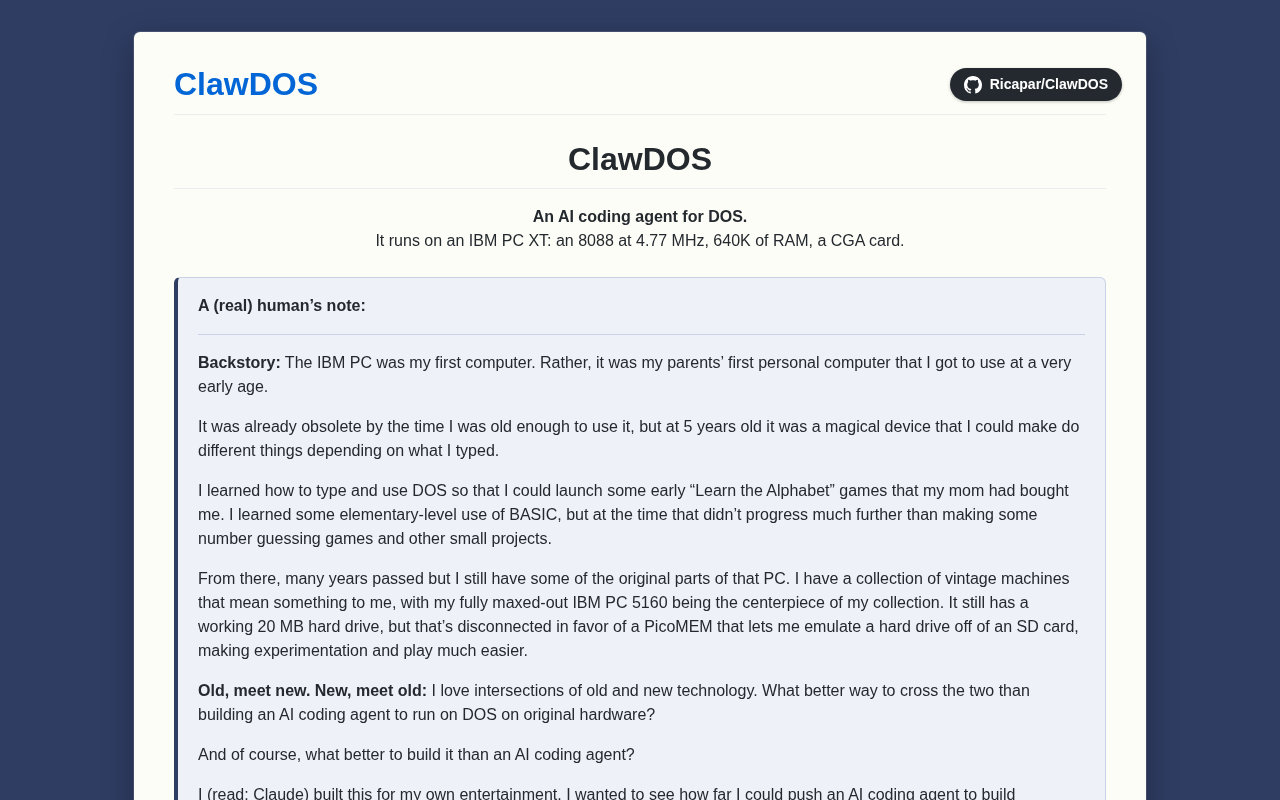
ClawDOS: Bringing AI Coding Capabilities to DOS
ClawDOS is an AI coding agent project for DOS, exploring the possibility of bringing AI coding assistance into resource-constrained retro computing environments. This article analyzes its positioning, use cases, and community response.

Baseten Releases Bison-1 and Groundhog-1, Topping the Decision Model Leaderboard
Baseten releases open-weight decision models bison-1 and groundhog-1 built on Gemma 4; bison-1 scores 76 on the AA Decision Index v2.1 to top the leaderboard. Both support 128k context and image input—here we analyze their capability combination, benchmark significance, and selection advice for developers.

Cline CLI v3.0.75 Released: Yolo Mode Now Default for One-Shot Runs
Cline CLI v3.0.75: one-shot runs now default to yolo mode, --timeout and Ctrl+C can interrupt the first round, read_files is no longer truncated to 8k chars, plus reasoning parameter fixes and 94 new providers.