A New Voice AI Option: High-Value Streaming Speech Model Now Available on Vercel
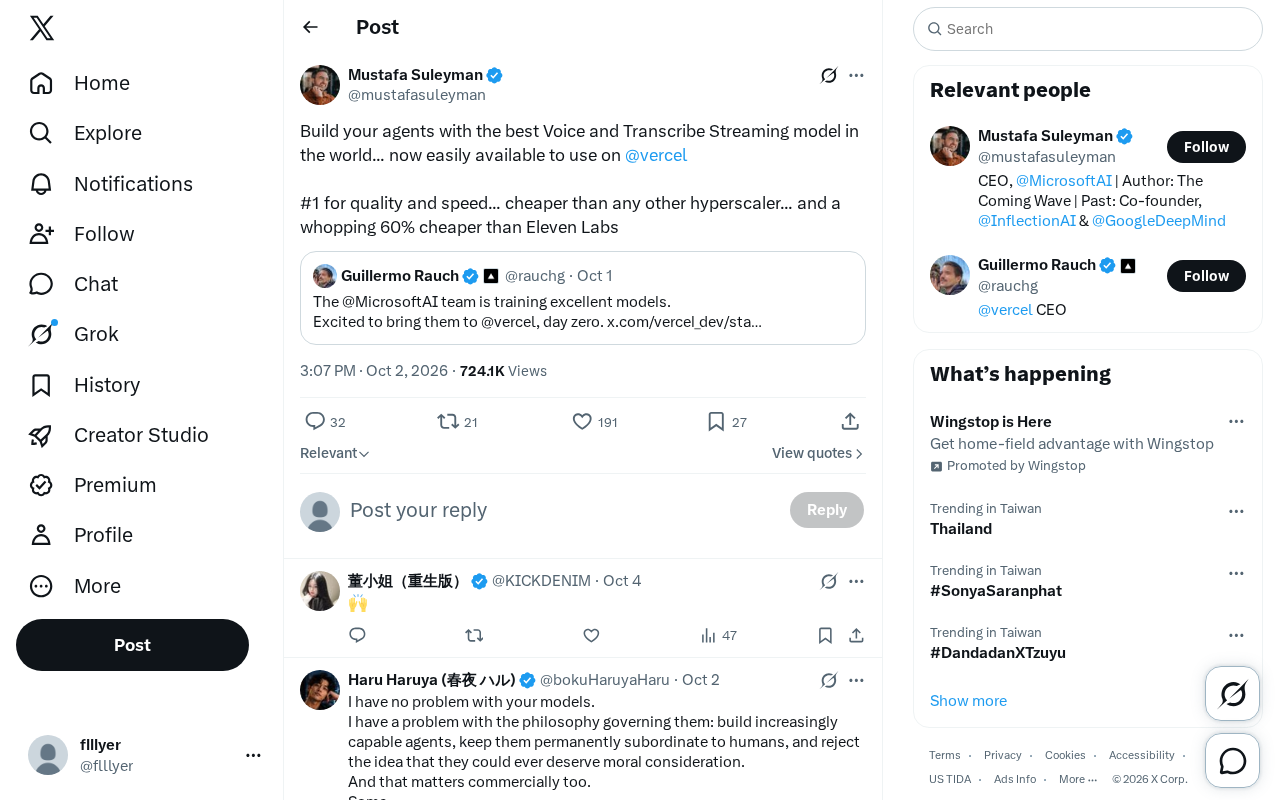
A streaming voice model claiming to beat ElevenLabs on quality, speed, and price by 60% lands on Vercel.
Speech synthesis and real-time transcription are becoming critical AI Agent infrastructure. A model claiming to be the "world's best" streaming voice and transcription solution has launched on Vercel, promising top quality, fastest speed, and pricing roughly 60% lower than ElevenLabs. While Vercel integration lowers the deployment barrier for frontend developers, the "world's best" and "number one" claims lack independent third-party benchmark support — developers should validate through hands-on testing before adopting.
Voice AI Competition Enters a Dual Race of Price and Performance
Speech synthesis and real-time transcription are becoming critical infrastructure for building AI Agents. A tweet revealed that a model claiming to be the "world's best" streaming voice and transcription model is now available on the Vercel platform. This means developers can integrate real-time voice capabilities into their applications without building complex speech processing pipelines from scratch.
The tweet's core selling points center on three dimensions: quality, speed, and price. According to the original post, the model ranks first in both quality and speed, costs less than any hyperscaler, and is approximately 60% cheaper than ElevenLabs — the standout company in the voice space.
Why Streaming Voice Matters So Much for Agents
When building voice-interactive AI Agents, latency is the make-or-break factor for user experience. The traditional approach — record first, transcribe the full audio, then generate a response — creates a noticeable wait. Streaming models, by contrast, transcribe as you speak and play audio as it's generated, compressing conversational latency to near-human levels.
This is exactly why the tweet emphasizes being "first in speed." For use cases like customer service bots, voice assistants, and real-time translation, response speed directly determines whether users will keep engaging. Streaming transcription also allows an Agent to begin understanding intent before the user finishes speaking, laying the groundwork for natural interactions like interruptions and follow-up questions.
How Quality and Speed Can Coexist
Conventional wisdom holds that model quality and inference speed often require trade-offs. If the claim of leading on both fronts is accurate, it typically relies on model architectures and inference infrastructure specifically optimized for streaming scenarios. That said, "world's best" and "ranked first" are unilateral vendor claims without independent third-party benchmark support — readers should approach them with appropriate skepticism.
From a technical implementation standpoint, streaming voice typically relies on two different processing paradigms: bidirectional streaming protocols based on WebSocket or gRPC, which allow clients to continuously push audio frames while the server returns transcription segments in real time; and HTTP chunked transfer encoding, better suited for scenarios with slightly more lenient latency requirements. Key metrics for evaluating streaming voice systems include Time to First Token (TTFT) — the time from when a user starts speaking to when the first transcription result is received — and end-to-end latency, which covers the full chain of network transmission, model inference, and audio synthesis. The industry generally considers a latency threshold of under 300ms necessary for natural conversational feel; beyond 500ms, users will clearly perceive a pause.
Price Advantage: 60% Cheaper Than ElevenLabs
In the voice synthesis space, ElevenLabs has long been regarded as the quality benchmark — but its pricing is also relatively steep. The tweet directly targets ElevenLabs as its reference point, claiming 60% lower costs while also being cheaper than mainstream cloud providers.
Pricing is a critical threshold for scaling voice APIs in production. Speech transcription and synthesis are typically billed by duration or character count, and in high-concurrency, long-call production environments, costs accumulate quickly. If this model can genuinely deliver significant cost reductions while maintaining quality, it will be highly attractive to budget-conscious small teams and independent developers.
What Vercel Integration Actually Means
Bringing the model onto the Vercel platform lowers the barrier to deployment. As a deployment platform for frontend and full-stack developers, Vercel naturally attracts a large number of developers using frameworks like Next.js. When the model is offered as a native platform capability, developers can call it directly within their familiar toolchain — no need to build backend services, manage API keys, or handle scaling. This "out-of-the-box" integration approach is the dominant trend in AI capability distribution today.
ElevenLabs was founded in 2022 and is known for its highly realistic voice cloning and emotionally expressive speech synthesis. It gained rapid popularity thanks to its low-barrier voice replication capabilities, while also sparking ethical debates around deepfakes. Its pricing model typically charges by character count, with professional plans ranging from tens to hundreds of dollars per month, and high-concurrency API access requiring enterprise contracts. This combination of strong quality reputation and relatively high prices has made ElevenLabs synonymous with "premium quality at a premium price" in the voice synthesis space — making it a natural pricing anchor for new entrants.
Vercel's business model aligns closely with AI capability distribution: the platform wraps model calls into frontend-friendly interfaces via Edge Functions and AI SDKs (developed in collaboration with Hugging Face and others), allowing developers to complete integrations in just a few lines of code within a Next.js API Route or Server Action. If this voice model is offered in a similar way, it means voice capability will become a platform-level primitive — alongside databases, authentication, and CDN — further shortening the engineering distance from prototype to production. This continues the broader "platformization" trend in AI infrastructure over the past two years: model capabilities are no longer distributed solely through standalone APIs, but embedded within the tooling ecosystems developers already use.
A Rational Look at the Marketing Language
At its core, this tweet is a product promotion packed with strong marketing language like "world's best," "number one," and "60% cheaper." For developers, real decision-making should be grounded in hands-on testing:
- Does the voice quality meet the naturalness requirements of your specific use case?
- How does real-time streaming latency perform under actual network conditions?
- What is the total cost based on real usage volume, not just a single price comparison?
- How accurate is recognition for edge cases like multiple languages, accents, and domain-specific terminology?
Without specific model names, benchmark data, or pricing details, this tweet reads more like a "worth watching" signal than a conclusion to act on immediately. Teams that are interested should run small-scale validation using official trial credits before making an adoption decision.
Conclusion
The infrastructure competition for voice Agents is shifting from a pure quality race to a three-way contest of quality, speed, and cost. Regardless of whether this model's claims hold up to scrutiny, it reflects a clear trend: real-time voice capabilities are becoming cheaper and easier to integrate. For developers, this is a good moment to build the next generation of voice-interactive applications — as long as you let real-world test data, not marketing slogans, drive your selection process.
Related articles

Free Unlimited Claude Code Solution: Agnes AI + CC Switch Setup Guide
No paid subscription needed — pair the free AI platform Agnes AI with the open-source tool CC Switch to provide a backend for Claude Code, enabling unlimited free calls to text, image, and video models. This guide covers the full setup, test results, and usage boundaries.

A Complete Zero-Cost Guide to Getting Started with Claude Code for Beginners in China
A beginner's guide to Claude Code for users in China: two installation methods (command line and IDE plugin), full configuration steps for replacing the official API with the free domestic LongCat model, and a hands-on demo of building a small tool with natural language, plus tips.

When the NSA Gets Involved: The AI Supply Chain Crisis Behind Open-Source CVEs and API Key Hijacking
Multiple open-source projects disclosed severe CVEs in one day, PHP flaws alarmed the FBI, and Railway and OpenCode were breached with API keys stolen. This article breaks down the vulnerability window, AI-accelerated exploitation, and the AI supply chain crisis behind the API key black market, with a developer defense checklist.