A Practical Guide to Calling the WorkOS API from Server-Side Swift
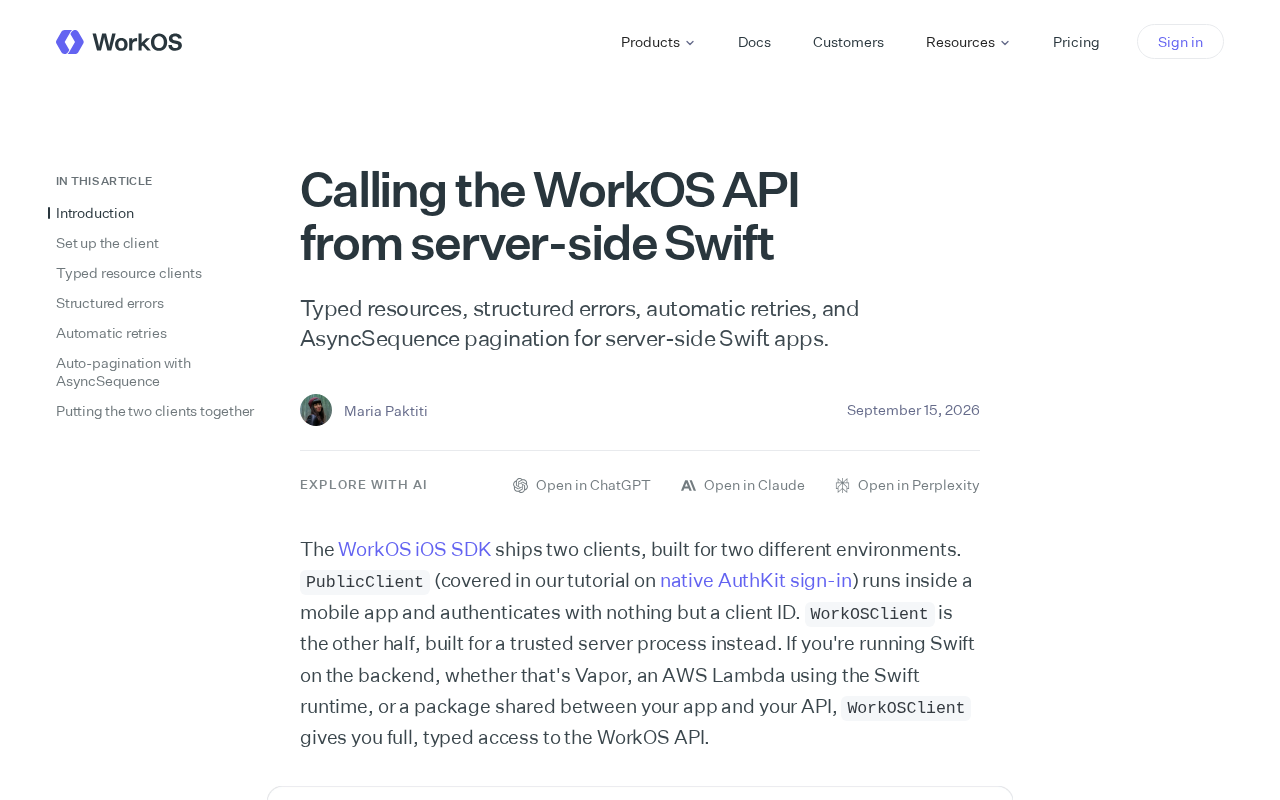
A practical guide to integrating WorkOS API in server-side Swift with typed resources, structured errors, retries, and AsyncSequence pagination.
This article explores integrating WorkOS enterprise identity management into server-side Swift, leveraging Swift's type safety to map API responses to structs via Codable, model failure cases as enums for precise error handling, apply exponential backoff retries at the client layer for resilience, and wrap pagination in AsyncSequence so developers can traverse large directories with a simple for await loop. The patterns discussed apply broadly to any third-party API client design in Swift.
The server-side Swift ecosystem has matured considerably in recent years, with more developers exploring Swift for backend services. In real-world enterprise applications, identity authentication and user management are often unavoidable requirements. WorkOS is a platform designed for enterprise SSO, directory sync, and user management, offering developers a comprehensive API. This article explores how to elegantly integrate the WorkOS API in a server-side Swift application, focusing on four core capabilities: typed resources, structured error handling, automatic retries, and AsyncSequence-based pagination.
Why Integrate WorkOS in Server-Side Swift
Swift is well known for its type safety and modern concurrency model. Bringing these qualities to a backend context can significantly improve the reliability of API integrations. WorkOS handles enterprise identity authentication — a domain where correctness is critical. A single incorrect user mapping or permission check can introduce serious security vulnerabilities.
In this context, wrapping API calls in a strongly typed language lets you surface many issues at compile time rather than discovering them at runtime. Compared to the dictionary lookups and string keys common in dynamically typed languages, Swift's type system lets you express the structure of WorkOS resources clearly and precisely in your code.
WorkOS is an identity infrastructure platform for B2B SaaS products. Its core features include enterprise single sign-on (SSO, supporting SAML and OIDC), SCIM directory sync (automatically syncing users and groups from enterprise IdPs into your app), fine-grained authorization (FGA), and AuthKit for standardized user login flows. Its target audience is development teams that need to quickly integrate with enterprise identity systems, without having to implement complex protocols like SAML parsing or LDAP connectors from scratch. For readers unfamiliar with WorkOS, think of it as "Stripe for enterprise identity" — it abstracts away the complexity of integrating with Okta, Azure AD, Google Workspace, and other enterprise IdPs behind a standardized API.
Typed Resources: Making API Responses More Reliable
Typed resources means mapping the JSON data returned by the WorkOS API to clearly defined Swift structs or enums, rather than working with loose dictionaries and optionals.
The benefits are straightforward: when you access a property on a user object, the compiler guarantees that property exists and has the correct type. If WorkOS changes its response structure, or you mistype a field name, the code fails at compile time rather than silently producing nil or crashing in production.
Combined with Swift's Codable protocol, developers can handle bidirectional conversion between JSON and model objects with relatively little boilerplate. For resources like enterprise identity data — whose structure tends to be stable — the maintainability gains from typed modeling are especially significant.
Structured Error Handling
API calls inevitably encounter failure scenarios: network interruptions, expired authentication, invalid request parameters, rate limiting, and more. Structured errors — as mentioned in the source material — means modeling these failure cases as concrete error types rather than generic string messages.
Using Swift's enum and Error protocol, you can define clear branches for different error categories. Calling code can then respond differently based on the specific error type — for example, triggering a token refresh on an expired credential, entering a backoff wait on a rate limit, or returning a clear message to the caller on a bad parameter.
Structured errors transform error handling from "guessing" into "decision-making," which is essential for building robust backend services.
Automatic Retries
Transient failures are a fact of life in distributed systems. Network jitter and temporary server overload can cause individual requests to fail, but such failures often succeed if retried after a brief wait.
The automatic retry capability mentioned in the source material bakes this logic into the API client layer itself. Developers don't need to manually write retry loops at each call site — the client handles it automatically based on error type and retry policy.
A sensible retry strategy typically incorporates exponential backoff to avoid making a stressed server's situation worse. It's also important to only retry idempotent or explicitly retryable errors, which requires careful design at the client level.
Exponential Backoff is a retry interval strategy where the wait time before each retry grows exponentially (e.g., 1s, 2s, 4s, 8s), typically combined with a random jitter to prevent the "thundering herd" problem when multiple clients retry simultaneously. For rate limiting (HTTP 429) and temporary unavailability (HTTP 503) scenarios, this strategy effectively prevents client retries from becoming the factor that overwhelms the server.
Idempotency is another critical constraint: only operations that have no side effects on system state, or that produce the same result when repeated (such as GET requests or write operations with idempotency keys), should be automatically retried. For ordinary POST create requests, blindly retrying can result in duplicate resource creation. Client design must therefore clearly distinguish between retryable and non-retryable error types.
AsyncSequence Pagination: Elegantly Traversing Large Datasets
In enterprise scenarios, data like user lists and organizational directories can be enormous, and APIs typically return it in pages. Traditional pagination requires developers to manually manage cursors and loop to fetch the next page — code that is verbose and error-prone.
Swift's AsyncSequence provides an elegant solution. By wrapping pagination in an async sequence, developers can iterate over all data with a simple for await loop, while the underlying page-fetching logic remains completely transparent:
for try await user in workos.users.list() {
    // Process each user — pagination happens automatically
}
This approach preserves the lazy evaluation characteristics of async streams (fetching on demand rather than loading everything at once), while dramatically reducing cognitive overhead. It's a textbook example of Swift's modern concurrency model applied to API client design.
AsyncSequenceis a protocol introduced in Swift 5.5 alongside the structured concurrency model — the asynchronous counterpart to the synchronousSequence. It allows elements to be produced asynchronously one at a time, with consumers processing them usingfor awaitsyntax. The whole process natively supports backpressure: the next async fetch is only triggered after the previous element has been processed. In pagination scenarios, this means the SDK only fetches the next page after the current page's data has been consumed, avoiding the memory pressure of preloading all data upfront.Compared to Combine's
Publisher,AsyncSequencedoesn't require a reactive programming paradigm, has a gentler learning curve, and integrates more naturally with Swift's structured concurrency (async/await,Task, task cancellation). It's currently the preferred pattern for handling streaming or paginated data in server-side Swift.
Conclusion
Integrating the WorkOS API into a server-side Swift application fully leverages Swift's language strengths in type safety and concurrency. Typed resources ensure correctness when accessing data, structured errors enable precise failure handling, automatic retries improve service resilience under unstable network conditions, and AsyncSequence-based pagination makes traversing large datasets simple and natural.
For teams exploring server-side Swift, this design philosophy applies well beyond WorkOS — it can serve as a reference pattern when building clients for any third-party API.
Related articles
DeepSeek Harness in Practice: Building a Low-Cost AI Coding Powerhouse
Learn how to transform DeepSeek's open-source harness using Claude Code, Bright Data scraping, and vision models to build an AI coding workflow costing just half a cent per task.
Overseas Developer Tests: DeepSeek Already Rivals Opus — Stop Waiting for the Next Model
An overseas developer finds DeepSeek V4 Pro rivals Opus 4.8 at a fraction of the cost. Learn how DeepSeek + BrightData compares to Claude Code for building SaaS.
DeepSeek V4.1 Flash Hands-On: Can a Small-Activation New Architecture Top the Open-Source Charts?
DeepSeek V4.1 Flash deep dive: new MoE encoder-decoder architecture, 552B total params, tiny active params, reduced KV cache. Open-source on Hugging Face. Full hands-on test from BrowserOS to 3D printing.