A Practical Guide to Securely Managing Client API Keys in AI Automation Projects

A practical security checklist for managing client API keys and credentials in AI automation projects.
AI automation practitioners often need access to sensitive client credentials. This article covers the risks of plaintext transfer, the security baseline of password managers, n8n's encrypted credential system, and architectural best practices like least-privilege service accounts, OAuth, and key rotation—offering an actionable security management checklist.
An Underestimated Operational Challenge
In the AI automation space, more and more independent developers and small teams are taking on client projects, building workflows with tools like n8n, Make, and Zapier. These projects often require access to a variety of sensitive client credentials—API keys, OAuth tokens, database connection strings, and even account permissions for third-party SaaS platforms.
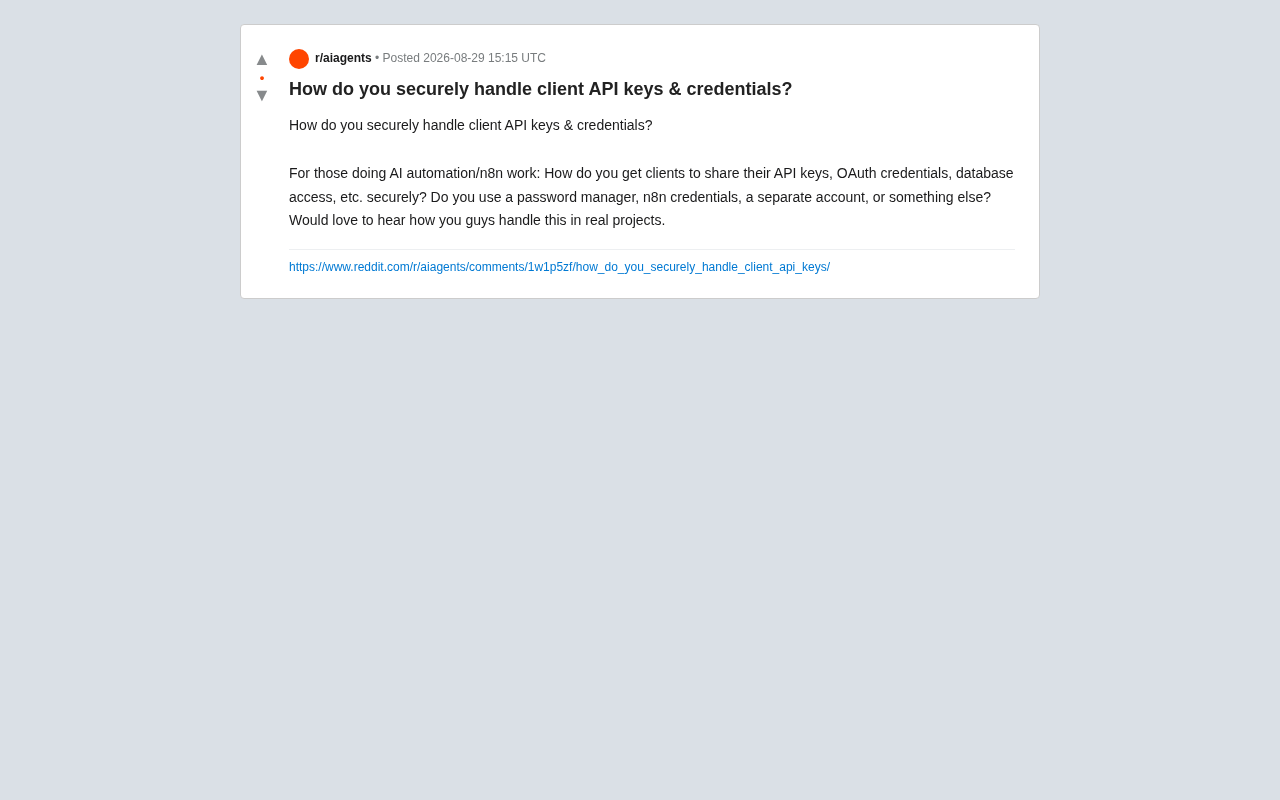
A recent question from an automation practitioner on Reddit sparked considerable discussion: "How do you get clients to securely share API keys, OAuth credentials, and database access with you?" The question may seem trivial, but it actually touches on one of the most easily overlooked—yet most critical—aspects of the automation delivery process. Once credentials leak, the consequences range from abused services racking up huge bills to large-scale client data breaches, which can directly trigger legal and reputational crises.
Common Methods of Passing Credentials and Their Security Risks
Plaintext Messaging: The Most Dangerous Approach
In real-world projects, the most common—and worst—practice is when clients send keys directly in plaintext via email, Slack, or WeChat. Most of these communication channels lack end-to-end encryption, and messages linger for a long time on servers and in chat histories. Any account compromise or lost device could expose these credentials. Even worse, it's very difficult to trace after the fact who accessed these keys and when.
Password Managers: The Security Baseline for Team Collaboration
More mature teams tend to use dedicated password managers for credential sharing. Tools like 1Password and Bitwarden support creating a "Shared Vault," where clients can store credentials and developers can access them as needed. The core advantages of these tools include:
- Credentials are encrypted end-to-end in storage, with no plaintext left during transmission
- Fine-grained access control and access audit logs
- One-click revocation of access permissions once the project ends
For long-term collaborations involving multiple credentials, a password manager is essentially the industry-standard security baseline.
n8n's Built-in Credential System: Sufficient, but Mind the Boundaries
n8n comes with built-in credential management, and keys are encrypted when stored. For a self-hosted n8n instance, credentials are saved in your own database, protected by an encryption key set in an environment variable. This is sufficient in many scenarios, but there are a few key points to keep in mind: who can access this server, how the encryption key is safeguarded, and whether backup files are also encrypted. If you're using n8n Cloud, you'll additionally need to evaluate whether entrusting client credentials to a third party meets your compliance requirements.
From Secure Transfer to Architectural Isolation
The truly professional approach goes beyond securely transferring keys—it involves reducing, at the architectural level, the very need for keys to end up in your hands.
Have Clients Create Independent, Restricted Service Accounts
One of the best practices is to guide clients to create a dedicated Service Account for the automation project rather than sharing their primary account credentials. This account is granted only the minimum permissions necessary to complete the task (Least Privilege)—such as read-only database access or a specific API call scope. This way, even if credentials leak, the attack surface is strictly limited, and the client can revoke it at any time without affecting their own primary account.
Prefer OAuth Authorization Over Long-Lived Static Keys
For services that support OAuth, use the OAuth authorization flow whenever possible instead of directly requesting static API keys. OAuth tokens typically have expiration times, can be revoked, and have clearly defined authorization scopes—making them far more secure than a never-expiring bare key. n8n's OAuth integration for mainstream services is already quite mature, so it should be your first choice.
Environment Isolation and Regular Key Rotation
For projects involving databases and production environments, it's advisable to separate credentials for development, testing, and production, avoiding a single set of keys that unlocks everything. At the same time, establish a Key Rotation mechanism—keys should not be configured once and left unchanged forever, but should undergo full lifecycle management.
A Practitioner's Checklist for Secure API Key Management
Combining community discussion with security best practices, here is a directly actionable workflow:
- Never pass credentials through plaintext channels—always use a password manager's encrypted shared vault.
- Require clients to create dedicated, restricted accounts, following the principle of least privilege rather than sharing primary accounts.
- Use OAuth instead of static keys whenever possible, leveraging its expirable and revocable nature.
- When self-hosting n8n, safeguard the encryption key, ensuring server access is controlled and backups are encrypted.
- Clearly revoke permissions after project delivery, and explain to clients how to independently manage these credentials.
- Spell out security responsibility boundaries in the contract or SOW, so that responsibilities are clear on both sides should a leak occur.
Conclusion
For AI automation practitioners, handling client credentials securely is not just a technical matter—it's a reflection of professionalism and trust. Many clients hesitate to hand things over to third-party developers precisely because they fear losing control of their keys and data. Conversely, a clear, auditable credential management process is itself a differentiating competitive advantage. Rather than scrambling to fix things after an incident, it's better to internalize the four principles—least privilege, encrypted transfer, revocability, and auditability—as standard practice from day one of the project.
Related articles

Chain of Thought Isn't Just for AI: How Humans Can Use CoT to Improve Thinking Quality
Chain of Thought isn't just a prompt trick for large models. Starting from a Hacker News discussion, this article analyzes why CoT works for human thinking too, breaks down actionable ways to transfer it, and highlights the key differences between human CoT and machine CoT.
Cloudflare Teams Up with OpenAI: Closi…
Cloudflare Teams Up with OpenAI: Closing the Loop from Vulnerability Discovery to Defense with AI
Cloudflare uses OpenAI Daybreak to investigate security vulnerabilities and generate reviewable remediation plans, while developers use Codex to boost coding efficiency and quality.

Orca Multi-Agent Orchestration in Practice: A Guide to Parallel Collaboration with Claude and Codex
Orca is Stable AI's free open-source agent workbench supporting 34 agents like Claude Code and Codex in parallel. Learn its Git worktree isolation, multi-model orchestration, and mobile management.