A Robotics & AI Student's Introduction: From Smart Blind Cane to Gesture Recognition

A robotics and AI student showcases a project-driven learning path through four hands-on projects and public progress sharing.
This article features a robotics and AI student's first developer community post. He has completed four projects—an ultrasonic smart blind cane, a gesture recognition system, Conway's Game of Life, and a forensic investigation game—covering sensor data acquisition, computer vision, algorithm implementation, and interaction design. He uses Python, C++, and Arduino, focuses on AI and computer vision, and admits he's still improving his problem-solving and development skills. His goals include building innovative projects, joining hackathons, collaborating, and learning from the community. The article argues the value lies in a replicable path: start with concrete projects, let projects drive learning, and share progress publicly for feedback.
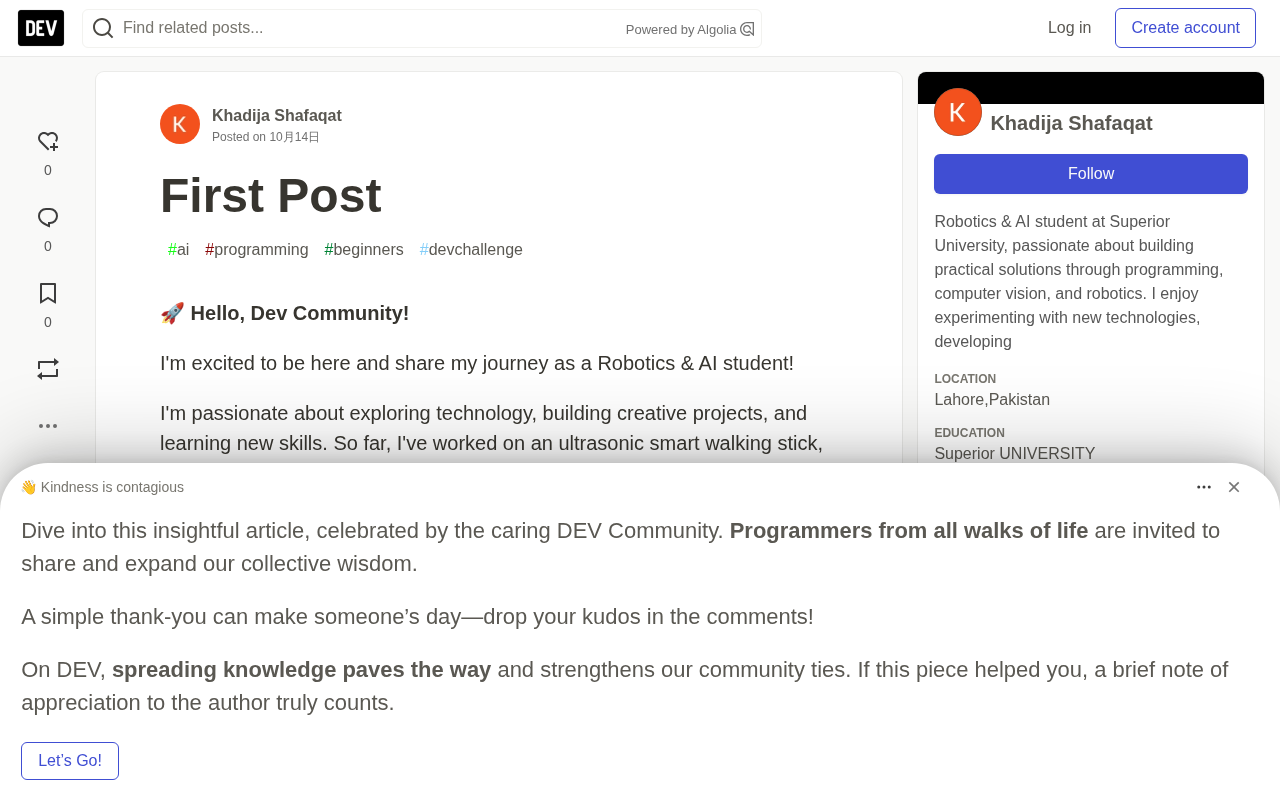
A student majoring in robotics and artificial intelligence has published their first post in a developer community, sharing the tech stack they are exploring and the hands-on projects they have completed. There are no grand declarations or carefully packaged showcases of achievement—what the post conveys is a plain, genuine picture of a developer's growth: learning by doing, exposing gaps through doing, and filling those gaps through community exchange.
What They've Already Built
The student lists four completed projects: an ultrasonic smart blind cane, a gesture recognition system, Conway's Game of Life, and a forensic investigation game.
Taken together, these four projects cover a surprisingly wide range of skills. The ultrasonic blind cane involves sensor data acquisition and embedded control; gesture recognition requires fundamentals in computer vision and model inference; Conway's Game of Life tests algorithmic implementation and state-machine thinking; and the forensic investigation game leans toward logical reasoning and interaction design. What they share is a common trait: this student isn't just turning in homework after class—they're actively seeking out problems and scenarios to practice with.
For a student still in the learning phase, being able to "turn every concept into a runnable project" says far more about learning quality than stacking up course certificates.
Conway's Game of Life is a two-dimensional cellular automaton proposed by British mathematician John Conway in 1970. It runs on a grid of cells, each of which is either "alive" or "dead." The next generation's state is determined solely by how many of the eight neighboring cells are alive: a live cell with fewer than 2 or more than 3 live neighbors dies; one with exactly 2 or 3 live neighbors survives; a dead cell with exactly 3 live neighbors comes back to life. The rules are just four, yet they give rise to complex structures like gliders and pulsars. It's often used as a beginner exercise for array manipulation, boundary handling, and state iteration, and stands as a classic example of the idea that "simple rules produce complex behavior."
Computer vision is the field of enabling machines to extract and understand information from images or video. Typical tasks include image classification, object detection, face recognition, and gesture recognition. Gesture recognition usually starts by capturing images through a camera, then uses skin-color segmentation, contour extraction, or deep learning models to locate hand keypoints, and finally maps hand poses to specific commands. This pipeline involves data collection, preprocessing, model inference, and post-processing—a fairly comprehensive workout for a learner's engineering skills.
What They're Learning Now and Where the Gaps Are
The post explicitly mentions the tools and languages being used: Python, C++, Arduino, along with AI and computer vision. This combination is very typical—Python for rapid algorithm validation, C++ and Arduino to make code actually run on hardware, and AI and computer vision as the main thread running through it all.
He also openly admits that at this stage he's still working on improving his problem-solving ability and development skills. That's not false modesty. Judging from the project list, he's already crossed the threshold of "can't write code," but what lies ahead are harder challenges: how to make prototypes more stable, how to push recognition accuracy from usable to reliable, and how to make trade-offs on resource-constrained hardware. These questions have no standard answers—you can only build up judgment by continuously working on projects.
Arduino is an open-source electronics prototyping platform consisting of a microcontroller board and a simplified programming environment. It encapsulates low-level register operations into easy-to-use functions, allowing developers to directly control sensors, motors, and displays using syntax close to C/C++. Unlike Python programs running on a computer, Arduino code runs independently on hardware after being flashed, interacting directly with the physical world. This is exactly the capability that projects like the ultrasonic blind cane require: reading distance sensor data, driving buzzers or vibration motors, and responding in real time.
A hackathon is a time-limited, intensive development event where participants typically team up to complete a demonstrable prototype within 24 to 48 hours. Its value lies not in producing a perfect product, but in compressing the cycle from idea to implementation, forcing teams to make rapid technical choices and trade-offs, while also exercising division of labor, collaboration, and on-the-spot presentation skills. For learners, a hackathon is an effective scenario for testing the real pace of development and exposing knowledge blind spots.
The Goals Aren't Complicated, but the Direction Is Clear
The goals he's set for himself include: building innovative projects, participating in hackathons, collaborating with other developers, and learning from the community.
There's a progression among these. Working on projects alone trains individual skills; hackathons force you to complete the full process from idea to demo within a limited time; and collaboration and community exchange solve a different layer of problems—you'll encounter pitfalls you never imagined, and you'll see others solve in a simpler way something you've been stuck on for ages.
For learners in robotics and AI, the value of community is especially pronounced. This field changes fast, has a complex toolchain, and is full of hardware pitfalls—going it alone makes it easy to get stuck on some step for a long time. Making your progress public, even if it's only incremental, can bring feedback and connections.
What It Means for Developers on the Same Path
The value of this post isn't in showcasing how impressive the technical achievements are, but in presenting a replicable growth path: start with concrete projects, let projects drive learning, and then make the learning process public to receive feedback.
If you're also a developer learning robotics or AI, consider borrowing his approach—pick a problem you can actually get your hands on, build it with the tools you currently have, even if it's just a rough version that runs. Then share it. What to learn next often emerges on its own during the process of doing.
One-line Summary
A robotics and AI student demonstrates a project-driven learning path through four hands-on projects and publicly sharing progress.
Paragraph Summary
This article introduces the first post published by a student majoring in robotics and artificial intelligence in a developer community. He has completed four projects—an ultrasonic smart blind cane, a gesture recognition system, Conway's Game of Life, and a forensic investigation game—covering capabilities such as sensor data acquisition, computer vision, algorithm implementation, and interaction design. He currently uses Python, C++, and Arduino, focuses on AI and computer vision, and openly acknowledges that he's still improving his problem-solving ability and development skills. His goals include building innovative projects, joining hackathons, collaborating with others, and learning from the community. The article argues that the value lies in presenting a replicable path: start with concrete projects, let projects drive learning, and then share progress publicly to gain feedback.
Related articles

Free Unlimited Claude Code Solution: Agnes AI + CC Switch Setup Guide
No paid subscription needed — pair the free AI platform Agnes AI with the open-source tool CC Switch to provide a backend for Claude Code, enabling unlimited free calls to text, image, and video models. This guide covers the full setup, test results, and usage boundaries.

A Complete Zero-Cost Guide to Getting Started with Claude Code for Beginners in China
A beginner's guide to Claude Code for users in China: two installation methods (command line and IDE plugin), full configuration steps for replacing the official API with the free domestic LongCat model, and a hands-on demo of building a small tool with natural language, plus tips.

When the NSA Gets Involved: The AI Supply Chain Crisis Behind Open-Source CVEs and API Key Hijacking
Multiple open-source projects disclosed severe CVEs in one day, PHP flaws alarmed the FBI, and Railway and OpenCode were breached with API keys stolen. This article breaks down the vulnerability window, AI-accelerated exploitation, and the AI supply chain crisis behind the API key black market, with a developer defense checklist.